You spend six weeks in a hiring process — three rounds of interviews, a take-home project, a final-round presentation — and then the offer lands 35% below what you were expecting. No salary was posted. No range was disclosed. You had no idea.
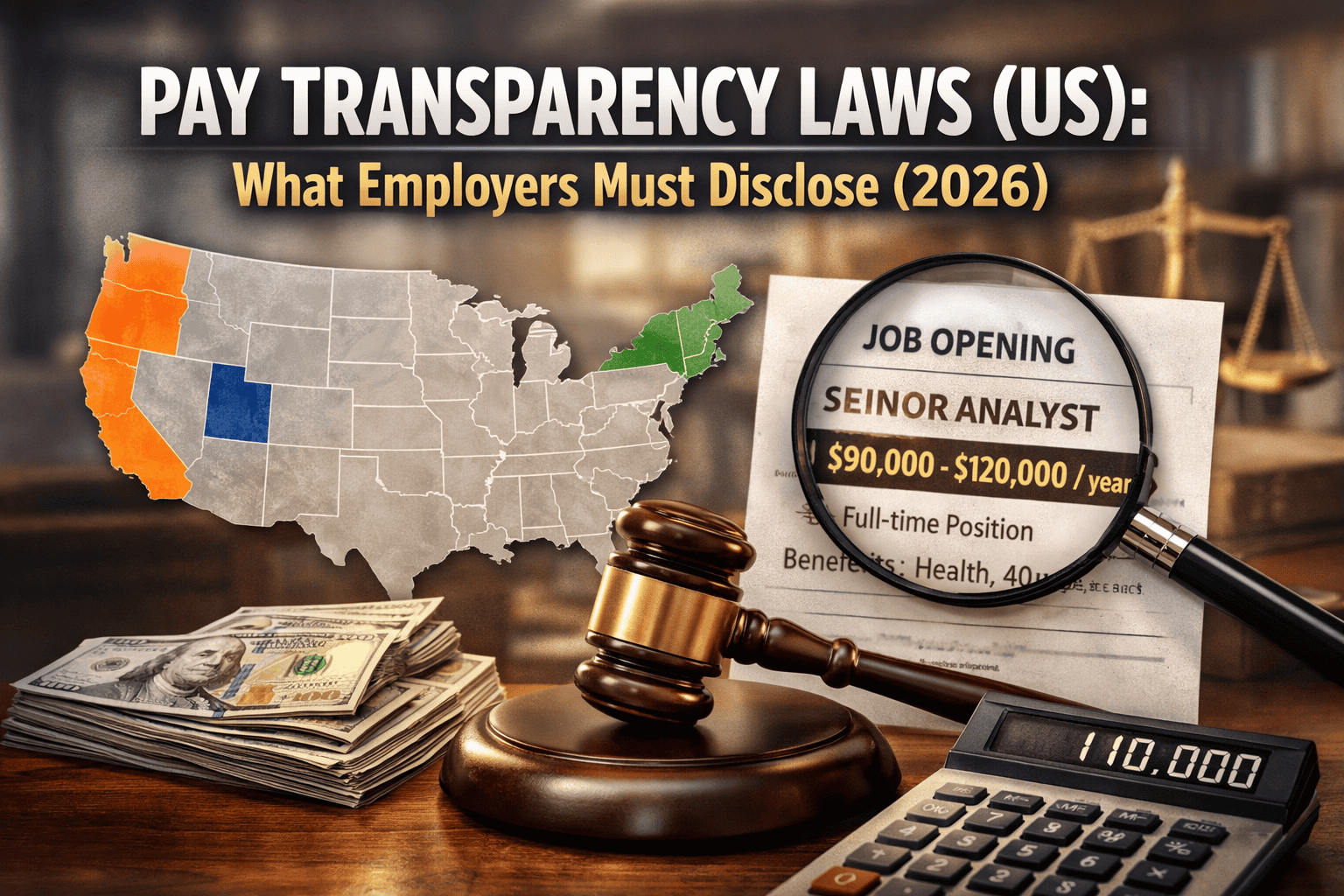
That situation is now illegal in a growing number of US states. Pay transparency laws have expanded aggressively across the country, and in 2026, they cover more employees, more job postings, and more internal compensation decisions than ever before. If you’re a working professional — whether you’re job hunting or already employed — understanding these laws is one of the highest-leverage things you can do for your career.
After years of watching candidates undersell themselves because they had no frame of reference, here’s what you actually need to know — and how to turn these laws into a negotiation advantage.
What Are Pay Transparency Laws?
Pay transparency laws are state (and sometimes local) regulations that require employers to share compensation information with job candidates, current employees, or both. Depending on the jurisdiction, this can mean disclosing salary ranges in job postings, providing pay bands to employees who ask, or publishing internal pay scales for promoted roles.
The key thing to understand: there’s no single federal pay transparency law in the US. What you’re entitled to depends entirely on where you work — or where the employer is hiring. That patchwork of rules is what makes this confusing for employees and, frankly, easy for some companies to game.
Here’s a working definition that covers the core of what these laws require:
- Salary range disclosure — the minimum and maximum the employer is willing to pay for a role
- Pay scale access — current employees can request the pay band for their position
- Benefits disclosure — some states require bonus, equity, or benefits information alongside base pay
- Internal posting requirements — open roles must be posted internally with compensation ranges before or alongside external listings
The goal is straightforward: level the information playing field between employers and candidates. Companies have always known exactly what a role pays. Now, increasingly, so do you.
Why These Laws Are Expanding So Fast
This isn’t just a progressive legislative trend. There are real structural forces driving pay transparency laws into mainstream policy, and they’re not going away.
The pay gap problem is one of them. Persistent wage gaps by gender and race — particularly in private-sector hiring — have pushed legislators to look for systemic solutions. Salary secrecy, it turns out, is one of the mechanisms that sustains those gaps. When candidates can’t benchmark against a range, they negotiate blind — and negotiation bias compounds over entire careers.
There’s also a talent market dynamic at play. The post-2020 hiring environment put real pressure on employers to be more transparent to attract candidates. Candidates started openly rejecting postings without salary information. Glassdoor, LinkedIn, and levels.fyi started publishing crowdsourced salary data at scale. Employers who refused to disclose looked evasive. Legislation is partly codifying what competitive hiring already demanded.
💼 Insider View:
Here’s the blunt reality from the HR side: salary secrecy has historically functioned as a negotiation tool. Companies anchored low with candidates who had no reference point. These laws eliminate that cold-start disadvantage. The employers most resistant to disclosure are often the ones paying below market — because transparency would expose it instantly.
The legislative momentum is also self-reinforcing. When Colorado passed its salary disclosure law in 2021, other states watched. When New York City followed in 2022 and Washington state aligned, a pattern emerged. By 2026, several more states have either enacted or expanded their frameworks, and federal legislation has gained renewed traction in Congress, though it hasn’t yet passed.
What Employers Must Disclose in 2026
Let’s get specific, because this is where vague articles fail you. What’s actually required varies by state, but across the jurisdictions with active transparency laws, here’s what the rules cover:
Salary Range in Job Postings
The most common requirement. In states like California, Colorado, New York, Washington, and Illinois, employers must include a minimum and maximum salary in any job posting — including third-party listings on Indeed, LinkedIn, and Glassdoor. “Competitive salary” and “DOE (Depends on Experience)” aren’t acceptable replacements for an actual range.
Benefits and Total Compensation
Colorado goes further than most: employers must also disclose general benefits — health insurance, paid time off, retirement contributions — alongside the pay range. Some states are beginning to require equity disclosure for tech and startup roles where RSUs or stock options form a meaningful part of total compensation.
Pay Scale for Current Employees
This is the one most employees don’t know about. In California, Colorado, Washington, and a handful of other states, you can request the pay range for your current role right now — and your employer is legally required to provide it. You don’t need to be job hunting. You don’t need a specific reason. You just need to ask.
That single fact has the potential to expose underpayment instantly. If you’ve been at your company for three years without a meaningful raise and the posted pay band for your role runs $95K–$130K while you’re earning $88K, you now have a data point that’s hard to argue with in a review conversation.
Promotion and Internal Transfer Disclosure
Several states now require that internal job postings — promotions, lateral transfers, new team openings — include salary ranges before or at the same time as external listings. This prevents the classic situation where a manager quietly promotes a favored external hire at a compensation level internal candidates never knew existed.
✅ Pro Tip:
Even in states without strict disclosure laws, you can still ask for the pay range. There’s no law that prevents an employer from disclosing it. Frame it professionally: “To make sure we’re aligned before we invest more time in this process, could you share the salary band for this role?” Most reasonable hiring managers will answer — and those who refuse are usually a red flag.
State-by-State Breakdown: Who’s Enforcing What
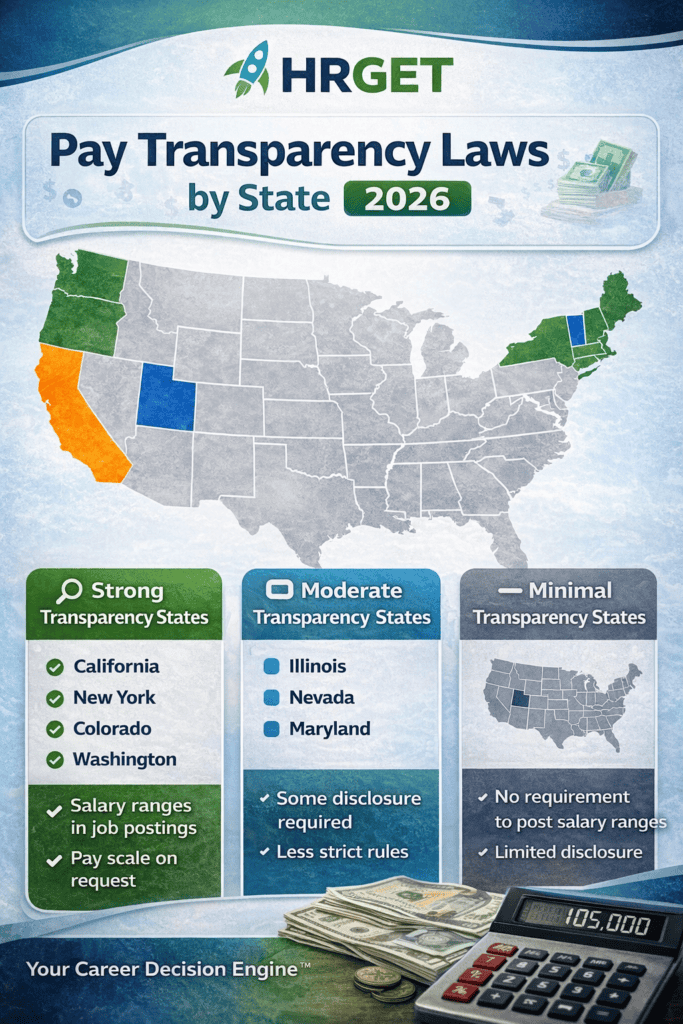
Not all states are equal. Here’s how the major jurisdictions look heading into 2026:
| State | Job Posting Range Required? | Employee Can Request Pay Scale? | Benefits Disclosure? | Strength |
|---|---|---|---|---|
| California | ✅ Yes (15+ employees) | ✅ Yes | Partial | Strong |
| Colorado | ✅ Yes (all employers) | ✅ Yes | ✅ Yes | Strong |
| New York | ✅ Yes (4+ employees) | ✅ Yes | Partial | Strong |
| Washington | ✅ Yes (15+ employees) | ✅ Yes | ✅ Yes | Strong |
| Illinois | ✅ Yes (as of 2025) | ✅ Yes | No | Moderate |
| Nevada | Upon request only | ✅ Yes (upon request) | No | Moderate |
| Maryland | Upon request only | ✅ Yes (upon request) | No | Moderate |
| Texas / Florida / Georgia | ❌ No requirement | ❌ Not mandated | No | Minimal |
The takeaway here isn’t just “California is good, Texas isn’t.” It’s that you need to know the rules of your specific state before you walk into any negotiation. Assuming protections you don’t have — or not claiming protections you do — both cost you money.
Job Posting Requirements: The Loopholes Companies Use
Here’s something most articles don’t tell you: compliance with transparency laws doesn’t always mean honesty. Companies have developed creative workarounds, and you should know them.
The Wide-Range Game. A posting that says “$55,000 – $175,000 per year” technically complies with the law. It’s also functionally useless for anchoring a negotiation. Wide ranges are common in companies that don’t want to narrow their options — and they’re a sign you should push harder for specificity during the process.
The Exclusion Clause. You’ve probably seen this: “This role is not open to applicants in Colorado or New York.” That’s not a typo. It’s a deliberate strategy by companies that want to avoid disclosure requirements by geographically excluding residents of strict states. It’s legal, and it happens regularly, even for fully remote roles.
The Title Swap. Some companies list the same role under different titles in different states — one title in California (with required disclosure), a slightly different title elsewhere (without). The compensation may be identical, but the posting doesn’t trigger the same rules.
⚠️ Warning:
A posted salary range is a floor-to-ceiling signal, not a firm offer. If a company posts $80K–$120K, they may be perfectly comfortable landing at $85K if you don’t negotiate. The range tells you what’s possible — your job is to establish why you deserve the top third of it.
Your Rights as a Current Employee
Most of the attention around pay transparency laws focuses on job postings. But the employee rights piece — what you’re entitled to ask for right now, in your current job — is arguably more impactful for mid-career professionals who aren’t actively job hunting.
In states with employee-facing transparency requirements, you have the right to request:
- The pay range or pay band for your current role
- The pay range for a role you’re being considered for internally
- In some states, whether the pay range for your role differs for colleagues in the same classification
Critically, employers in these states cannot retaliate against you for making this request or for discussing your salary with colleagues. That protection exists federally under the National Labor Relations Act (NLRA) for most private-sector employees — and state transparency laws often reinforce it.
I’ll be direct about something here: most employees don’t ask. Not because they can’t, but because they’re afraid of how it looks. That’s a $10K–$20K mistake compounded annually. Asking for your pay band is a normal professional act in any organization that actually values pay equity.
Remote Jobs and Multi-State Complexity
Remote work created a genuine legal puzzle for pay transparency, and in 2026, it’s still not entirely resolved.
The general principle that courts and regulators have moved toward: if you work in a state with pay transparency requirements, those requirements apply to you — regardless of where your employer is headquartered. A company based in Dallas hiring a fully remote employee in Washington state needs to follow Washington’s disclosure rules for that role.
But here’s where it gets complicated. “Where you work” in a remote context means your primary work location — typically your home state. If you move from California to Texas and work remotely for the same company, your California-era transparency protections don’t follow you.
📋 Scenario:
Situation: A product manager in Chicago sees a remote listing with no salary posted from a company headquartered in Atlanta. The listing says “open to applicants in IL, TX, FL, OH.” Illinois has salary disclosure requirements as of 2025. The company should be including a range — their omission may violate Illinois law. The PM emails HR requesting the pay band before proceeding. Legal requirement aside, that email signals seriousness and filters out wasted time on both sides.
Real Scenario: What $25K Looks Like When You Know the Range
Let’s make this concrete, because abstract legal rights only matter when they translate to actual dollars.
❌ Without Transparency
- No salary range posted
- Candidate anchors based on current comp ($88K)
- Asks for $92K, gets $90K
- Later learns role pays up to $125K
- Leaves $35K on the table
✅ With Transparency
- Job posting shows $90K–$125K
- Candidate anchors at $118K
- Settles at $112K after negotiation
- Gains $22K over prior offer
- Compounded over 5 years: ~$120K difference
That’s not a hypothetical edge case. I’ve seen this exact dynamic play out repeatedly — candidates who were hired at the bottom of a range simply because they had no idea how wide the range was. The information asymmetry was the problem. Transparency eliminates it.
Smart Strategy: Turning Transparency Laws Into Leverage
Knowing the law exists is step one. Using it effectively is where most people stop short. Here’s how to actually convert this information into better compensation outcomes.
Anchor to the Upper Third — Not the Midpoint
When a range is posted, most candidates mentally target the middle. That’s a mistake. Companies post ranges expecting negotiation. Their budget typically accommodates the upper third of the posted range for a strong candidate. If the range is $85K–$115K, your opening number should be $110K–$115K — not $100K.
Ask One Specific Question That Forces Justification
Once you have an offer, say: “Where does this offer fall within your published pay range, and what’s the primary factor driving that placement?” This accomplishes two things: it signals you know the range (so they can’t lowball you on ignorance), and it forces them to articulate why you’re being placed below the ceiling — which opens the door for you to address those factors directly.
Use the Pay Band in Your Current Role Review
If you’re not job hunting, request your current role’s pay band before your next performance review. Walk into that conversation knowing whether you’re at $88K in a band that tops out at $115K. Your manager knows this number. Now you do too.
Document Everything
If an employer retaliates against you for requesting a pay range, discussing salary with a colleague, or citing the law, document it. Email confirmations, Slack messages, meeting notes — anything that creates a record. Retaliation under most state transparency laws carries meaningful penalties, and employment attorneys take these cases on contingency.
Common Mistakes Employees Make With These Laws
Assuming the posted range is the best available offer. Companies post ranges that reflect their budget ceiling for the role. That ceiling is rarely the default offer — it’s the ceiling. You have to earn placement toward it through negotiation.
Not asking because it feels awkward. This discomfort is costing people real money. Requesting a pay range is professional. It’s expected. Any recruiter or hiring manager who reacts poorly to that question is telling you something important about how the company approaches fairness — and it’s not a green flag.
Thinking these laws apply everywhere in the US. They don’t. If you’re in Florida, Texas, Georgia, or most of the Southeast and Midwest, you currently have minimal legal protection. That doesn’t mean you can’t ask — it means you can’t require an answer. The distinction matters.
Ignoring benefits and total compensation. Base salary is what gets disclosed. But in many roles — particularly in tech, finance, and consulting — bonus eligibility, RSU vesting schedules, and 401(k) matching can add $15K–$40K annually to total compensation. Get those numbers before evaluating any offer.
Failing to use internal transparency rights. The right to request your current pay band is probably the most underused employee protection in any of these laws. If you’re in a covered state and haven’t asked, you’re missing a free data point that could change your next salary conversation significantly.
💼 Insider View:
From the hiring side: most companies set salary offers based on what they think the candidate will accept, not what the role is budgeted for. With a posted range, that calculation changes. The company knows you can see the ceiling. The entire dynamic of the negotiation shifts from “what can we get them to accept?” to “how do we justify our placement within the range?” That’s a fundamentally better starting position for you.
Frequently Asked Questions
The Bottom Line on Pay Transparency Laws
Pay transparency laws have fundamentally changed the hiring negotiation in states that enforce them — but the shift only benefits you if you actively use it. The salary range in a job posting isn’t just a compliance checkbox. It’s a signal of budget, an anchor for your counter, and a benchmark against your current compensation. That’s three separate leverage points from a single data point.
Know which state you’re in. Know your rights. And whether you’re applying for a new role or heading into your next performance review, request the pay band. It’s free information, it’s increasingly your legal right, and in many cases, it’s the single most valuable input you can have in any compensation conversation.
Pay transparency laws exist to fix a broken information asymmetry. Use them accordingly.
Now that you know the range — learn exactly how to negotiate toward the top of it. Read: Salary Negotiation Tips for Working Professionals →

Emily Carter is a career coach and former McKinsey talent advisor with 15+ years of experience helping professionals navigate career transitions, promotions, and high-stakes job decisions. She has advised professionals across consulting, technology, finance, and corporate leadership roles on offer negotiations, career positioning, and long-term growth strategy.
Role: Career Coach & Ex-McKinsey Talent Advisor: Focuses on helping professionals make smarter career moves—switching jobs, negotiating offers, and long-term career growth. She blends structured thinking with real-world coaching insights.