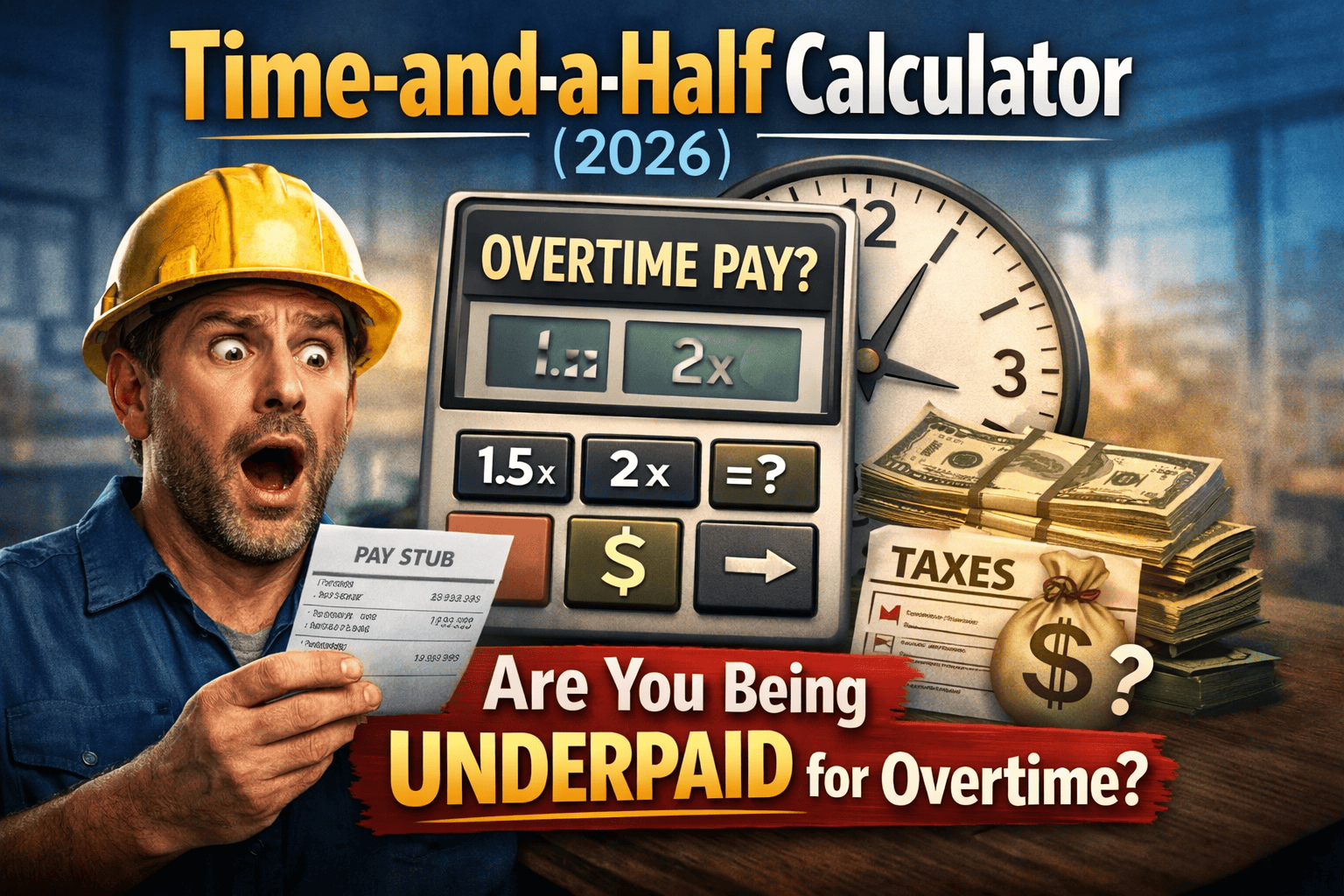
You worked 50 hours last week. You know overtime kicks in after 40. So you multiplied your hourly rate by 1.5, did the quick math, and expected a specific number on your paycheck.
Then the check arrived — and the number was different.
That’s the moment most workers shrug and assume payroll knows better. After 15 years in HR, I’ll tell you plainly: payroll makes mistakes more often than anyone admits. And most employees never catch them because they don’t know how the time-and-a-half calculator actually works — beyond the basic formula.
This guide will fix that. You’ll walk away knowing exactly how to calculate your overtime pay, what legally belongs in that calculation, and three situations where employers quietly underpay — whether intentional or not.
What Time-and-a-Half Actually Means
The name is literal: you earn one-and-a-half times your regular hourly rate for every overtime hour worked.
Under the Fair Labor Standards Act (FLSA), the federal law that governs overtime in the US, non-exempt employees must receive at least 1.5× their regular rate for hours beyond 40 in a workweek. Most states follow this, and a few — California being the notable one — go further by requiring daily overtime after 8 hours on the clock.
Here’s where it gets interesting: your “regular rate” is not always your base hourly wage. That distinction is where most overtime disputes begin.
If you earn $22/hour and work 48 hours, the surface math is easy:
- Regular pay: 40 × $22 = $880
- Overtime rate: $22 × 1.5 = $33/hour
- Overtime pay: 8 × $33 = $264
- Total: $1,144
But if you also earned a $150 performance bonus that week? Your regular rate just changed — and so does your overtime obligation. More on that in a moment.
The point is: “1.5×” sounds simple. The calculation underneath it isn’t always.
The Time-and-a-Half Calculator: Step-by-Step Formula
Let’s build the formula properly. Use this every time you want to verify your paycheck.
Step 1: Determine Your Regular Rate
If you earn only hourly wages with no bonuses:
Regular Rate = Hourly Wage
If you earn bonuses, commissions, or shift premiums in addition to hourly pay:
Regular Rate = Total Earnings for the Week ÷ Total Hours Worked That Week
This is the FLSA-mandated calculation. Most people skip this and get the wrong number.
Step 2: Calculate the Overtime Rate
Overtime Rate = Regular Rate × 1.5
Step 3: Calculate Total Overtime Pay
Overtime Pay = Overtime Rate × Number of Overtime Hours
Step 4: Add It All Up
Total Weekly Pay = (40 × Hourly Rate) + Overtime Pay
A clean example:
- Hourly rate: $28
- Hours worked: 52
- Overtime hours: 12
Overtime rate = $28 × 1.5 = $42/hour Overtime pay = 12 × $42 = $504 Regular pay = 40 × $28 = $1,120
Total weekly pay: $1,624
Save that formula. Screenshot it if you need to. It’s the foundation you’ll need for the more complex scenarios below.
Real Scenario: When a Bonus Changes Everything
Here’s the situation I’ve seen play out dozens of times in payroll disputes.
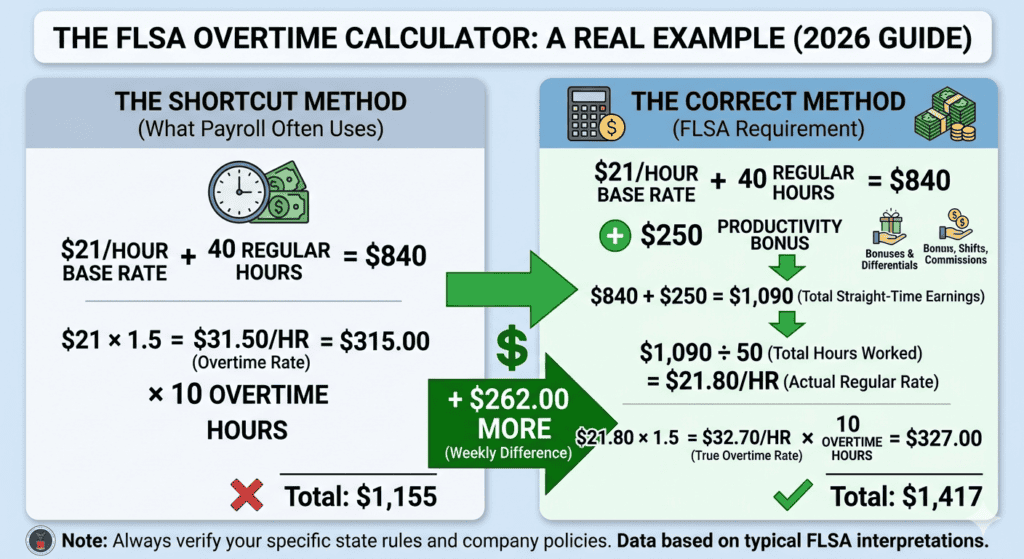
Marcus is a warehouse shift supervisor in Ohio. His base rate is $21/hour. In a busy week, he works 50 hours and also earns a $250 productivity bonus.
Most payroll systems would calculate his overtime on $21/hour. But that’s wrong under the FLSA.
Here’s what the law actually requires:
- Total earnings: (50 × $21) + $250 = $1,300
- Actual regular rate: $1,300 ÷ 50 = $26/hour
- Overtime rate: $26 × 1.5 = $39/hour
- Overtime pay: 10 × $39 = $390
Compare that to the shortcut calculation:
- $21 × 1.5 = $31.50/hour × 10 hours = $315
The difference? $75 per week. In a single year with consistent overtime, that’s $3,900 Marcus never received.
This isn’t a hypothetical. The Department of Labor recovers hundreds of millions in back wages each year — the majority involving exactly this kind of regular rate miscalculation. Bonuses, non-discretionary incentives, and shift differentials all legally belong in the overtime base.
The one exception: purely discretionary bonuses (a one-off “great job” gift at the manager’s sole discretion) don’t need to be included. But if a bonus is tied to production, attendance, or any defined metric — it counts.
Why Your Overtime Paycheck Looks Wrong
Beyond the bonus issue, there are four other common reasons your overtime check doesn’t match your math.
Wrong workweek definition. Overtime is calculated per workweek, not per pay period. If your employer pays biweekly but your workweek runs Tuesday to Monday, hours don’t carry over between weeks. Work 44 hours week one and 36 hours week two? You get 4 hours of overtime — not zero just because the pay period averages out to 40.
Comp time instead of cash. Some employers offer time-off-in-lieu of overtime pay. In the private sector, this is generally illegal under federal law. You’re entitled to be paid for your overtime hours. Full stop. (Government employees have different rules under the FLSA.)
Off-the-clock hours. Mandatory pre-shift tasks, post-shift equipment checks, or “quick” email responses after hours — these count as compensable time if the employer knows about them or should reasonably know. I’ve seen $40/hour professionals lose thousands annually to unpaid 20-minute pre-shift prep.
Misclassification as exempt. This is the biggest one. Employers sometimes label workers “salaried exempt” to avoid paying overtime. But the label doesn’t determine eligibility — the actual job duties do. If you don’t genuinely manage two or more employees, exercise real discretionary authority, or meet the salary threshold ($684/week under current federal rules, though some states set higher floors), you may still be entitled to overtime regardless of your job title.
How Taxes Work on Overtime Pay
Let’s kill a persistent myth: overtime is not taxed at a higher rate.
It is taxed as ordinary income — the same as your base wages. The reason your overtime check sometimes feels like you’re losing more to taxes is a withholding math issue, not a tax law issue.
Here’s what actually happens: when you earn overtime, your paycheck jumps. Payroll systems often use that single check as the basis for annualizing your income, which can temporarily spike your withholding bracket. So more tax gets withheld from that one check than you’d technically owe if you smoothed it across the year.
Come April, if you overpaid due to aggressive overtime withholding, you get a refund.
The practical impact: if you regularly work overtime and find you’re always getting a large tax refund, consider adjusting your W-4 withholding. You’re essentially giving the government an interest-free loan all year. That $2,000 refund could be $167 extra per month in your pocket through the year.
One real exception: if overtime pushes you from the 22% federal bracket to the 24% bracket, that extra 2% only applies to the income above the bracket threshold — not your entire paycheck. The US has a marginal tax system, not a flat one.
Who Actually Qualifies for Overtime?
Under the FLSA, you’re entitled to overtime if you’re a non-exempt employee. That includes most hourly workers and salaried workers earning below $684/week (as of 2026 — this threshold has been subject to regulatory updates, so always verify the current DOL figure).
You’re generally exempt if you meet all three of these simultaneously:
- Paid on a salary basis (not docked for partial days)
- Earn at least $684/week
- Your primary job duties meet the definition of executive, administrative, or professional work
The “duties test” is where employers frequently get it wrong — or where they bank on workers not pushing back. A job title like “Assistant Manager” or “Team Lead” doesn’t automatically make someone exempt. If that person isn’t genuinely directing two or more employees and has limited decision-making authority, they may well be non-exempt and owed overtime.
Industries with the most rampant misclassification: tech (especially growth-stage startups labeling everyone “exempt knowledge workers”), hospitality, retail management, and consulting.
If you’ve been classified as exempt but spend most of your day doing the same task-level work as your hourly colleagues, it’s worth a conversation with an employment attorney. Many offer free consultations, and the DOL’s wage and hour complaint process is free.
Smart Strategies to Maximize Your Overtime Earnings
This is the section nobody else covers — because most articles treat overtime as a passive thing that happens to you. It doesn’t have to be.
Stack your overtime into fewer, concentrated weeks. If you have flexibility over when you pick up extra hours, it’s smarter to work 50 hours in one week than to spread 10 extra hours across two weeks at 45 each. Both scenarios involve the same additional hours — but concentrating them maximizes your hours above the 40-hour threshold in a single calculation period.
Time your high-bonus weeks with your high-hour weeks. If you know a production bonus is being paid in a specific week, that’s the week to take on extra shifts. Since bonuses increase your regular rate, and your regular rate drives your overtime multiplier, you earn more per overtime hour when both are in the same week.
Track your own hours independently. Use your phone’s notes app, a simple spreadsheet, or a time-tracking app like Toggl. If a dispute ever arises, your personal records — especially if contemporaneous — carry real weight. Employers are required to maintain accurate records, but that doesn’t mean their records are always accurate.
Know your shift differential rights. Night differentials, hazard pay, and weekend premiums must be included in your regular rate calculation. If you earn $25/hour base with a $3/hour night differential, your overtime should be calculated at $28/hour × 1.5, not $25 × 1.5. Verify this is happening on your stub.
Common Mistakes That Cost Employees Real Money
Accepting the paycheck without checking the math. A $40/week underpayment across 50 overtime weeks is $2,000 annually. That’s real money. It takes about 10 minutes to verify your overtime calculation — do it at least once a quarter.
Assuming the 40-hour threshold is the only rule. If you work in California, Nevada, Alaska, or a handful of other states, daily overtime kicks in after 8 hours even if your weekly total stays under 40. Know your state’s rules.
Forgetting about the half-time method. If you’re salaried non-exempt (paid a fixed salary but still eligible for overtime), your employer might use the fluctuating workweek method, which only pays 0.5× your regular rate for overtime hours instead of 1.5×. This is legal in some circumstances but only with your agreement and only if your salary genuinely covers all hours worked. Many workers don’t realize they’ve consented to this arrangement — or that they may have grounds to challenge it.
Not filing a complaint when underpaid. The FLSA has a two-year statute of limitations for wage claims (three years if the violation was willful). Workers often assume “it’s not worth it” or they’ll face retaliation. Retaliation for filing a wage complaint is itself illegal under federal law, and the DOL’s Wage and Hour Division investigates complaints at no cost to the worker.
Pro Tip: The Payroll Audit You Should Do Right Now
Pull your last three pay stubs. For any week where you worked more than 40 hours, run this check:
- Add up all earnings for that week — base wages plus any bonuses or incentive pay
- Divide by total hours worked to get your actual regular rate
- Multiply that by 1.5 to get your true overtime rate
- Multiply by your overtime hours
If the number on your stub is lower than your calculation — even by a few dollars — ask your payroll team for a breakdown in writing. Most discrepancies get fixed quietly once an employee demonstrates they understand the math.
FAQ: Time-and-a-Half Calculator
How do I calculate time-and-a-half from my hourly rate?
Multiply your hourly rate by 1.5 to get your overtime rate. Then multiply that by the number of hours you worked over 40 in the week. If you also earned bonuses or incentive pay that week, first add those to your total earnings, divide by total hours to get your true regular rate, then apply the 1.5 multiplier.
Does a bonus affect my overtime pay calculation?
Yes — and this is one of the most common payroll errors. Non-discretionary bonuses (tied to production, attendance, or performance metrics) must be included in your regular rate before overtime is calculated. This means your overtime rate is often higher than your base rate × 1.5. Run the math yourself to verify.
Is overtime taxed at a higher rate than regular wages?
No. Overtime wages are taxed as ordinary income at your marginal rate. What often creates confusion is that a larger paycheck may push your withholding into a higher bracket temporarily, resulting in more tax withheld from that check. This often corrects itself at tax filing time as a refund.
Can salaried employees get overtime pay?
Yes, if they meet the non-exempt criteria. Being paid a salary doesn’t automatically make you exempt from overtime. If your salary is below the federal threshold ($684/week in 2026) or your job duties don’t genuinely qualify as executive, administrative, or professional, you’re likely still entitled to overtime.
How is overtime calculated — daily or weekly?
Under federal FLSA rules, overtime is calculated on a weekly basis — over 40 hours in a single workweek. However, states like California, Nevada, and Alaska also apply daily overtime rules (after 8 hours in a day), so you could qualify for overtime in those states even without exceeding 40 hours for the week.
What can I do if I think my overtime pay is incorrect?
Start by pulling your own records and running the calculation manually using total weekly earnings ÷ total hours to get your regular rate. If there’s a discrepancy, raise it with your HR or payroll department in writing. If the issue isn’t resolved, you can file a complaint with the DOL’s Wage and Hour Division at no cost. Keep all records.
Are shift differentials included in overtime calculations?
Yes. Night pay, weekend premiums, hazard pay, and similar shift differentials are part of your regular rate and must be factored into your overtime calculation. If your employer calculates overtime on your base rate alone and excludes your differential, that’s an underpayment.
What’s the overtime threshold for 2026?
The federal salary threshold for overtime exemption is currently $684/week ($35,568/year) under FLSA. Workers earning below this amount are generally entitled to overtime regardless of job title. Some states set higher thresholds — California’s, for instance, is significantly above the federal floor.
The Bigger Picture
Understanding how your time-and-a-half calculator works isn’t just about one paycheck. It’s about recognizing what you’re legally owed — and having the tools to verify it.
Most employees never run the math. They trust payroll, accept the number, and move on. That’s exactly why wage theft — whether deliberate or through honest error — remains one of the most common labor violations in the US.
You don’t need a lawyer to catch most overtime errors. You need this formula, 10 minutes, and three pay stubs.
Run the check. If the numbers don’t match, ask the question. You earned those hours — make sure you’re paid for all of them.
For more on understanding your total compensation package, read our guide on [how to read your pay stub and decode every line item] — including the deductions most employees never question.
External reference: US Department of Labor — Wage and Hour Division (dol.gov/agencies/whd) for the current FLSA salary threshold and filing a wage complaint.Share

Eleanor Whitmore | Former Partner, Mercer | Advisor, World Economic Forum | 20+ Years in Global Compensation
Author bio: Eleanor Whitmore has spent over two decades shaping how the world’s leading organisations pay, retain, and reward talent. As a former Partner at Mercer and an advisor to World Economic Forum working groups on the Future of Work, she has designed compensation frameworks for Fortune 500 companies across the US, UK, Europe, and emerging markets. Based between London and New York, Eleanor writes for HRGet.com to translate boardroom-level pay strategy into actionable guidance for working professionals navigating real compensation decisions.