What FLSA Exempt vs Non-Exempt Actually Means
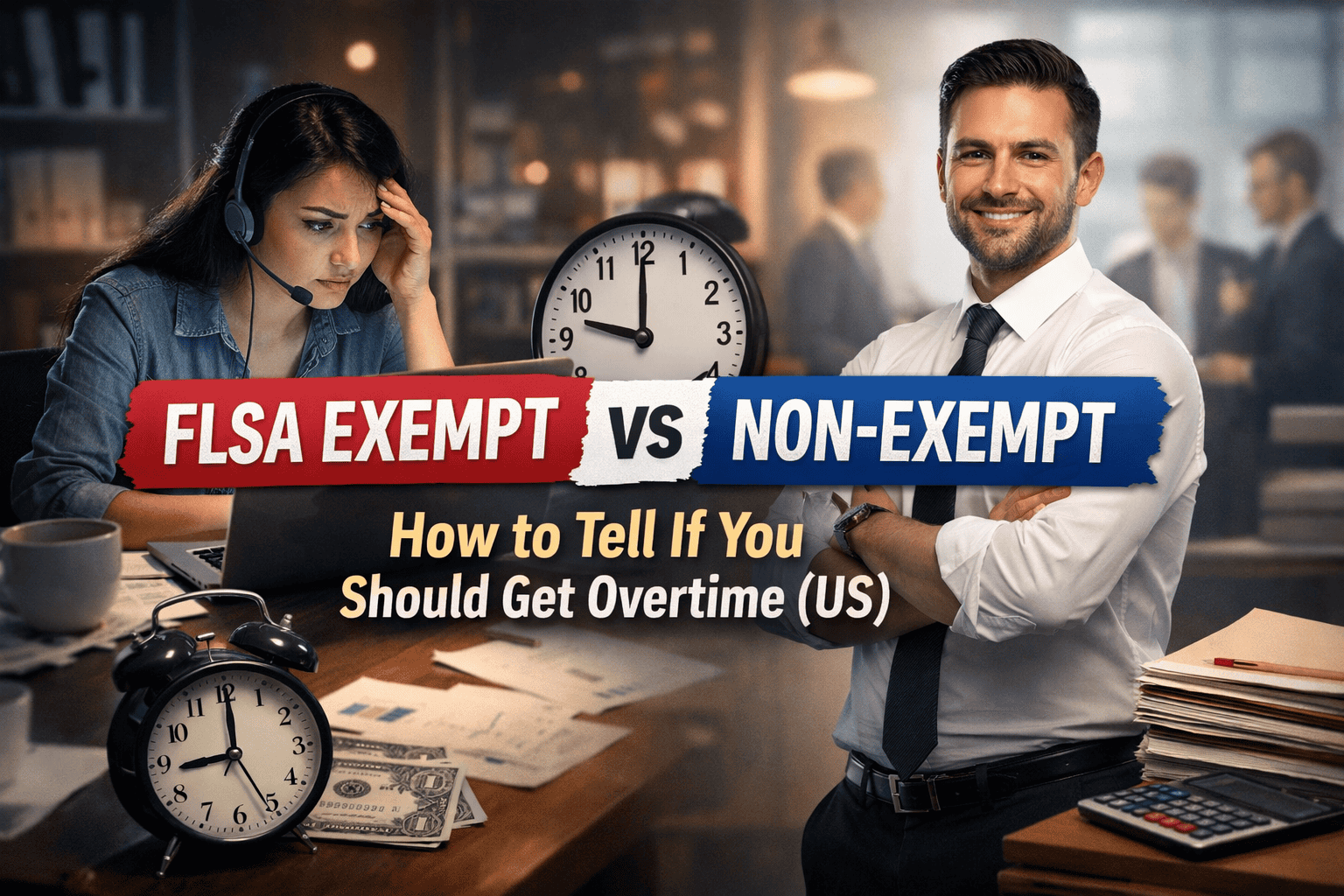
The Fair Labor Standards Act (FLSA) is the federal law that governs minimum wage, overtime pay, and child labor protections in the US. Under the FLSA, every employee falls into one of two categories: exempt (not entitled to overtime) or non-exempt (must receive overtime pay).
Non-exempt employees are entitled to 1.5× their regular pay rate for every hour worked beyond 40 in a workweek. Exempt employees get no such protection — they can work 60 hours and receive the same paycheck every week.
Here’s the thing most professionals don’t realize: your employer doesn’t get to just choose which bucket you’re in. Classification isn’t a management decision. It’s a legal determination based on strict criteria the Department of Labor sets. If your employer gets it wrong — intentionally or not — they can owe you years of back pay.
I’ve seen this play out at companies of every size. A fast-growing startup reclassifies a dozen “managers” as exempt to cut payroll costs. A retail chain calls every shift supervisor salaried-exempt. A tech company gives IT coordinators the title of “Specialist” and suddenly stops tracking their hours. Sometimes it’s intentional. Often it’s sloppy HR during a period of rapid hiring. Either way, the financial hit lands on you.
⚠ Common MisconceptionBeing paid a salary does not automatically make you exempt. Salaried employees can — and often should — receive overtime. This is the single most expensive misconception in US employment law.
The 3 Tests That Decide Your FLSA Status
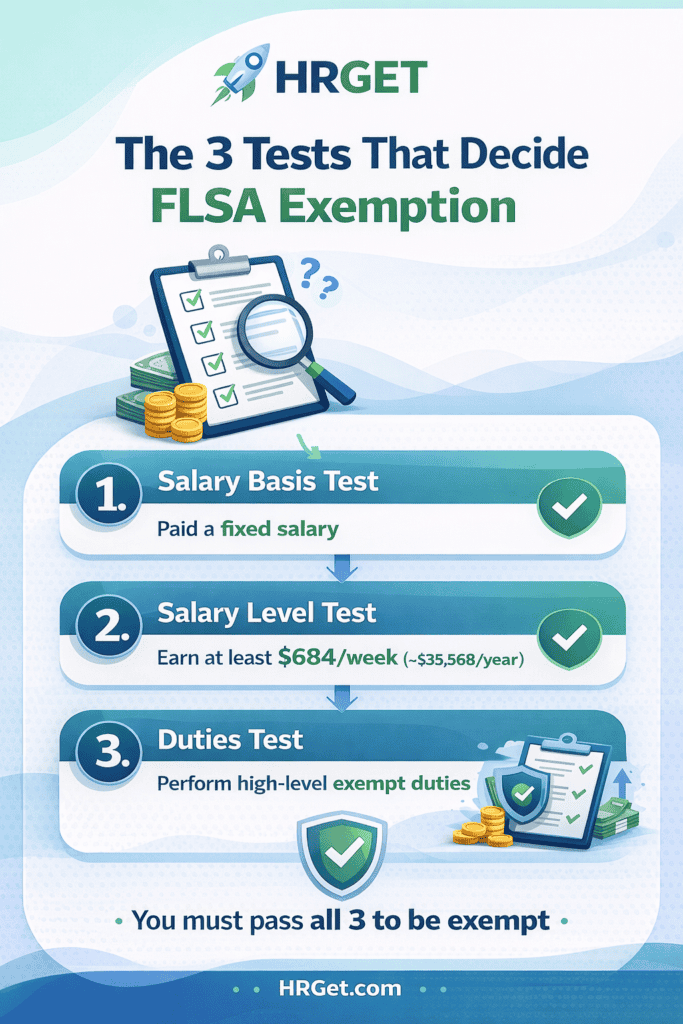
To legally classify you as exempt from overtime, your employer must satisfy all three of the following tests. Failing even one means you’re non-exempt — full stop.
Test 1: The Salary Basis Test
You must be paid a predetermined fixed salary that doesn’t fluctuate based on hours worked or quantity of output. If your employer docks your pay when you take a half-day sick leave or work 38 hours instead of 40, that’s a red flag. Deductions like that can actually destroy your exempt status retroactively.
Test 2: The Salary Level Test
As of 2026, you must earn at least $684 per week (approximately $35,568 per year) to qualify for most exemptions. If you earn less than this threshold, you’re automatically non-exempt — regardless of your job title or duties. The DOL has proposed raising this threshold in recent years; always check the current figure at dol.gov since it can change.
Pro Tip: Highly compensated employees (HCEs) earning $107,432+ per year face a lighter duties test. But the salary threshold for standard exemptions hasn’t changed since 2019 — and that gap matters when you’re evaluating your classification.
Test 3: The Duties Test (This Is Where Misclassification Hides)
This is the test that trips up the most employees — and the most employers. Even if you meet the salary tests, you must perform duties that fall into one of the recognized exempt categories:
- Executive Exemption: You manage 2+ full-time employees, your primary duty is management, and you have genuine authority to hire, fire, or meaningfully recommend it. A “manager” who mostly does individual contributor work and can’t actually fire anyone doesn’t meet this test.
- Administrative Exemption: Your primary work is office/non-manual work directly related to the business’s operations or customers, and you regularly exercise independent judgment on significant matters. Following a script or set procedures? Probably not exempt.
- Professional Exemption: Your role requires advanced knowledge in a field of science or learning customarily acquired through a prolonged course of specialized intellectual instruction — think licensed engineers, CPAs, attorneys, or registered nurses.
- Computer Employee Exemption: A special category for certain systems analysts, programmers, and software engineers — but notably not most IT support or help desk roles.
- Outside Sales Exemption: You make sales or obtain orders away from your employer’s place of business. Remote inside sales reps typically don’t qualify.
The duties test is evaluated on what you actually do, not what your job description says you do. If you spend 70% of your week handling individual contributor tasks alongside two people you nominally supervise, the “executive” label won’t hold up under scrutiny.
Real Scenarios: Where People Get Burned
Abstract tests are one thing. Let me walk you through situations I’ve seen play out in real workplaces — names changed, details composited from actual cases.
Role: Team Lead at a mid-size logistics company | Salary: $62,000/year | Hours: 50–55/week
This employee was classified as exempt under the executive exemption. But when audited: she had zero hiring or firing authority. Performance reviews went to her manager, not through her. She spent about 80% of her time doing the same operational work as the five people on her “team.”
Result: Non-exempt. At her effective hourly rate of roughly $29/hr, she was owed approximately $450/week in unpaid overtime — or around $22,000/year.
Role: IT Support at a healthcare company | Title: Systems Engineer | Salary: $55,000/year
The title sounded technical and senior. But the daily reality was: follow troubleshooting scripts, escalate anything complex to the actual engineers, manage tickets, reset passwords. No systems architecture. No independent judgment on significant matters.
Result: Non-exempt. The computer exemption requires applying systems analysis techniques and procedures — not executing defined support workflows. The fancy title was irrelevant.
Role: Store Manager at a national retail chain | Salary: $72,000/year
Managed 8 employees. Had genuine authority to hire seasonal staff and initiate terminations. Spent the majority of her time on management functions — scheduling, performance management, vendor coordination. Yes, she sometimes stocked shelves during holiday rushes. But her primary duty remained management.
Result: Exempt. Legitimately classified. Her employer got this one right.
Overtime Rules Every Non-Exempt Employee Should Know
If you’re non-exempt, the FLSA gives you specific, enforceable protections — and understanding them in detail matters when it’s time to raise a concern.
The basic rule: 1.5× your regular rate of pay for all hours worked beyond 40 in a single workweek. Note that “workweek” is a fixed, defined 7-day period set by your employer — averaging hours across two weeks doesn’t satisfy the requirement.
What many employees don’t realize is what counts as “hours worked” for overtime purposes:
- Mandatory training and orientation — if attendance is required, it counts
- Pre-shift and post-shift activities — if your employer requires you to boot up systems before your shift starts, that’s work time
- Work emails and messages after hours — if your employer knows about it and benefits from it, it likely counts under the “suffer or permit to work” standard
- On-call time — depending on the restrictions placed on you while on-call
That last point about emails is the one most people overlook in 2026. If you’re non-exempt and your manager regularly sends you messages at 9pm expecting a response before midnight, your employer may owe you overtime for that time — even if they never formally asked you to work it.
💡 Pro TipYour employer cannot waive your right to overtime by having you sign an agreement. Non-exempt status and overtime entitlements are determined by law, not by contract. Any agreement to “voluntarily” forgo overtime pay is unenforceable.
Common Misclassification Traps Employers Use
Some employers misclassify intentionally. Many do it out of genuine ignorance — especially smaller companies that never had a real HR function. Either way, the result is the same for you. Here are the patterns that show up most often:
The Impressive Title Trick
“Director of Client Success.” “Head of Operations.” “Principal Coordinator.” These titles imply seniority, but titles have zero legal weight under the FLSA. The DOL evaluates what you do, not what you’re called. I’ve seen $38,000-a-year employees given director titles specifically to justify an exempt classification — and it doesn’t hold up.
The Blanket Policy Problem
“Everyone at this company is salaried-exempt.” You’ll hear this at startups and small businesses a lot. But FLSA classification is determined individually. A blanket policy that misclassifies a group of employees doesn’t get weaker with repetition — it creates greater legal exposure, not less.
Blended Roles That Cross Exempt/Non-Exempt Lines
When an employee’s role mixes exempt-level duties (like managing a team) with clearly non-exempt work (like data entry or manual processing), the classification depends on which duties are primary. “Primary” generally means occupying the majority of time. If the manual work dominates your week, you’re likely non-exempt regardless of the management component.
The Independent Contractor Reclassification
This one’s slightly different but deserves mention: some employers classify workers as independent contractors to sidestep overtime entirely. The IRS and DOL apply their own multi-factor tests for this. If your “contractor” arrangement looks like employment — fixed schedule, company equipment, single client — you may actually be an employee entitled to overtime protections.
⚠ Watch OutState law can be more protective than federal FLSA rules. California, for instance, requires daily overtime (over 8 hours/day) in addition to weekly overtime, and uses a stricter duties test. Always check your state’s wage and hour laws alongside the federal baseline.
Smart Strategy: What to Do If You’re Misclassified
Think something’s off? Don’t walk into HR without a plan. Here’s the step-by-step approach that protects you while giving you the best shot at a real resolution.
1Audit your actual duties — not your job description. Write down what you genuinely do each week. What decisions do you make independently? Who do you manage, and what does that management look like in practice? Be honest. This is your internal evidence base.
2Run your role against all three FLSA tests. Salary basis? Salary level ($684/week+)? Duties test? If any one of these fails, you likely have a misclassification issue. Use the DOL’s FLSA resources at dol.gov as your reference — not your employer’s interpretation of them.
3Start tracking your hours immediately. Keep a personal log — a note on your phone, a simple spreadsheet, anything. Don’t rely on your employer’s system. Your records will be essential if this escalates. Note start and end times, after-hours work, and any off-clock activities your employer benefits from.
4Raise it internally — strategically, not emotionally. Request a meeting with HR framed as a “classification review question.” Don’t lead with accusations. Something like: “I’ve been reviewing my role responsibilities and the FLSA requirements and wanted to understand how my classification was determined.” Put the question in writing afterward so there’s a record of your inquiry.
5Escalate if internal resolution fails. If HR dismisses the issue or confirms an exemption you don’t believe is legitimate, you can file a complaint with the DOL’s Wage and Hour Division (dol.gov/agencies/whd). There’s no fee. The WHD will investigate, and if they find violations, you can recover back pay for up to 2 years — or 3 years if the violation is found to be willful.
10 extra hours per week × $30/hr effective rate × 1.5 overtime multiplier × 52 weeks. That’s the annualized overtime owed to a misclassified employee at a $62,000 salary working modest extra hours. Over two years? $46,000 in recoverable back pay.
The Insider View: What HR Actually Thinks About This
🔍 Insider Perspective
Here’s what most articles about FLSA classification won’t say: most HR departments aren’t adversarial on this issue — they’re under-resourced. Classification decisions often get made by a department head during a hiring push, rubber-stamped by a generalist HR coordinator who doesn’t specialize in wage and hour law, and never revisited as the role evolves.
When an employee raises a thoughtful, documented classification question, the HR reaction is often: “We probably should have looked at this more carefully.” That’s very different from a retaliation scenario. Lead with curiosity, bring the facts, and you’ll find most companies would rather fix the issue than litigate it.
That said — some employers do classify intentionally and incorrectly. In those situations, documentation is everything. The DOL takes willful violations seriously, and the 3-year back pay window for willful misclassification is a significant financial liability for any employer that fights a losing case.
One more thing: if you’re correctly classified as exempt and working long hours, you still have leverage. Many exempt employees successfully negotiate comp time policies, performance bonuses tied to extended effort periods, or flexible schedule arrangements. “Exempt” doesn’t mean “without recourse” — it just means the conversation is about compensation design rather than legal rights.
Quick Comparison: Exempt vs Non-Exempt at a Glance
| Factor | Exempt | Non-Exempt |
|---|---|---|
| Overtime Pay (1.5×) | ✗ Not required | ✓ Required after 40 hrs/wk |
| Pay Structure | Fixed salary | Hourly or salary |
| Salary Minimum ($684/wk) | ✓ Required | ✗ Not required |
| Duties Test | ✓ Must pass | ✗ Not required |
| Hours Tracked by Employer | Not legally required | Legally required |
| Pay Dockable for Partial Days? | Generally no (can void exemption) | Yes (hourly basis) |
| State Law Can Expand Protections? | ✓ Yes | ✓ Yes |
| Back Pay Window if Violated | N/A | 2 yrs (3 if willful) |
Frequently Asked Questions
The Bottom Line
Here’s what I want you to take away from this: FLSA exempt vs non-exempt classification isn’t HR paperwork — it’s a direct line to your paycheck. Getting it wrong (or letting your employer get it wrong) can cost you tens of thousands of dollars over the course of a career.
The three-part test isn’t complicated once you understand it. Salary basis. Salary level. Duties. All three must be satisfied. If any one fails, you’re non-exempt, and you’re owed overtime. Your title doesn’t matter. Your agreement doesn’t matter. What you actually do every day — that’s what the law cares about.
Start with an honest audit of your own role. If something feels off, document it, raise it strategically, and know that the DOL’s Wage and Hour Division exists exactly for situations where internal resolution doesn’t work. You have more leverage than you think.
What to Do Next
Run the three FLSA tests against your actual role today. If you pass all three, you’re likely correctly classified. If anything flags, start tracking your hours and review our guide on how to negotiate compensation when you’re exempt — because even exempt employees shouldn’t silently absorb unlimited overtime.

Victoria Hale | Former Partner, Freshfields Bruckhaus Deringer | Employment Law Specialist | 20+ Years Advising Multinationals & Executives
Author: Victoria Hale spent over two decades as an Employment Law Partner at Freshfields Bruckhaus Deringer — one of the world’s most prestigious Magic Circle law firms — advising multinational corporations and senior executives on some of the most complex employment disputes in the US and Europe. Her practice covered wrongful termination litigation, executive exits, non-compete enforcement, FLSA compliance, and cross-border workforce restructuring under EU labour law. Now based between London and New York, Victoria writes for HRGet.com to close the gap between legal theory and how employment law actually plays out in the real world — for employees who need to know their rights before it’s too late.