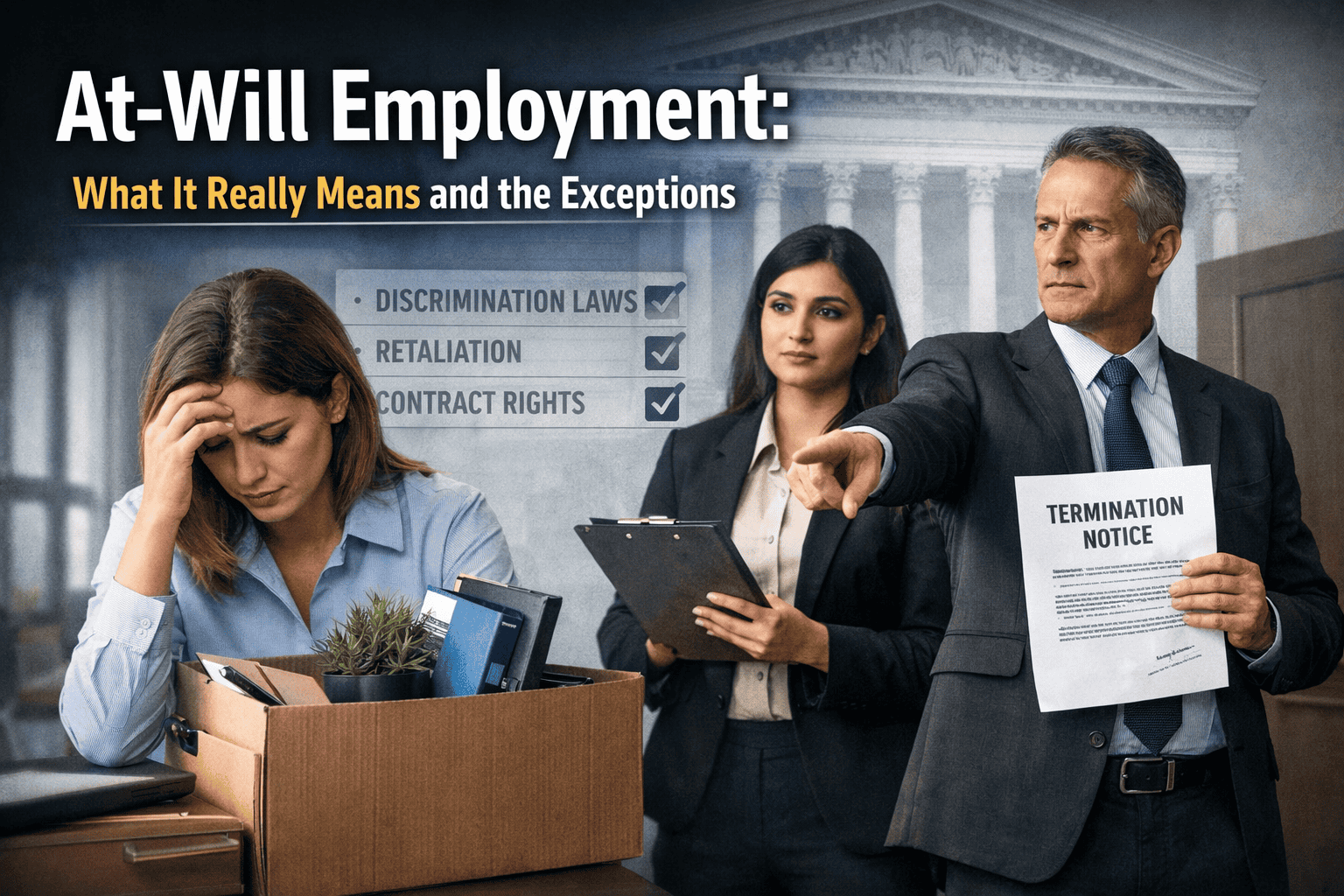
You accept a job. Everything looks fine. Then one ordinary Tuesday, your manager calls you in and says: “We’re letting you go. Today is your last day.” No warning. No paper trail. No explanation beyond a vague “strategic shift.”
Someone tells you: “It’s at-will employment — they can do that.” And technically, they’re right. But only partially. After 15 years working inside HR at companies across the US, I’ve watched employees walk away from valid legal claims — real money, real rights — because they assumed at-will employment meant employers could do anything.
They can’t. At-will employment is powerful, but it has hard legal limits that most employees never learn about until it’s too late. This article will walk you through exactly where those limits are — and what you can do about it.
What Is At-Will Employment?
At-will employment means either party — you or your employer — can end the employment relationship at any time, for almost any reason, or for no reason at all. No advance notice required. No written justification. No formal process.
This is the default employment rule in 49 US states. Montana is the only state that has largely moved away from it, requiring “good cause” for termination after a probationary period.
The simplest version: you can quit tomorrow without penalty, and your employer can fire you tomorrow without explanation. That’s the core of it.
But here’s what the quick definition leaves out — the word “almost” is doing enormous legal work in that sentence. The exceptions to at-will are where employment law gets serious, and where real money changes hands in courts every year.
When I was in HR, we never used the phrase “at-will” when terminating someone. We’d say things like “role elimination” or “org realignment.” That language was deliberate — it sounds business-driven, not personal. It also makes discrimination claims harder to prove. Know this going in.
What Employers Can Legally Do Under At-Will Employment
Let’s be direct about what is fully legal under at-will employment, because a lot of people are shocked by this list:
- Fire you without warning — even if yesterday’s performance review was positive
- Terminate for vague business reasons — budget cuts, restructuring, “culture fit,” manager preference
- Replace you with someone cheaper — even after years of service, as long as it’s not discriminatory
- Let you go without severance — unless your offer letter or contract specifically promises it
- Give no reason at all — legally, they don’t have to tell you why
I’ve seen employees terminated on a Friday afternoon with no warning after eight years with a company. Perfectly legal. Brutal, yes. Illegal, no.
What makes this especially difficult is that employers are coached to give neutral termination language precisely to avoid liability. “Role eliminated.” “Team restructured.” “No longer a fit for our direction.” These phrases mean nothing — and that’s the point.
Never ask HR “why am I being let go?” and expect a candid answer. Their job in that moment is to protect the company. Ask for the reason in writing — even a vague written reason creates a record you can later challenge or contradict with evidence.
The At-Will Employment Exceptions That Actually Protect You
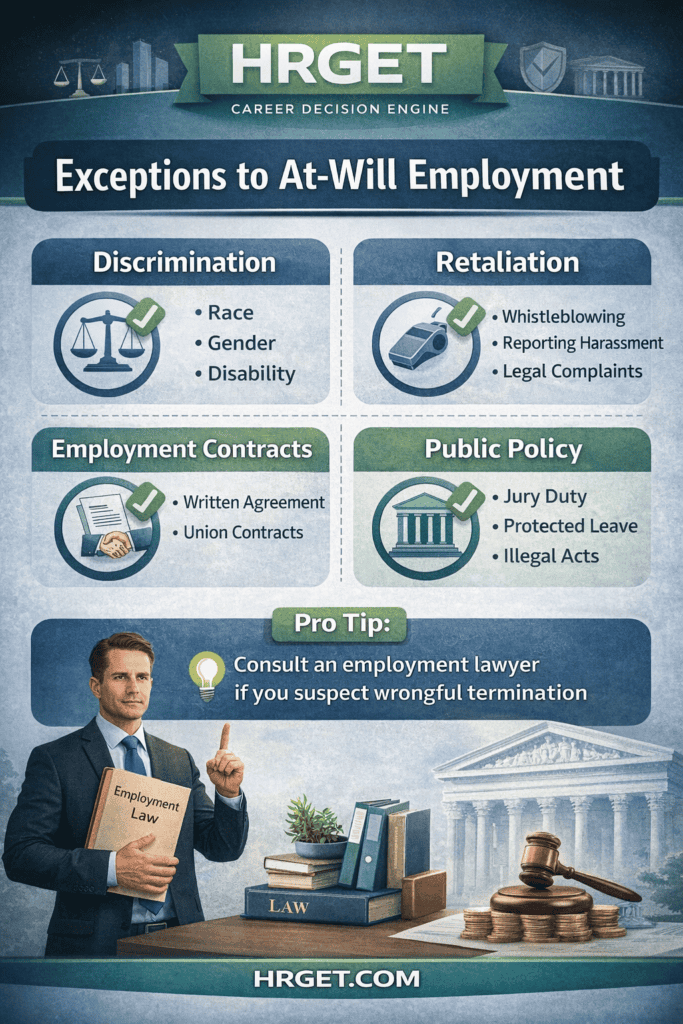
Here’s where at-will employment hits its legal ceiling. These aren’t loopholes — they’re hard federal and state law protections that override at-will status entirely. If your termination falls into any of these categories, you may have a legitimate wrongful termination claim.
1. Discrimination (Title VII, ADA, ADEA, and More)
Federal law — specifically Title VII of the Civil Rights Act, the Americans with Disabilities Act (ADA), and the Age Discrimination in Employment Act (ADEA) — prohibits firing someone because of:
- Race, color, national origin
- Sex or gender identity
- Religion
- Age (if you’re 40 or older)
- Disability
- Pregnancy (Pregnancy Discrimination Act)
Proving discrimination is fact-specific and often requires showing a pattern, not just a single incident. But it’s far more winnable than most employees assume — especially if there’s documented evidence of differential treatment.
2. Retaliation
This is one of the most misunderstood exceptions, and in my experience, one of the most frequently violated. Employers cannot fire you in retaliation for:
- Reporting workplace harassment or discrimination to HR or the EEOC
- Filing a workers’ compensation claim
- Whistleblowing illegal activity (protected under various state and federal whistleblower statutes)
- Taking FMLA (Family and Medical Leave Act) leave
- Participating in a workplace investigation — even as a witness
The timing matters a lot here. Getting fired two weeks after filing an HR complaint looks very different to a court than getting fired six months later.
3. Implied Contract
This one surprises most people. Even without a formal employment contract, an employer can create an implied contract through their own language and conduct. Examples:
- An employee handbook that says “employees will only be terminated for cause after a performance improvement process”
- A manager who verbally promises job security (“you’re safe as long as you hit your numbers”)
- Established company practice of progressive discipline before termination
If the company routinely puts employees on PIPs before firing them and skips that process for you, that inconsistency can support an implied contract claim in some states.
4. Public Policy Violations
Employers cannot fire you for actions that serve the public interest, including:
- Serving on jury duty
- Refusing to commit an illegal act on the employer’s behalf
- Reporting safety violations to OSHA
- Voting or engaging in other civic duties protected by state law
5. Written Employment Contract
If your offer letter, employment agreement, or union contract includes specific termination procedures — notice periods, cause requirements, severance — those override at-will status. Always read your offer letter carefully, because that document matters far more than most people realize at signing time.
The Biggest Myth About At-Will Employment
The myth: “At-will means employers can fire you for ANY reason.”
The reality: “At-will means employers can fire you for any LEGAL reason.”
That one word — legal — changes everything. Employers don’t have unlimited authority. They have wide authority, bounded by federal and state law. Most employees (and honestly, some managers) don’t fully grasp that distinction until they’re sitting across from an employment attorney.
At-will employment protects employer flexibility — but it does not protect illegal employer conduct. The question after any unexpected firing isn’t “can they do this?” It’s “did they do something illegal in the process?” Those are very different questions.
Real-World Scenarios: Legal, Gray Area, and Illegal
Theory is one thing. Here’s what this actually looks like in practice:
A mid-level marketing manager at a SaaS company is let go during a 10% RIF (reduction in force). No PIP. No warning. She’s replaced by a contractor at lower cost. Painful? Absolutely. Illegal? No. This is textbook at-will termination with a legitimate business reason.
A warehouse supervisor files an internal safety complaint with HR about an OSHA violation. Three weeks later, he’s terminated for “performance issues” — his first in five years. The timing is suspicious. This may be retaliatory firing. Whether it’s actionable depends on documentation, what the performance issues were, and whether similarly-situated employees were treated differently. A strong case? Not guaranteed. Worth an employment attorney conversation? Absolutely.
A senior accountant discloses her pregnancy in a team meeting. Six weeks later, she’s terminated with a “restructuring” justification. Her position is filled by a non-pregnant woman two months later. This has the hallmarks of pregnancy discrimination — a protected class under federal law, and even more strongly protected in states like California and New York. This is a serious claim.
| Situation | Legal Status | What To Do |
|---|---|---|
| Laid off in a company-wide RIF | ✅ Legal | Negotiate severance, file for unemployment |
| Fired after reporting harassment | ⚠️ Likely illegal retaliation | Consult employment attorney immediately |
| Terminated after pregnancy disclosure | 🚫 Likely illegal | File EEOC charge within 180–300 days |
| Let go with no reason given | ✅ Legal if no protected class involved | Request written reason; review for red flags |
| Fired for refusing to falsify reports | 🚫 Public policy violation | Whistleblower protections likely apply |
State-Level Differences You Must Know
At-will employment is a federal baseline, but states can — and do — expand employee protections significantly. Where you work matters as much as what happened to you.
California
California has some of the strongest employee protections in the country. The FEHA (Fair Employment and Housing Act) extends anti-discrimination protections beyond federal law, and California courts have been expansive in recognizing implied contract claims from employee handbook language.
Montana
The only state that has essentially abandoned full at-will employment. The Wrongful Discharge from Employment Act requires employers to show “good cause” for termination after a probationary period. If you’re in Montana, your rights are meaningfully stronger than in other states.
New York
New York is at-will at the state level, but NYC’s Human Rights Law provides broader anti-discrimination protections than federal law — including protections based on sexual orientation, gender identity, and caregiver status that go further than Title VII.
Texas and Florida
Both states are employer-friendly and have few additional protections beyond federal law. At-will employment operates with wide latitude. If you’re in either state, your primary protections come from federal statutes.
Search “[your state] + wrongful termination exceptions” before assuming your situation is hopeless. State law often adds meaningful protections beyond federal baseline that most employees — and frankly, many managers — don’t know exist.
How Employers Quietly Protect Themselves
Here’s something most articles won’t tell you: HR departments are not neutral arbiters. They exist to minimize legal exposure for the company. Understanding their playbook helps you respond to it intelligently.
Documentation Campaigns
When a company decides to let someone go — sometimes weeks or months in advance — HR often initiates a documentation effort. Suddenly you’re receiving written feedback you never got verbally. Performance notes appear in your file. Emails are saved. This isn’t coincidence; it’s legal preparation.
If you notice a sudden uptick in written performance feedback after a conflict, a complaint, or a protected event (like a medical leave), pay attention. That’s a signal.
At-Will Language in Every Document
Every offer letter you’ve ever signed almost certainly includes something like: “Employment with [Company] is at-will and may be terminated at any time by either party.” That language is intentional. Companies have their legal teams review this language regularly to make sure it holds up and isn’t overridden by handbook language.
Neutral Termination Scripting
HR managers are trained to follow termination scripts that avoid specific reasons — because specific reasons can be legally challenged. “Role eliminated” or “position no longer exists” is carefully chosen over anything that sounds performance-related or personal. This is why you so rarely get a real explanation when you’re let go.
What To Do If You’re Fired Suddenly
Don’t panic. Don’t sign anything. Do this instead, in this order:
- Ask for the termination reason in writing. Even a brief written statement. You may not get one, but asking creates a record of the refusal.
- Review your offer letter and any employment agreement. Look for termination clauses, notice period language, severance promises, or cause requirements. These override at-will if they exist.
- Think about the timeline. Did this happen after a complaint, a leave, a disclosure, or a workplace conflict? Timing is evidence.
- Preserve everything now. Emails, Slack messages, performance reviews, any written feedback — save or forward to a personal account before your corporate access is cut. Once you’re locked out, it’s gone.
- Do not rush to sign a severance agreement. Most severance agreements require you to waive your right to sue. You typically have at least 21 days to review (45 days if you’re over 40, under the OWBPA). Use that time to consult an employment attorney if you have any doubt about what happened.
- File for unemployment immediately. In most states you can file the same day. Waiting costs you money.
Common Mistakes Employees Make After At-Will Terminations
I’ve watched these mistakes cost real people real money. Don’t repeat them.
Assuming nothing can be done. The most common one. Many people walk away from valid claims because they heard “at-will” and thought it was the end of the conversation. It isn’t.
Signing the severance agreement immediately. Companies often pressure you to sign quickly — sometimes the same day. That urgency is not in your interest. A 10-minute consultation with an employment attorney could tell you whether you have leverage to negotiate the amount, or whether signing would be a serious mistake.
Failing to document before termination. By the time you’re fired, it’s often too late to build a record. The time to start preserving evidence of differential treatment, problematic comments, or timeline anomalies is when you first notice something is wrong — not after you’re escorted out.
Ignoring patterns in favor of incidents. A single off-color comment isn’t necessarily actionable. A pattern of comments combined with a demotion, exclusion from meetings, and eventual termination — that’s a different story entirely. Courts look at patterns.
Smart Strategy: Protect Yourself Before It Happens
The best time to think about this isn’t after you’re fired — it’s right now, while you’re still employed.
Keep a Running Career File
A simple document (stored outside company systems) where you log achievements, positive feedback, conflicts, and any incidents that concern you. Date everything. This becomes invaluable if you ever need to reconstruct a timeline for an attorney or an EEOC filing.
Confirm Key Conversations in Writing
After any verbal conversation that matters — a performance discussion, a promise, a complaint — send a brief follow-up email: “Just to confirm what we discussed this morning…” This creates a contemporaneous written record without looking adversarial. It’s one of the highest-value habits you can develop.
Read Your Company Handbook Carefully
Many companies say “at-will” in the offer letter but describe a progressive discipline process in the handbook. That inconsistency is legally meaningful in some states. Know what your handbook promises — because it may promise more than you think.
Build Optionality
The harshest truth about at-will employment: the best protection you have is having other options. A competitive job market position makes you less vulnerable to a bad-faith termination, because the cost of fighting it is lower when you’re already employed elsewhere or have strong alternatives lined up.
Most terminations I’ve been involved in were planned 4–6 weeks in advance. By the time the meeting is scheduled, the decision is made. Early warning signs: reduced scope, exclusion from key meetings, sudden documentation of minor issues, a new manager who seems uninterested in your success. If you see two or more of these, start preparing. Not panicking — preparing.
Frequently Asked Questions
Can I be fired without notice under at-will employment?
Yes. Unless your offer letter, employment contract, or company handbook explicitly requires advance notice, at-will employment allows immediate termination with no warning required. Some states have specific rules for mass layoffs (like the federal WARN Act requiring 60 days’ notice for large layoffs), but individual terminations require no notice by default.
Is at-will employment legal in all US states?
At-will employment is the default in 49 states. Montana is the exception — after a probationary period, employers there must show “good cause” for termination under the Wrongful Discharge from Employment Act. However, every state, including at-will states, applies federal anti-discrimination and retaliation protections on top of the at-will baseline.
Can I sue for wrongful termination if I’m an at-will employee?
Yes — if the termination violated a legal exception. At-will status doesn’t protect employers from discrimination, retaliation, or public policy violations. If you were fired for a protected reason (race, pregnancy, disability, etc.), fired in retaliation for a protected act, or fired in violation of an implied contract, you may have a wrongful termination claim regardless of at-will status.
Does an employer need to prove poor performance to fire someone at-will?
No. Under at-will employment, employers are not required to document or prove performance issues before terminating. They don’t need a paper trail, a PIP, or a written warning. However, if the company’s own handbook or established practice promises progressive discipline, that pattern can create an implied contract obligation that complicates a no-warning termination.
Is severance required when an at-will employee is fired?
No. Severance is not legally required for at-will employees unless it’s promised in an employment contract, offer letter, or company policy. That said, many companies offer severance in exchange for a release of claims — meaning they want you to sign away your right to sue. Never sign a severance agreement without reviewing it carefully, especially if you have reason to believe the termination was unlawful.
What’s the difference between at-will employment and a contract job?
At-will employment allows either party to end the relationship at any time with no defined conditions. A contract job specifies terms — including how and when termination can occur, what severance is owed, and what grounds exist for firing. Contract employees have far more defined protections but also less flexibility. Many senior-level roles and executive positions involve employment contracts for precisely this reason.
Can an employer change the stated reason for termination after the fact?
Legally, yes — and it happens. This is why documenting everything at the time of termination matters. If an employer gives one reason verbally and a different reason in writing six months later during litigation, that inconsistency is something courts pay attention to. It doesn’t automatically prove illegal conduct, but it raises serious questions about the credibility of their justification.
The One Thing to Remember About At-Will Employment
At-will employment is not a legal blank check for employers. It’s wide authority, not unlimited authority.
If you’re ever told “it’s at-will, nothing you can do” — pause. Ask yourself whether the termination timing, the stated reason, or the treatment you received lines up with the legal exceptions covered in this article. Often, the real question isn’t whether they had the right to fire you. It’s whether they fired you illegally in the process of doing so.
That distinction matters. It can mean the difference between walking away with nothing and walking away with a severance negotiation, an EEOC claim, or a wrongful termination settlement.
Your next step: if you were recently terminated and something felt off, consult an employment attorney before signing anything. Most offer free consultations. You have nothing to lose by asking, and potentially a great deal to gain.
For more on your rights at work, read our guide on wrongful termination: what qualifies and how to build a case.

Eleanor Whitmore | Former Partner, Mercer | Advisor, World Economic Forum | 20+ Years in Global Compensation
Author bio: Eleanor Whitmore has spent over two decades shaping how the world’s leading organisations pay, retain, and reward talent. As a former Partner at Mercer and an advisor to World Economic Forum working groups on the Future of Work, she has designed compensation frameworks for Fortune 500 companies across the US, UK, Europe, and emerging markets. Based between London and New York, Eleanor writes for HRGet.com to translate boardroom-level pay strategy into actionable guidance for working professionals navigating real compensation decisions.