Teacher salary by state in 2026 is not just a “which state pays more?” question. It’s really a career decision question — and most salary comparison articles get it completely wrong.
A teacher earning $96,589 in Washington may look worlds ahead of one earning $63,749 in Texas. But once you account for housing costs, pension rules, union strength, class size, state income taxes, certification requirements, and district-level salary schedules, the “best” state isn’t always the state with the biggest headline number.
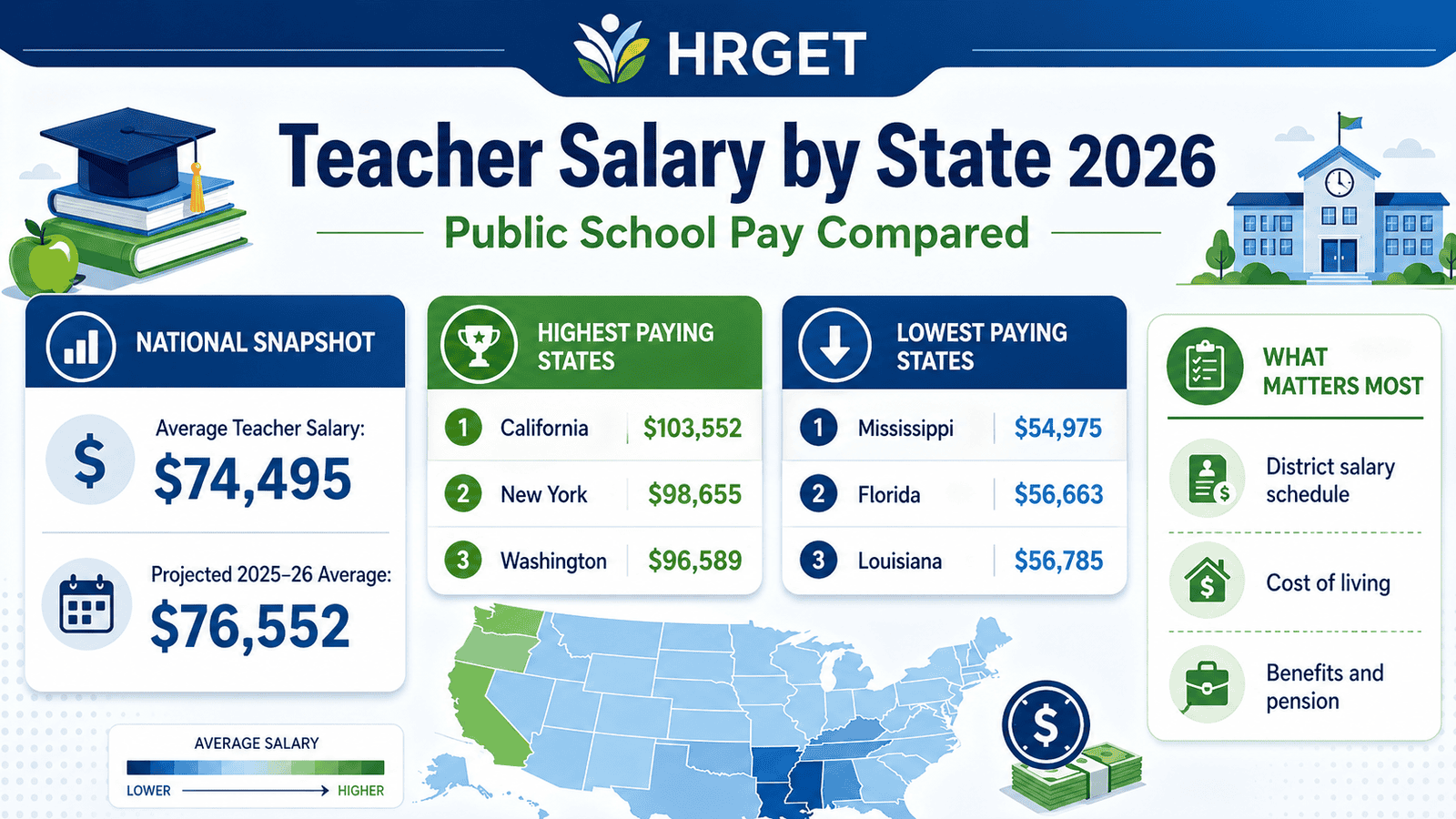
Here’s the truth: public school teacher pay in the United States is deeply, stubbornly uneven. According to the National Education Association’s 2026 Rankings and Estimates Report, the national average public school teacher salary was $74,495 for 2024–25, up 3.5% from the prior year — with projections placing the 2025–26 national average at $76,552.
But averages hide the real story. California crossed $103,000 in average teacher pay, while Mississippi remained below $55,000. That $48,000 gap isn’t academic. It can change your mortgage approval, retirement contribution, second-job pressure, and whether you stay in teaching long-term.
This guide compares public school teacher salary by state for 2026, explains what actually drives the differences, and tells you how to use this data before you move, negotiate, or sign a contract.
Teacher Salary by State 2026: Full Comparison Table
Below is the complete state-by-state breakdown using NEA’s 2026 educator pay report, based on FY 2024–25 average public school teacher salary data. Rankings reflect the full 50 states plus the District of Columbia.
| State | Avg Teacher Salary 2024–25 | National Rank | YoY Change |
|---|---|---|---|
| California | $103,552 | 1 | +2.4% |
| New York | $98,655 | 2 | +3.2% |
| Washington | $96,589 | 3 | +5.3% |
| District of Columbia | $95,077 | 4 | +9.7% |
| Massachusetts | $93,554 | 5 | +2.8% |
| Connecticut | $89,593 | 6 | +3.6% |
| Maryland | $87,409 | 7 | +3.6% |
| Rhode Island | $85,772 | 8 | +4.4% |
| New Jersey | $84,974 | 9 | +2.5% |
| Oregon | $81,657 | 10 | +5.9% |
| Alaska | $81,450 | 11 | +4.1% |
| Pennsylvania | $79,078 | 12 | +2.8% |
| Illinois | $78,495 | 13 | +3.3% |
| Delaware | $76,570 | 14 | +7.6% |
| Minnesota | $76,234 | 15 | +5.3% |
| Hawaii | $75,860 | 16 | +2.2% |
| Nevada | $74,812 | 17 | +11.8% |
| Utah | $72,882 | 18 | +5.4% |
| Colorado | $72,781 | 19 | +6.0% |
| Vermont | $71,871 | 20 | +3.3% |
| Georgia | $71,524 | 21 | +5.7% |
| Michigan | $71,023 | 22 | +2.8% |
| Ohio | $70,586 | 23 | +3.4% |
| New Mexico | $69,736 | 24 | +1.9% |
| New Hampshire | $69,432 | 25 | +3.4% |
| Virginia | $69,254 | 26 | +4.4% |
| Wisconsin | $67,794 | 27 | +3.1% |
| Wyoming | $65,668 | 28 | +3.1% |
| Maine | $65,621 | 29 | +4.9% |
| Iowa | $65,312 | 30 | +4.7% |
| Arizona | $64,291 | 31 | +2.5% |
| South Carolina | $64,050 | 32 | +5.4% |
| Texas | $63,749 | 33 | +2.1% |
| Nebraska | $63,326 | 34 | +5.1% |
| Alabama | $62,985 | 35 | +1.7% |
| Idaho | $62,786 | 36 | +2.1% |
| Oklahoma | $61,931 | 37 | +1.0% |
| Indiana | $61,661 | 38 | +5.2% |
| Kansas | $61,470 | 39 | +5.5% |
| Tennessee | $61,222 | 40 | +4.5% |
| North Dakota | $60,704 | 41 | +3.6% |
| Kentucky | $60,594 | 42 | +3.9% |
| North Carolina | $60,323 | 43 | +3.5% |
| Montana | $59,305 | 44 | +3.0% |
| Arkansas | $59,193 | 45 | +1.5% |
| South Dakota | $58,486 | 46 | +3.8% |
| West Virginia | $58,099 | 47 | +5.1% |
| Missouri | $57,366 | 48 | +4.1% |
| Louisiana | $56,785 | 49 | +1.6% |
| Florida | $56,663 | 50 | +3.3% |
| Mississippi | $54,975 | 51 | +2.4% |
National average (2024–25): $74,495 | Projected national average (2025–26): $76,552
Source: NEA 2026 Rankings and Estimates Report
Highest-Paying States for Teachers in 2026
The highest-paying states cluster in the Northeast, West Coast, and the DC metro — high-cost, high-union, or heavily funded education markets. The top five:
- California — $103,552
- New York — $98,655
- Washington — $96,589
- District of Columbia — $95,077
- Massachusetts — $93,554
On paper, California is the clear winner. But here’s where most salary articles mislead teachers: a $103,000 average does not mean a new teacher earns $103,000.
That figure blends veteran educators, advanced-degree holders, union-negotiated step increases, and teachers in higher-paying districts like Los Angeles Unified or San Francisco Unified. A first-year credential holder in a lower-funded California district may start closer to $52,000–$58,000 on the BA lane, Step 1.
Two states worth watching closely in 2026: Nevada posted the single largest year-over-year gain at +11.8%, driven by SB 231 funding legislation. And Washington’s 5.3% jump pushed it past DC for the first time. Both states are worth a serious look if you’re early in your career and open to the West.
⚠ Pro Tip
Don’t compare your salary to the state average. Compare it to the district salary schedule for your exact step (years of experience) and lane (education level). That’s the number that decides your actual paycheck — and where negotiation leverage lives.
Lowest-Paying States for Teachers in 2026
The lowest-paying states for public school teachers are:
- Mississippi — $54,975
- Florida — $56,663
- Louisiana — $56,785
- West Virginia — $58,099
- Should I become a teacher?
- Should I move states for better pay?
- Am I underpaid compared to my peers?
Some of these states are still paying average teacher salaries closer to entry-level professional wages than mid-career professional wages. That gap has compounding effects that go well beyond take-home pay.
Teachers in lower-paying states often absorb significant unpaid or underpaid time for grading, parent communication, lesson planning, professional development, and classroom supplies — costs that don’t disappear just because the base salary is lower.
Florida is particularly notable. Despite being the third-most-populous state with a booming economy, it ranks 50th in average teacher pay — and near-zero collective bargaining rights. SB 1 legislation added starting salary floors, but compression at mid-career levels remains a serious issue.
💡 Smart Strategy
If you’re teaching in a lower-paying state, look beyond base salary before deciding to move or quit. Check whether your district offers: paid master’s degree lanes, hard-to-staff subject bonuses (STEM, bilingual, special education), National Board Certification pay increases, coaching or extracurricular stipends, summer school opportunities, PSLF loan forgiveness eligibility, and defined-benefit pension vesting rules. Sometimes the base salary is weak, but the total compensation package can be meaningfully improved — if you know exactly where to push.
Why Teacher Pay Varies So Much by State
The gap between California and Mississippi isn’t just about “how much a state values teachers.” That framing makes for good advocacy but poor career planning. Here are the five structural drivers you need to understand.
1. State and Local School Funding
Public school funding depends on state budget allocations, local property tax revenue, per-pupil spending formulas, and legislative priorities. States that fund schools heavily — and equitably — tend to run more competitive salary schedules. That’s why Massachusetts, Connecticut, and New Jersey consistently rank near the top despite enormous variation in their cost of living.
2. Collective Bargaining and Union Strength
NEA’s 2026 report indicates teachers earn roughly 24% more on average in states with collective bargaining rights. That’s not a small effect size. Union states can negotiate step increases, benefit floors, planning-time protections, and binding grievance procedures. Non-union states leave individual teachers to advocate for themselves against institutional employers — a structural disadvantage that compounds over careers.
3. Cost of Living
California, New York, Massachusetts, and Washington pay more partly because housing, childcare, taxes, and transportation cost significantly more. A teacher earning $90,000 in the San Francisco Bay Area isn’t necessarily living better than a teacher earning $65,000 in Columbus, Ohio. That’s why comparing raw salaries across states without a cost-of-living adjustment is a decision-making trap.
4. Teacher Shortages and Targeted Incentives
States and districts facing chronic shortages — particularly in special education, STEM, bilingual education, and rural placements — have been raising starting salaries and offering signing bonuses in 2025–26. But these increases are uneven. New teachers often get the bump while experienced educators face salary compression, which quietly erodes the value of staying in a district long-term.
5. Salary Schedules: Steps and Lanes
Most public school teachers are paid via a structured salary schedule. Your position on that schedule depends on your years of experience (steps), your education level and graduate credits (lanes), your certification area, and your district’s contract terms. Two teachers in the same state, same grade level, same school can easily differ by $8,000–$15,000 per year based on step placement alone. That’s why the single highest-leverage question a teacher can ask when changing districts is: “What step and lane will you credit me for?”
Average Salary vs Starting Salary: The Mistake Teachers Make
Most people searching “teacher salary by state 2026” are really trying to answer one of three questions:
The mistake is using the state average as a proxy for your personal earning potential. It isn’t.
Average salary includes everyone on the salary schedule — entry-level, mid-career, veteran, and near-retirement. The national average starting teacher salary, per NEA 2026 data, is $48,112 — far below the overall national average of $74,495. That $26,383 gap represents roughly 15–20 years of step progression, graduate credits, and in some cases additional certifications or administrative roles.
Here’s what that means in practice. A new teacher in Washington, ranked #3 in average salary, might start at $53,000–$57,000 — not the $96,589 state average. A 15-year veteran with a master’s degree in Texas might actually outperform a first-year teacher in Massachusetts once steps are counted.
👥 Practical Advice
Before accepting a teaching position, ask HR or the district office: “What step and lane will I be placed on given my years of experience and graduate credits?”
Then request the full salary schedule in PDF or spreadsheet form. Calculate your exact salary at hire, at year 5, and at year 10. That projection is the number that should drive your decision — not the state headline average.
One teacher I advised nearly took a job in a higher-average state without asking this question. She lost 4 years of step credit in the transfer and ended up $9,000 below what she would have earned staying put. One question would have saved her that income.
Best States for Teachers: Salary Is Only One Part
A high teacher salary doesn’t automatically make a state the best place to build a teaching career. You need to evaluate what I call the full career equation — because the number on your offer letter is only the first variable.
Salary Adjusted for Cost of Living
A $75,000 salary in Columbus, Ohio or Raleigh, North Carolina may leave you with more financial room than $88,000 in Boston or $96,000 in Seattle. Before moving states for a teaching job, run a true cost-of-living comparison across: rent or mortgage payments, state income tax rate, health insurance premiums, pension contribution percentages, childcare, commuting costs, and out-of-pocket classroom supply expenses.
Your take-home pay is what your family actually lives on — not your gross salary.
| State | Avg Teacher Salary | State Income Tax | Avg 1BR Rent (Metro) | Pension Type |
|---|---|---|---|---|
| California | $103,552 | Up to 13.3% | $1,900–$3,200 | Defined benefit (CalSTRS) |
| New York | $98,655 | Up to 10.9% | $1,800–$3,600 | Defined benefit (NYSTRS) |
| Washington | $96,589 | 0% (no income tax) | $1,400–$2,500 | Hybrid (DRS TRS) |
| Texas | $63,749 | 0% (no income tax) | $1,100–$1,900 | Defined benefit (TRS) |
| Florida | $56,663 | 0% (no income tax) | $1,300–$2,200 | Defined benefit / hybrid |
| Mississippi | $54,975 | 5.0% | $750–$1,100 | Defined benefit (PERS) |
Class Size and Workload
The U.S. average student-to-teacher ratio held at 15.1 in 2024–25, but state variance was significant. Arizona, Nevada, and Utah had the highest ratios, meaning teachers there manage larger classrooms per dollar earned. Vermont, New York, and DC had among the lowest. A higher salary in a state with 28 students per class may represent less actual purchasing power per unit of professional effort than a lower salary with 18 students per class.
Pension and Retirement Strength
This is the variable most teachers in their 20s and 30s completely ignore — until they’re 45 and realize they’ve made an irreversible career-benefit decision. Defined-benefit pension plans remain the standard in public education, but the quality varies enormously by state. Key questions to ask: How many years until vesting? Does the benefit carry if you leave the state? What’s the multiplier formula? Does it include health insurance in retirement?
A teacher in Illinois or California with a strong defined-benefit pension may ultimately earn far more in lifetime compensation than a Texas or Florida teacher with a comparable base salary but weaker pension — even if the headline salaries look similar at mid-career.
Real Scenario: Should a Teacher Move for Higher Pay?
👤 Real Scenario — Composite Case
Maya, 8th-year high school English teacher in North Carolina (rank #43, $60,323 state average). She’s offered a position in Maryland (rank #7, $87,409 average). The headline gap is $27,086. She’s excited. Should she take it?
What the numbers actually say:
Maya currently earns $56,200 (Year 8, BA+30 lane, NC salary schedule). Maryland’s salary schedule for the same credentials and step would place her at roughly $72,000 — not the $87,409 average. Maryland has state income tax (up to 5.75% plus county tax of 2.25–3.2%). North Carolina has a flat 4.5% rate. Her net difference in take-home pay is approximately $11,000–$13,000 per year — real money, but not the $27,000 the averages suggested.
The non-salary factors: Maryland’s pension (Maryland State Retirement System) has a longer vesting period, and Maya would forfeit 8 years of NC pension credit without reciprocity. The move would also require a new state teaching license (Maryland requires a different credential), costing time and fees. Rent near her target district runs $1,400–$1,800/month more than her current home.
The real answer: Maya should negotiate. Using Maryland’s salary offer as leverage with her current district — specifically at renewal time — she was able to secure a $5,200 increase plus a National Board Certification stipend of $3,500. Her total compensation rose $8,700 without the relocation cost or pension risk. That’s the move most salary comparison articles never tell you to consider.
Smart Strategy for Teachers in 2026
Whether you’re a first-year teacher or a 15-year veteran, these are the highest-leverage moves for your compensation in 2026.
Maximize Your Step and Lane Immediately
Document all prior teaching experience — including substitute teaching, private tutoring in some districts, military service, or foreign teaching experience. Many districts will count more than you expect if you ask directly. Simultaneously, if you don’t have a master’s degree, price it out. A $3,000–$7,000 degree program that moves you to the MA lane can add $4,000–$8,000 per year to your salary for the rest of your career. The ROI math is often compelling.
Pursue National Board Certification
Over 25 states offer automatic salary bonuses for National Board Certification — ranging from $1,500 to $10,000 per year, sometimes for life. In North Carolina, the state bonus was $4,750 annually. In some California districts, the district supplement stacks on top of the state supplement. This is one of the highest-ROI credentials available to classroom teachers, and it travels across district lines.
Use Competing Offers Strategically
Private and charter schools, corporate training roles, and neighboring districts all create leverage. You don’t have to accept a competing offer to use it. A verified offer at a higher salary is a legitimate negotiation tool in most districts, particularly at renewal time or when a principal wants to retain you. The key is to be specific: present the step, lane, and total compensation — not just a number.
Target PSLF If You Have Student Loans
Public Service Loan Forgiveness (PSLF) forgives remaining federal loan balances after 10 years of qualifying payments in a public school. For a teacher with $60,000–$80,000 in federal loans, this program can be worth more than a year’s salary. Make sure your employer is certified, your loans are consolidated under the Direct Loan program, and your payments are on an income-driven repayment plan.
Common Mistakes to Avoid
I’ve watched well-intentioned teachers make avoidable compensation errors repeatedly. Here are the five I see most often.
Mistake 1: Accepting Step Placement Without Negotiating
Many districts low-ball step placement as a default. If you have experience outside public K-12 — tutoring, adjunct teaching, curriculum development, or even relevant corporate roles — advocate for credit. The worst they say is no. Getting one extra step at hiring can mean $1,500–$4,000 more per year, compounded over a full career.
Mistake 2: Comparing Salary to the State Average Instead of the Salary Schedule
The state average is a statistical artifact. Your salary schedule is a binding contract. These are different documents. One describes where you might end up. The other describes where you actually are. Base your decisions on the schedule.
Mistake 3: Ignoring the Pension in Relocation Decisions
Teachers who move states mid-career often discover too late that their pension credit doesn’t transfer, their new state’s vesting period restarts the clock, or that their new pension formula is weaker. This can cost hundreds of thousands of dollars in lifetime retirement income. Always run the pension math before signing a relocation contract.
Mistake 4: Undervaluing Benefits as Compensation
A district offering $62,000 with full family health insurance, a strong pension, and a $3,500 National Board stipend may provide more real compensation than a district offering $67,000 with a weaker benefits package and no stipend opportunities. Total compensation — not base salary — is the number that matters.
Mistake 5: Waiting for the Raise Instead of Asking for the Step
In most public school systems, step progression is not automatic in every district. Some require an annual evaluation, a specific performance rating, or an explicit administrator approval. Know your contract. If you’re eligible to advance a step and it hasn’t happened, ask. Passive waiting is not a compensation strategy.
FAQs on Teacher Salary by State
What is the average teacher salary in the US in 2026?
The national average public school teacher salary was $74,495 for 2024–25, per NEA’s 2026 Rankings and Estimates Report. The projected 2025–26 national average is $76,552, reflecting roughly 3–4% year-over-year growth. These figures represent all experience levels and education lanes combined, not what a starting teacher earns.
Which state pays teachers the most in 2026?
California ranks first with an average public school teacher salary of $103,552, followed by New York ($98,655) and Washington ($96,589). California’s high average reflects strong union contracts, district-level salary supplements, and a large share of experienced, credentialed educators in high-cost urban districts.
What is the starting teacher salary in the US?
The national average starting teacher salary was $48,112 per NEA’s 2026 data — more than $26,000 below the overall average. Starting salaries vary significantly by state and district. New teachers in California and New York may start around $52,000–$60,000, while starting salaries in Mississippi or Louisiana can fall below $38,000 at certain districts.
Which states pay teachers the least in 2026?
Mississippi ranks last at $54,975, followed by Florida ($56,663), Louisiana ($56,785), Missouri ($57,366), and West Virginia ($58,099). These states combine lower state education funding, limited collective bargaining rights, and constrained local tax bases — all of which suppress salary schedules systemically rather than cyclically.
Is teacher salary negotiable in public schools?
Yes, in specific ways. Base salary is generally set by salary schedule, but step and lane placement is often negotiable — and this is where real money is made. Teachers can also negotiate signing bonuses, relocation assistance, stipend assignments, and accelerated evaluation timelines. In districts without union contracts, there may be additional flexibility on base pay itself.
How much do teachers make per hour effectively?
If you divide the national average salary of $74,495 by 1,800 contracted hours (approximately 180 school days × 10 hours including prep), you get roughly $41/hour. But most teachers work 50–60 hours per week during the school year, which reduces the effective hourly rate considerably. Factoring in summer preparation and professional development, the effective hourly rate is often $28–$34 for average-salary teachers.
Do teachers get paid more with a master’s degree?
In most public school systems, yes — moving to the MA lane on the salary schedule adds $2,000–$8,000 per year depending on the district and state. Over a 25-year career, that lane differential compounds significantly. Some states (like North Carolina) have eliminated automatic master’s lane bumps for new hires, so it’s worth verifying your district’s current schedule before investing in a graduate degree purely for the pay increase.
Is teaching worth it financially in 2026?
It depends heavily on state, district, subject area, and total compensation — not just base salary. Teachers with strong pension benefits, loan forgiveness eligibility, and full family health insurance often receive total compensation packages worth $95,000–$120,000 even when the base salary is $65,000. The profession has real financial trade-offs, but a strategic approach to salary schedule optimization, credentials, and benefits can produce a competitive lifetime income.
Making Your Teacher Salary Decision in 2026
Teacher salary by state in 2026 ranges from $54,975 in Mississippi to $103,552 in California — a nearly $49,000 gap that reflects decades of policy differences, union strength, funding structures, and cost-of-living realities. But that number alone won’t tell you whether to move, negotiate, or stay put.
The teachers who maximize their lifetime compensation do three things well: they understand their exact position on the salary schedule and advocate for step and lane credit at every opportunity; they use competing offers and credentials strategically instead of waiting for raises; and they treat pension, health benefits, and loan forgiveness as real compensation rather than afterthoughts.
Use the comparison table in this guide to benchmark your state’s position. Then go deeper — pull your district’s actual salary schedule, run your step and lane math, and make decisions based on your real numbers, not state averages.
→ Ready to negotiate? Read our guide on how to negotiate a salary offer — the same frameworks that work in the private sector apply in public education, with a few key adaptations.

Eleanor Whitmore | Former Partner, Mercer | Advisor, World Economic Forum | 20+ Years in Global Compensation
Author bio: Eleanor Whitmore has spent over two decades shaping how the world’s leading organisations pay, retain, and reward talent. As a former Partner at Mercer and an advisor to World Economic Forum working groups on the Future of Work, she has designed compensation frameworks for Fortune 500 companies across the US, UK, Europe, and emerging markets. Based between London and New York, Eleanor writes for HRGet.com to translate boardroom-level pay strategy into actionable guidance for working professionals navigating real compensation decisions.