
Yes — you can sue your employer for discrimination. But let me be direct with you: most people who try, lose. Not because their experience wasn’t real, not because the bias didn’t happen, but because they approached a legal process emotionally rather than strategically.
I’ve spent 20 years in employment law, advising both sides of these disputes. I’ve seen genuinely wronged employees walk away with nothing because they filed too late or had no documentation. I’ve also seen employers lose cases they assumed were ironclad — because one employee kept careful records over 18 months.
This guide covers exactly what you need to know: when you legally have a case, what you must prove, how the filing process actually works in 2026, and — critically — where most discrimination claims collapse before they reach a courtroom.
What Counts as Workplace Discrimination?
Here’s the thing — not every unfair treatment at work is legally actionable. This is the first point where people get confused, and it matters enormously.
For a discrimination claim to hold up legally, the mistreatment must be tied to a protected characteristic. In the US, those are defined primarily under Title VII of the Civil Rights Act, the ADA, the ADEA, and the Pregnancy Discrimination Act. In the UK, the Equality Act 2010 governs. In the UAE, Federal Decree-Law No. 33 of 2021 on Labour applies, with additional anti-discrimination provisions in play as of 2023.
The protected characteristics that matter across most major jurisdictions:
- Race or ethnicity
- Sex or gender (including pregnancy and gender identity)
- Religion or belief
- Age — 40 and older in the US under the ADEA; all ages protected in the UK
- Disability
- Sexual orientation — now federally protected in the US post-Bostock v. Clayton County (2020)
- National origin
- Caste — increasingly recognized in UK and California legislation
⚠️ Important Distinction:
“My boss doesn’t like me” → Not discrimination, legally speaking.
“My boss denied my promotion because I’m South Asian” → That’s a potential Title VII violation.
The line is whether the adverse treatment connects to a protected characteristic. Personality clashes, management style differences, even genuinely unfair treatment — none of these are automatically illegal unless that protected link exists.
There’s also a distinction between disparate treatment (intentional bias — they treated you differently because of who you are) and disparate impact (a neutral policy that disproportionately harms a protected group). Both are actionable, but they require different types of evidence.
Can You Actually Sue Your Employer for Discrimination?
The short answer is yes — but there’s a process you must follow first, and most people don’t realize this before it’s too late.
In the United States, you generally cannot file a federal discrimination lawsuit directly in court. You must first exhaust your administrative remedies. That means filing a charge with the Equal Employment Opportunity Commission (EEOC) — and doing so within 180 days of the discriminatory act (extended to 300 days if your state has its own anti-discrimination agency, which most do).
Only after the EEOC issues a “Right to Sue” letter can you proceed to federal court. From that point, you have 90 days to file your lawsuit — another hard deadline that kills cases.
| Jurisdiction | Filing Body | Deadline to File | Next Step |
|---|---|---|---|
| United States | EEOC | 180–300 days from act | Right to Sue → 90 days to file in court |
| United Kingdom | Employment Tribunal | 3 months from act | ACAS early conciliation first (mandatory) |
| UAE | Ministry of Human Resources (MOHRE) | 1 year from termination | Mediation → Labour Court |
| India | Internal Complaints Committee (POSH) / Labour Court | 3 months (POSH) / varies | Conciliation → Civil court for broader claims |
Missing any of these deadlines is typically fatal to your claim. Courts don’t grant extensions because you “didn’t know” — and the employer’s legal team will know this better than you do.
💡 Pro Tip:
If you’re in the UK, ACAS early conciliation is mandatory before you can bring a claim to Employment Tribunal. Many employees skip this thinking it’s optional — it isn’t. And the clock doesn’t pause unless you contact ACAS within the 3-month window. The day you experience the discriminatory act is day one of your deadline.
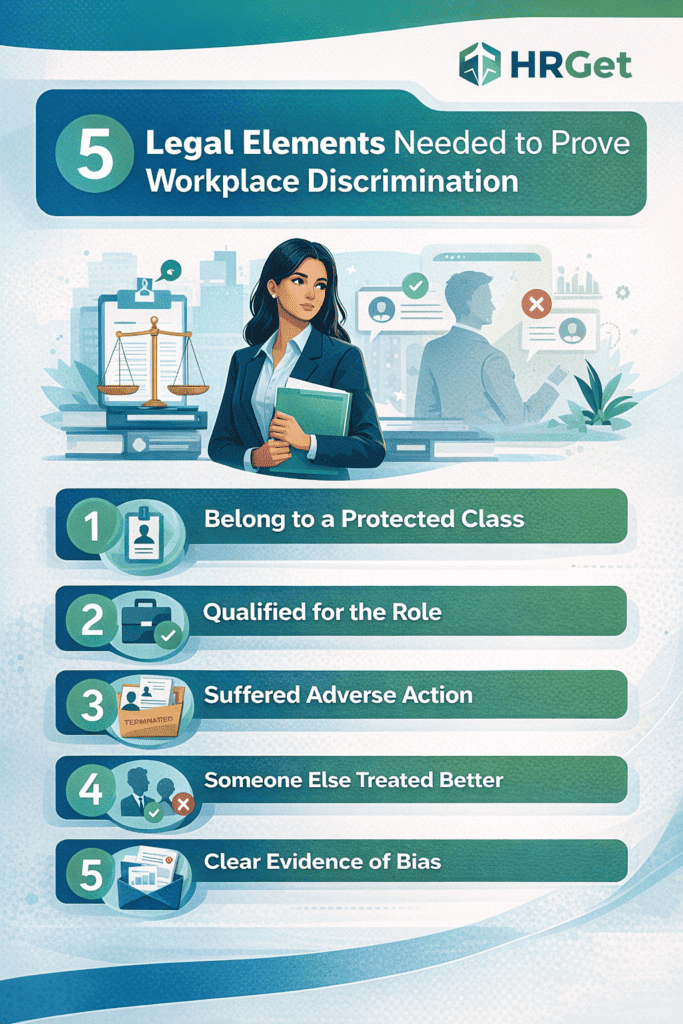
The 5 Legal Elements You Must Prove
This is where most discrimination claims actually fail. The emotional experience of being discriminated against is real. But courts operate on evidence, not feelings — and the burden of proof sits squarely on you as the claimant.
Here’s what you typically need to establish:
1
You belong to a protected class
You are female, over 40, a racial minority, disabled, LGBTQ+, or otherwise protected under applicable law. This is usually the easy part.
2
You were qualified for the role or opportunity
You met the stated requirements — you had the experience, qualifications, and performance record for the promotion, position, or benefit that was denied. If genuine performance issues are documented, this element gets complicated fast.
3
You suffered an adverse employment action
This means something concrete happened — you were fired, demoted, denied promotion, paid less, or subjected to a hostile work environment severe enough to affect your ability to work. Vague “bad treatment” typically doesn’t meet this threshold.
4
Someone outside your protected class was treated more favorably
A comparator — ideally someone similarly situated — received the opportunity you were denied. This is often the linchpin of a disparate treatment claim. Courts look for apples-to-apples comparisons.
5
There is evidence of discriminatory intent or impact
This is the hardest element. It can be direct (a manager’s comment, an email, a recorded statement) or circumstantial (patterns of behaviour, statistical disparities in promotion rates, suspicious timing of a termination). Without this, you don’t have a case — even if discrimination genuinely occurred.
🔍 Insider View:
Employers rarely put discrimination in writing anymore. Most experienced HR teams are trained to document performance-based rationales for every significant employment decision — even when bias is driving the actual choice. This is called “pretext,” and your job is to demonstrate that the stated reason doesn’t hold up. A pattern of decisions across your protected group is often more powerful evidence than any single incident.
Real Scenario: What a Strong Discrimination Case Looks Like
📋 Real Scenario:
The situation: Priya, a Senior Financial Analyst with 6 years at a London-based investment firm, applies for a newly created Associate Director role. She has consistently exceeded her performance targets. The role goes to a male colleague with 3 fewer years of experience and lower performance ratings.
When she asks for feedback, her manager says: “This role needs someone who can really assert themselves in client meetings.”
What makes this case strong:
- HR records show zero women promoted to Director level in 4 years, despite women comprising 40% of analyst-level staff
- The hiring manager’s “assertiveness” comment has a documented history in UK case law as a gender-coded qualifier
- The successful candidate’s qualifications are objectively weaker by the firm’s own stated criteria
- Priya retained copies of her performance reviews, the internal job posting requirements, and the email from her manager
Outcome: She files an Employment Tribunal claim within 3 months, contacts ACAS, and ultimately reaches a confidential settlement for £62,000 — without a full trial.
Notice what made Priya’s case work: it wasn’t the emotional experience of feeling discriminated against — it was the paper trail, the statistical pattern, and the documented comparator. She’d been quietly collecting evidence for months before taking action.
Step-by-Step: How to File a Discrimination Claim
The process varies by country, but the underlying logic is the same: exhaust internal remedies first, then escalate to government bodies, then court. Here’s how it plays out in practice.
1
Start documenting immediately — before you do anything else
Dates, times, what was said, who was present, what action was taken. Save every relevant email to a personal account. Print performance reviews. Screenshot any relevant internal communications if your policies permit it. Your memory alone won’t be enough — courts want contemporaneous records.
2
Raise an internal complaint through HR or formal grievance process
This feels counterintuitive — reporting to the company that harmed you. But it serves a critical legal function: it shows you gave the employer an opportunity to remedy the situation, and it creates an official record. If HR buries it, that itself becomes relevant evidence.
3
File with the relevant government agency — and watch the clock
US: EEOC charge within 180–300 days. UK: ACAS early conciliation, then Employment Tribunal within 3 months. UAE: MOHRE complaint within 1 year. India: Internal Complaints Committee (for harassment under POSH) within 3 months. These are not soft deadlines.
4
Get legal counsel early — not after you’ve made your first mistake
An employment solicitor or attorney will assess your evidence objectively, tell you if your case is worth pursuing, and protect you from strategic errors (like sending an emotional email to your manager that later gets submitted as an exhibit). Many employment lawyers work on contingency for strong cases.
5
Receive your “Right to Sue” letter and decide: court or settlement?
In the US, once the EEOC issues this letter, you have 90 days. In the UK, if ACAS conciliation fails, your Tribunal claim proceeds. At this stage, your lawyer should advise whether to negotiate a settlement or proceed to a full hearing. Most cases — roughly 70–80% — settle before trial.
Compensation: What Can You Actually Win?
People often come into discrimination cases with either wildly inflated expectations or no idea what they can claim. Let me be clear about what the realistic range looks like.
| Type of Compensation | What It Covers | Notes |
|---|---|---|
| Back Pay | Lost wages from the discriminatory act to resolution | Offset by any income earned during this period |
| Front Pay | Projected future income loss if reinstatement isn’t feasible | Calculated on career trajectory and earning history |
| Compensatory Damages | Emotional distress, reputational harm, career disruption | Capped at $300K for large employers under Title VII (US) |
| Punitive Damages | Awarded when employer acted with malice or reckless indifference | Not available in UK Employment Tribunals; available in US federal court |
| Legal Fees | Attorney costs if you prevail | Often negotiated as part of settlement |
| Reinstatement | Return to your job or equivalent position | Rarely practical; most prefer financial settlement |
Reality check: the median EEOC settlement in the US hovers between $40,000 and $75,000. UK Employment Tribunal awards for discrimination average around £15,000–£30,000, though cases involving senior executives or prolonged campaigns of harassment can reach six figures. High-profile cases that reach trial can result in multi-million awards — but those are the outliers, not the rule.
Court is a last resort for a reason. Litigation takes 18 months to 3 years, costs money even on contingency (disbursements, expert fees), and causes genuine psychological stress. A well-negotiated settlement 6 months in is often the superior outcome — financially and personally.
The goal isn’t to “win the case.” The goal is to maximize your outcome with the minimum viable risk. Your lawyer should be optimizing for this, not for a dramatic courtroom victory.
Smart Strategy Before You Take Legal Action
Here’s what experienced professionals — the ones who actually get outcomes — do differently from everyone else.
They build the case quietly before announcing it. The worst thing you can do is tell your manager, your team, or your HR department that you’re “thinking about legal action” before you have your documentation in order. The moment you flag intent, employers begin building their defensive paper trail. Don’t give them the head start.
They stay professionally impeccable throughout. This is hard when you’re being treated unfairly, but it’s essential. Every performance issue documented against you after you raise a complaint becomes part of the employer’s defense. Be on time. Hit your targets. Respond to emails promptly. Your professional conduct becomes evidence — in your favour or against you.
They are strategic about timing their exit. Quitting too early — especially before filing an internal grievance — weakens your constructive dismissal or wrongful termination claim significantly. In the UK, you generally need to resign in response to a fundamental breach of contract to establish constructive unfair dismissal. Leaving casually months before making that connection muddies your case considerably.
They get independent legal advice before engaging the employer’s HR process. HR serves the company, not you. They may be professional and well-intentioned, but their instinct is to protect the organisation. Knowing your rights before you step into that meeting changes the dynamic entirely.
Common Mistakes That Kill Discrimination Cases
I’ve watched winnable cases collapse because of avoidable errors. Here are the most common ones:
Filing too late. Deadlines under discrimination law are jurisdictional — courts typically cannot extend them regardless of circumstances. In the US, 300 days from the discriminatory act is the outer limit in most states. In the UK, 3 months from the act is strict. A single missed deadline ends your case before it begins.
Having no documentation beyond personal recollection. “I felt discriminated against” is not evidence. Courts want contemporaneous records — documents created at the time, not reconstructed later. Start your evidence file on day one.
Sending emotional messages or making verbal threats of legal action. Every email you write can be submitted as evidence. An angry Slack message to a colleague saying “these people are racist and I’m going to destroy them” doesn’t help your credibility before a Tribunal.
Quitting without a plan. If you resign without a documented resignation in response to a specific breach, you lose significant legal ground on constructive dismissal claims. And you lose leverage in any settlement negotiation.
Confusing unfairness with illegality. Your manager can be a bad manager, a petty person, or genuinely incompetent without any of that being illegal. The protected characteristic link must be present. Without it, you have a grievance — not a legal claim.
When You Should Not Sue
This is the section most articles skip — and it’s the one that could save you significant time, money, and emotional energy.
Be honest with yourself. A discrimination claim is probably not worth pursuing if:
- You have no documentary evidence and no witnesses willing to testify
- Your employer has a documented trail of genuine performance concerns predating the discriminatory act
- The adverse action isn’t clearly connected to a protected characteristic
- You missed the filing deadline
- The financial upside doesn’t justify the legal costs and emotional toll
- You want to stay in the same industry and the reputational exposure of litigation isn’t worth it to you
In these situations, a better strategy is often to negotiate a clean exit — a severance package, a mutual separation agreement with a neutral reference, and a non-disparagement clause. You walk away with something, preserve your professional reputation, and avoid a protracted battle you’re unlikely to win.
🔍 Insider View:
Most employment lawyers who work exclusively on contingency (no win, no fee) will decline weak cases. If you consult three reputable employment attorneys and all three pass on your case, that’s useful information. It doesn’t mean you weren’t discriminated against — it means the case isn’t winnable enough to justify the investment. Listen to that signal.
Frequently Asked Questions
The Bottom Line on Suing for Discrimination
You can sue your employer for discrimination — and in 2026, the legal frameworks across the US, UK, UAE, and India are more robust than they’ve ever been. But the right to sue and the ability to win are two very different things.
Most people who lose discrimination claims don’t lose because they were wrong. They lose because they acted emotionally instead of strategically: they filed too late, they had no documentation, or they made statements that undermined their own credibility. The ones who win — or who extract meaningful settlements — are the ones who built their case quietly, stayed professionally composed, and understood the process before engaging it.
If you believe you’ve experienced workplace discrimination, start documenting today. Get legal advice before raising your first formal complaint. And go in knowing that the goal isn’t a courtroom win — it’s the best possible outcome for you, with the least possible cost.
Understand Your Full Workplace Rights
Discrimination claims are one part of a broader picture. Learn how wrongful termination law intersects with discrimination protections — and what options you have if you’ve already been let go.

Victoria Hale | Former Partner, Freshfields Bruckhaus Deringer | Employment Law Specialist | 20+ Years Advising Multinationals & Executives
Author: Victoria Hale spent over two decades as an Employment Law Partner at Freshfields Bruckhaus Deringer — one of the world’s most prestigious Magic Circle law firms — advising multinational corporations and senior executives on some of the most complex employment disputes in the US and Europe. Her practice covered wrongful termination litigation, executive exits, non-compete enforcement, FLSA compliance, and cross-border workforce restructuring under EU labour law. Now based between London and New York, Victoria writes for HRGet.com to close the gap between legal theory and how employment law actually plays out in the real world — for employees who need to know their rights before it’s too late.

Pingback: Workplace Discrimination Complaint Process: Your 2026 Guide – California Employment Lawyer | Serving Federal Employees
Pingback: Workplace Discrimination Complaint Process: Your 2026 Guide – California Employment Lawyer | Serving Federal Employees