By Daniel Carter — Director of Compensation & Benefits | Ex-Mercer, PwC | New York / London | 15+ Years
Last updated: 2026
Here’s something I’ve seen too many talented professionals get wrong: they look up “data scientist salary,” find a range like $90K–$180K, and think they have a clear picture. They don’t. That range is nearly useless without understanding why the gap exists — and how to land on the right side of it.
The data scientist salary in the US in 2026 is not a single number. It’s a spectrum shaped by your experience level, the type of company you work for, the city you’re based in, and — critically — how well you can articulate your business impact. I’ve spent 15 years advising on compensation at firms where we routinely set data science pay bands across multiple tiers. The patterns are clear. What most people miss is equally clear.
This guide breaks down the real numbers by experience, employer type, and location — and tells you exactly what drives the difference between a $100K offer and a $250K one.
What you’ll walk away with: Real salary ranges at every career stage, a company-type breakdown, city-by-city numbers, the hidden drivers of high pay, and a practical strategy to increase your salary faster than the average data scientist.
Average Data Scientist Salary in the US (2026)
Let’s cut to it. The national median base salary for a data scientist in the US sits around $120K–$135K in 2026. But “median” masks the real story — because total compensation, once you factor in equity and bonus, tells a completely different tale depending on where you sit in your career.
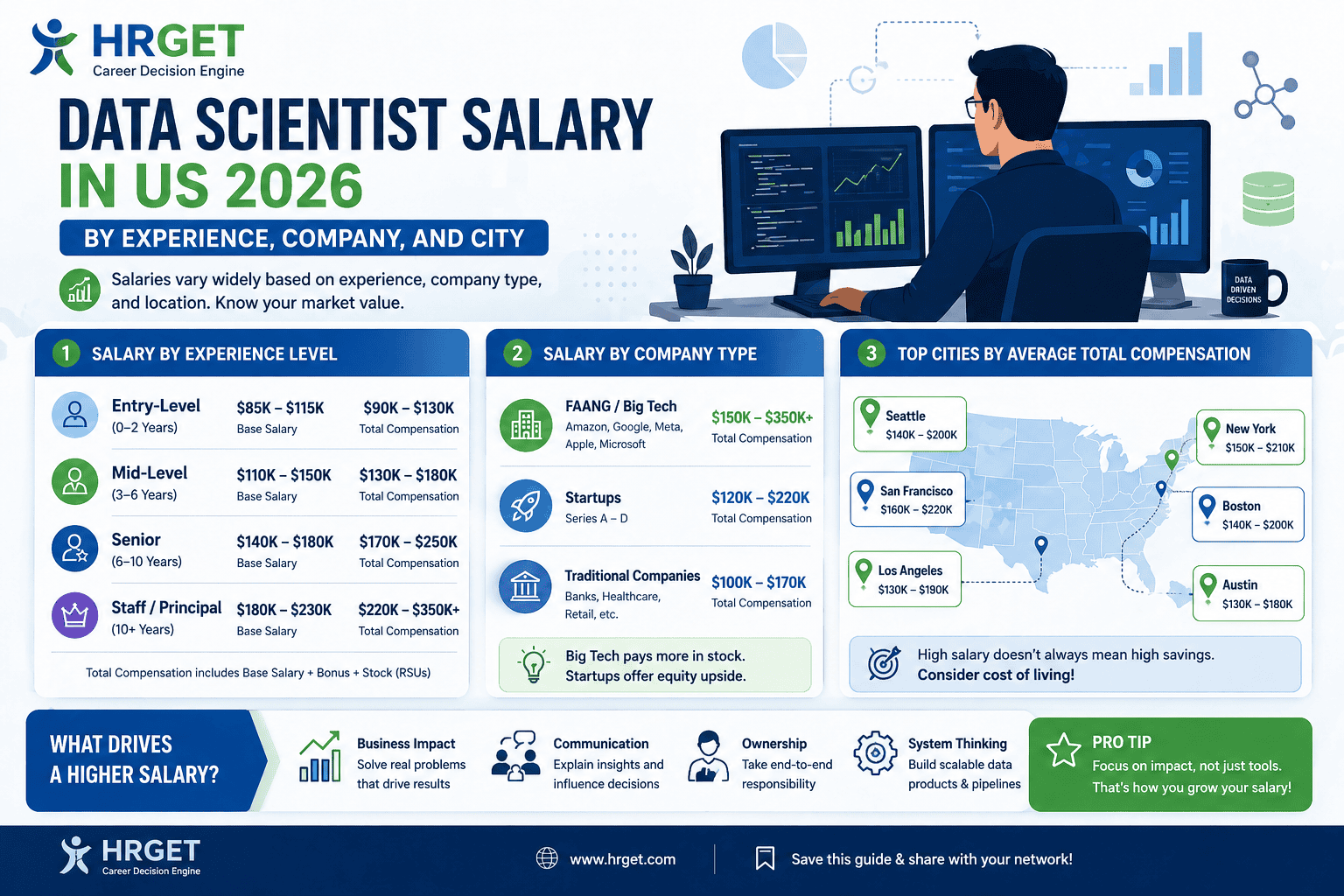
The table below reflects realistic ranges drawn from industry compensation surveys, publicly shared Levels.fyi data, and Bureau of Labor Statistics occupational data — not inflated job posting figures:
| Career Level | Base Salary | Total Compensation |
|---|---|---|
| Entry-Level (0–2 yrs) | $85K – $115K | $90K – $130K |
| Mid-Level (3–6 yrs) | $110K – $150K | $130K – $180K |
| Senior (6–10 yrs) | $140K – $180K | $170K – $250K |
| Staff / Principal (10+ yrs) | $180K – $230K | $220K – $350K+ |
Notice the total comp column. Most people negotiate only the base. That’s the single most expensive mistake a data scientist can make. RSUs at a company like Google or Meta can easily add $60K–$120K annually on top of base — and that equity vest compounds if the stock performs.
Pro Tip: When evaluating any offer, build a simple four-year model: (Base × 4) + (Annual Bonus × 4) + (Total RSU Grant). That single calculation changes how you evaluate every offer you’ll ever receive.
Data Scientist Salary by Experience Level
Experience doesn’t scale linearly in data science — and that’s both a warning and an opportunity. Here’s what each stage actually looks like on the ground.
Entry-Level: 0–2 Years ($85K–$115K Base)
Typical titles: Junior Data Scientist, Data Analyst with ML exposure, ML Analyst. The “entry-level” bar has risen sharply since 2023. Expecting to walk in fresh from a bootcamp? It won’t work at most companies anymore. Recruiters I’ve spoken to consistently say they want to see applied project work — a Kaggle competition placement, a deployed model, a GitHub repo that shows end-to-end thinking.
The core skills that move the needle at entry level: SQL fluency, Python for data manipulation and modeling, and the ability to communicate a finding clearly to a non-technical audience. You’re not expected to build production-grade ML systems — but you need to demonstrate you can think beyond Jupyter notebooks.
Mid-Level: 3–6 Years ($110K–$150K Base)
This is where the biggest salary growth happens — and also where most professionals stagnate for years without realizing it. I’ve seen data scientists with six years of experience earning $115K because they stayed “tool-focused.” They got better at Python, added more models to their repertoire, took courses. None of that moved their salary.
The ones who cleared $160K at this stage all had one thing in common: they started owning business problems, not just technical tasks. They sat in stakeholder meetings. They defined success metrics before building anything. They became the person leadership called when they needed clarity — not just a model.
Senior: 6–10 Years ($140K–$180K Base, $200K+ Total Comp)
At this level, the salary gap between a weak senior and a strong senior is enormous — we’re talking $150K vs $250K+ in total comp. What separates them isn’t technical depth. It’s scope. A strong senior data scientist owns projects end-to-end, mentors junior team members, and actively shapes the product or data strategy. A weak senior is still waiting to be told what to build.
Staff / Principal: 10+ Years ($220K–$350K+ Total Comp)
This is elite territory — and it’s genuinely rare. Staff and Principal Data Scientists at top-tier companies aren’t just technical experts. They’re organizational multipliers. They define the data strategy for an entire product line, influence hiring and tooling decisions, and can speak fluently at the C-suite level. If you’re at this stage, base salary is almost secondary — the RSU package and performance bonuses are where the real wealth is built.
Data Scientist Salary by Company Type (FAANG vs Startup vs Traditional)
Company type is arguably the single biggest lever on your total compensation. Same experience, same skills — but the employer can swing your annual earnings by $80K or more. Here’s the breakdown:
FAANG and Big Tech (Amazon, Google, Meta, Apple, Microsoft)
| Level | Total Compensation |
|---|---|
| Entry | $120K – $155K |
| Mid | $155K – $225K |
| Senior | $225K – $360K+ |
FAANG pays what it pays because the stakes are high. Your models touch hundreds of millions of users. The structured career ladders mean promotions are well-defined, and the stock compensation is substantial — particularly if you join before a major run-up. The trade-off is real though: expectations are extremely high, scope can be narrower than you’d expect at a smaller company, and the hiring bar is brutal to clear.
High-Growth Startups (Series A–D)
| Level | Total Compensation |
|---|---|
| Entry | $90K – $120K |
| Mid | $120K – $175K |
| Senior | $155K – $225K |
Startups pay lower base but offer equity that can be worth nothing or life-changing depending on the exit. The real upside of a startup role is breadth — you’ll likely own the entire data science function, interface with the founding team directly, and build skills that take years to accumulate at a large company. If you’re at a Series B or C with genuine product-market fit, the equity upside is real.
Traditional Enterprises (Banks, Healthcare, Retail)
| Level | Total Compensation |
|---|---|
| Entry | $80K – $110K |
| Mid | $100K – $145K |
| Senior | $130K – $170K |
The ceiling is real. Traditional enterprises offer more stability and often excellent benefits, but the pay cap is meaningful — and the promotion clock tends to be slower. That said, if you’re in financial services at a JP Morgan or Goldman Sachs and working on quant/risk data science, the numbers can look more like big tech. Industry context matters enormously within this category.
Data Scientist Salary by City — and What the Numbers Don’t Tell You
Location still matters significantly for data scientist compensation in 2026, despite the normalization of remote work. Here’s the city-by-city breakdown — with the reality check most salary guides skip:
| City | Avg Base Salary | Reality Check |
|---|---|---|
| San Francisco / Bay Area | $160K – $225K | Highest pay, highest cost — a $200K salary feels like $130K elsewhere |
| New York City | $150K – $215K | Finance and fintech demand is strong; state income tax is significant |
| Seattle | $140K – $205K | No state income tax; Amazon and Microsoft anchor the market |
| Austin | $130K – $185K | Best cost-vs-salary ratio; growing tech scene with no state income tax |
| Chicago | $115K – $160K | Lower pay but significantly lower cost of living than coastal cities |
| Remote (US-Based) | $110K – $175K | Pay varies widely — many companies now geo-adjust compensation |
On remote roles — this is worth a direct answer because I get this question constantly. Yes, remote data science roles are well-established in 2026. But the pay-location relationship has shifted. Many companies (Google, Stripe, Airbnb among them) now use location-adjusted pay bands. If you’re working remotely from Boise, Idaho, your salary will likely be benchmarked to Boise, not San Francisco — even if your manager sits in the Bay Area.
The exception: if you negotiated a remote role when the company was fully remote and never agreed to geographic pay adjustments, you may be grandfathered at the higher rate. Worth understanding before you relocate and trigger a pay review.
Real Scenario: Two Offers, One $300K Decision
The Situation
Priya is a mid-level data scientist — 4 years of experience, strong Python and SQL, solid track record building churn prediction models. She receives two offers simultaneously.
Offer A — Regional Bank: $132K base, 8% annual bonus potential, no equity. Total year-one compensation: ~$143K.
Offer B — Growth-stage Fintech (Series C): $150K base, 10% bonus target, $200K in stock options vesting over 4 years (~$50K/year). Total year-one compensation: ~$215K.
The 4-year gap: If Offer B’s equity delivers even 50% of its projected value, the total compensation difference over four years exceeds $280K. That’s not a career choice — it’s a financial inflection point.
This is exactly why company selection matters as much as salary negotiation skill. Priya chose Offer B — not just for the numbers, but because the fintech company was data-driven in a way the bank wasn’t. Her models would actually influence product decisions, not sit in a reporting dashboard nobody reads.
Choosing where you work determines your ceiling. No amount of negotiation at the wrong company will get you to $250K total comp if their pay bands cap out at $160K.
What Actually Drives a High Data Scientist Salary (Not What You Think)
The conventional wisdom — “learn more tools, get paid more” — is dangerously incomplete. I’ve reviewed hundreds of compensation benchmark submissions and interviewed data scientists across experience levels. The pattern is consistent: technical skill level alone explains very little of the salary gap at the senior level.
Here’s what actually moves compensation:
1. Measurable Business Impact — Can you point to a model that increased conversion by 12% or reduced cost by $2M? That’s what gets you to the top of the salary band. “I built a recommendation system” is table stakes. “My recommendation system drove $4.7M in incremental revenue in Q3” is a compensation conversation starter.
2. Communication with Non-Technical Stakeholders — The highest-paid data scientists I know can translate complex model outputs into a three-sentence insight a VP can act on in a board meeting. This skill is rarer than it should be, and companies pay for it.
3. Ownership Mindset — There’s a meaningful difference between someone who waits for a Jira ticket and someone who proactively identifies where data can solve a business problem. The latter commands $30K–$50K more at otherwise identical experience levels.
4. Systems Thinking — Moving from notebook to production is a skill many data scientists still don’t fully own. Understanding MLOps basics, building reproducible pipelines, and thinking in systems (not just models) separates the top quartile earners from the middle.
Smart Strategy to Increase Your Data Scientist Salary Fast
You can shortcut years of slow wage growth with the right moves. Here’s the playbook I’d give to any data scientist who wants to be meaningfully better compensated within 12–18 months:
Stop being just a model builder. The next time you’re given a data task, ask “what decision will this enable?” before you write a single line of code. Then make sure your final output answers that decision question directly. Do this consistently for six months and watch how stakeholder perception of you shifts.
Target companies deliberately. Make a list of companies known for data-mature cultures — think Stripe, Airbnb, DoorDash, Duolingo, Figma, or any company where data science is a core revenue function, not a support function. Being at the right company is worth $30K–$80K per year in differential pay.
Build a salary narrative. Don’t say “I have five years of experience in Python and ML.” Say “I built a dynamic pricing model at my last company that reduced inventory waste by 22% and contributed $1.8M to the bottom line.” Quantified impact narratives make negotiation nearly effortless — the number justifies itself.
Use job switches strategically. This is uncomfortable but true: the single fastest way to increase your salary as a data scientist is to change employers. Internal raises in data science roles average 5–10%. An external move typically delivers 20–40%. If you’ve been in the same role for more than two years and haven’t received a meaningful promotion, you’re likely losing ground relative to market.
The Insider View: From an HR and compensation standpoint, we don’t approve salary increases above band without a strong business case tied to the employee. The most effective request I’ve seen? A one-page doc showing the employee’s model impact, external market benchmarks from Levels.fyi or Glassdoor, and two competing offer letters. That combination almost always wins.
Common Mistakes That Cost Data Scientists $50K or More
I see these patterns repeatedly — smart people who leave significant money on the table simply because nobody told them the rules of the compensation game.
Accepting the first offer without negotiating. Most initial offers in data science are 8–15% below the approved budget for the role. The hiring manager expects a counter. Staying quiet costs you $10K–$25K per year from day one — and since future raises are pegged to your base, the lifetime cost compounds dramatically.
Ignoring equity in the negotiation. If a company offers RSUs and you only negotiate base, you’re leaving the biggest lever untouched. RSU grants are often more negotiable than base at tech companies, especially for senior hires. Always ask for the grant size to be increased — the worst they can say is no.
Staying in the same role too long without visible promotion criteria. Two to three years in a role without a clear promotion path is usually a sign the opportunity isn’t there — not that you need to work harder. Know your company’s leveling criteria and explicitly ask your manager what “promotion-ready” looks like at your level.
Equating technical depth with compensation leverage. Being a world-class PyTorch practitioner won’t guarantee you a $200K salary. Showing you used PyTorch to solve a $5M business problem will. The shift from “I know tools” to “I create outcomes” is the most important transition in a data scientist’s career arc.
Is Data Science Still Worth It in 2026? An Honest Answer
Yes — but with a meaningful asterisk. The field has matured. The “data scientist” label covers a wider range of actual jobs than it did five years ago. Entry-level roles are more competitive, and AI tooling has automated a significant portion of routine data analysis work. The professionals who are thriving are those who adapted toward one of three directions: ML engineering and production systems, domain-specific data science (healthcare, finance, logistics), or strategy-adjacent roles where data fluency drives business decisions.
What still works in 2026: strong statistical fundamentals, genuine business acumen, the ability to work cross-functionally, and comfort with LLM-augmented workflows. The data scientists who positioned themselves as “AI-capable” rather than “replaced by AI” are doing exceptionally well.
For mid-to-senior practitioners who evolve: data science remains one of the highest-paying technical careers available — and the total comp ceiling is genuinely extraordinary compared to most professions.
FAQ: Data Scientist Salary in the US (2026)
What is the starting salary for a data scientist in the US in 2026?
Entry-level data scientists in the US typically earn between $85K and $115K in base salary, depending on location, company type, and how well they can demonstrate applied skills. Total compensation including bonus can push this to $90K–$130K at competitive employers. Big tech entry-level roles often start above $120K total comp.
Can data scientists earn $200K or more in the US?
Yes — but typically at senior level or above at tech-first companies. Mid-level data scientists at FAANG companies regularly hit $150K–$225K in total compensation once RSUs are included. $200K+ is achievable at mid-level if you’re at a company like Google, Meta, or a well-funded fintech with meaningful equity.
Which US city pays data scientists the highest salary?
San Francisco and the broader Bay Area pay the highest nominal salaries — $160K–$225K average base — but also carry the highest cost of living. Seattle offers nearly comparable pay with no state income tax, making it arguably the best net-pay market for data scientists. Austin is the best cost-adjusted option for those who want strong salaries with dramatically lower living costs.
Are remote data science jobs still well-paying in 2026?
Remote roles are common and pay well — typically $110K–$175K depending on company and seniority. However, geographic pay adjustment is now the norm at most major tech employers. If you’re remote and your company geo-adjusts, your compensation will reflect your location, not a major metro. Negotiate this explicitly before accepting any remote offer.
What skills increase a data scientist’s salary the most in 2026?
The highest salary multipliers aren’t purely technical. Business impact quantification, executive communication, and ownership of end-to-end ML pipelines are the three most financially valuable skills at mid-to-senior levels. On the technical side: MLOps proficiency, LLM fine-tuning/deployment, and production engineering skills command significant premiums in 2026.
Is data science oversaturated in 2026?
Entry-level is genuinely competitive — the number of graduates and bootcamp completers applying for junior roles has outpaced hiring. Mid and senior roles, however, remain undersupplied with truly strong candidates. The gap between what companies say they want and what they can actually hire is largest at the senior level, which is good news for experienced practitioners who invest in business and communication skills.
How quickly can a data scientist double their salary?
With deliberate moves — targeting the right companies, negotiating aggressively, and transitioning from tool-user to business-impact driver — many data scientists double their compensation within 3–5 years. The biggest single jump typically comes from a well-timed job switch combined with a move to a higher-paying employer type (for example, from a traditional company to a growth-stage tech company).
Your Data Scientist Salary Is a Decision, Not a Discovery
Here’s the takeaway I want to leave you with: most data scientists treat their salary as something that happens to them — a number HR offers, that they accept, and then wonder about for the next two years. The highest-earning data scientists I’ve worked with treat it as something they engineer.
The data scientist salary range in the US in 2026 is genuinely wide — $85K to $350K+. The distance between those numbers isn’t luck, credentials, or even technical skill. It’s the combination of choosing the right employer, building a quantified impact narrative, and negotiating with the confidence of someone who knows their market value precisely.
Start with the number you want. Work backward to the company type, city, and level that gets you there. Then negotiate every component of the package — not just base.
Once you have an offer, knowing how to negotiate it effectively is the next step. Read: How to Negotiate Your Package Like a Senior Hire for tactics that work across both salary and severance situations.
About the Author: Daniel Carter is a Director of Compensation & Benefits with over 15 years of experience advising Fortune 500 companies and private equity-backed firms on executive and technical compensation strategy. He has previously worked with clients at Mercer and PwC and consults from New York and London. His work spans total rewards benchmarking, salary band design, and equity compensation architecture across the US, UK, and Europe.

Eleanor Whitmore | Former Partner, Mercer | Advisor, World Economic Forum | 20+ Years in Global Compensation
Author bio: Eleanor Whitmore has spent over two decades shaping how the world’s leading organisations pay, retain, and reward talent. As a former Partner at Mercer and an advisor to World Economic Forum working groups on the Future of Work, she has designed compensation frameworks for Fortune 500 companies across the US, UK, Europe, and emerging markets. Based between London and New York, Eleanor writes for HRGet.com to translate boardroom-level pay strategy into actionable guidance for working professionals navigating real compensation decisions.