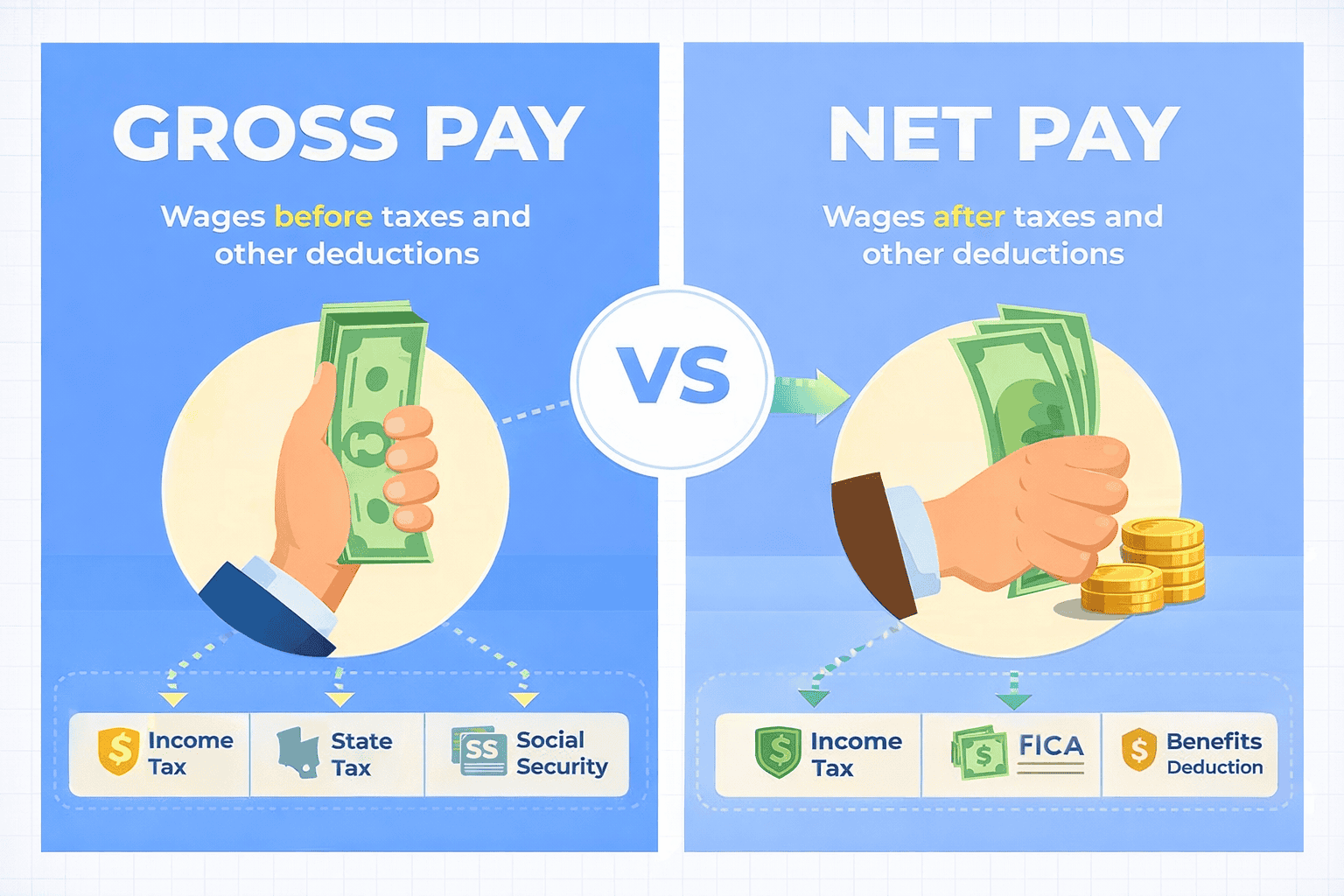

Most people get this wrong. They look at the salary number on the offer letter — and stop there.
Here’s what I’ve seen after 15 years in compensation consulting, including time advising Mercer clients across both coasts: a $100K salary in San Francisco vs $70K in Austin is one of the most deceptive salary comparisons in the US job market. On paper, SF wins by $30K. In practice, the person in Austin is often saving twice as much money every single year.
If you’re staring at two offers right now — or weighing a relocation — this breakdown will show you the real numbers. Not headlines. Not rough estimates. The kind of math that actually determines your financial life five years from now.
By the end, you’ll know exactly which city wins for your situation — and under what conditions the math flips.
The Real Question You Should Be Asking
Stop asking: “Which salary is higher?”
Ask this instead: “Where will I save more money and build wealth faster?”
Because salary is a vanity metric. What you keep — after federal taxes, state taxes, FICA, rent, food, and transport — is what actually moves your net worth. I’ve worked with compensation data for Fortune 500 companies and individual professionals alike, and the pattern is consistent: people in lower-cost cities earning 20–30% less often accumulate significantly more wealth by their mid-30s.
The $100K vs $70K comparison is the perfect case study. The gap looks like $30K. It’s actually much smaller. And for many people, it reverses entirely.
Here’s the math that proves it.
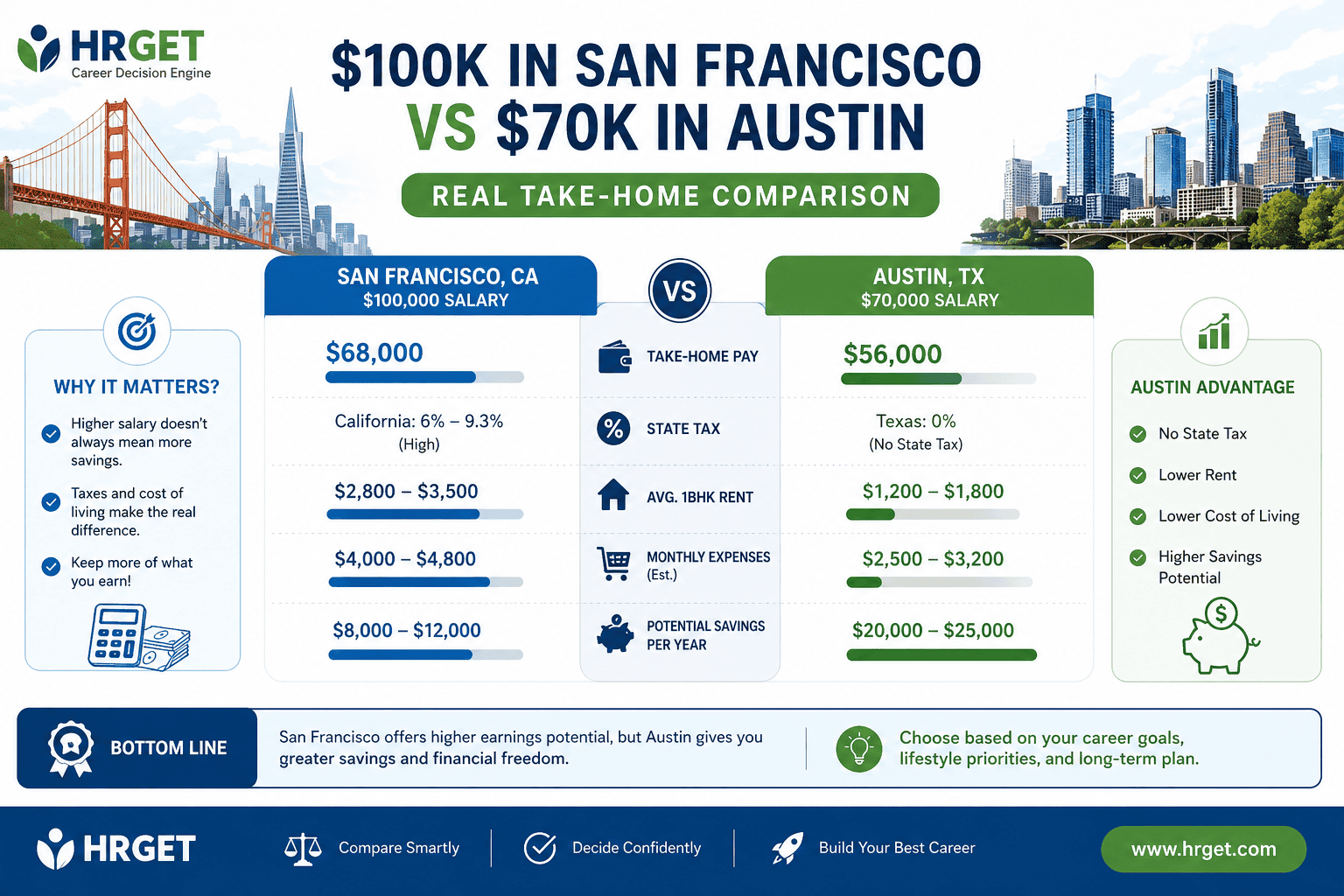
Quick Snapshot: SF vs Austin Salary Reality
Before we get into the detailed breakdown, here’s the 30-second summary of where the two cities stand:
| Factor | San Francisco ($100K) | Austin ($70K) |
|---|---|---|
| State Income Tax | High (California, up to 9.3%) | Zero (Texas) |
| Average 1BR Rent | $2,800 – $3,500/mo | $1,200 – $1,800/mo |
| Overall Cost of Living | ~80% above US average | ~5–10% above US average |
| Tech Job Density | Top-tier (FAANG HQs) | Fast-growing (Tesla, Oracle, Dell) |
| Annual Savings Potential | Low–Medium (~$8K–$12K) | Medium–High (~$20K–$25K) |
The summary: higher gross salary does not equal better financial outcome. Let’s prove it with actual numbers.
Take-Home Salary Comparison After Taxes
This is where the gap starts shrinking fast.
San Francisco — $100K gross (single filer, 2026 estimates):
- Federal income tax: ~$15,000–$18,000
- California state income tax: ~$6,000–$8,000 (marginal rate hits 9.3% at $66K+)
- Social Security + Medicare (FICA): ~$7,650
- SDI (State Disability Insurance): ~$900
Estimated SF take-home: ~$67,000–$70,000/year ($5,580–$5,830/month)
Austin — $70K gross (single filer, 2026 estimates):
- Federal income tax: ~$8,000–$10,000
- Texas state income tax: $0
- Social Security + Medicare (FICA): ~$5,355
Estimated Austin take-home: ~$55,000–$57,000/year ($4,580–$4,750/month)
So the take-home difference is roughly $12,000–$14,000 per year. SF person takes home about $1,100 more per month.
Sounds decent. Now watch what happens when you subtract rent.
Cost of Living Breakdown: Where SF Bleeds You Dry
1. Rent — The Single Biggest Variable
This is not subtle. A one-bedroom apartment in San Francisco averages $2,800–$3,500/month in 2026. Even in slightly more affordable SF neighborhoods like the Outer Sunset or Excelsior, you’re looking at $2,600+ for a decent place. The Mission or SOMA? Closer to $3,200–$3,800.
Austin’s 1BR average runs $1,200–$1,800/month. Even post-pandemic price increases, it’s still a fraction of SF. Neighborhoods like Mueller, East Austin, or North Loop offer solid apartments in that range.
| City | 1BR Monthly Rent | Annual Rent Cost |
|---|---|---|
| San Francisco | $2,800–$3,500 | $33,600–$42,000 |
| Austin | $1,200–$1,800 | $14,400–$21,600 |
The rent gap alone is $15,000–$20,000 per year. That’s already more than the entire take-home advantage SF had over Austin.
2. Food, Transport, and Daily Life
Groceries run 30–50% higher in SF than Austin. Eating out at a mid-range SF restaurant will cost you $20–28 for a basic lunch; Austin is $12–18 for the same quality meal. Even Uber fares are higher due to the city’s geography and traffic.
If you’re commuting in SF, BART or Muni adds another $100–$150/month, and parking (if you have a car) can run $200–$400/month just for a garage spot.
A realistic extra daily-life premium in SF: $5,000–$8,000/year compared to Austin.
3. The Full Annual Cost Picture
| Category | San Francisco | Austin |
|---|---|---|
| Take-Home Pay | ~$68,000 | ~$56,000 |
| Annual Rent | ~$37,200 | ~$18,000 |
| Other Expenses | ~$18,000–$22,000 | ~$13,000–$16,000 |
| Estimated Annual Savings | ~$8,000–$12,000 | ~$20,000–$25,000 |
Austin doesn’t just win. It wins by more than 2x on annual savings, despite paying $30K less in gross salary. That’s the number that should stop you in your tracks.
Real Scenario: Two Engineers, Same Career Stage
I’ve had this conversation more times than I can count — someone calls me after two years in SF saying they feel financially stuck despite a “great” salary. Let me make it concrete.
Priya (San Francisco) — Software Engineer, 3 years experience
- Gross: $100,000
- Take-home: ~$68,000
- Shared 2BR apartment (her share): $1,800/month
- Food, transport, misc: ~$1,400/month
- Monthly savings: ~$1,000 | Annual savings: ~$12,000
Marcus (Austin) — Software Engineer, 3 years experience
- Gross: $70,000
- Take-home: ~$56,000
- Own 1BR apartment: $1,500/month
- Food, transport, misc: ~$1,100/month
- Monthly savings: ~$1,750 | Annual savings: ~$21,000
After 3 years:
- Priya’s savings: ~$36,000
- Marcus’s savings: ~$63,000 — plus investment compounding
Marcus has nearly twice the financial cushion — while earning $30K less. Priya has the fancier city and the higher-sounding title. Marcus has options.
Hidden Costs Nobody Talks About in the SF vs Austin Debate
The numbers above are the obvious ones. Here are the ones that don’t show up in calculators but absolutely show up in your life.
Lifestyle Inflation in High-Cost Cities
San Francisco has a particular social dynamic: when everyone around you is spending $18 on a cocktail and $200 on a weekend trip to Tahoe, the pressure to keep up is real. I’ve seen compensation-savvy professionals lose $10,000–$15,000/year to social lifestyle creep they didn’t budget for. In Austin, the culture is more financially mixed — you’re not surrounded exclusively by Big Tech spenders.
The Burnout Tax
SF tech culture is intense. Long hours, hyper-competitive peer groups, and the chronic anxiety of not being able to afford a home creates a stress load that affects health decisions, career risk tolerance, and long-term thinking. When you’re financially stressed despite a six-figure salary, you don’t negotiate for raises as confidently. You don’t leave a bad job as easily. Austin’s lower pressure baseline has real financial value — even if you can’t put a dollar figure on it.
Investment Opportunity Cost
This is the compounding killer. If Marcus invests his extra $9,000/year in a low-cost index fund at a modest 8% average return, over 10 years that differential alone becomes roughly $130,000–$140,000 in additional wealth. The SF earner can’t invest what they don’t have left over. The cost of living isn’t just expensive today — it’s a 10-year tax on your wealth-building capacity.
But here’s where it gets interesting — because SF isn’t wrong for everyone.
Career Growth Factor: Where SF Still Has a Real Edge
I’ll be honest — this section is the counterbalance. San Francisco still wins in one dimension that matters enormously depending on your career stage: salary ceiling and career acceleration.
The Bay Area concentration of Google, Meta, Apple, Salesforce, Stripe, OpenAI, and hundreds of high-growth startups means you’re not competing for $100K roles — you’re one strong performance review away from $150K, $200K, or $300K total compensation once you factor in RSUs and bonuses. That ceiling exists in Austin, but it’s lower and more spread out.
In my experience advising mid-level tech professionals, the SF premium pays off most clearly when:
- You’re in your first 3–5 years of a high-growth tech career and proximity to top companies accelerates your progression
- You’re targeting Staff/Principal Engineer, Director, or VP-level roles where Bay Area comp packages are significantly larger
- Your goal is to build resume credentials at a company whose name opens doors globally (which matters for Indian professionals targeting H-1B sponsorship at brand-name firms, for example)
- You have a concrete 3–5 year exit plan — use SF to scale salary, then relocate
Austin is growing fast. Tesla, Oracle, Dell, Apple (2nd campus), Google, and Amazon have significant presences there now. But the density and depth of opportunity in SF still wins for the highest-ceiling tech trajectories in 2026.
The question isn’t whether SF is better or worse. The question is whether it’s better or worse for you, at your career stage, given your 5-year goal.
Smart Strategy: How to Actually Decide Between These Two Offers
Here’s the framework I walk my clients through. It takes about 20 minutes and saves years of regret.
Step 1: Calculate your actual monthly surplus — not gross salary, not take-home. Your take-home minus realistic rent and living costs. For most people, this exercise alone is clarifying.
Step 2: Decide your 3-year wealth goal. Is it $50K in savings? Down payment for a home? Emergency fund? Then work backwards. Which city gets you there faster?
Step 3: Map your career ceiling. At your current role and industry, what does the ceiling look like in each city? If you’re a mid-career marketing manager, Austin’s ceiling may not be that much lower than SF’s. If you’re targeting FAANG engineering, the gap is real.
Step 4: Apply the remote work test. Can you do this job remotely? If yes — and your company allows it — take the higher-paying offer and live in Austin. That’s the ultimate arbitrage: SF-level income, Austin-level costs. In 2026, more companies allow this than three years ago, but fewer than in 2021. Worth asking directly before you accept.
Step 5: Run a 5-year scenario. Assume you take the SF job. Project your savings at year 1, 3, and 5. Do the same for Austin. If the SF trajectory doesn’t dramatically outpace Austin by year 5 — either through higher savings or dramatically higher salary — Austin wins.
The general rule I’ve seen hold up: if you’re earning under $150K gross in SF, Austin will almost always give you more financial freedom. The SF premium only reliably pays off above $150K, where the salary ceiling effect starts to dominate the cost-of-living drag.
Common Mistakes That Cost People $50K+ Over 5 Years
Mistake 1: Accepting the higher number without running the math. This is the most common one. “I got a $100K offer in SF — that’s great!” Maybe. Or maybe the $70K offer in Austin was worth more. Run the numbers before you celebrate or decline anything.
Mistake 2: Ignoring state tax as a one-time hit. California’s progressive income tax is not a minor inconvenience. At $100K, you’re paying $6,000–$8,000/year in state tax that a Texas resident pays $0. Over 5 years, that’s $30,000–$40,000 in pure state tax savings by being in Austin — not counting compounding on invested savings.
Mistake 3: Planning rent based on “I’ll find a roommate.” Shared living in SF is a financial strategy, not a living upgrade. $1,800/month for a room in a shared apartment is still more than a solo 1BR in many Austin neighborhoods. And roommate situations add friction to your life that has its own cost.
Mistake 4: Treating the decision as permanent. Neither city is forever. The smart play is often: use SF early to accelerate your career and salary history, then relocate to Austin (or another lower-cost city) once you’ve hit a salary level where savings really kick in. Many of the most financially successful tech professionals in their 30s followed exactly this path.
Mistake 5: Not negotiating either offer. Whether you pick SF or Austin, both offers have room to move. Austin employers often have more negotiation flexibility. SF employers are used to competing hard for talent. Neither number is final until you’ve pushed back at least once.
Final Verdict: Which City Wins?
Here’s my direct answer after 15 years in compensation consulting:
For most professionals earning under $150K gross — Austin wins on financial outcomes, almost every time. The savings differential is too wide to ignore, and the career opportunities are genuinely good and growing.
SF makes sense if: you’re early-career targeting FAANG-level roles, you have a clear 3–5 year relocation plan, or you’re targeting roles where Bay Area presence materially accelerates your trajectory past $150K–$200K within 3–4 years.
For Indian professionals specifically — weighing an L1 transfer or H-1B sponsorship — the SF calculation changes slightly. Brand-name SF companies (Google, Meta, Apple) have historically been stronger H-1B sponsors with better visa success rates. If immigration security is a factor, the premium may be worth it for that stability alone. But it’s worth verifying current sponsorship data with the company before factoring it in.
A higher salary in the wrong city will make you poorer. A lower salary in the right city will make you wealthier. That’s not a catchphrase — it’s the math, playing out year after year in real people’s bank accounts.
If you’re still negotiating your offer, read our guide on how to negotiate a salary offer effectively — including how to use cost-of-living data as leverage in the conversation.
FAQ: $100K San Francisco vs $70K Austin
Is $100K a good salary in San Francisco in 2026?
It’s survivable, not comfortable. After federal and California state taxes, FICA, and average rent, most single professionals take home around $68K and spend $55K–$60K on basic living costs. That leaves roughly $8K–$12K in annual savings — less than many professionals earning $70K in Austin. For financial stability, $100K in SF requires either a roommate, strict budgeting, or supplemental income.
Is $70K enough to live comfortably in Austin?
Yes, genuinely. At $70K in Austin with no state income tax, you take home roughly $55K–$57K. With average rent at $1,200–$1,800/month for a 1BR, most professionals can save $18,000–$22,000 annually while maintaining a solid lifestyle — including eating out, traveling occasionally, and investing in retirement accounts.
Which city is better for tech jobs in 2026?
San Francisco still leads in raw job density and comp ceilings, particularly for FAANG and late-stage startup roles. Austin has grown meaningfully with Tesla, Apple, Oracle, and Google expansions, making it genuinely competitive — especially at mid-level. For staff-level and above tech roles, SF still has a real edge. For mid-level roles, Austin’s tech scene is more than sufficient.
How much do California state taxes cost someone earning $100K?
At $100K, California’s marginal state income tax rate hits 9.3% on income above $66,295 (2026 rates). Your effective state tax rate lands around 6–7%, meaning you’ll pay roughly $6,000–$8,000/year in California state income tax alone. A Texas resident earning $70K pays $0 in state income tax. Over five years, that’s a $30K–$40K gap — purely from state tax savings.
What’s the best long-term wealth-building strategy between these two cities?
The most effective strategy: use San Francisco early in your career to build brand-name credentials and accelerate salary growth toward $150K+. Then relocate to Austin (or similar low-tax city) once your salary level is high enough that the savings differential really compounds. Remote work, where available, is the ideal version — SF-level income, Austin-level costs, with maximum wealth accumulation.
Can I negotiate salary differently based on which city I’m in?
Yes, and this is underused leverage. SF employers benchmark tightly against Levels.fyi and Glassdoor — there’s less room to negotiate base, but more room on equity (RSUs) and signing bonuses. Austin employers often have more flexibility on base salary and are less rigid on compensation bands. In both cities, your best leverage is a competing offer from a credible alternative employer.
Is remote work really better than relocating to either city?
Financially, yes — remote work combining SF-level pay with Austin-level costs is the optimal scenario. You avoid California’s 9.3% state tax, keep your income competitive, and dramatically reduce living costs. The catch: not all companies allow it, and some apply geographic pay adjustments for remote employees. Always clarify the remote pay policy before accepting — some employers reduce base salary for Texas-based remote workers.
Daniel Carter
Director of Compensation & Benefits | Ex-Mercer, PwC clients | New York & London | 15+ years in total compensation strategy across the US, UK, and India

David Schneider : HR Technology Consultant & Former Head of People Systems | Former SAP SuccessFactors Implementation Lead | HR Tech Consultant (Workday, ADP) | 17+ Years in People Systems
David Schneider has spent 17 years on the implementation side of HR technology — the part vendors never show you in the demo. As a former SAP SuccessFactors implementation lead and Head of People Systems, he has designed and deployed HRIS, payroll, ATS, and performance management systems for organisations ranging from 1,000 to 50,000 employees across Europe and North America. He has advised enterprise clients on Workday and ADP migrations, untangled integration disasters, and helped HR teams understand why they’re overpaying for tools they’re only using at 30% capacity. Based between Berlin and New York, David writes for HRGet.com to give buyers the honest, implementation-level perspective that analyst reports and vendor case studies never will.