
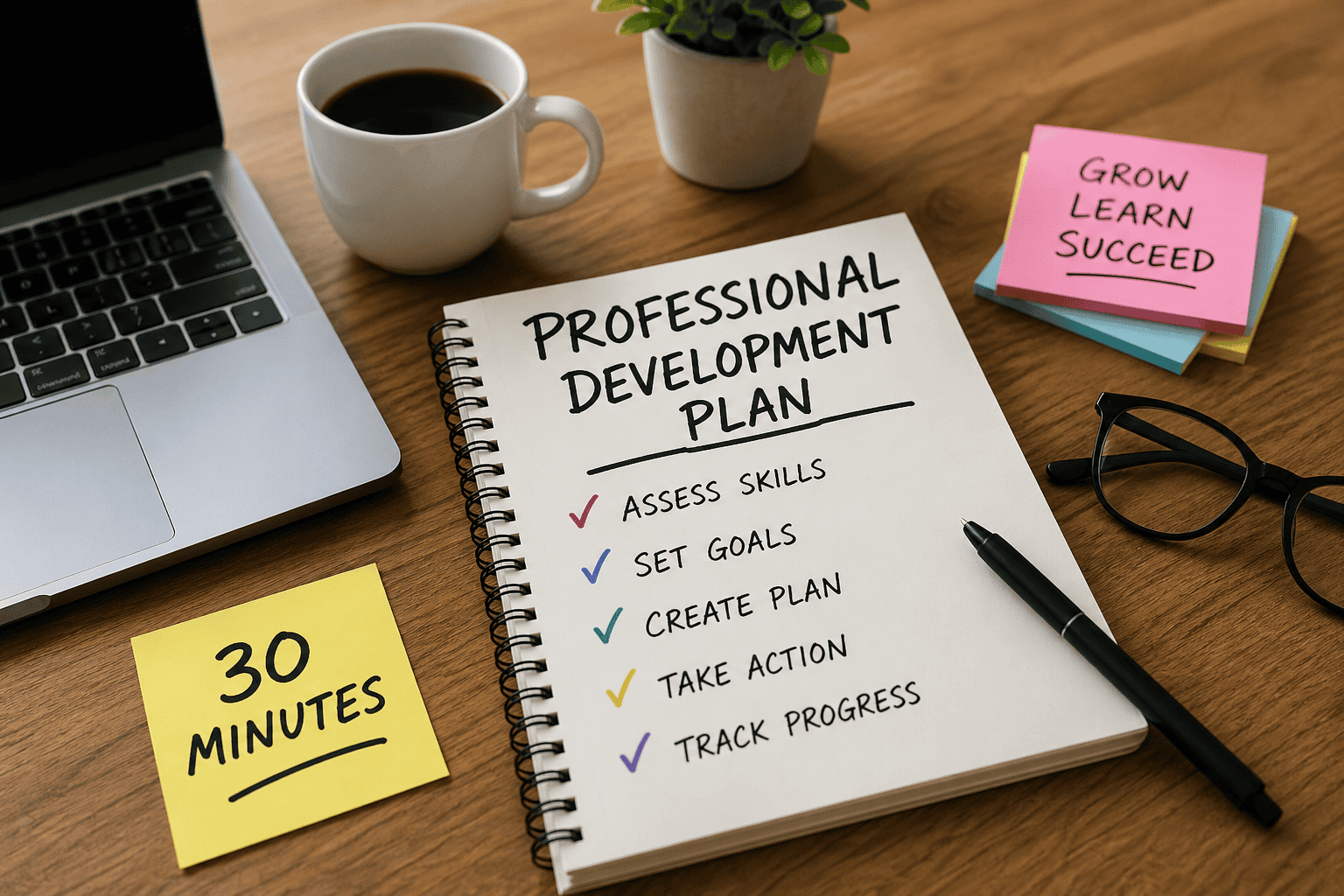
If you’re being brutally honest with yourself—most “career growth” advice is useless. People say “learn new skills” or “set goals,” but nobody shows you how to actually build a professional development plan that moves your salary, role, or career forward in a measurable way.
So you stay stuck: busy but not progressing, learning but not getting promoted, working harder but not earning more.
Here’s the truth: a good professional development plan template is not a document. It’s a decision system. In this guide, I’ll show you how to build one in 30 minutes—a plan that actually leads to promotions, salary growth, or a successful career switch.
After 18 years advising senior leaders and mid-career professionals at McKinsey, Amazon, and Unilever, I’ve seen this work hundreds of times. Let’s get into it.
What Is a Professional Development Plan (Really)?
A Professional Development Plan (PDP) is a structured way to answer one question:
“What should I do in the next 90–180 days to meaningfully increase my career value?”
Not activity. Not busyness. Value.
The distinction matters more than most people realise. I’ve reviewed hundreds of PDPs over the years, and the majority are shopping lists—”take this course, attend that workshop, read this book.” None of that moves salaries. What moves salaries is connecting skills to visible, measurable outcomes that your organisation actually cares about.
A strong professional development plan connects three things:
Skills → Visible Outcomes → Career Impact
Consider the difference between these two goal statements:
| Weak PDP Goal | Strong PDP Goal |
|---|---|
| “Improve communication skills” | “Lead 3 cross-team presentations to improve visibility and qualify for promotion” |
| “Improve coding” | “Build a dashboard that reduces reporting time by 30%” |
| “Learn SQL” | “Use SQL to automate the monthly ops report, saving the team 4 hours per cycle” |
See the difference? One is activity-oriented. The other is outcome-oriented. Only one gets you promoted.
Why Most PDPs Fail (And Yours Probably Will Too)
Let’s be direct. Most professional development plans fail—not because people are lazy, but because they’re built on the wrong foundation.
Here’s what I see again and again when coaching executives at the Senior Manager and Director level:
The plan is too vague. “Become a better leader” is not a goal. It’s a wish. Without a concrete target—a specific role, title, salary band, or project—your plan has no real direction.
It’s not tied to business outcomes. Your manager doesn’t promote you for personal growth. They promote you because promoting you solves a problem for the business. If your PDP doesn’t connect to what your team or company actually needs, you’re optimising in the wrong direction.
It’s not measurable. “Improve stakeholder management” cannot be evaluated in a performance review. “Secure sign-off from three senior stakeholders on Q3 product roadmap” can be.
It ignores visibility. And this is the one nobody talks about. You can be the most skilled person in the room, but if leadership doesn’t see your work, doesn’t hear your name in promotion conversations, and doesn’t associate you with results—it doesn’t count.
The core mistake? Most PDPs optimise for learning, not leverage. You don’t get promoted because you learned something. You get promoted because you created visible impact.
The 30-Minute Professional Development Plan Template
Here’s the high-performance PDP template I recommend to every professional I coach. Copy it into Notion, Google Docs, Word, or even a plain note—format doesn’t matter. Clarity does.
🧩 Professional Development Plan Template
1. Career Goal (Next 6–12 Months)
Be specific. “Get promoted to Senior PM” or “Move into a $130K+ salary band” — not “grow my career.”
2. Current Gap Analysis
- Skills missing:
- Visibility gaps (who doesn’t know your work?):
- Experience gaps (what have you never led or owned?):
3. Top 3 Focus Areas — Only 3
- Skill 1:
- Skill 2:
- Skill 3:
4. Outcome-Based Goals (Not Tasks)
- Deliver X project by [date]:
- Improve Y metric by [amount]:
- Lead Z initiative for [audience]:
5. Action Plan (12-Week Execution)
- Month 1: Learn + small execution
- Month 2: Build something real
- Month 3: Showcase the impact
6. Proof of Work (Non-Negotiable)
- Reports, dashboards, presentations, GitHub repos, case studies
7. Feedback Loop
- Manager check-ins (cadence):
- Mentorship:
- Performance review alignment:
8. Success Metrics
- Promotion / salary increase / role change
- Quantifiable impact (revenue, time saved, error reduction):
This template works because it forces three things simultaneously: clarity, accountability, and visibility. Remove any one of those and the plan collapses.
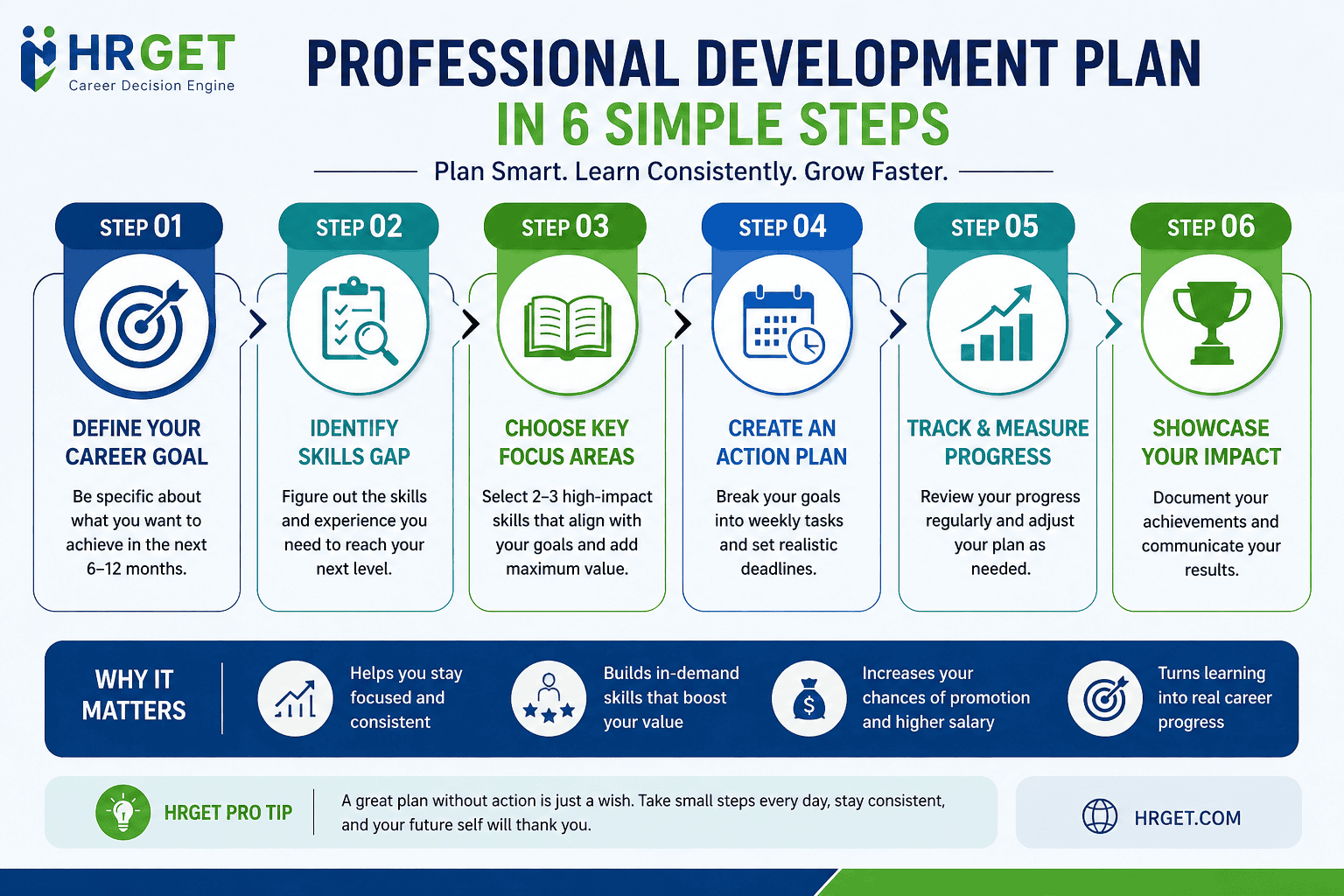
Step-by-Step: Build Your Plan in 30 Minutes
Let me walk you through each section so you’re not staring at a blank page.
Step 1: Define a Brutally Clear Career Goal (5 Minutes)
Vague goals produce vague plans. Don’t write “grow in my career.” Write something you’d be embarrassed to admit you didn’t achieve in six months.
Good examples:
- “Get promoted to Senior Software Engineer in Q3 2026”
- “Transition from marketing into a product management role”
- “Move into a ₹25–30 LPA salary band at a Series B or larger company”
- “Reach $150K total comp within 12 months”
If your goal is vague, your plan will fail. I’ve never seen an exception to this rule.
Step 2: Identify the Real Gap (5–7 Minutes)
This is where most professionals go wrong. They assume the gap is technical skills. Often it isn’t.
Ask yourself: what do the top performers at my next level actually do that I don’t do today? Focus on three categories:
Ownership: Do they own outcomes, or just tasks? Are they the person the business calls when something goes wrong—or do they wait to be told?
Impact: Is their work directly tied to revenue, cost savings, or a KPI that shows up in leadership conversations?
Visibility: Do senior stakeholders know their name, their work, their results? Visibility is a skill, not luck.
Write down your honest answers to all three. That’s your gap analysis done.
Step 3: Pick ONLY 3 High-Leverage Skills (5 Minutes)
This is where ambition becomes a liability. I watch talented professionals stall out because they’re trying to develop 8–10 skills simultaneously. Spreading yourself thin across a laundry list of courses is not a development plan—it’s a distraction strategy.
Pick exactly three skills. Apply this filter: does mastering this skill directly accelerate my path to the goal I defined in Step 1?
If the answer is “probably yes but indirectly”—cut it. Focus ruthlessly on skills with a direct line to the outcome.
Step 4: Convert Skills → Outcomes (5 Minutes)
This is the game changer—and almost nobody does it. Every skill in your plan needs to be converted into a deliverable your manager can see.
“Learn SQL” becomes “Automate the weekly ops report and present findings to the Director of Operations.”
“Improve stakeholder management” becomes “Get written sign-off from Finance, Legal, and Product on the Q2 launch plan without escalation.”
Outcome equals promotion trigger. If you can’t turn the skill into an observable result, it doesn’t belong in your plan.
Step 5: Create a 12-Week Execution Plan (5–7 Minutes)
Structure your 12 weeks in three phases, and resist the urge to overengineer this:
- Month 1: Learn the foundational skill and execute one small, visible task using it
- Month 2: Build something real—a project, a report, a process improvement
- Month 3: Showcase the impact to leadership and document the result
The third month is what most people skip. That’s exactly why most people don’t get promoted on the timeline they expect.
Step 6: Define Proof of Work (3 Minutes)
Here’s a rule I give every executive coaching client: if it’s not visible, it doesn’t exist.
Before you start executing your plan, decide exactly what evidence you’ll produce. A case study write-up. A metrics dashboard. An internal presentation to leadership. A GitHub repository showing the before and after. A Slack message where your manager publicly acknowledged your result.
These artifacts become your promotion case. Without them, you’re relying on your manager’s memory—which is unreliable and unfair to yourself.
Real Scenario: Bad vs Smart PDP
I worked with a software engineer—let’s call him Arjun—who had been stuck at the mid-level for three years despite being technically excellent. His PDP when we first met looked like this:
❌ Weak Plan (Arjun’s original)
- Goal: Improve coding skills
- Action: Watch 3 Udemy courses on system design
- Metric: Complete courses by Q2
- Result: No promotion. No salary increase. Frustration.
He’d been running this same type of plan for two cycles. Technically, he was getting better. Organisationally, nothing changed.
We rebuilt his plan around outcomes and visibility:
✅ Smart Plan (Rebuilt)
- Goal: Promotion to Senior Engineer by Q4 2026
- Action 1: Lead the API latency optimisation project (own it end-to-end)
- Action 2: Reduce API response time by 25% and document the methodology
- Action 3: Present results and business impact to the VP of Engineering
- Proof of work: Technical write-up + before/after metrics in engineering all-hands
- Result: Promoted in the next cycle. Salary moved from ₹18 LPA to ₹26 LPA.
Same person. Completely different approach. The difference was visibility and impact, not skill level.
High-Impact Skill Selection Strategy
Not all skills are created equal. Here’s the framework I use with senior professionals to identify what’s actually worth developing.
Focus on “Career Multiplier Skills”
Career multiplier skills are ones that give disproportionate returns relative to the time invested. They’re not necessarily the most complex skills—they’re the ones that influence how decision-makers perceive you.
The four highest-leverage skills I consistently see across industries and seniority levels:
- Executive communication — presenting insights to leadership clearly and confidently
- Business acumen — understanding what drives revenue, cost, and the company’s strategic priorities
- Problem-solving under ambiguity — operating effectively when there’s no clear answer or playbook
- Cross-team collaboration — influencing without authority, aligning stakeholders who don’t report to you
These show up in every promotion conversation I’ve ever been part of—regardless of whether the role is in tech, finance, operations, or HR.
What to Avoid
Skip the low-impact certifications that look impressive on LinkedIn but don’t translate to visible results in your current role. Avoid stacking courses you’ll never apply. A Python certification means nothing if nobody in your organisation ever sees you use Python to solve a real problem.
The question isn’t “is this skill useful?” The question is “will developing this skill be visible and impactful to the people who make promotion decisions?”
Common Mistakes That Kill Career Growth
1. Overplanning, No Execution
You don’t need a perfect professional development plan. You need momentum. A 70% plan that gets executed beats a perfect plan that sits in a Google Doc. Start imperfect. Adjust as you go.
2. Learning Without Applying
Courses don’t get promotions. Impact does. For every hour you spend learning something, spend at least two hours applying it to something visible. The learning without application trap is especially common among high performers who are comfortable consuming information.
3. Ignoring Visibility
If leadership doesn’t see your work, it doesn’t count—no matter how good the work is. Visibility is a legitimate professional skill, and neglecting it is not modesty. It’s a career strategy error. Write the internal post-mortem. Send the summary email. Volunteer for the cross-team presentation.
4. Too Many Goals
More goals equals less progress. Every additional focus area in your plan dilutes the others. If you have five development goals this quarter, you effectively have none. Ruthlessly limit yourself to three, and watch what happens.
Pro Tips (From an Insider Who’s Run These Conversations)
A few things I’ve learned sitting on both sides of the promotion table:
Managers promote people who solve bigger problems—not people who work longer hours. Being the person who removes a recurring headache for your manager is worth more than a year of staying late.
Your PDP should align with company priorities, not just personal interests. If your company is obsessed with cost reduction right now and your PDP is about becoming a better public speaker, you’re developing the wrong thing at the wrong time. Read the business.
Document everything. Every positive piece of feedback, every metric improvement, every stakeholder shoutout. This becomes your promotion case. Your manager will not remember everything you did. You need to remind them, professionally and factually.
Ask your manager this exact question: “What would I need to demonstrate over the next 90 days to be considered for promotion?”
That single question can shortcut your entire development process. Most managers have a clear picture of what promotion-ready looks like—they just don’t volunteer it unless you ask. And most professionals never ask.
Smart Strategy: Turn Your PDP Into a Promotion Machine
Here’s the reframe that changes everything: stop thinking of your professional development plan as a checklist. Start thinking of it as a portfolio.
At the end of 90 days, you should have produced something—not just completed something. The difference is everything.
A portfolio-oriented PDP produces:
- 2–3 high-impact projects with measurable outcomes
- Documented results that can be presented in a performance review
- A clear narrative: “In the last quarter, I did X, which resulted in Y, and here’s the evidence”
That narrative—backed by evidence—is what gets you promoted, gets you a salary increase, and gets you better job offers when you decide to move. It’s the same logic whether you’re in Bangalore, London, New York, or Dubai. Decision-makers everywhere respond to the same thing: demonstrated impact, clearly communicated.
Quick Copy-Paste Version (Minimal Template)
If you want something ultra-simple to start today—here it is. Fill this in right now:
Goal: _______________________________________________
Skill 1: _____________________________________________
Skill 2: _____________________________________________
Skill 3: _____________________________________________
Outcome 1: __________________________________________
Outcome 2: __________________________________________
Outcome 3: __________________________________________
12-week plan: _______________________________________
Proof of work: ______________________________________
Success metrics: ___________________________________
Done. That’s all you need to start.
FAQ: Professional Development Plan
1. What is a professional development plan example?
A strong example: Goal — get promoted to Senior Product Manager within 6 months. Skill — stakeholder alignment. Outcome — secure cross-functional sign-off on Q3 roadmap without escalation. Proof of work — written confirmation from three stakeholders and a summary presented in the leadership sprint review. That’s what a real, outcome-oriented PDP looks like.
2. How long should a PDP be?
One to two pages maximum. If your development plan is longer than that, you’re overcomplicating it. A concise plan you’ll actually follow beats a comprehensive plan that sits unread. Clarity and brevity are features, not corners being cut.
3. How often should I update my PDP?
Every 90 days. Career growth works in cycles—a quarter is long enough to achieve something meaningful and short enough to stay sharp. Review what worked, drop what didn’t, and set fresh outcomes for the next cycle. Annual plans are too slow to be useful in most modern roles.
4. Can a professional development plan help with a salary increase?
Yes—but only if it’s built around measurable impact. A PDP that ends with documented results and quantifiable outcomes gives you the evidence base for a salary conversation. Walk into that discussion with numbers: “I led X, which delivered Y result, and I’m now ready for a compensation conversation that reflects that.” Without proof of impact, salary negotiations are just opinions.
5. Should I share my PDP with my manager?
Yes, and sooner than you think. Sharing your professional development plan with your manager aligns expectations, signals ambition, and gives your manager the context they need to support you. It also makes your promotion conversation much easier—they’ve been watching you execute the plan they already know about.
6. What tools can I use to create a PDP?
Notion, Google Docs, Excel, or a simple note. The tool genuinely doesn’t matter. What matters is that it’s somewhere you’ll look at it weekly. A PDP in a tool you never open is not a plan—it’s a hope. Pick the tool you actually use every day and put it there.
7. What is the difference between a PDP and an IDP?
A PDP (Professional Development Plan) and IDP (Individual Development Plan) are essentially the same concept—the naming varies by company and HR system. Some organisations use IDP specifically for company-sponsored development, while PDP is used for self-directed growth. In practice, the structure, purpose, and best practices are identical. Use whichever term your organisation prefers.
Build Your Professional Development Plan Today
Here’s the uncomfortable truth I’ll leave you with: 90% of people who read this will do nothing. They’ll agree with everything, feel briefly motivated, and return to the same routine tomorrow.
The 10% who act will pick a goal, build this plan, and execute for 90 days. Those are the ones who get promoted, who land salary increases of 25–40%, and who look back a year from now wondering why they didn’t do it sooner.
A professional development plan template is only as powerful as your willingness to use it. Thirty minutes is enough to get started. The rest is execution.
If you’re working toward a promotion, read our guide on how to ask for a promotion—it pairs directly with this plan and covers the conversation you’ll need to have once your 90-day results are ready.

Jonathan Reed: Executive Career Strategist & Leadership Advisor | Former Partner, McKinsey & Company | Executive Coach to Amazon & Unilever Leaders | 18+ Years in Career Strategy
Jonathan Reed spent nearly two decades as a Partner at McKinsey & Company, where he advised organisations on leadership development, talent strategy, and organisational design across the US, UK, and Asia. Since leaving consulting, he has worked as an executive coach to senior leaders at Amazon, Unilever, and a clutch of high-growth scale-ups — helping them navigate promotions, career pivots, and the unwritten rules of visibility and influence at the top. Based between London and New York, Jonathan writes for HRGet.com to give working professionals an honest look at how careers actually scale — and why so many talented people stall without ever knowing why.