VH
Victoria Hale
Employment Law Partner — Former Partner, Freshfields Bruckhaus Deringer · London & New York · 20+ years advising on FLSA, EU labour law, executive exits, and wrongful termination. Updated May 2026.
Quick Answer
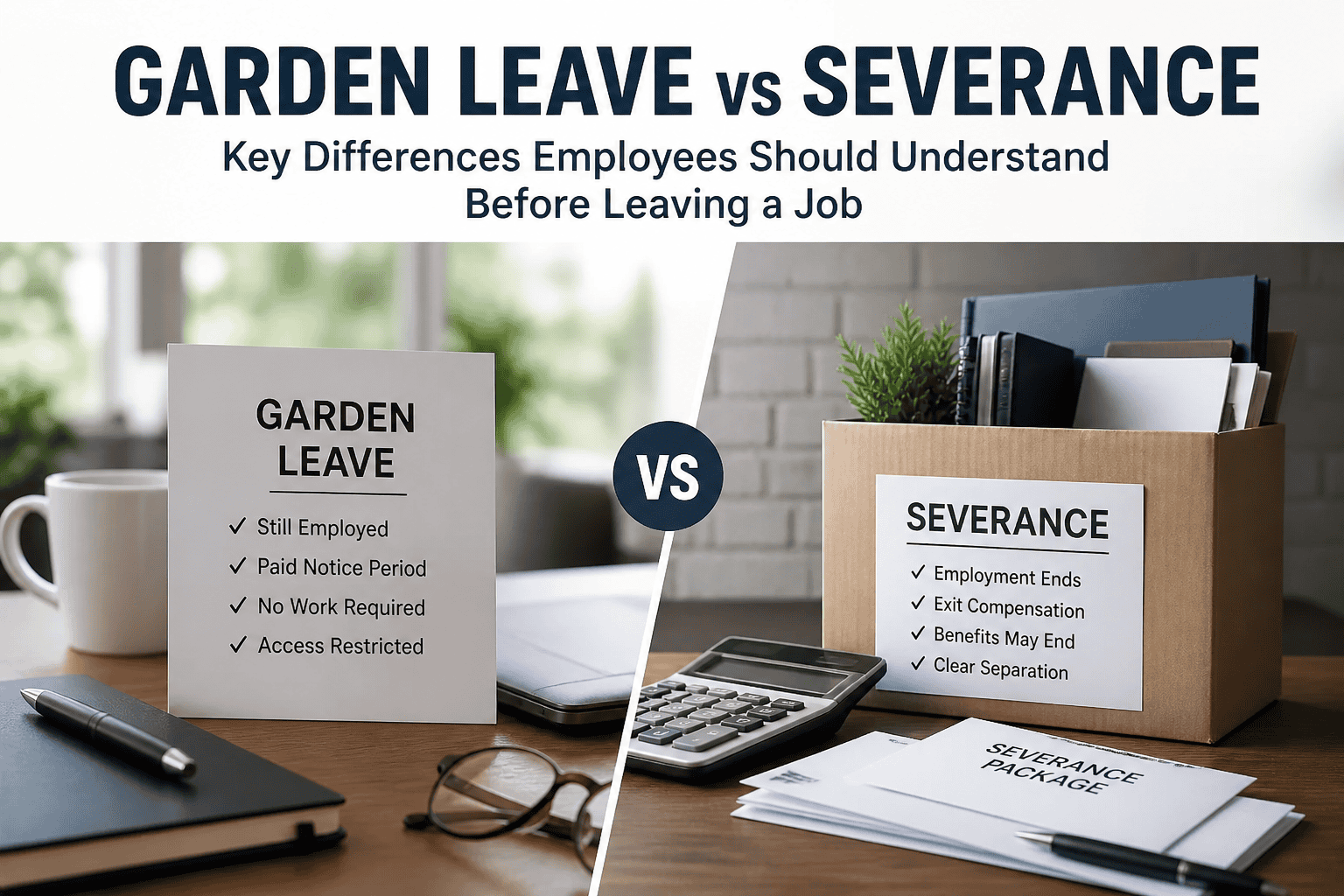
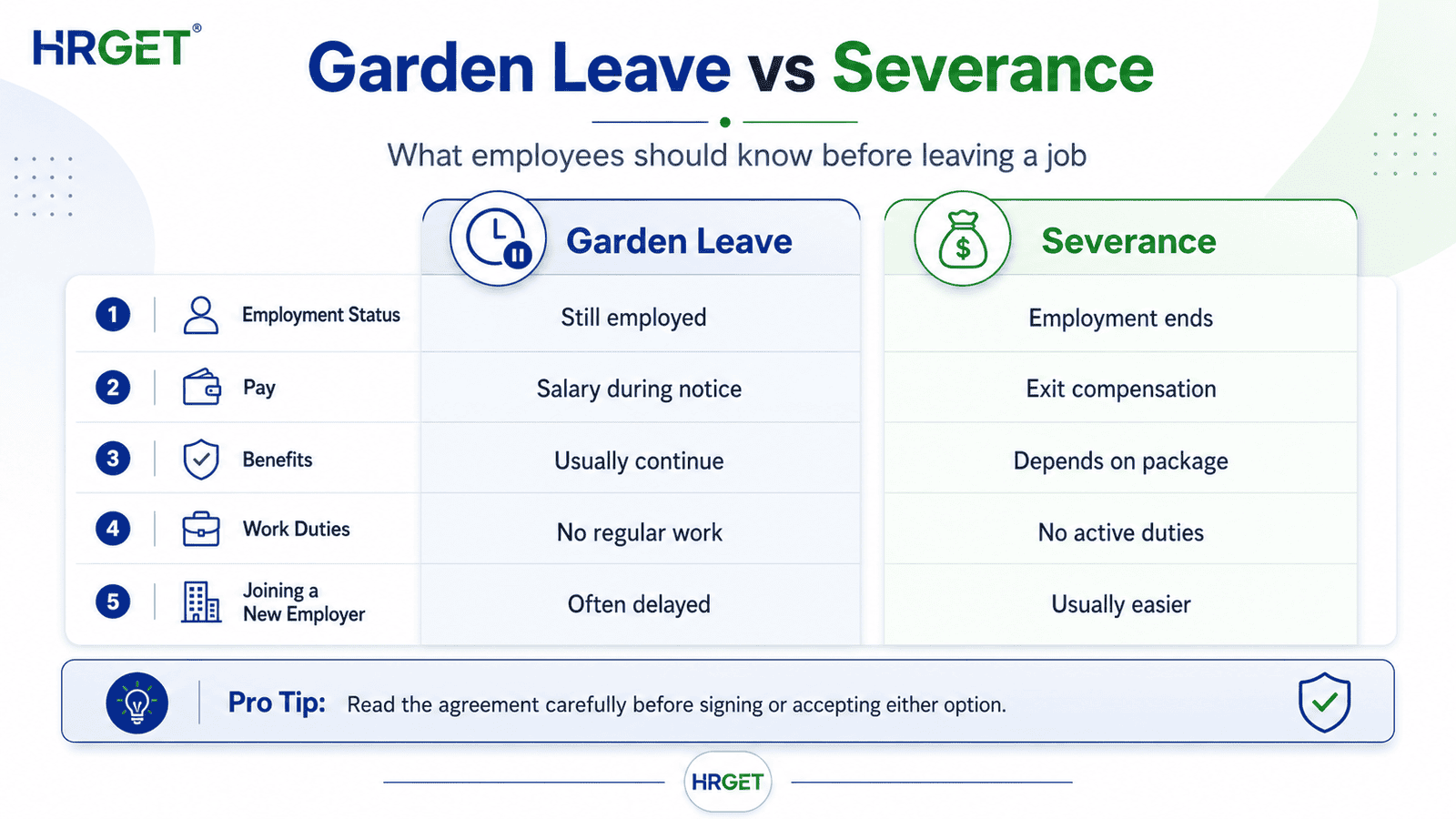
Garden leave means you remain employed and on payroll during your notice period but are not required — and often not permitted — to work. Severance is compensation paid when your employment ends. The core difference: on garden leave you’re still legally inside the employment relationship; with severance you’re leaving it. That single distinction changes your benefits, legal obligations, tax treatment, and your freedom to start a new job.
Important: Employment law varies by country, state, contract, and role. This article provides practical career guidance, not legal advice. For high-value exits, executive roles, disputed terminations, or non-compete enforcement, consult a qualified employment lawyer in your jurisdiction.
Here’s something I’ve seen happen dozens of times over two decades of employment law work: a professional reaches out after they’ve already signed the separation paperwork. They’ve accepted the garden leave terms, or they’ve signed the severance agreement, and now they want to know whether they got a fair deal.
Almost always, the answer is: they left something on the table. Not because the employer was dishonest — but because the employee didn’t understand the difference between garden leave vs severance before they signed.
These are not interchangeable terms. They describe two different legal and financial situations. Garden leave means you’re still employed — paying you to stay away from work. Severance means your employer is compensating you for leaving. That gap in understanding can cost you weeks of pay, lost equity, benefits you were entitled to keep, and the freedom to start your next job when you wanted.
This guide closes that gap. By the end, you’ll know exactly what each arrangement means, what’s negotiable, what to watch for in the contract, and which situation is actually better for your circumstances.
What Is Garden Leave?
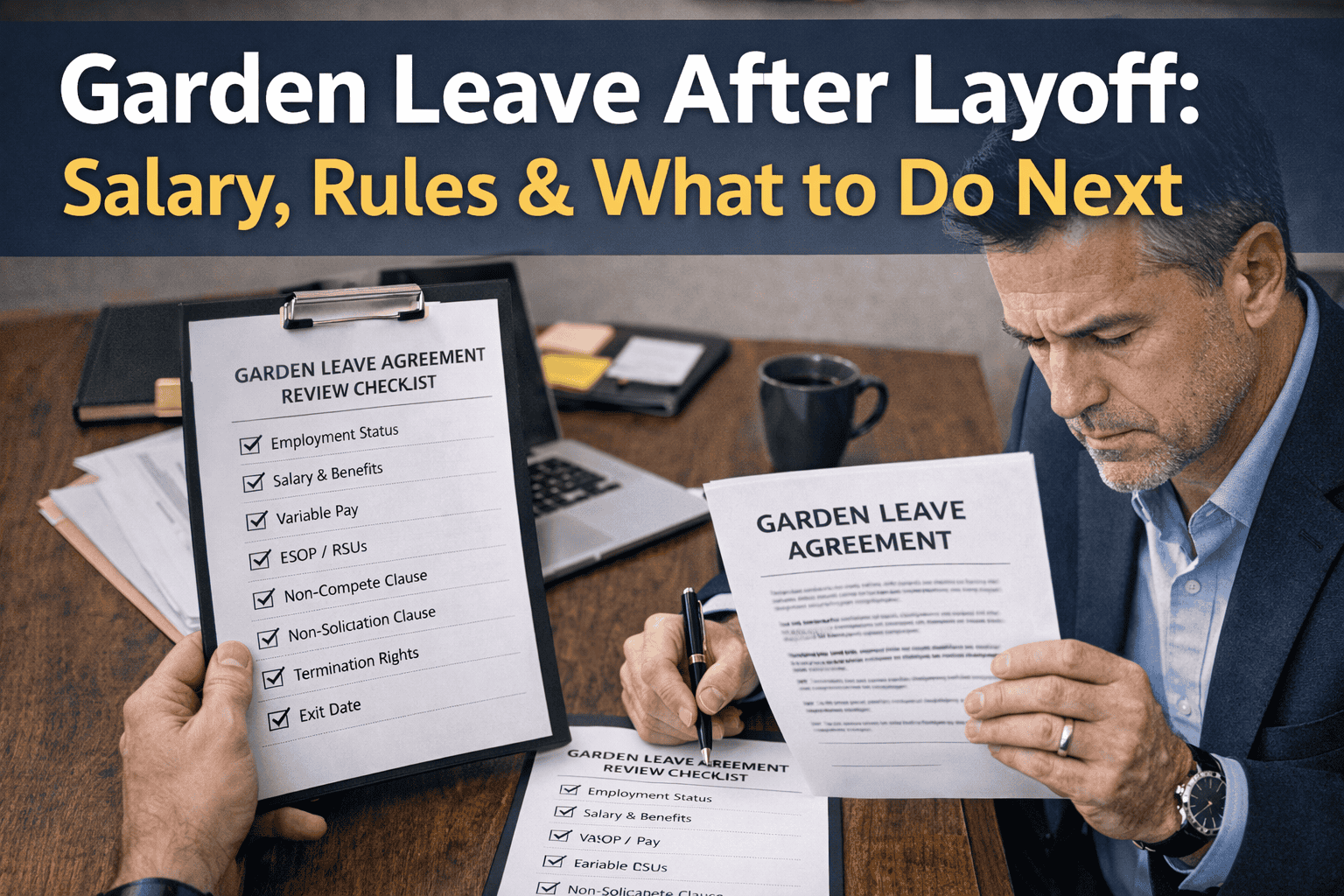
Garden leave — sometimes called gardening leave — is a notice-period arrangement where your employer keeps you on full payroll but instructs you not to perform your regular work duties. You’re paid. You’re employed. You’re just not in the office — or on Slack, or in client calls, or anywhere near the company’s operations.
The term is believed to have originated in the UK, conjuring the image of an employee sent home to tend their garden during the notice period. The image is quaint. The legal reality is less so.
GOV.UK describes garden leave as a period during notice where the employer asks the employee not to come to work, while the employee continues to receive the same pay and contractual benefits. ACAS confirms that the employee remains employed during the garden leave period and must ordinarily be paid as normal throughout.
Garden leave is most common in finance, technology, sales leadership, and any senior role where the departing employee holds client relationships, pricing strategy, competitive roadmaps, or trade secrets. The employer isn’t doing you a favour by paying you to stay home — they’re managing their exposure while they own your time.
| Employer Concern | How Garden Leave Helps |
|---|---|
| Employee is joining a competitor | Delays immediate transfer of sensitive knowledge and client relationships |
| Employee has key client access | Prevents last-minute poaching before the handover is complete |
| Employee holds confidential strategy | Removes system access while maintaining legal control via employment relationship |
| Employee is at VP level or above | Protects leadership decisions, pricing, and product roadmap during transition |
| Exit is tense or contested | Keeps the person physically away from the workplace and team |
Insider View
I’ll be direct about this: garden leave is a paid restriction, not a gift. The employer is continuing your salary because it gives them legal and practical control over your transition. In many cases, a shorter notice period with clean release terms would serve the employee better. The paid period sounds attractive — but only if the restrictions are short, the equity keeps vesting, and you don’t have a competitor offer waiting on a firm start date.
What Is Severance Pay?
Severance is money, benefits, or other support offered to an employee when their employment ends — typically at or after the point of separation. It most commonly arises during layoffs, redundancies, restructuring events, mutual separations, executive exits, or negotiated departures.
A severance package can include any combination of the following:
| Severance Component | What It Means in Practice |
|---|---|
| Lump-sum cash payment | One-time amount paid after termination, often in exchange for signing a release |
| Salary continuation | Regular paycheck for a defined period after your last day |
| Health insurance support | Employer-paid COBRA premiums (US) or private medical extension |
| Bonus payout | Full, partial, or prorated annual/quarterly bonus |
| Equity treatment | Accelerated vesting, extended exercise window, or forfeiture terms |
| Outplacement services | Resume coaching, job search support, interview prep |
| Release of claims | You give up certain legal claims in exchange for severance payment |
| Non-disparagement clause | Both sides agree not to speak negatively about each other |
| Confidentiality clause | You agree not to disclose the agreement’s terms |
| Cooperation clause | You agree to assist with future audits, litigation, or transitions |
One thing that surprises many employees: severance is not automatically required in most US private-sector jobs. The US Department of Labor confirms that the Fair Labor Standards Act does not mandate severance pay — it is generally a matter of agreement between employer and employee, contract terms, company policy, or union arrangement.
In the UK, statutory redundancy pay kicks in after two years of continuous service, with amounts based on age, length of service, and weekly pay. In India, the Payment of Gratuity Act mandates gratuity after five years of service, and many firms offer additional ex-gratia amounts in redundancy scenarios.
One more thing: severance is typically taxable. The IRS treats severance payments as wages subject to federal income tax withholding and payroll taxes in the year received. In the UK, the first £30,000 of a genuine redundancy payment may be tax-free under specific statutory conditions — but that exemption doesn’t apply automatically to all separation payments, and your employment lawyer or tax advisor should confirm what qualifies.
Garden Leave vs Severance: Quick Comparison Table
| Factor | Garden Leave | Severance |
|---|---|---|
| Employment status | Usually still employed | Employment has ended or is ending |
| When it applies | During the notice period | At or after the point of separation |
| Main purpose | Protect the employer during transition | Compensate the employee for leaving |
| Pay type | Regular salary — same as when working | Lump sum, salary continuation, or negotiated mix |
| Benefits | Usually continue because employment continues | Varies — depends on agreement and jurisdiction |
| Work duties | Reduced or paused — no active work expected | None — employment has ended |
| Start a new job? | Usually not until garden leave ends | Usually yes, unless restrictions apply |
| System / office access | Typically removed immediately | Removed at or before termination |
| Negotiability | Somewhat — duration, benefits, equity terms | Significantly — pay, benefits, restrictions, references |
| Tax treatment | Normal payroll — salary taxed as usual | Taxable as wages (US); partial exemption possible (UK) |
| Common in | Finance, tech, sales, senior roles; standard in UK/Europe/India notice periods | Layoffs, redundancies, mutual separations, executive exits |
| Primary employee risk | Breaching restrictions while still legally employed | Signing away legal claims or accepting weak terms without review |
| Best used when | You have a new role with a flexible start date and want benefits/equity to continue | You want financial runway, a clean break, and freedom to move quickly |
The Biggest Difference: Are You Still Employed?
This is the question that changes everything else in the garden leave vs severance discussion. And it’s the one employees most often get wrong.
On garden leave, you remain an employee. You may not be sitting at a desk, but you are still inside the employment relationship. That means:
- Your duty of loyalty to the employer continues
- Confidentiality obligations remain fully in force
- Internal company policies still apply
- Non-solicitation clauses are active — don’t contact clients or recruit colleagues
- Conflict-of-interest rules still govern your behaviour
- Your employer may require you to remain available for questions or handover tasks
- You cannot join a competitor until your employment officially ends
Garden leave is not a free pass. It’s paid leave with strings attached — some visible, some buried in the contract.
With severance, your daily employment duties end. But post-employment obligations can continue for months or years depending on what you sign. Watch for these in a separation agreement:
- Confidentiality — often permanent; applies to trade secrets, strategy, financials
- Non-disparagement — limits what you can say about the company publicly
- Non-solicitation — prevents recruiting former colleagues or contacting clients
- Non-compete — may restrict working in the same industry or for named competitors
- Intellectual property assignment — work product you created may remain theirs
- Cooperation clause — requires future assistance with litigation or audits, sometimes for years
- Clawback clause — employer can recover severance payments if you breach terms
Warning
Many employees believe that once they sign a severance agreement, they’re done with the company. Not necessarily. A cooperation clause may require you to answer questions, review documents, or appear as a witness in legal proceedings — sometimes two or three years after you left. Before signing, understand exactly what obligations survive the separation and for how long.
Pay and Benefits: What You Actually Receive
During Garden Leave
Garden leave typically pays your normal contractual salary — same as when you were working. Depending on your contract and jurisdiction, you may also keep:
- Health insurance and private medical cover
- Pension / retirement contributions
- Annual leave accrual
- Bonus eligibility (if you’re still employed on the payment date)
- Equity vesting — this one is crucial and frequently contested
- Company allowances — car, phone, housing
Here’s what catches people out: the phrase “same pay and benefits” in a garden leave letter is strong. The phrase “base salary only” is much weaker. If your total comp includes a £40,000 annual bonus and the letter only guarantees base salary during garden leave, you’ve just lost something significant — especially if the bonus payment date falls within the notice period.
For tech employees with unvested RSUs or stock options, whether equity continues vesting during garden leave can be worth more than the salary itself. Get it confirmed in writing before day one of the leave period.
During Severance
Severance is where the numbers can look generous on the surface but fall short in total value. A common formula — one to two weeks’ pay per year of service — sounds reasonable, but that baseline is negotiable and doesn’t account for what you might lose in bonus, benefits, or equity.
Pro Tip
Don’t evaluate a severance offer on the headline cash figure alone. A £35,000 lump sum with no health extension, bonus forfeiture, accelerated equity cancellation, and a six-month non-compete in your core industry may be worth far less than a £22,000 package with clean terms, continued benefits, and an extended equity exercise window. Map the full value — including what you’re giving up — before you sign.
And remember: if severance is paid in the US, it’s subject to income tax and payroll taxes in the year you receive it. Requesting deferred payment into a new tax year, or splitting across two years, is sometimes negotiable and can materially reduce your tax bill. Talk to a tax advisor before finalising payment timing.
Can You Join a Competitor? Garden Leave vs Severance Rules
This is where garden leave vs severance becomes a live career decision — not just an intellectual one.
During Garden Leave
Because you remain employed, your contract’s restrictions on outside work, competitor employment, and client contact almost certainly apply. Even if you’re sitting at home with nothing to do, starting work for a new employer before your official last day can constitute a breach of contract. That can expose you to claims for injunctive relief or damages — particularly in finance or senior tech roles.
If your new employer wants you on site by a specific date and your garden leave runs longer, you’ll need to negotiate. Either your old employer agrees to an earlier release (sometimes they will, in exchange for a clean departure), or your new employer adjusts the start date. Good employers understand this — communicate it early and directly.
During Severance
After employment ends, you’re generally free to work elsewhere — unless the severance agreement or pre-existing contract includes restrictions. These are the clauses to watch:
| Clause | What It Can Prevent | Key Question to Ask |
|---|---|---|
| Non-compete | Working for named competitors or in the same sector | Which companies are named? For how long? Is it enforceable in my state/country? |
| Non-solicitation | Contacting former clients or recruiting ex-colleagues | How long does it run? Does it cover all clients or just active accounts? |
| Confidentiality | Using or disclosing company information in a new role | Is “confidential information” defined narrowly or broadly? |
| Clawback | Keeping severance payments if you breach any term | What triggers clawback? Is it limited to material breaches? |
| Cooperation | Freedom to fully focus on new employment | How much time can this demand? Is there a sunset date? |
On US non-competes: the FTC’s 2024 rule that would have banned them nationwide is not currently in effect. A federal district court blocked enforcement in August 2024, and the FTC subsequently moved in 2025 to dismiss its own appeal. As of 2026, enforceability still depends heavily on state law — California and Minnesota effectively void most non-competes; Texas, Florida, and others allow them under specific conditions. Never assume a non-compete is unenforceable without checking your specific state and contract language.
In India, post-employment non-competes face a significant enforceability hurdle under Section 27 of the Indian Contract Act, which broadly treats restraints of trade as void. But restrictions during active employment — including garden leave — are treated differently. And in the UK, reasonable non-competes limited in scope, geography, and duration are generally enforceable if supported by legitimate business interests.
Real Scenarios: Resignation, Layoff, and the Executive Exit
Real Scenario 1 — You Resign to Join a Competitor
Priya is a senior product manager at a SaaS company in London earning £95,000. She resigns to join a competitor offering £130,000. Her employer responds: “We accept your resignation. You’ll be on 60 days’ garden leave, payroll continues, system access ends today.”
What Priya needs to confirm in writing: her final employment date, full salary and benefits continuation, whether her April bonus vests if the payment date falls within the garden leave window, whether unvested RSUs continue accruing, and whether she can accept the new offer and delay the start. Her new employer was expecting her in four weeks — that conversation needs to happen immediately.
Real Scenario 2 — You Are Laid Off
Marcus is a marketing director in Chicago. His role is eliminated in a company restructuring. HR gives him a separation agreement: employment ends today, six weeks’ severance if he signs by Friday, COBRA support for 30 days, non-solicit for 12 months.
What Marcus should do: ask for the standard 21-day review period (required under the ADEA for employees over 40 in the US when signing releases of age discrimination claims). Review the release scope carefully — does it waive ERISA claims, discrimination claims, unpaid wage claims? Calculate whether the six weeks is fair relative to his five years of service and his original offer letter. Ask whether the non-solicit covers only active clients or all companies in his CRM. Consider whether an employment lawyer review — typically £150–£500 for a separation agreement review — is worth it for a package of this value.
Real Scenario 3 — The Executive Exit with Both
David is a VP of Engineering being asked to exit as part of a leadership restructure. His package includes 90 days’ garden leave followed by 16 weeks’ severance, health benefits for four months, equity vesting continues through garden leave, non-solicit for 18 months, bonus paid pro-rata if he signs. Total cash value: approximately $185,000.
On the surface, this looks generous. But the 18-month non-solicit in tech is extremely broad. And the cooperation clause requires availability for up to 20 hours per month for 24 months — during which he cannot charge for his time. David’s employment lawyer negotiates the non-solicit down to 12 months and the cooperation clause to 10 hours per month with a fee for requests exceeding two hours. The final package is meaningfully more valuable than the first offer — even though the cash number didn’t change.
Smart Strategy: How to Negotiate Garden Leave or Severance
Most professionals negotiate aggressively when they accept a job and passively when they leave one. That’s backwards. Your exit terms affect your income, your freedom to work, your tax bill, your references, and your next opportunity’s start date.
Negotiating Garden Leave Terms
- Confirm the exact final employment date in writing — this is the date that governs when you can legally start your next role.
- Clarify the full pay and benefits scope — salary, insurance, pension contributions, allowances, bonus eligibility, and equity vesting. “Same as before” isn’t a contract term — get specifics.
- Negotiate equity continuation explicitly — for tech employees, whether RSUs vest through garden leave can be worth tens of thousands of pounds or dollars.
- Understand the restrictions during the leave period — can you interview? Sign an offer letter? Do board-level advisory work? Start onboarding activities? Each of these may or may not be permitted.
- Request written confirmation of the reference — agree on wording before your last day, not afterwards.
- Confirm unused leave payout — earned annual leave may be payable separately, particularly in the UK and India.
- Negotiate the duration — if 90 days of garden leave is commercially unnecessary given your role, a shorter period of 60 or 45 days in exchange for a signed confidentiality agreement is a reasonable ask.
Negotiating Severance Terms
| What to Negotiate | Why It Matters | Opening Ask |
|---|---|---|
| More weeks of pay | Direct financial runway — the single biggest lever | Two weeks per year of service as a floor |
| Health benefits extension | COBRA in the US can cost $600–$1,800/month — employer contribution is enormous value | Three to six months’ employer-paid coverage |
| Bonus payout | Often omitted from the first offer despite being earned compensation | Pro-rata bonus through separation date |
| Equity vesting extension | Accelerated vesting or extended exercise window can be worth more than the cash | Full vesting of next scheduled tranche, or 90-day exercise window |
| Restriction narrowing | A broad non-compete limits your income for a year or more — it has real financial value | Scope limited to direct competitors; 6 months maximum |
| Reference language | A neutral or positive reference can unlock your next role quickly | Agreed written reference statement before you sign |
| Payment timing | Deferring into the next tax year can reduce your effective rate significantly | Payment split across two calendar years, or January of next year |
| Outplacement services | For senior roles, a quality outplacement provider is worth $3,000–$8,000 | Executive-tier outplacement with a reputable provider |
The right framing matters. Use this:
“I want to make this transition professional and clean for both sides. Before I sign, I’d like to walk through a few items — pay continuation, benefits, how bonus and equity are treated, and the scope of the post-employment restrictions.”
That’s not aggressive. It signals that you’re reasonable, that you’ve read the agreement, and that you’re not going to be rushed into signing something you don’t understand. Good HR professionals and employment counsel on the other side will respect it.
Common Mistakes Employees Make
Mistake 1: Assuming Garden Leave Means You’re Free
You’re not. You’re still employed, still bound by your contract, and still legally restricted. Starting a new role before your employment officially ends — even if your employer told you informally that it was fine — can create real contractual and legal exposure. Get the release date in writing.
Mistake 2: Signing Severance the Same Day It’s Presented
Some employers create a false sense of urgency: “Sign by end of day or the offer expires.” Legitimate employers don’t do this with senior employees. In the US, employees over 40 have a statutory 21-day review period under the ADEA for releases of age discrimination claims. Even if that doesn’t apply, you’re entitled to ask for review time. The offer almost never disappears.
Mistake 3: Focusing Only on the Cash and Ignoring Equity
For anyone in tech, finance, or a startup with equity compensation, lost unvested shares or cancelled options can dwarf the severance cash. Always ask: What happens to unvested equity? Is there an accelerated vesting provision? How long is the exercise window? Does garden leave count toward the vesting schedule? These numbers can run into six figures.
Mistake 4: Missing the Clawback Language
Some agreements allow the employer to stop or recover severance payments if you breach confidentiality, non-disparagement, or non-solicit terms — including inadvertently. A LinkedIn post that implicitly criticises the company. A coffee with a former client. A reference call about a colleague. Understand precisely what triggers clawback before you sign anything.
Mistake 5: Assuming Legal Rules Are the Same Everywhere
A California-based employee has significantly stronger non-compete protections than an employee in Texas or Florida. A UK employee has different redundancy rights than a US one. A Bengaluru tech employee operating under Indian contract law faces different restraint-of-trade rules than a London banker. The jurisdiction matters enormously — and so does the contract governing law clause, which can specify that even though you work in California, your contract is governed by New York law.
Mistake 6: Not Coordinating the New Job Start Date
If your new employer expects you on the 1st and your garden leave runs until the 15th, you have a problem that only gets worse if you ignore it. Tell your prospective employer upfront: “My current employer may enforce a notice period. I want to confirm the exact dates before we lock in a start date.” Reputable employers have seen this before and will work with you.
Which Is Better for Employees: Garden Leave or Severance?
Look, the honest answer is that it entirely depends on what you’re trying to accomplish. But that’s not an unhelpful non-answer — it’s actually the right framing, because the wrong choice (or the wrong terms) in either scenario can cost you weeks of income or months of freedom.
Garden Leave May Be the Better Outcome If:
- You want paid transition time before your next role begins
- Your equity is vesting and garden leave counts toward the schedule
- Your benefits — especially health insurance — continue through the period
- You’ve accepted a new role with a flexible start date that accommodates your notice window
- You need genuine recovery time after burnout or a difficult work environment
- The restrictions are short (30–45 days), clearly defined, and don’t block your next opportunity
Severance May Be the Better Outcome If:
- You want a clean, documented separation with cash in hand
- You need financial runway while you search — particularly after an unexpected layoff
- You want to start a new job quickly without a restrictive notice period ticking down
- Your current employer is hostile, toxic, or is not trustworthy about honouring verbal commitments
- The severance terms can be negotiated to improve the cash, benefits, equity, and restriction scope
- You have potential legal claims (discrimination, retaliation, underpayment) that give you negotiating leverage
Verdict
Garden leave gives you paid time inside the employment relationship — useful if restrictions are short and equity keeps vesting. Severance gives you compensation as you exit — better if you want a clean break and freedom to move quickly. The employee who wins in either scenario is the one who reads the agreement carefully, calculates total value (not just the cash), negotiates before signing, and doesn’t mistake paid absence for freedom.
FAQ: Garden Leave vs Severance
Is garden leave the same as severance?
No. Garden leave means you remain employed and on payroll during your notice period but are not required — and often not permitted — to work. Severance is money or benefits paid when employment actually ends. The core difference is your legal employment status: on garden leave you’re still inside the relationship; with severance you’re leaving it. That gap changes your benefits, obligations, tax treatment, and ability to start a new job.
Can I start a new job while on garden leave?
Usually not. Because you remain employed during garden leave, your contract’s restrictions on competitor employment and outside work typically still apply. Starting a new role before your official last day — even informally — can constitute a breach of contract. Always confirm your final employment date in writing and review your garden leave letter before committing to a new start date with a prospective employer.
Is severance pay legally required?
Not automatically in most US private-sector roles — the FLSA does not mandate severance, and the Department of Labor confirms it’s typically a matter of contract, policy, or negotiation. In the UK, statutory redundancy pay applies after two years of service. In India, the Payment of Gratuity Act mandates gratuity after five years. Beyond statutory minimums, entitlement depends on your employment contract, company policy, union agreement, or what you can negotiate.
Do benefits continue during garden leave?
Often yes, because you typically remain employed. Health insurance, pension contributions, and other contractual benefits tend to continue during garden leave. But never assume — confirm whether your contract says “full pay and benefits” or only “base salary,” and get the answer in writing before your notice period starts. Equity vesting in particular requires explicit confirmation.
Is severance pay taxable?
Yes, in the US — the IRS treats severance payments as wages subject to federal income tax withholding and payroll taxes in the year received. In the UK, the first £30,000 of a genuine statutory redundancy payment may be tax-exempt, but that exemption has conditions and doesn’t apply to all separation payments. In India, statutory gratuity has tax exemptions under the Income Tax Act up to specified limits. Consult a tax advisor before agreeing on payment structure or timing.
Can I negotiate my severance package?
Yes — and you should. Most first offers are not final. You can ask for more weeks of pay, extended health benefits, bonus treatment, equity vesting extension, a neutral reference, and narrower post-employment restrictions. Employees with longer tenure, senior titles, potential legal claims, or documented performance achievements have the most leverage. Almost anyone can ask for more review time and present a counter, even in a large-scale layoff situation.
Can an employer legally enforce garden leave?
It depends on whether your contract explicitly permits it and whether the employer maintains pay and benefits during the period. In the UK, garden leave clauses are generally enforceable when properly drafted and where the employer has a legitimate business interest to protect. In the US, enforceability varies by state. In India, whether an employer can require notice-period absence without work depends on contract language and whether the employee is compensated throughout.
Which is better for employees — garden leave or severance?
Garden leave is better when you want paid transition time, benefits continuation, and equity vesting — particularly if you have a new role with a flexible start date. Severance is better when you want a clean break, financial runway, and freedom to move immediately. The right answer depends on your next move, the restrictions attached to each arrangement, and the total value of the package — not just the headline cash figure.
The Real Question Isn’t “How Much Am I Getting?”
When employees come to me after a garden leave or severance situation has gone wrong, the conversation almost always starts the same way: “I thought I understood the offer.” And most of the time, they understood the cash number. They didn’t understand everything attached to it.
The garden leave vs severance distinction is not just semantic. It determines whether you’re still employed, whether your benefits continue, whether your equity vests, when you can legally start your next job, and what obligations you carry into your next chapter. These are not minor footnotes — they’re the terms that govern your professional freedom for the months ahead.
Before you sign anything, ask yourself eight questions: Am I still employed? When does that end? What happens to benefits? What happens to bonus and equity? What restrictions follow me? Can those restrictions be triggered by innocent behaviour? Am I releasing legal claims? And is the total value of this package — including what I’m giving up — actually fair?
Garden leave is paid restriction. Severance is exit compensation. Both can be negotiated. Neither should be signed without reading carefully and, where the value warrants it, a conversation with a qualified employment lawyer in your jurisdiction.
Related reading: Once you know what you’re entitled to, the next step is knowing how to ask for more. See our guide on how to negotiate severance pay — including scripts, timing strategy, and what senior employees are leaving on the table.

Victoria Hale | Former Partner, Freshfields Bruckhaus Deringer | Employment Law Specialist | 20+ Years Advising Multinationals & Executives
Author: Victoria Hale spent over two decades as an Employment Law Partner at Freshfields Bruckhaus Deringer — one of the world’s most prestigious Magic Circle law firms — advising multinational corporations and senior executives on some of the most complex employment disputes in the US and Europe. Her practice covered wrongful termination litigation, executive exits, non-compete enforcement, FLSA compliance, and cross-border workforce restructuring under EU labour law. Now based between London and New York, Victoria writes for HRGet.com to close the gap between legal theory and how employment law actually plays out in the real world — for employees who need to know their rights before it’s too late.