
By Victoria Hale — Employment Law Partner, Former Partner at Freshfields Bruckhaus Deringer | London / New York | 20+ years
Updated: 2026 | Employment Laws & Rights
Disclaimer: This article is for general career and HR awareness only — not legal advice. If you face a serious employment dispute over moonlighting, consult a qualified labour or employment lawyer.Moonlighting policy in India is one of those subjects where two colleagues can give you completely opposite advice — and both be partly right. One tells you “It’s your free time, the company can’t control you.” Another warns you “If HR finds out, expect a termination letter.”
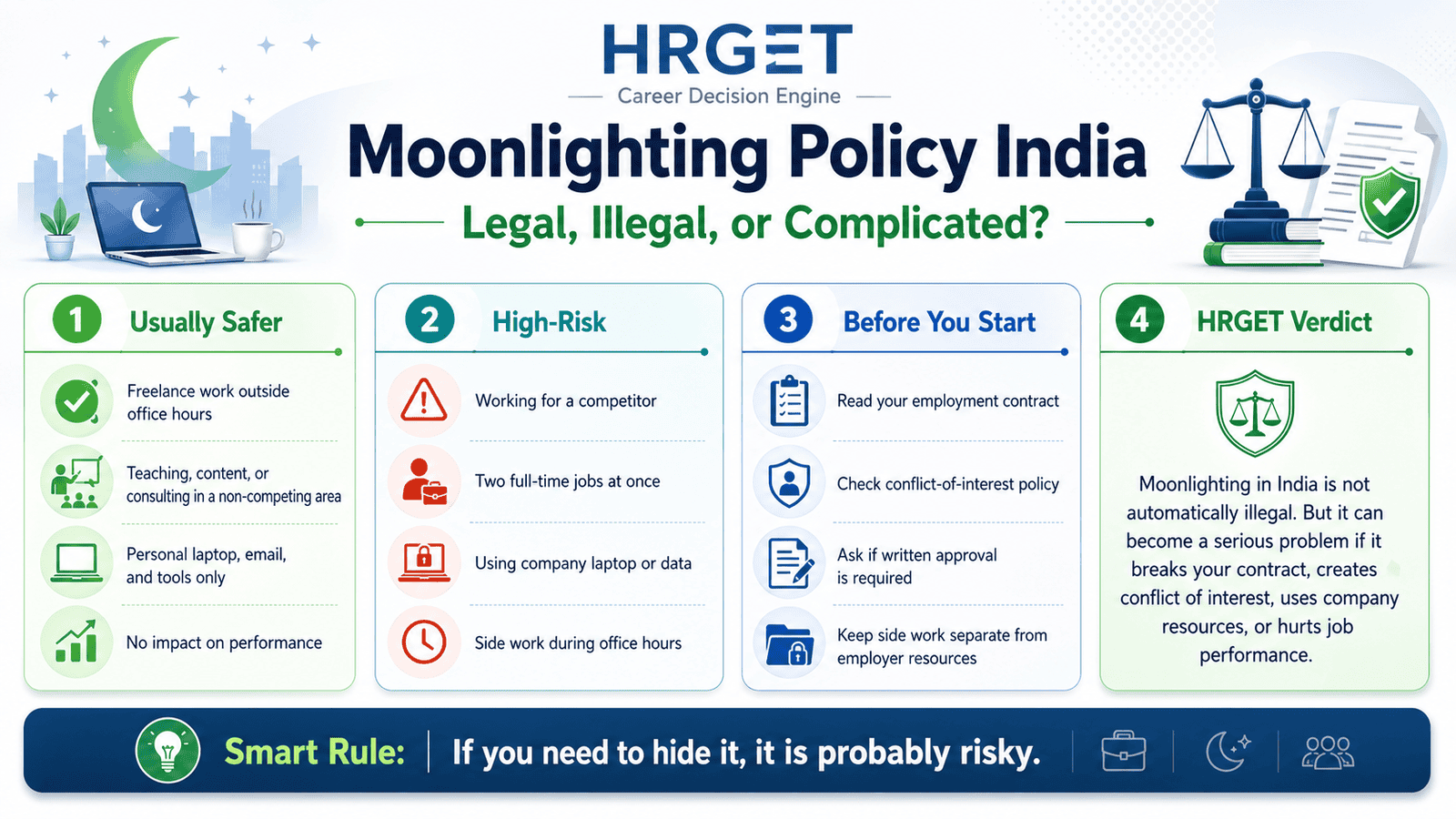
Here’s the honest answer: moonlighting is not automatically illegal in India, but it can become a serious employment problem if it violates your contract, creates a conflict of interest, bleeds into company time, touches confidential data, or involves a direct competitor.
In 20 years of employment law practice across India, the UK, and the US, I have seen professionals lose jobs over perfectly legal side work — simply because they didn’t understand what their contract said or why their employer cared. That’s the gap this article fills.
The real question is never just “Is moonlighting legal in India?” The smarter question is: can your specific side work survive your employment contract, company policy, state labour rules, and a conflict-of-interest check? Let’s work through that, section by section.
What Is Moonlighting in India?
Moonlighting means taking paid work outside your primary employment — usually after office hours, on weekends, or during personal time. In India, the term gained enormous public attention after the 2022 debate triggered by Wipro’s termination of employees found working for competitors, followed by public statements from Infosys, IBM India, and others.
But moonlighting covers a wide spectrum. Examples include:
- A software engineer doing freelance coding projects on weekends.
- An HR professional offering resume review or career coaching services.
- A designer taking logo and branding projects after work hours.
- A finance professional teaching online courses or webinars.
- A full-time employee secretly working as a full-time employee at a second company.
Not all of these carry the same risk. Some are harmless. Some are contractually prohibited. Some can expose you to disciplinary action or termination. The legal and practical risk depends on four things: what your contract says, whether the second work competes with your employer, whether you use company time or resources, and whether your performance suffers.
Most professionals get the analysis wrong. They assume “I did it after work, so I’m safe.” Your employer may not own your evenings — but it can enforce reasonable contract terms around exclusivity, confidentiality, conflict of interest, and business protection. Those terms don’t turn off at 6 PM.
Is Moonlighting Legal or Illegal in India?
Moonlighting is not completely illegal in India — but it is not risk-free either.
India has no single national statute that straightforwardly declares all moonlighting banned or all moonlighting permitted. Instead, the issue sits at the intersection of employment contracts, company policies, labour laws, standing orders, sector-specific regulations, and state-level Shops and Establishments laws. That patchwork is why legal analysis consistently describes India’s moonlighting framework as a grey area.
The practical bottom line: moonlighting in India is generally not a criminal offence in itself, but it can constitute misconduct under your employment contract or company policy. That distinction matters enormously in practice.
You probably won’t face criminal prosecution for freelancing on Saturday. But you could face:
- A formal warning letter and disciplinary inquiry.
- Termination for breach of employment policy.
- Full-and-final settlement disputes or delays.
- Background verification problems at your next employer.
- Reputational damage within a tightly networked industry.
For professionals in IT, consulting, finance, analytics, HR, legal, and product roles — the biggest exposure is not “law” in the abstract. It’s contract breach plus conflict of interest. Those two combined are what actually triggers action from employers.
Moonlighting vs Dual Employment: An Important Difference
People often use “moonlighting” and “dual employment” interchangeably. They are related, but the distinction matters from an employer’s and a compliance perspective.
| Aspect | Moonlighting | Dual Employment |
|---|---|---|
| Nature | Freelance, part-time, consulting, content work | Two formal, full-time employment relationships simultaneously |
| Traceability | Harder to detect unless it involves a conflict | Detectable via PF/UAN records, background checks |
| Typical risk level | Low to medium (depends on contract and conflict) | High — especially if working hours overlap |
| Common example | Marketing manager writing paid content on weekends | Developer on full-time payroll at Company A and Company B simultaneously |
Dual employment is generally riskier because it tends to involve overlapping working hours, overlapping PF/UAN contributions (which employers and background verification firms can now cross-check), and stronger evidence of deliberate concealment. The legal discussion in India sharpens considerably when moonlighting tips into undisclosed dual employment.
What Indian Law Says About Double Employment
There is no “Moonlighting Act” in India. But several existing legal instruments touch the issue directly.
1. Factories Act, 1948 — Section 60
Section 60 of the Factories Act restricts double employment for adult workers in factories. An adult worker should not be required or allowed to work in a factory on a day on which they have already worked in another factory, except in prescribed circumstances. This is an explicit statutory restriction — but it applies to factory workers, not to most white-collar IT, consulting, or finance professionals who work in offices and are not covered under the Factories Act framework.
2. Industrial Employment (Standing Orders) Act, 1946
Model Standing Orders may include restrictions on employment that adversely affects the employer’s interests, or clauses requiring “exclusive service.” Employers covered under this framework can use standing orders to regulate outside work. Again, the specifics depend on whether your establishment is covered under this Act and what your company’s certified standing orders actually say.
3. State-Level Shops and Establishments Acts
This is where many professionals miss a critical point. Shops and Establishments laws are state-specific — and they vary significantly. Rules in Karnataka, Maharashtra, Tamil Nadu, Delhi, Telangana, and other states may differ in how they regulate working hours and employment conditions. Generic internet advice that treats India as a single uniform regime is dangerous here. What holds in one state may not hold in another.
4. Your Employment Contract — The Most Important Document
For most private-sector professionals, this is what actually governs your situation. Your offer letter, appointment letter, employee handbook, code of conduct, confidentiality agreement, and conflict-of-interest policy may collectively restrict:
- Working for competitors, vendors, or clients.
- Accepting outside employment without approval.
- Consulting or freelancing without disclosure.
- Using company resources, code, data, or IP for outside work.
- Running a competing business while employed.
- Soliciting company clients or colleagues for a side venture.
- Doing paid work during office hours.
If your contract says written approval is required and you skip it, your employer can treat that as misconduct — even if the side work itself would have been approved had you asked.
Why Companies Ban Moonlighting
Look, companies are not policing your weekends because someone started a hobby pottery business. Their concerns are specific, and understanding them helps you navigate the conversation better.
Conflict of Interest
If you work in product strategy for an HR software company and consult for another HR SaaS startup on weekends — that’s not a harmless side hustle. You are, intentionally or not, in a position where knowledge from one role can benefit the other. That is a textbook conflict-of-interest situation, and most employment contracts explicitly prohibit it.
Confidentiality Exposure
Employees frequently underestimate how much sensitive information they carry without realising it. Pricing strategy, product roadmaps, client lists, salary bands, internal hiring plans, system architecture, and code patterns may all be material. Even without deliberate leakage, working on adjacent problems creates suspicion — and in some cases, real risk.
Productivity and Availability
If your deliverables slip, deadlines move, or you’re visibly distracted during office hours, your manager will look for explanations. Moonlighting becomes the easy target — even if fatigue is not the actual reason. The moment performance dips, undisclosed side work becomes a liability.
Use of Company Assets
Using your employer’s laptop, licensed software, internet connection, cloud storage, internal code libraries, or design templates for outside work is a serious mistake. This can escalate a contractual issue into a misconduct and intellectual property claim.
Trust and Role Sensitivity
Roles in HR, finance, legal, data security, senior leadership, sales, and client management require especially high trust. Undisclosed outside work in these functions can damage that trust materially — independent of whether any measurable financial harm occurs.
Common Moonlighting Policy Clauses in India
Most employees click “I agree” during onboarding and never revisit these documents. Before you take any paid side work, open your employment contract and search specifically for these terms:
🔍 Contract Search Keywordsoutside employment · dual employment · conflict of interest · exclusivity · confidentiality · non-compete · code of conduct · business ethics · intellectual property · prior written approval · disclosure
Here are the common clause types and what they typically say:
Outside Employment Clause
“You shall not take up any employment, consulting assignment, business, or professional engagement outside the company without prior written approval.” This is the most common restriction. If it requires written approval, a verbal “my manager knows” is not sufficient protection.
Conflict of Interest Clause
“You must avoid any activity that conflicts with the interests of the company or its clients.” This is intentionally broad. It can cover direct competitor work, vendor relationships, and situations where your outside work creates a perceived conflict even without actual harm.
Exclusivity Clause
“During employment, you shall devote your full professional time and attention to the company.” This is the most restrictive version. It can restrict even harmless, non-competing outside work — though its enforceability depends on reasonableness and industry context.
Non-Compete During Employment
Indian courts are generally cautious about post-employment non-competes (after you leave, restraints on working elsewhere). But restrictions during active employment are treated quite differently — courts and legal commentators tend to uphold reasonable during-employment restraints as valid business protections.
Company Asset Clause
“You must not use company systems, devices, software, data, or intellectual property for non-company work.” A clear bright line — and one of the easiest mistakes to make if you’re not thinking about it.
Can You Be Fired for Moonlighting in India?
Yes — if your side work breaches your employment contract, company policy, confidentiality obligations, conflict-of-interest rules, or demonstrably harms your employer. That said, not every moonlighting situation justifies immediate termination.
A fair employer conducting a proper disciplinary inquiry should weigh:
- What kind of side work was involved, and was it competing?
- Was it disclosed or actively concealed?
- Was written approval required but not sought?
- Were company time, devices, or data used?
- Was there measurable performance impact or financial harm?
- Did the employee misrepresent facts during inquiry?
Even if your side work is legally defensible, disputing your employer over it is expensive and stressful. You may win the technical argument and still lose the promotion you were due, your manager’s trust, your internal reputation, and future reference letters. Always ask: is this side work worth that risk?
The smart framing is not “Can I technically defend this?” It’s “Is this side work worth the career trade-off?”
Safe vs Risky Moonlighting — A Practical Framework
Here’s a simplified risk classification based on common employment contract patterns in India. Every situation depends on your specific contract — but this framework helps you sense-check before proceeding.
| Risk Level | Examples | Typical Position |
|---|---|---|
| Lower Risk | Teaching weekend classes unrelated to your role; writing a personal blog without company data; selling digital products in a different industry; passive investing. | Generally acceptable; still check exclusivity clauses. |
| Medium Risk | Freelancing in the same skill area; startup consulting; building a SaaS product; YouTube/LinkedIn content related to your profession; weekend agency work. | May be acceptable with proper disclosure and written approval. Needs careful review. |
| High Risk | Working for a competitor; two simultaneous full-time jobs; using company laptop or data; work during office hours; consulting for your employer’s vendor or client; hiding dual employment on a declaration form. | Avoid without explicit written employer clearance. High termination risk. |
Real Scenario: IT Engineer, Freelance Work, and Where It Gets Complicated
Rohan is a full-time software engineer at a mid-size product company in Bengaluru. His appointment letter includes a clause requiring prior written approval for any outside employment or consulting. On weekends, he builds a custom analytics dashboard for a US-based e-commerce startup and earns ₹55,000 per month from it.
Is this moonlighting legal for Rohan in India? Honest answer: it depends on the facts.
If the client is in a completely unrelated space, Rohan works exclusively on weekends using his personal laptop, no internal code is reused, and his daytime performance remains strong — the practical risk is lower. But he still has not taken the written approval his contract requires. Technically, he may already be in breach.
Now change one variable: the US client is building a product that directly competes with Rohan’s employer’s product. Suddenly, conflict-of-interest concerns arise — even if Rohan works only on weekends and has no intention of leaking information. Perception alone can trigger an inquiry.
Change another variable: Rohan uses his company-issued MacBook because it’s faster, and copies a few reusable internal code patterns. Now this is no longer just a moonlighting policy question. It becomes a misconduct and intellectual property matter. The risk category shifts from “manageable” to “serious.”
This is why moonlighting policy in India cannot be answered with internet generalisations. The facts of each situation determine the legal and practical exposure.
Smart Strategy Before You Take Side Work
If you are seriously considering moonlighting, follow this sequence before you sign any client agreement or accept the first payment.
Step 1: Read Your Contract — All of It
Not the parts you remember signing. The actual documents. Your offer letter, appointment letter, HR handbook, code of conduct, and any confidentiality or non-disclosure agreements you signed at onboarding. Look specifically for whether outside work is completely banned, allowed with approval, allowed only if non-competing, or simply not addressed. Each of these situations calls for a different approach.
Step 2: Run the Conflict Test
Ask yourself honestly: Is this work in the same industry? Does the side client compete with, supply to, or buy from my employer? Does doing this work put confidential knowledge at risk — even inadvertently? Would my employer object if they saw the proposal? If you hesitate while answering, that hesitation is itself a warning signal.
Step 3: Use Only Personal Resources
Your personal laptop, personal email, personal software subscriptions, personal cloud accounts, personal phone. Never mix company assets with side work. Not even once. Not even “just to send one email.” Company devices are often monitored, and their activity logs are admissible in disciplinary proceedings.
Step 4: Keep Everything Outside Office Hours
No client calls during sprints. No freelance deliverables finished using sick leave. No project management notifications appearing on your work devices. If your employer can demonstrate overlap between your office hours and your side work — your defence becomes significantly weaker.
Step 5: Get Written Approval If Required
If your contract requires prior written approval, obtain it — in writing. A calm, professional disclosure note works well. Something like: “I am considering a weekend freelance activity unrelated to the company’s business. It will not involve company time, resources, confidential information, clients, vendors, or competitors. Please confirm whether written approval is required and, if so, the process for requesting it.”
That one step eliminates your biggest legal exposure. Verbal assurances from managers do not. Written approvals do.
Step 6: Protect Your Primary Job Performance
This sounds obvious, but it genuinely matters. The moment your performance metrics soften, your side work becomes the first explanation HR reaches for — even if fatigue is not the actual reason. Maintaining strong performance is your best defence against unwanted scrutiny.
Common Mistakes Employees Make Around Moonlighting
Mistake 1: “After hours means automatically allowed.”
Time of day does not override contract terms. If your agreement restricts outside paid work — the restriction doesn’t dissolve at 6 PM. Read what you signed.
Mistake 2: Working in the same professional domain without disclosure.
If you work in fintech and freelance for another fintech startup, expect your employer to have serious questions — regardless of how careful you are. Same domain automatically raises the conflict bar.
Mistake 3: Using the company laptop.
One of the most common and consequential mistakes I see. Company devices may be monitored, subject to IT audits, or covered by internal security policies. Using them for outside work creates evidence that is difficult to explain away in a disciplinary hearing.
Mistake 4: Running two full-time jobs simultaneously.
Two full-time jobs is the highest-risk form of moonlighting in India. It can generate PF/UAN overlap records, attendance inconsistencies, and background check flags. It also tends to involve deliberate concealment — which makes the disciplinary picture worse when it surfaces.
Mistake 5: Signing false employment declarations.
Many employers require periodic declarations confirming that employees hold no other employment. Signing a false declaration turns a moonlighting policy issue into a misrepresentation matter. The legal and disciplinary consequences become substantially more serious.
Mistake 6: Assuming “everyone does it.”
Maybe they do. Maybe they have written approvals you don’t know about. Maybe they will eventually face consequences too. “Others are doing it” has never functioned as a defence in a disciplinary inquiry — and it won’t in yours either.
What Employers Should Do Instead of Blanket Bans
A thoughtful moonlighting policy in India doesn’t treat all side work as equivalent. A blanket “no outside work, ever” policy is increasingly difficult to defend in a talent market where professionals expect autonomy, financial flexibility, and side-income opportunities.
A mature employer policy should distinguish between harmless side work and harmful conflict. It should include:
- A clear definition of moonlighting and dual employment — with examples of what is and isn’t covered.
- An explicit disclosure and written approval process that is simple to use.
- Conflict-of-interest rules that are specific enough to be actionable.
- Clear confidentiality and company-asset restrictions.
- Defined performance expectations that apply regardless of outside activities.
- Proportionate consequences for non-disclosure — not automatic termination for every case.
- A fair investigation process before any disciplinary action.
The better policy statement is: “We allow non-conflicting outside activities with disclosure, provided they do not affect performance, confidentiality, company resources, clients, vendors, or competitors.” That is more realistic, more legally defensible, and more likely to retain trust with your workforce.
💡 Pro Tip: The Highest-Paying Side Work Is Often the RiskiestThe side gigs that pay best — freelance coding if you’re a developer, resume coaching if you’re in HR, investment advisory if you’re in finance — are almost always closest to your current job. And that proximity is exactly what raises the conflict-of-interest risk. The safest side hustles are skill-adjacent but employer-distant: educational content, productised services, or work in a different client market. Don’t just calculate the income. Calculate the career risk.
Final Verdict: Legal, Illegal, or Complicated?
Moonlighting policy in India is complicated — and that complexity is not a bug. It reflects the reality that the same activity can be entirely acceptable for one employee and a serious breach for another, depending on their contract, role, employer, and the specific side work involved.
The framework is clear once you understand it:
Moonlighting is generally acceptable when it is outside office hours, non-competing, disclosed where your contract requires, uses no company resources, and doesn’t affect your primary job performance.
It becomes risky — and potentially terminable — when it involves competitors, confidential information, company assets, office-hour overlap, hidden dual employment, or false declarations.
The professionals who manage moonlighting successfully in India aren’t the ones who assume it’s fine. They’re the ones who read their contracts, classified their risk accurately, got approval where required, and kept their primary job performance strong. That combination is your best protection — far more than any optimistic interpretation of “after hours means my time.”
If you’re evaluating a side opportunity right now, start with your employment contract. Everything else flows from there. And if you’re genuinely uncertain after reading it, speak with an employment lawyer before you commit — not after your employer discovers the arrangement.
Related reading: Non-Compete Agreements in India: What’s Actually Enforceable?
Frequently Asked Questions — Moonlighting Policy India
Is moonlighting illegal in India for IT employees?
Moonlighting is not automatically illegal for IT employees in India. However, most IT employment contracts include outside employment clauses, exclusivity requirements, and conflict-of-interest restrictions. Whether your specific freelance or consulting work violates those terms depends on what your contract says and the nature of the side work. In 2022, companies including Wipro terminated employees found working for competitors — the issue was contract breach, not criminal law.
Can a company fire you for moonlighting in India?
Yes, a company can terminate employment for moonlighting if it violates your contract, company policy, confidentiality obligations, or conflict-of-interest rules — or if it demonstrably harms the employer. A fair employer should conduct a proper inquiry before terminating, weighing factors like the nature of the work, whether it was disclosed, and whether company resources were used. Termination without any process may itself be challengeable.
What is the Factories Act provision on double employment in India?
Section 60 of the Factories Act, 1948 restricts adult workers in factories from working in another factory on the same day without prescribed exception. This is an explicit statutory prohibition — but it applies to factory workers, not to most white-collar professionals in IT offices, consulting firms, or financial services companies who are not covered under the Factories Act framework.
Does moonlighting affect PF or UAN records in India?
It can — particularly in cases of dual full-time employment. If two employers are both contributing to your Provident Fund under a single UAN, background verification services and employers can potentially identify the overlap. This is one reason undisclosed dual full-time employment is higher risk than casual freelancing. Freelance income generally doesn’t create PF contributions and is therefore less traceable through this route.
Do I need to declare freelance income from moonlighting in my Indian income tax return?
Yes. Freelance and consulting income earned in India is taxable under the Income Tax Act, 1961 — typically as “income from other sources” or “business/professional income” depending on the nature and regularity of the work. Failure to declare it is a separate legal risk entirely, independent of your employment contract situation. Consult a CA for filing strategy, especially if your combined income crosses threshold limits.
Can I moonlight if my employment contract is silent on outside work?
Silence in a contract is not automatic permission. If there is no explicit outside-employment clause, you should still assess whether your side work creates a conflict of interest, involves confidential information, or uses company resources — all of which remain governed by general employment principles and implied duties of loyalty. If in doubt, a brief written disclosure to your manager or HR creates a protective record.
Which Indian companies allow moonlighting officially?
A small but growing number of Indian employers — including some newer tech companies and startups — have adopted formal moonlighting-permission policies that allow non-competing outside work with disclosure. Swiggy was among the more prominent examples to introduce an explicit policy permitting moonlighting with conditions. However, the majority of large Indian IT and professional services firms still require prior written approval or prohibit it outright. Always check your specific employer’s current policy.

Victoria Hale | Former Partner, Freshfields Bruckhaus Deringer | Employment Law Specialist | 20+ Years Advising Multinationals & Executives
Author: Victoria Hale spent over two decades as an Employment Law Partner at Freshfields Bruckhaus Deringer — one of the world’s most prestigious Magic Circle law firms — advising multinational corporations and senior executives on some of the most complex employment disputes in the US and Europe. Her practice covered wrongful termination litigation, executive exits, non-compete enforcement, FLSA compliance, and cross-border workforce restructuring under EU labour law. Now based between London and New York, Victoria writes for HRGet.com to close the gap between legal theory and how employment law actually plays out in the real world — for employees who need to know their rights before it’s too late.