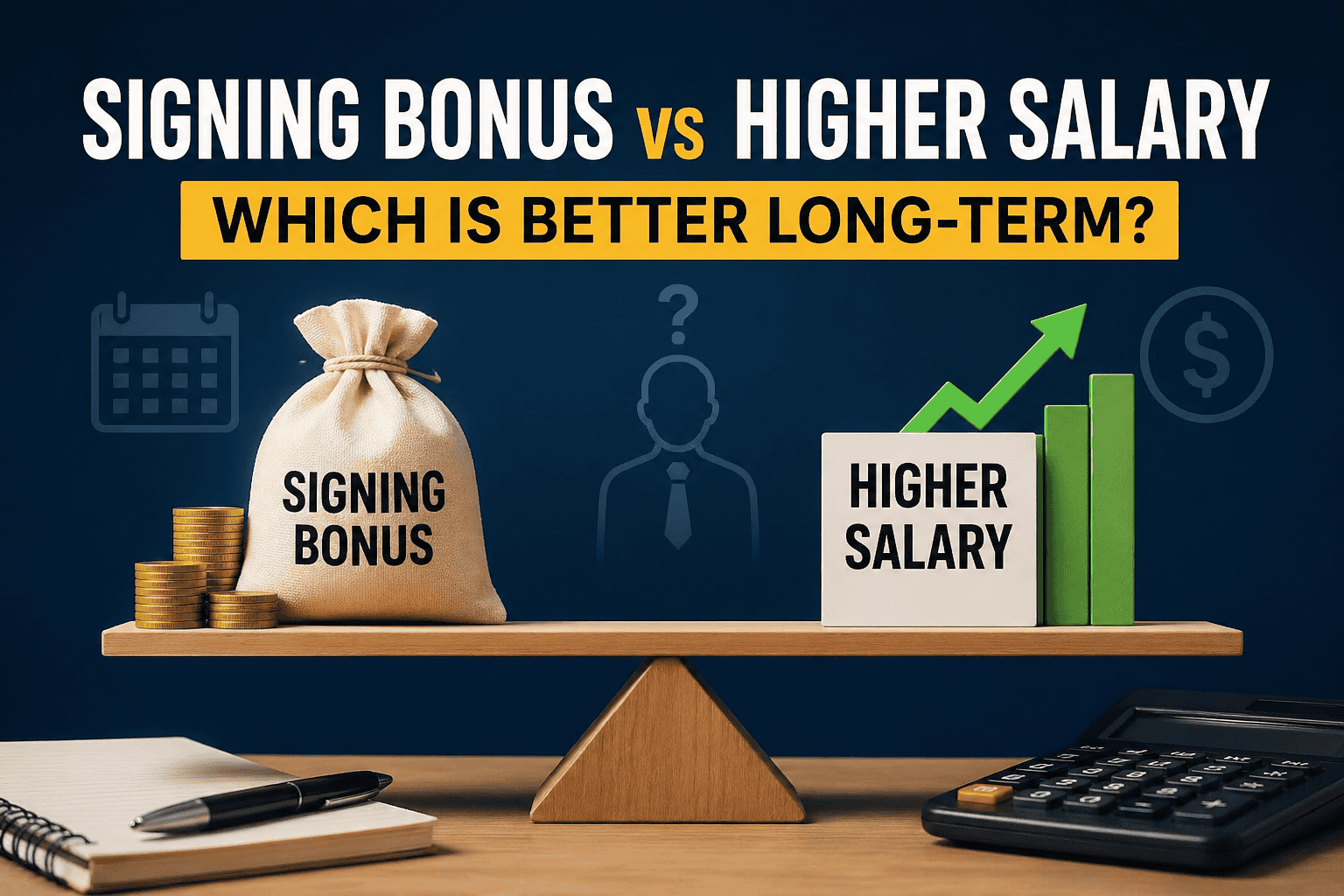
Signing Bonus vs Higher Salary: Which Is Better Long-Term?
Signing bonus vs higher salary — which offer wins long-term? A compensation expert breaks down the real math, clawback risks, and how to negotiate both.
By Daniel Carter | Director of Compensation & Benefits (Ex-Mercer, PwC clients) | New York / London | 15+ years in total rewards strategy
You’ve just received an offer. The title looks right, the company is solid — and then HR drops a choice in your lap that most candidates aren’t prepared for.
Option A: ₹5 lakh (or $10,000) as a signing bonus. Option B: ₹1.5 lakh (or $3,000) added to your annual base salary. Same total value on paper. Completely different outcomes over time.
The signing bonus feels like a win. Immediate. Tangible. But I’ve spent 15 years building compensation frameworks at Mercer and advising Fortune 500 HR leaders, and I’ll tell you this plainly: the signing bonus vs higher salary decision is one of the most consequential — and most misunderstood — career finance choices a professional makes.
In this article, I’ll break down exactly how each option plays out over three, five, and ten years, when a signing bonus is actually the right call, and the negotiation move that often gets you both.
What Is a Signing Bonus vs Higher Salary?
Before the math, let’s get the definitions straight — because they’re not as similar as they look on a total compensation sheet.
Signing Bonus
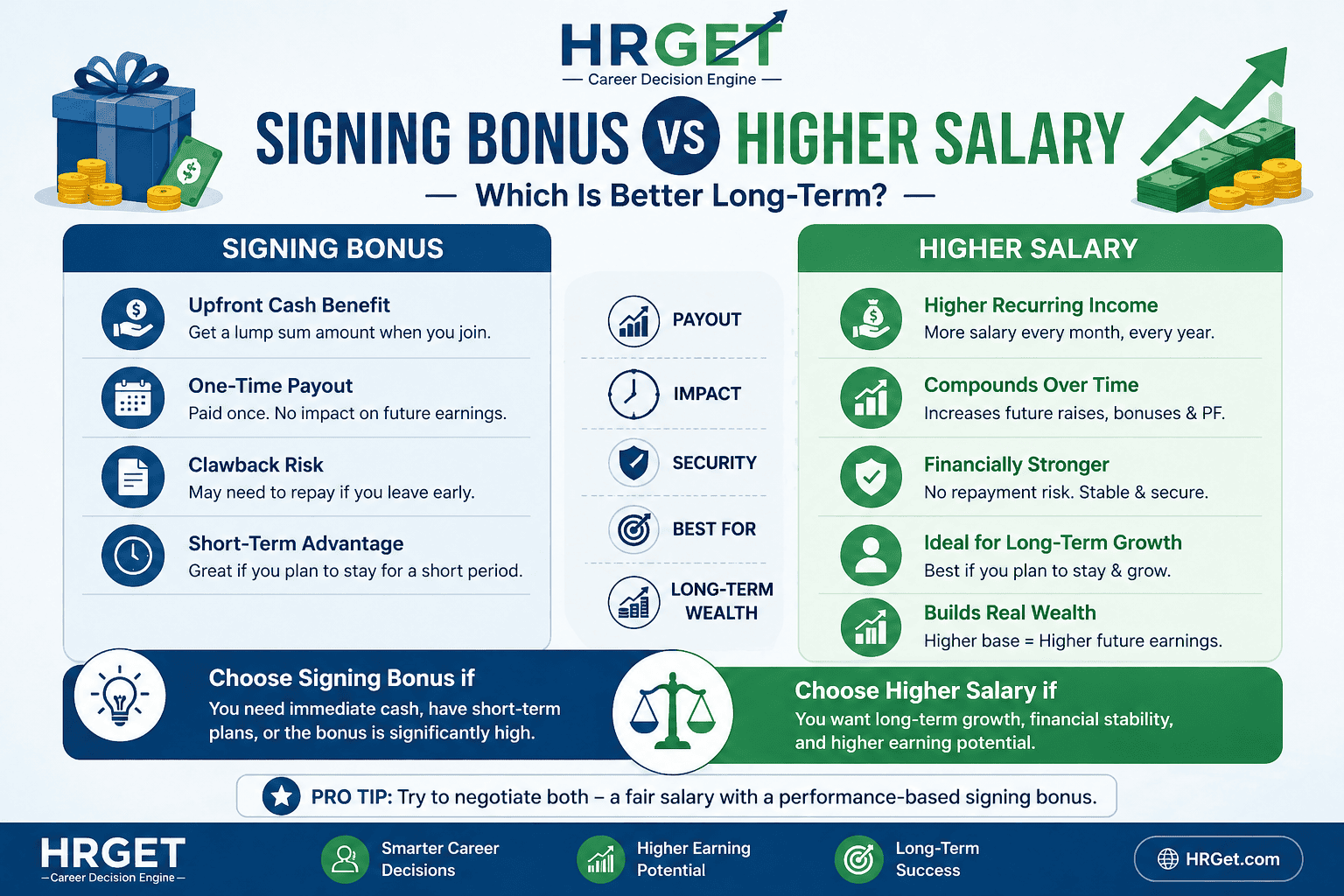
A signing bonus is a one-time payment made when you formally accept and join a company. It’s typically paid in the first paycheck or within your first 90 days. Here’s what most candidates don’t read carefully enough:
- It’s non-recurring. Once paid, it’s gone. It does not factor into your next annual raise calculation.
- It usually comes with a clawback clause. If you leave within 12–24 months, you may be contractually required to repay part or all of it.
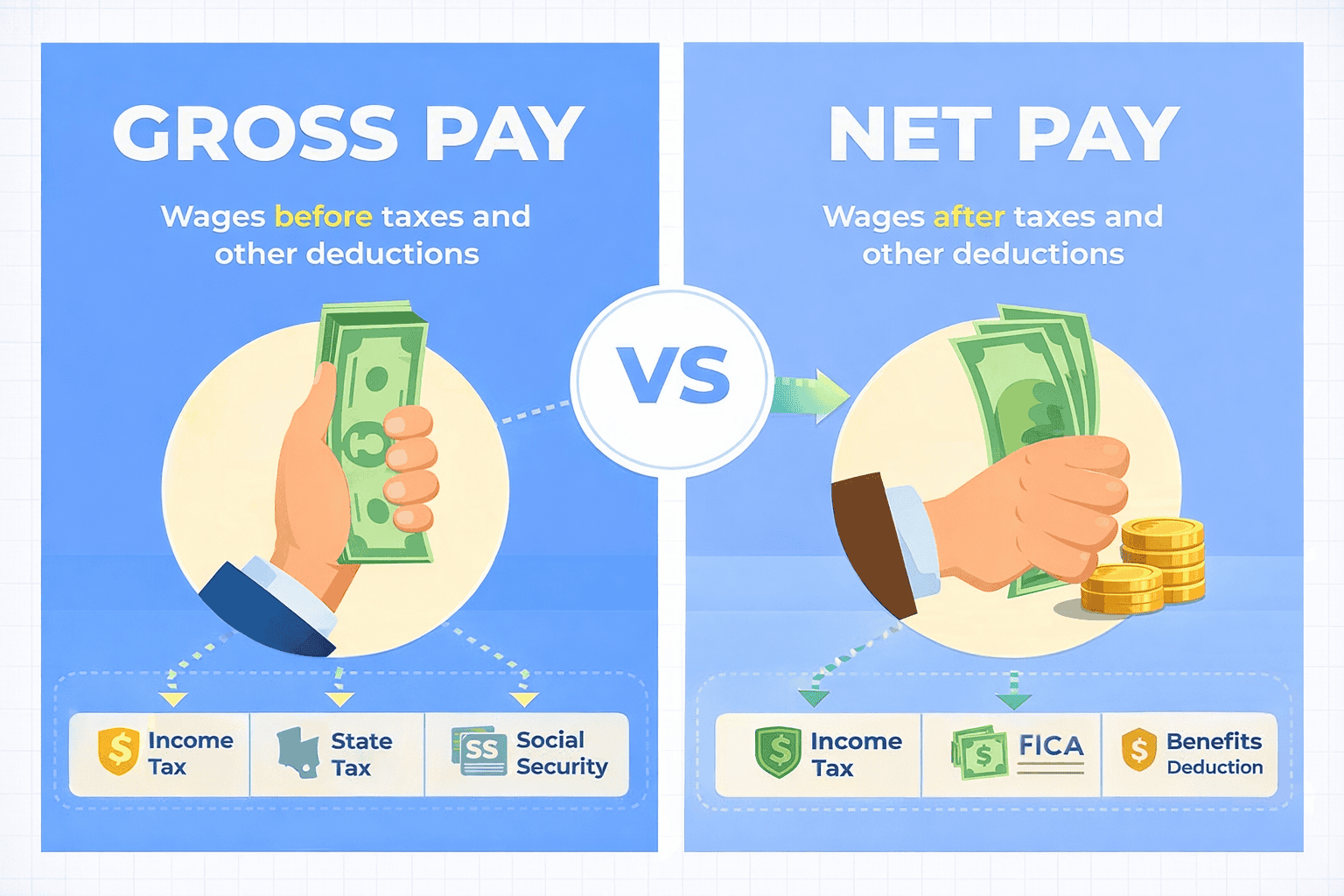
- It’s taxed as ordinary income. In India, it’s added to your gross salary and taxed at your slab rate. In the US, it’s subject to federal withholding — often at a flat 22% rate, plus state taxes. The ₹5L or $10K you see often nets down significantly.
Higher Base Salary
A higher base salary is a permanent increase in your fixed monthly or annual pay. Every element of your financial life compounds from this number:
- Annual increments are calculated as a percentage of your base — so a higher base means larger rupee/dollar raises each year
- Performance bonuses at most companies are set as a percentage of base (10%, 15%, 20%)
- PF contributions in India, 401(k) employer matches in the US, and gratuity calculations are all pegged to base pay
- Your next employer will anchor their offer to your current salary — and that anchor sets your negotiating floor for years
One is a transaction. The other is infrastructure.
Why Companies Offer Signing Bonuses (The Hidden Motive)
Here’s the part that most career advice articles gloss over — and it’s the most important thing to understand before you respond to any offer.
The Insider View
Signing bonuses are almost always cheaper for the company than raising base salary. When HR pushes a bonus offer, it’s not generosity — it’s arithmetic. A one-time ₹5L payment costs them exactly ₹5L. That same ₹1.5L in additional annual salary costs them ₹1.5L this year, ₹1.5L next year, and then compounds with every raise cycle — forever.
Beyond the raw cost, companies use signing bonuses for three structural reasons:
- They don’t break internal salary bands. Every role has a salary band. If they pay you above the band top, it creates equity problems with existing employees doing the same job. A bonus sidesteps this entirely.
- They create a retention lock without long-term obligation. The clawback clause keeps you from walking for 12–24 months. After that, you’re free — and so are they. No ongoing commitment was made.
- They look impressive on offer letters. A bold “₹5,00,000 Signing Bonus” in large text is a psychological win for the recruiter. Most candidates don’t run the long-term numbers. They accept.
Understanding this isn’t cynical — it’s useful. When you know what’s driving the offer structure, you negotiate from clarity rather than flattery.
Long-Term Impact: Salary vs Bonus — The Real Numbers
Let’s stop being vague and actually run the numbers. I’ll use the exact scenario from the draft offer above, because it’s one of the most common structures I see in mid-career offers across India and the US.
The Setup
- Option A: ₹20L base salary + ₹5L signing bonus (one-time)
- Option B: ₹21.5L base salary, no signing bonus
Assuming a conservative 10% annual increment in both cases, here’s how the total cumulative earnings look:
| Year | Option A Earnings (₹20L base + ₹5L bonus yr 1) | Option B Earnings (₹21.5L base) | Salary Advantage (B over A) |
|---|---|---|---|
| Year 1 | ₹25L (₹20L + ₹5L bonus) | ₹21.5L | A leads by ₹3.5L |
| Year 2 | ₹22L | ₹23.65L | B leads by ₹1.65L |
| Year 3 | ₹24.2L | ₹26L | B leads by ₹1.8L/yr |
| Year 5 | ₹29.3L | ₹31.5L | B leads by ₹2.2L/yr |
| Cumulative (5 yrs) | ~₹1.25 Cr | ~₹1.29 Cr | B wins by ₹4L+ |
By Year 2, the salary option overtakes. By Year 5, it’s meaningfully ahead — and that gap widens with every subsequent job switch, because future employers anchor on your current base salary, not your one-time bonus history.
The signing bonus is spent. The base salary is still working.
Real Scenario: Two Engineers, Same Role, Very Different Outcomes
Real Scenario
Priya accepts a Senior Product Manager role in Bengaluru. Offer: ₹28L base + ₹6L signing bonus. She’s thrilled — the bonus covers her next international trip and emergency fund.
Arjun negotiates the same role at a competing firm. He declines a ₹6L signing bonus and pushes for ₹30L base instead. The recruiter agrees.
Three years later, both switch companies. Priya’s résumé shows ₹28L current CTC. Arjun’s shows ₹30L — already ₹2L ahead before increments. His new offer is anchored at ₹38L. Priya’s is at ₹35L. The ₹6L signing bonus Priya took cost her ₹3L per year — compounding.
This plays out across industries, countries, and career levels. The signing bonus is a short-term optic. The base salary is the foundation everything else is built on.
When a Signing Bonus Is Actually the Right Choice
I don’t want to make this a one-sided argument, because there are genuine situations where the signing bonus wins. Here’s when to take it:
1. You Have an Immediate Financial Need
Relocation costs, a loan you need to clear, a family medical expense, or an emergency fund that simply isn’t there yet. If the bonus solves a real problem right now, it has genuine utility that a higher monthly salary can’t replicate fast enough.
2. You’re Already Planning to Leave Within 18 Months
If you know this is a stepping-stone role — a title upgrade, a sector switch, a bridge while you finish an MBA — extract the upfront value. You won’t be around long enough for the base compounding to matter, and if you negotiate well, you can get the clawback window down to 12 months or less.
3. The Salary Band Is Genuinely Fixed
Some companies — particularly listed firms in India with rigorous pay-band structures, or US corporates in highly regulated sectors — simply cannot move base salary above a set ceiling for your grade. In these cases, the signing bonus is the only lever HR can pull. Take it, but know what it is: a workaround, not a reward.
4. The Bonus Is Disproportionately Large
If a company offers you a signing bonus equivalent to 40–60% of your annual salary, the math changes. At that scale, even with compounding on the salary side, the payback period extends long enough that the bonus wins — especially if paired with a market-rate base.
Pro Tip
If you take the signing bonus, negotiate the clawback window down before signing. Standard is 24 months — push for 12. Also ask if the clawback is on a declining scale (e.g., 100% in Year 1, 50% in Year 2). This is common and significantly changes your risk profile.
When Higher Salary Wins — Which Is Most of the Time
For the majority of professionals in their 25–40 earning window, base salary is almost always the better negotiation target. Here’s why, systematically:
Everything Percentages Scale From Base
Your annual performance bonus is typically 10–20% of base. Your PF contribution in India is 12% of basic. Your 401(k) employer match in the US ties to salary. ESOPs and RSU grants at many companies are calculated as a multiple of base. A ₹2L increase in base might add another ₹30–40K in PF contributions, ₹20–40K in bonus payout, and materially more in ESOP value — in Year 1 alone.
Future Employers Start From Your Current Base
This is the career finance concept most people underestimate. When you negotiate your next role, the recruiter’s first question — spoken or unspoken — is: “What are you currently making?” Whether you disclose it or not, your current CTC shapes the conversation. A ₹2L higher base today may anchor your next offer ₹4–6L higher, especially if you switch companies every 2–3 years.
Increment Math Rewards Higher Bases
A 12% annual increment on ₹20L = ₹2.4L raise. The same 12% on ₹22L = ₹2.64L raise. Small difference in Year 1, but it compounds. Over a decade, the gap between two professionals who started at ₹20L vs ₹22L — with identical raise percentages — can easily exceed ₹30–40L in cumulative earnings.
Smart Strategy: How to Negotiate Both
Here’s the negotiation move that most candidates leave on the table: don’t choose one. Negotiate for both — and position yourself strategically to get at least some of each.
The Opening Frame
What to Say (Exact Script)
“Thank you for the offer — I’m genuinely excited about this role. I’d prefer to close the gap through base salary if possible, since that aligns better with how I think about long-term growth. If there’s limited flexibility on base, I’m open to discussing a signing bonus to bridge the difference. Is there room to explore both?”
This script does three things: it signals that you understand compensation structure (credibility), it frames the preference without being combative, and it opens the door to a hybrid outcome. In my experience, this phrasing — or something close to it — results in a better outcome than candidates who lead with a number or say nothing at all.
The Counter-Offer Structure
If HR comes back firm on base, pivot to the bonus — but ask for it to be split. Request 60% at joining, 40% at 12-month anniversary. This reduces their clawback risk perception and often unlocks a larger total bonus. You get early cash plus a reason to stay.
What to Verify Before Signing
- Clawback terms: percentage, duration, and whether it’s pro-rated
- Tax treatment of the bonus in your jurisdiction (India: taxed as salary; US: withholding rate varies)
- Whether the bonus is counted toward your total CTC or listed separately — this matters for future disclosure
Common Mistakes Professionals Make With This Decision
After reviewing hundreds of offer negotiations, these are the errors that cost people the most:
Mistake 1: Treating the Bonus as Found Money
It isn’t free. You earned it by accepting below-market base salary. Frame it that way in your own head, or you’ll fail to negotiate it properly.
Mistake 2: Not Reading the Clawback Clause
I’ve seen professionals repay ₹8–10L when they left a company at 14 months because the clawback was 24 months, non-negotiated, and full repayment. Read the clause. Negotiate the terms. This is not optional.
Mistake 3: Ignoring Tax Impact
A ₹5L signing bonus in the 30% tax bracket in India nets to roughly ₹3.5L. That ₹5L headline number should be evaluated against the post-tax reality. The same logic applies in the US, where signing bonuses are often withheld at a supplemental rate of 22% federally, plus state taxes — before you see a rupee or dollar of it.
Mistake 4: Accepting the Offer Structure as Fixed
Many candidates assume the offer letter is the final word. It rarely is. HR expects negotiation. Compensation teams often have 10–20% flexibility they don’t disclose in the initial offer. The professionals who negotiate respectfully and specifically almost always do better than those who accept immediately.
Mistake 5: Thinking Only About Year 1
Career finance is a multi-decade game. A ₹5L difference in base salary today — compounded through increments, job switches, and percentage-based benefits — can be worth ₹1–2 Cr over a 15-year career. Do the projection. It changes how you think about every offer.
Final Verdict: Signing Bonus vs Higher Salary — Which Should You Choose?
Let me be direct, because hedging on this question doesn’t serve anyone.
The Decision Framework
- If you plan to stay 2+ years and care about career earnings trajectory: Negotiate base salary first. Every time.
- If you have an immediate financial need or this is a short-term role: Signing bonus can make sense — but negotiate the clawback terms aggressively.
- If salary bands are fixed and you’ve confirmed this: Take the bonus, but ask for it to be as large as possible and structured to minimize tax impact.
- In all cases: Try to negotiate both. More often than not, a confident, well-framed ask gets you a hybrid outcome better than either option alone.
The signing bonus feels like a win on offer day. The higher salary feels like a win every day after that — for the rest of your career at that company, and every job that follows. That asymmetry is why I tell virtually every professional I advise to prioritize base.
Your compensation structure doesn’t just reflect your current value. It determines your future earning power. Choose accordingly. And if you want to go into that negotiation conversation fully prepared, read our guide on how to negotiate a salary offer without losing the job — it covers the exact language and timing that works.
Frequently Asked Questions
Is a signing bonus taxable in India?
Yes. In India, a signing bonus is treated as part of your salary income for the year it is received and taxed at your applicable income tax slab rate. If you receive it in a year where it pushes you into the 30% bracket, you may net significantly less than the headline figure. Ask HR to structure the payout timing to manage this.
Can I negotiate both a signing bonus and a higher salary?
Yes, and this is usually the smartest approach. Lead with a request for higher base salary — which has long-term compounding value — and then, if base is capped, ask for a signing bonus to bridge the gap. Framing it this way signals compensation intelligence and often results in a better total outcome than asking for either in isolation.
Does a signing bonus affect future salary increments?
No. A signing bonus is a one-time payment and has zero bearing on your annual increment calculations, which are always based on your base salary. This is one of the core reasons why higher base salary is structurally more valuable — every future raise, bonus percentage, and PF contribution scales from that number, not from any lump sum you received at joining.
What is a signing bonus clawback clause and how does it work?
A clawback clause is a contractual provision requiring you to repay part or all of your signing bonus if you leave the company before a specified period — typically 12 to 24 months. Some clauses require full repayment regardless of timing; others use a pro-rated structure. Always negotiate this term before accepting. A 12-month window with pro-rating is far more favorable than a flat 24-month full-repayment clause.
Why do companies prefer to offer a signing bonus over higher salary?
Companies prefer signing bonuses because they’re a one-time cost with no long-term obligation. A higher base salary increases the company’s total payroll permanently, impacts internal salary band equity, and raises future increment baselines. A bonus avoids all of that. It also creates a retention lock through the clawback clause. Understanding this dynamic helps you negotiate more effectively.
How does a higher base salary affect future job offers?
Your current base salary is the anchor point for most future offers. Recruiters and hiring managers — especially in India — often ask for your current CTC before making a counter-offer. A higher base raises your negotiating floor at every subsequent job switch, creating a compounding advantage that can be worth several lakhs per year over a 10-year career.
Should I disclose my signing bonus when a new employer asks for my CTC?
This is a nuanced call. Technically, your signing bonus is part of your first-year CTC — but it’s non-recurring. When disclosing CTC, it’s fair and accurate to present your base salary (and recurring benefits like annual bonus) separately from one-time components. Many candidates present it as “₹20L fixed + ₹5L joining bonus (one-time)” to give the recruiter an honest picture of your actual recurring compensation.

Eleanor Whitmore | Former Partner, Mercer | Advisor, World Economic Forum | 20+ Years in Global Compensation
Author bio: Eleanor Whitmore has spent over two decades shaping how the world’s leading organisations pay, retain, and reward talent. As a former Partner at Mercer and an advisor to World Economic Forum working groups on the Future of Work, she has designed compensation frameworks for Fortune 500 companies across the US, UK, Europe, and emerging markets. Based between London and New York, Eleanor writes for HRGet.com to translate boardroom-level pay strategy into actionable guidance for working professionals navigating real compensation decisions.