Most professionals think equity compensation is “free money.” It’s not.
The difference between RSUs (Restricted Stock Units) and stock options can easily swing your long-term wealth by $50,000 to $500,000 — and most of that gap comes down to one thing: understanding what you actually have.
I’ve spent 15 years structuring compensation packages at firms like Mercer and advising Fortune 500 clients on equity strategy. Here’s what I see most: people don’t lose money because they joined the wrong company. They lose because they misread their equity package entirely.
This guide cuts through the noise. By the end, you’ll know exactly which type of equity suits your situation — and how to avoid the mistakes that cost professionals real money every year.
What Are RSUs (Restricted Stock Units)?
RSUs are the simpler of the two. The company grants you a set number of shares — but there’s a condition: you have to stay employed long enough for them to vest.
Once vested, those shares are yours. No purchase required. You can sell immediately in most public company situations, or hold and wait for the stock to appreciate further.
Here’s how a typical RSU grant plays out:
- Company grants you 1,000 RSUs when stock is trading at $50/share
- They vest on a 4-year schedule — 25% per year (250 shares annually)
- After year one, 250 shares vest → at $50/share, that’s $12,500 in your pocket
- If stock climbs to $80 by year two vesting → those 250 shares = $20,000
The key thing: there’s no upfront cost. You’re not buying anything. The only real downside is if the stock drops significantly before you sell — which is why RSUs are considered the “lower risk” equity type.
RSUs are common at large, established companies — think Meta, Google, Amazon, Microsoft, and major financial institutions. When a recruiter says “we’re offering $180K total comp with $60K in equity,” they almost certainly mean RSUs.
What Are Stock Options?
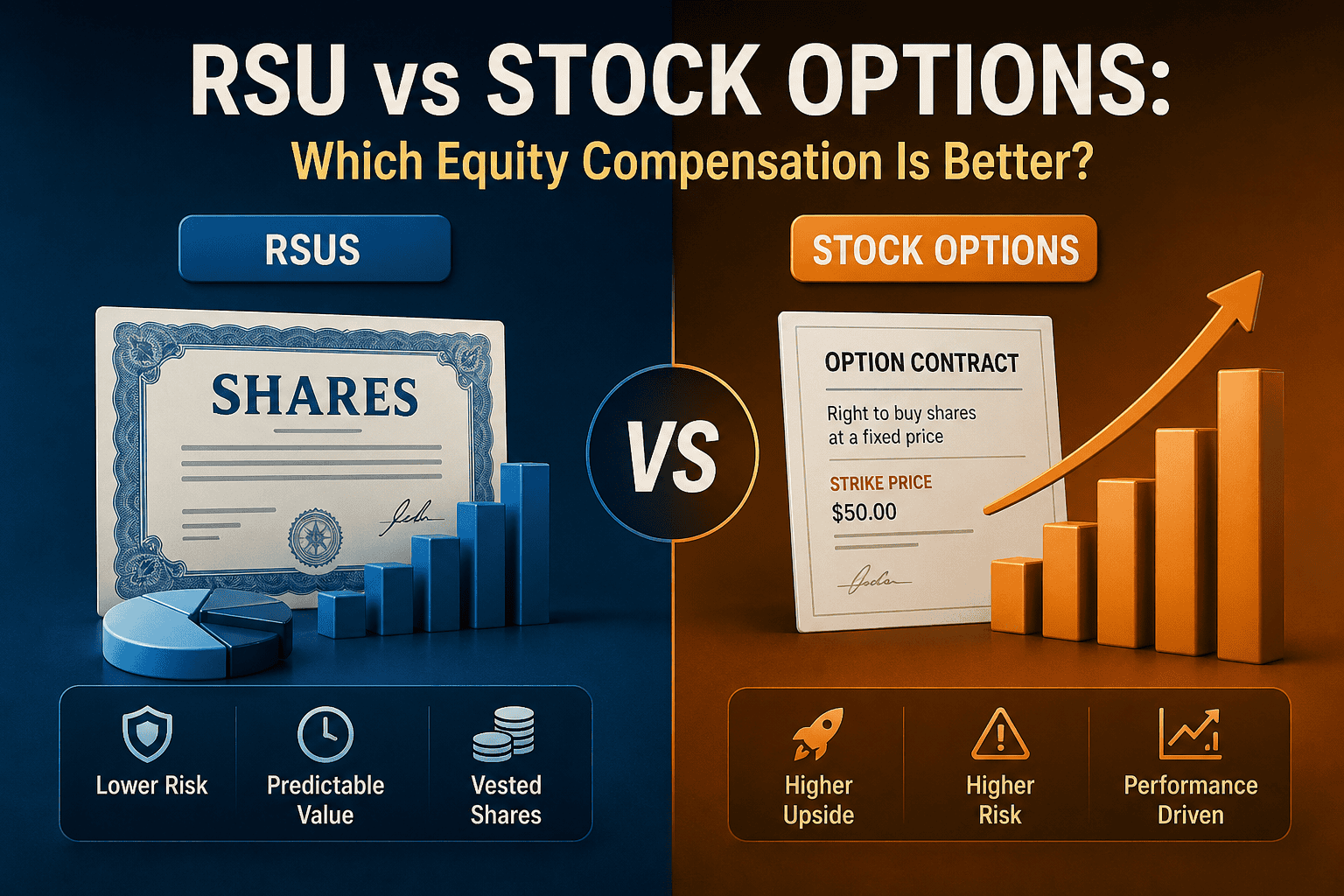
Stock options are different — and more complex. You’re not being given shares. You’re being given the right to buy shares at a fixed price, called the strike price (also called the exercise price).
You only make money if the stock price rises above that strike price. If it doesn’t, your options are worthless.
Example: Your strike price is $20. The stock is now trading at $50. Your profit per share = $30. That’s real money. But if the stock stays at $18? You have nothing worth exercising.
There are two main types of stock options, and the tax treatment is completely different:
- NSOs (Non-Qualified Stock Options) — available to employees, contractors, and advisors. Taxed as ordinary income when you exercise.
- ISOs (Incentive Stock Options) — only for employees, with more favorable tax treatment (no income tax at exercise in most cases), but can trigger the Alternative Minimum Tax (AMT).
Stock options are the standard currency at early-stage startups and Series A/B companies. They’re designed to attract talent when a company can’t compete on base salary — the pitch is “join us now, get rich when we IPO.”
Sometimes that pitch delivers. Often it doesn’t. The math on when it does is worth understanding clearly.
RSU vs Stock Options: Key Differences at a Glance
Before diving into scenarios, here’s the structural comparison that matters:
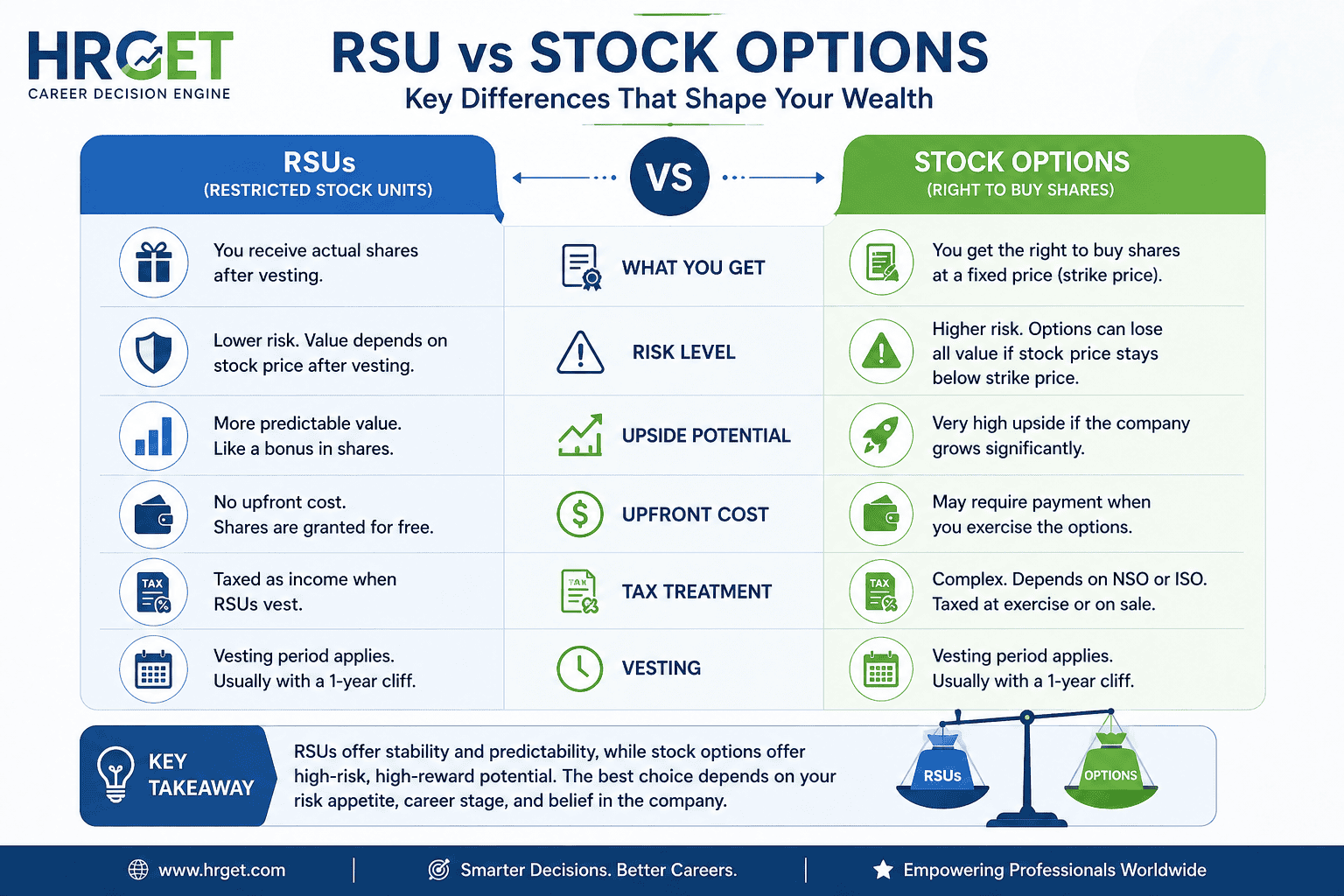
| Factor | RSUs | Stock Options |
|---|---|---|
| What you get | Actual company shares | Right to buy shares at a fixed price |
| Upfront cost | None | Must pay strike price to exercise |
| Risk level | Low — stock just needs to hold value | High — can become completely worthless |
| Upside potential | Moderate (tied to stock growth) | Very high (leveraged returns) |
| Tax event | At vesting (income tax) | At exercise (NSO: income tax; ISO: potentially AMT) |
| Typical company type | Public / large established firms | Startups / pre-IPO companies |
| Best for | Wealth preservation, mid/late career | High-growth bets, early career, risk tolerance |
Real Scenario: RSUs vs Options Side-by-Side
Let’s make this concrete. You’re evaluating two offers in 2026:
Offer A — Big Tech (RSUs): 1,000 RSUs, current stock price $100/share. Total equity value at grant: $100,000, vesting over 4 years.
Offer B — Series B Startup (Options): 10,000 stock options, strike price $5/share, current valuation implying $10/share.
Now play out three realistic scenarios:
Scenario 1: Moderate growth (the most common outcome)
Big Tech stock goes from $100 → $150. Your 1,000 RSUs are worth $150,000.
Startup stock goes from $10 → $15. Your options: ($15 − $5) × 10,000 = $100,000 profit.
RSUs win — better return, lower risk.
Scenario 2: Startup explodes (the dream scenario)
Startup hits $100/share. Your options: ($100 − $5) × 10,000 = $950,000.
Options win — massively. This is the scenario that creates overnight millionaires.
Scenario 3: Startup fails (the most likely startup outcome)
Startup stock drops to $3 — below your $5 strike price. Options are worthless: $0.
Your Big Tech RSUs? Still worth ~$150,000 assuming the stock held.
RSUs win by sheer survival.
The brutal honest summary: RSUs are wealth preservation. Stock options are wealth creation — or wealth destruction. The difference is almost entirely determined by the company’s outcome, not your skill or effort.
Which Is Better for You? A Decision Framework
Here’s the framework I walk clients through. Stop guessing and match your equity type to your actual situation.
Choose RSUs if:
- You’re mid or late in your career and building toward financial independence
- You have a mortgage, kids, or financial dependents — stability matters
- You’re joining a large public company (FAANG, major banks, established tech)
- You want predictable income you can plan around
- You don’t want to spend mental energy tracking strike prices, exercise windows, and AMT calculations
Choose stock options if:
- You genuinely believe in the company’s trajectory — not just the product, but the business model and team
- You’re early in your career with fewer financial obligations
- You can absorb losing the entire equity value without derailing your life
- You’re already financially stable from other income streams
- You want life-changing upside and you’re prepared to earn it with risk
The hybrid strategy (what sophisticated professionals actually do): Keep a high-RSU job at a large company for financial stability, while taking small angel/advisor equity positions at startups on the side. You get the floor and the ceiling. It’s not glamorous advice, but it’s what actually works over a 10-year horizon.
Tax Implications: Where Most People Lose Real Money
I’ll be direct — this section is where misunderstanding costs people tens of thousands of dollars. Pay attention.
RSU taxes: RSUs are taxed as ordinary income at vesting — not at sale. The moment your shares vest, the IRS (or HMRC, or Indian IT department) treats the fair market value of those shares as compensation income. You owe tax immediately, even if you haven’t sold a single share.
Example: 250 RSUs vest when stock is at $80. That’s $20,000 of ordinary income — taxed at your marginal rate, which for a $150K/year employee in the US might be 32–35%. Your company will typically withhold shares to cover this tax automatically, but that doesn’t mean you’re off the hook for planning around it.
After vesting, if you hold the shares and they appreciate, you’ll owe capital gains on that additional growth — either short-term (if held under 1 year) or long-term (if held over 1 year, taxed at lower rates).
NSO (Non-Qualified Stock Options) taxes: When you exercise NSOs, the “spread” — the difference between the strike price and the current fair market value — is taxed as ordinary income. Then, any further gains when you eventually sell are taxed as capital gains.
ISO (Incentive Stock Options) taxes: ISOs have potentially better tax treatment — no ordinary income tax at exercise. But exercising ISOs can trigger the Alternative Minimum Tax (AMT), which is a parallel tax calculation that trips up many startup employees who exercise a large batch of ISOs in a single year. This is not a theoretical risk. I’ve seen professionals receive unexpected $40K–$80K AMT bills.
Pro tip: RSUs are tax-simple but tax-heavy. Options are tax-complex but tax-optimizable — especially ISOs held for the qualifying periods. If you’re sitting on a large options grant, work with a CPA who specializes in equity compensation before you exercise anything. The tax planning window is narrow and the mistakes are irreversible.
Common Mistakes That Cost Professionals the Most
In 15 years of compensation work, I’ve watched smart people make the same avoidable errors. Here are the ones that actually matter:
1. Treating stock options like guaranteed cash. Until a liquidity event — an IPO, acquisition, or secondary sale — your options have no liquid value. They’re theoretical. Don’t factor them into your financial planning the same way you’d factor in a salary increase. I’ve watched people decline better-paying offers because of options packages that ultimately expired worthless.
2. Ignoring dilution. You join a Series A startup with 1% equity. The company raises Series B, C, D — each round issues new shares. Your 1% can realistically become 0.15–0.25% by exit. Ask for the fully diluted capitalization table before you sign anything.
3. Not understanding the vesting cliff. Most equity plans have a one-year cliff — meaning you vest nothing until you’ve completed 12 months. Leave at month 11? You get zero. After the cliff, vesting typically becomes monthly or quarterly. Know your exact schedule before considering any job move.
4. Missing the exercise window after leaving. Many companies give you only 90 days after your last day to exercise vested options. Miss that window — for any reason, including not having the cash to buy — and you forfeit everything. Some better-funded companies now offer extended windows of 5–10 years, but this is not standard. Always confirm your post-termination exercise period before you resign.
5. Concentrating too much of your net worth in company stock. This applies especially to RSUs. Your career is already correlated with your employer’s performance — your salary, bonus, and job security all depend on the same company. Holding large amounts of that company’s stock magnifies that risk considerably. Sell RSUs on a disciplined schedule and diversify.
Smart Strategies: Getting the Most from Your Equity
Most equity compensation advice stops at “understand the difference.” Here’s what actually moves the needle:
Negotiate equity, not just salary. Most professionals spend all their energy negotiating base pay and treat equity as a fixed number. It often isn’t. At large tech companies, additional RSU grants are sometimes more negotiable than salary — especially for senior roles. Ask explicitly. The worst answer is no.
Ask these three questions before accepting any equity offer: What is the total share count on a fully diluted basis? What is the company’s current 409A valuation (for private companies)? And what is the expected liquidity timeline — are there plans for an IPO or acquisition? If the company can’t answer these clearly, treat that as a serious red flag about internal financial hygiene.
Sell RSUs on a scheduled basis, not emotionally. The most common RSU mistake I see is holding indefinitely because “the stock might go higher.” It might. It also might drop 40% in a correction. Set a rule — for example, sell 50–75% of each vesting tranche within 30 days of vesting and invest in diversified assets. Keep a portion if you want company exposure, but don’t let it accumulate unchecked.
For options: consider an early exercise (83b election) carefully. If you’re joining a startup early and the stock price is still very low, exercising options immediately after grant and filing an 83(b) election can start the clock on long-term capital gains treatment — potentially saving a substantial amount in taxes if the company succeeds. But this requires upfront cash and real conviction in the company. It’s not right for everyone.
India-specific note: For professionals in India receiving ESOPs (the local equivalent of stock options), the tax treatment changed significantly with the 2020 Finance Act. ESOPs from eligible startups now defer tax to sale, rather than exercise — a meaningful improvement. Check whether your employer qualifies for DPIIT recognition, as this determines your tax treatment entirely.
RSU vs Stock Options: The Honest Final Verdict
Here’s my honest answer after 15 years in compensation: RSUs are better for most working professionals in 2026.
They’re simpler, lower risk, immediately liquid once vested, and at large tech companies they represent genuinely significant compensation — often $50K–$200K+ per year for senior roles. The predictability alone has real value when you’re making financial plans.
Stock options are better if — and only if — you have high confidence in a specific company’s growth trajectory, you can financially and emotionally handle the possibility of getting nothing, and you’re prepared to manage the complexity of exercise timing, dilution, and tax optimization.
The choice isn’t really RSUs vs options. It’s a question of what stage you’re at, what risk you can absorb, and how well you understand the mechanics of what’s being offered. Get those three things right, and the specific equity type becomes a secondary decision.
If you’re currently evaluating a compensation package and want to understand the full picture — base, bonus, equity, and benefits — read our guide on how to negotiate your total compensation package for the complete framework.
Frequently Asked Questions: RSU vs Stock Options
Are RSUs always better than stock options?
No — RSUs are safer and simpler, but stock options can dramatically outperform if the company grows significantly. RSUs are better for stability and predictability; options are better for high-risk, high-reward bets at early-stage companies. Your career stage, financial situation, and risk tolerance should drive the choice.
Can stock options make you rich?
Yes — but three conditions need to align: the company must succeed and reach a liquidity event (IPO or acquisition), you must stay long enough to vest a meaningful amount, and you must manage the tax implications correctly at exercise. When all three work out, early startup options have created enormous wealth. When any one fails, the outcome is typically zero.
Do RSUs lose value?
Yes. RSUs are tied to the company’s stock price. If the stock drops significantly after vesting — which happens even at large companies — the value of your RSUs falls accordingly. This is why selling a portion of vested RSUs promptly and diversifying into other assets is generally sound financial practice rather than speculative caution.
What happens to my RSUs and options if I leave before vesting?
Unvested RSUs are forfeited — you receive nothing for shares that haven’t yet vested. For options, you typically have a 90-day window after your last day to exercise vested options before they expire. Unvested options are lost. Always check your grant agreement for the exact post-termination exercise period, as this varies by company and can be as short as 30 days.
Should I exercise stock options early?
Early exercise combined with an 83(b) election can be tax-efficient if the stock price is very low and you have strong conviction in the company. It starts the long-term capital gains clock early and limits ordinary income exposure. However, it requires upfront cash and carries real risk of loss. Consult a CPA who specializes in startup equity before proceeding — the decision window is narrow and typically irrevocable.
Are RSUs taxed twice?
Not exactly twice. RSUs are taxed as ordinary income at vesting on the fair market value at that time. If you then hold the shares and they appreciate further before selling, the additional gain is taxed as capital gains — short-term or long-term depending on how long you hold. Two separate tax events, but you’re only ever taxed on the actual value received at each point.
What is better for startups: RSUs or stock options?
Most early-stage startups offer stock options rather than RSUs. RSUs at private companies create an immediate tax liability at vesting even though the shares aren’t liquid — which is a real problem for employees. Options defer that tax event to exercise, making them far more practical for pre-IPO companies. Some later-stage startups (Series C and beyond) do offer RSUs, often structured with double-trigger vesting to manage the tax issue.
What is a vesting cliff and how does it affect me?
A vesting cliff is the minimum time you must stay employed before any equity vests. The standard is a one-year cliff — meaning if you leave before 12 months, you receive nothing from that grant. After the cliff, vesting typically continues monthly or quarterly for the remaining years. Understanding your cliff is critical before making any career move that would take you past month six or seven with a current employer.

Eleanor Whitmore | Former Partner, Mercer | Advisor, World Economic Forum | 20+ Years in Global Compensation
Author bio: Eleanor Whitmore has spent over two decades shaping how the world’s leading organisations pay, retain, and reward talent. As a former Partner at Mercer and an advisor to World Economic Forum working groups on the Future of Work, she has designed compensation frameworks for Fortune 500 companies across the US, UK, Europe, and emerging markets. Based between London and New York, Eleanor writes for HRGet.com to translate boardroom-level pay strategy into actionable guidance for working professionals navigating real compensation decisions.