

Losing your job hits differently than most setbacks. One day you’re in back-to-back meetings, planning your next move up the ladder. The next, you’re staring at a termination letter and trying to remember how much is in your savings account.
Here’s what 18 years of employment law and severance advisory work has taught me: the first 72 hours after a layoff determine how well you come out the other side. Not the weeks. Not the months. The first three days.
Act randomly, and you’ll lose money, miss irreversible benefit windows, and start your job search in a weaker position than you need to be. Act with a clear plan — and you can protect your finances, negotiate better terms, and even use this moment as a genuine career reset.
This is your complete, no-fluff guide on what to do after a layoff — built for professionals across the US, India, UK, and UAE in 2026. Let’s get into it.
Immediate Actions: What to Do in the First 24 Hours
Most people’s instinct is to panic-apply to every job on LinkedIn within 48 hours. Resist that. The first day is not about job searching — it’s about protecting yourself legally and financially before company access is cut.
Secure Your Key Documents Before Access Is Cut
This is step one, and there’s no recovering from missing it. Once your email and internal systems are shut off — which can happen within hours of notification — you lose access to documents you’ll absolutely need later.
Before you log off that last time, download or forward to a personal email:
- Your original offer letter and any promotion letters
- Pay slips from the last 3–6 months
- Performance reviews (especially positive ones — these matter in severance negotiations)
- Bonus agreements, stock/RSU grant letters, and ESOP documentation
- Any HR policies referenced in your offer (notice period, severance formula)
- Expense reimbursements that are still pending
Why does this matter? These documents directly affect your severance negotiation, unemployment eligibility, and salary benchmarking in your next role. I’ve seen professionals lose out on tens of thousands of dollars — or lakhs in India — simply because they couldn’t produce the right paperwork at the right moment.
Clarify Your Exit Package — Don’t Assume Anything
Companies often present layoff terms as final and non-negotiable. They’re frequently not. But you need clarity before you can evaluate anything.
Request a written summary from HR that covers:
- Severance amount and payment structure (lump sum vs. continued payroll)
- Your official last working day
- Whether any pro-rated bonus is owed
- RSU/stock option vesting status and your exercise window post-exit
- Unused PTO or earned leave payout (in many US states, this is legally required)
- Health insurance end date and continuation options
Get everything in writing. Verbal assurances are worth nothing once HR moves on to the next conversation.
Do Not Sign Anything for at Least 24–72 Hours
I’ll be honest — this is where I see professionals make the most expensive mistake. Companies often create urgency around signing exit paperwork. “We need this back by end of day.” That pressure is intentional.
What you’re typically signing away: a release of legal claims (including potential wrongful termination claims), non-compete and non-solicitation terms, and the specific severance structure. Once signed, your negotiation window largely closes.
In the US, workers over 40 are legally entitled to at least 21 days to consider a severance agreement under the ADEA (Age Discrimination in Employment Act). Even if you’re younger, take the time. In India, review your appointment letter clauses carefully — non-competes are increasingly enforceable in the tech sector.
Pro Tip: If the severance feels low relative to your tenure or seniority, you have more leverage than you think. I’ve helped professionals at Fortune 500 companies increase initial severance offers by 30–60% simply by asking, in writing, for a review — especially when they can reference performance records or point to equity that hasn’t fully vested.
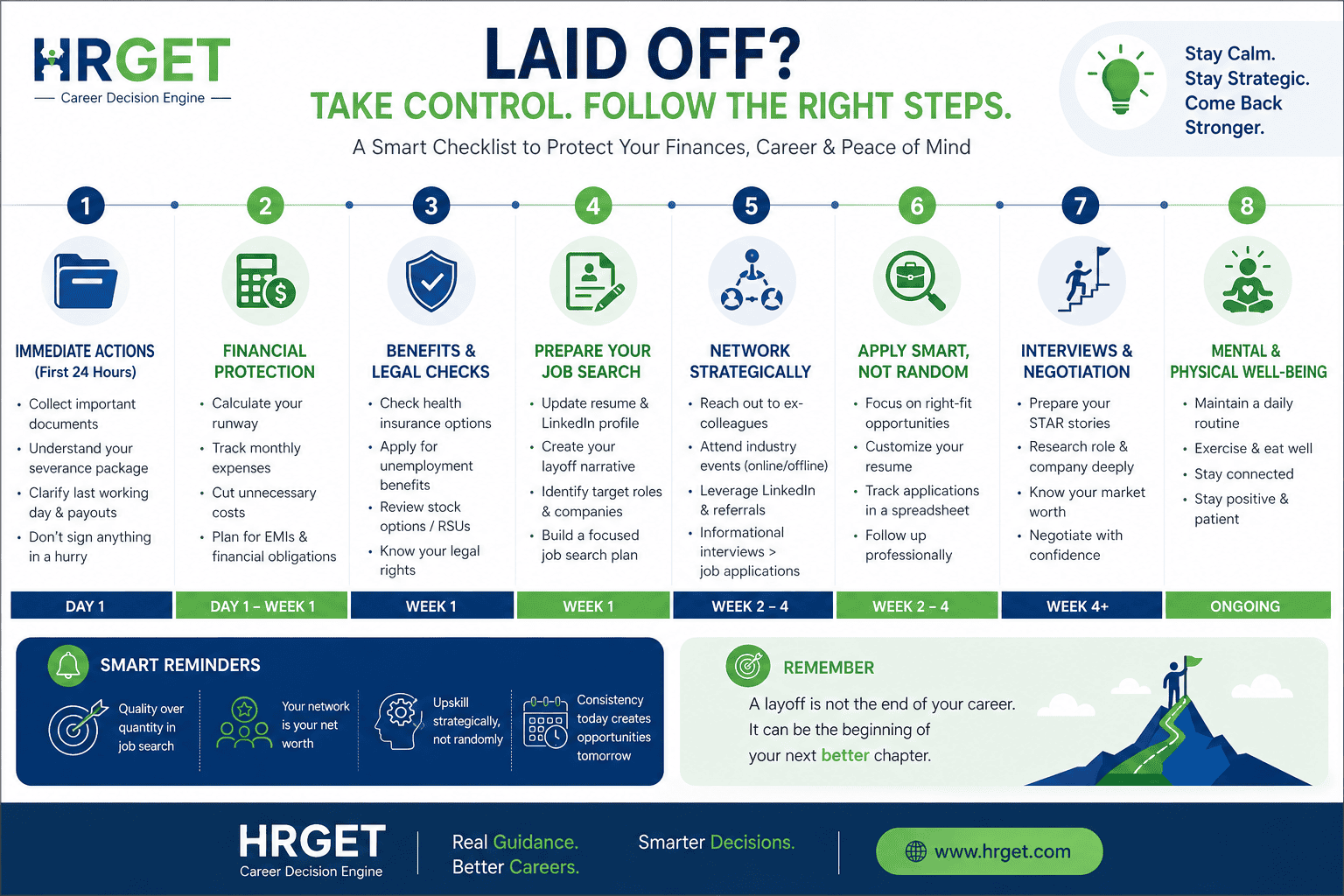
Financial Protection: Get Your Numbers Right
This is where most people lose control — not because they make dramatic mistakes, but because they don’t run the numbers quickly enough and end up making fear-based decisions later.
Calculate Your Real Runway
Sit down and do this exercise within 48 hours. Add up:
- Available liquid savings (not investments — cash or near-cash)
- Expected severance payout (net of tax)
- Any PTO payout
- Monthly fixed burn: rent/mortgage or EMI, utilities, food, insurance premiums, loan repayments
Divide your total available resources by your monthly burn. That number — your runway in months — is the single most important figure in your post-layoff financial plan.
For most mid-career professionals in India’s Tier 1 cities, a realistic monthly burn ranges from ₹60,000 to ₹1.8 lakh depending on lifestyle and family obligations. In the US, $4,000–$8,000/month is typical for a professional in a major metro. Know your number. It determines how much time pressure you’re actually under.
Triage Your Spending — Calmly, Not Drastically
You want to extend runway without destroying your mental state. Drastic cuts — eliminating everything enjoyable — tend to create the kind of anxiety that leads to accepting the wrong job offer too quickly.
Instead, separate expenses into three buckets: non-negotiable (rent, food, health insurance), reducible (subscriptions, dining out, discretionary travel), and deferrable (major purchases, vacations, investment contributions). Cut the reducible and defer the deferrable. Keep the non-negotiable intact.
If your runway is under 3 months, add one more action: contact lenders early. In India, most banks offer EMI moratoriums for documented job loss. In the US, mortgage servicers and many auto lenders have hardship programs. These conversations are far easier when you initiate them proactively rather than after a missed payment.
Benefits and Legal Moves You Cannot Afford to Miss
Here’s where uninformed professionals leave real money on the table. Benefits have strict windows. Legal rights have deadlines. Miss them and they’re gone.
Health Insurance: Act Within Days, Not Weeks
US: Under COBRA, you have 60 days from the loss of coverage notice to elect continuation. COBRA is expensive (you pay the full premium the employer was covering, plus 2%), but it’s a bridge. Compare it against ACA marketplace plans — a Special Enrollment Period opens when you lose job-based coverage, and depending on your income, subsidies may make marketplace plans significantly cheaper.
India: Group health policies end quickly — sometimes on your last day of employment. Don’t assume you have time. Get a portable individual or family floater policy lined up before your exit date. Costs range from ₹8,000 to ₹25,000/year for solid coverage, and it’s worth every rupee.
UK/UAE: If you’re on an employer-sponsored plan, check the exact end date and explore short-term private cover to bridge to your next role.
Unemployment Benefits: File Immediately
I cannot stress this enough. In the US, roughly 40% of eligible laid-off workers don’t file for unemployment benefits — often because of stigma or the assumption that they’ll find a job quickly. That’s free money you’re leaving behind.
Benefits typically replace 40–60% of your prior weekly wage, up to state caps. Processing takes 2–4 weeks, so the sooner you file, the sooner payments begin. File the same week you’re laid off — even if you’re confident a new role is weeks away. You can always stop claiming once you’re reemployed.
In India, the equivalent is ESIC (Employees’ State Insurance Corporation) unemployment benefit for those who were covered under the scheme — worth checking if your employer contributed to ESIC.
RSUs and Stock Options: This Could Be Your Biggest Financial Decision
If you had equity compensation, this deserves its own focused attention. The most common scenario I see professionals miss: unvested RSUs that are partially accelerable under good-leaver provisions in the company’s equity plan, and ISOs (Incentive Stock Options) that expire 90 days post-termination.
Ask HR specifically: What vests on my last day? What is my post-termination exercise window for options? Are there any good-leaver provisions that could accelerate vesting given the circumstances?
Missing a 90-day exercise window on in-the-money options is a mistake that can cost $10,000–$100,000+ at larger companies. This is worth a one-hour consultation with an employment attorney if the equity value is significant.
Know Your Legal Rights by Region
A quick reference for what to check based on where you’re employed:
| Region | Key Rights to Check |
|---|---|
| USA | WARN Act (60 days notice for mass layoffs at 100+ employee companies), COBRA, earned PTO payout (state-dependent), ADEA review period if 40+ |
| India | Notice period pay or buy-out, gratuity (if 5+ years), PF withdrawal/transfer, retrenchment compensation under Industrial Disputes Act (for eligible roles) |
| UK | Statutory Redundancy Pay (if 2+ years service), consultation rights, notice period, potential unfair dismissal claim if process wasn’t followed |
| UAE | End-of-service gratuity calculation, notice period entitlement under UAE Labour Law, arbitrary dismissal protection |
Job Search Strategy: Weeks 1 Through 4
Here’s the counterintuitive advice that actually leads to faster, better job outcomes: don’t mass-apply in Week 1.
The professionals I’ve seen land the best roles post-layoff — not just fast roles, but genuinely better roles — spent their first week positioning before applying.
Week 1: Build Your Foundation Before You Apply
Your resume needs measurable impact, not just responsibilities. “Managed a team” becomes “Led a cross-functional team of 9 that delivered a $2.4M product migration on time.” Every bullet should answer: so what? What was the outcome?
Your LinkedIn profile should signal that you’re an attractive candidate, not someone in distress. Update your headline to reflect the role you’re targeting — not your last title. Turn on “Open to Work” but restrict it to recruiters only if you’re concerned about visibility to your former employer’s network.
Also prepare your layoff narrative. You will be asked about this in every interview. Keep it short, neutral, and forward-focused:
“My role was eliminated as part of a company-wide restructuring. I have full clarity on why it happened — it was a business decision, not a performance issue. I’m now focused on [specific type of role] where I can bring my experience in [key skill area].”
That’s it. No over-explaining. No criticizing the former employer. No visible anxiety. Interviewers are watching how you handle adversity — your response is a preview of how you’ll handle it at their company.
Weeks 2–3: Targeted Applications, Not Volume
Ten to fifteen high-quality applications per week consistently outperforms 80+ spray-and-pray applications. Here’s why: tailored applications that speak directly to the job description get callback rates of 15–25%. Generic applications rarely break 5%.
Prioritise referral pathways. Research suggests roughly 70% of filled roles are never publicly posted — and of those that are, referrals get a dramatically higher response rate than cold applications. Every job you apply to, check whether you have a first or second-degree LinkedIn connection at that company first.
Week 4: Interview Prep and Salary Anchoring
By Week 4, if your positioning is right, you should be in early-stage conversations. This is when to invest time in STAR method story preparation — structured behavioral answers that demonstrate impact rather than activity.
On salary: anchor 15–20% above your last base. Being laid off does not reduce your market value. Research current market rates on LinkedIn Salary, Glassdoor, and for India-based roles, AmbitionBox. Know your number before any compensation conversation starts.
Real Scenario: Two Professionals, One Layoff Event
I’ve worked with hundreds of people navigating layoffs. Here’s a composite that captures what I see play out most often.
Priya, Senior Product Manager, Bangalore (8 years experience): Gets laid off from a mid-stage startup. She panics, applies to 120 jobs in Week 1, accepts the first offer she gets — a step-down in title — at ₹22 LPA when her market rate is ₹28–32 LPA. She didn’t negotiate severance. She didn’t check her ESOP vesting. She left ₹4+ lakhs in unvested equity on the table.
Amit, same role, same layoff: Spends Day 1 securing documents and clarifying his exit package. Pushes back on severance with a single well-worded email — gets an extra month added. Files PF transfer immediately. Takes a week to update his resume and LinkedIn. Reaches out to 14 former colleagues. Gets 3 referrals into strong hiring pipelines. By Week 7, he has two competing offers and negotiates to ₹31 LPA — a 12% increase over his previous package.
Same layoff. Vastly different outcomes. The difference wasn’t luck or connections. It was a structured plan executed calmly in the first week.
Common Mistakes That Cost You Money
These come up repeatedly — and most are completely avoidable.
Signing severance immediately. You lose negotiation leverage the moment you sign. Even a brief “I’d like a few days to review this with an advisor” email buys you time and sometimes leads to a better offer.
Missing benefits deadlines. COBRA election windows, ACA special enrollment, ESIC claims — these have hard cutoffs. Missing a COBRA election window by a week can mean a gap in coverage that creates thousands in out-of-pocket medical costs.
Not tracking applications. By Week 3, if you’re applying to 10–15 roles/week, you have 20–30 open threads. Without a simple tracker (a spreadsheet works fine), you lose follow-up timing, forget contact names, and appear disorganised in follow-up conversations.
Applying without a clear target. “I’m open to anything” is not a strategy. Hiring managers respond to specificity. Pick your lane — even if you’re open to pivoting, lead with a clear target role and adjust from there.
Burning bridges on the way out. Your former manager is likely your first reference. The colleagues you worked with are your most valuable network for the next role. Exit professionally regardless of how the layoff was handled.
Pro Strategy: How to Turn This Into a Career Upgrade
Here’s the part of this conversation that most layoff advice never gets to.
A layoff forces a pause that most ambitious professionals never give themselves voluntarily. That pause, used deliberately, is genuinely valuable. The professionals I’ve seen come out of layoffs in a better position — better role, better pay, better culture fit — are the ones who treat the transition period as a strategic window, not just a crisis to survive.
Get Honest About What You Actually Want Next
Before the first interview, answer these questions in writing: Do you want the same type of role, or is this an opportunity to pivot? Do you want to move up, move laterally into a higher-growth domain, or optimise for quality of life? Are there industries or company sizes you’ve avoided that are now worth exploring?
These aren’t philosophical questions — they determine which roles you apply to, how you position yourself, and what you negotiate for.
Upgrade Strategically — One or Two High-Value Skills
Resist the temptation to spend the entire transition period doing online courses. What actually moves the needle in hiring conversations is demonstrable skill application — a project, a case study, a freelance engagement that shows current-year competency.
In 2026, the highest-ROI upskilling investments for mid-career professionals tend to be: AI tool integration in your domain (not generic AI literacy, but specific tools used in your field), data analysis and presentation skills, and cross-functional communication at the senior level.
Run Multiple Interview Pipelines Simultaneously
Never enter salary negotiations with only one offer on the table. It eliminates your leverage entirely. The goal of Weeks 2–4 is to build 3–5 active pipelines so that when offers start coming in, you’re choosing between them rather than accepting the only one available.
This isn’t about being aggressive — it’s about being in a position to negotiate with credibility. “I have another offer under consideration” is the single most effective negotiation tool available to a job seeker. Create that situation deliberately.
Quick Reference: Your Layoff Action Timeline
| Timeframe | Priority Actions |
|---|---|
| Day 1–3 | Download documents, clarify exit package, do NOT sign anything yet, calculate financial runway |
| Day 3–7 | File for unemployment benefits, evaluate COBRA/health coverage, review RSU/stock options, consider severance negotiation |
| Week 1 | Update resume and LinkedIn, build layoff narrative, reach out to 10–15 former colleagues |
| Weeks 2–3 | 15 targeted applications/week, prioritise referral routes, set up job alerts for target roles |
| Week 4+ | Interview prep, STAR stories, salary anchoring, build competing offer pipelines |
| Ongoing | Protect mental health, track all applications, negotiate — never accept first offer by default |
The Part Nobody Talks About: Your Mental State
Getting laid off triggers a genuine psychological response — one that research in occupational psychology consistently links to grief stages, not just inconvenience. That’s not weakness. That’s human.
Amazon, Google, Meta, Goldman Sachs, and hundreds of mid-size companies executed large layoffs between 2023 and 2025. This is macro-economic, not a personal verdict on your value.
What helps: maintaining a structured daily routine (the loss of routine is one of the most destabilising parts of unemployment), keeping exercise non-negotiable, and staying socially connected even when you don’t feel like it.
What doesn’t help: applying to 100+ jobs randomly as a way of feeling productive, catastrophising about job gaps (most hiring managers don’t penalise a 2–3 month gap in 2026 if you explain it well), and comparing your timeline to others. Everyone’s market is different. Every network is different.
If you have the financial runway, give yourself 1–2 weeks at the start to decompress before launching the serious job search. The candidates who take that reset period typically interview better — because they’re not visibly desperate or exhausted.
FAQ: What to Do After a Layoff
Should I start applying to jobs immediately after being laid off?
Not immediately. Spend the first 3–5 days securing documents, clarifying your severance, filing for unemployment benefits, and reviewing your legal rights. Starting your application process with a polished resume and clear narrative consistently produces better results than applying in a panic the day after layoff.
Can I negotiate my severance package after a layoff?
In many cases, yes. Severance negotiation is most effective when you have seniority, strong performance records, or equity that hasn’t fully vested. A simple written request asking HR to review the package — citing your tenure and contributions — often results in an improvement, particularly at larger companies. Don’t sign before exploring this option.
How long does it realistically take to find a new job after a layoff?
For mid-career professionals actively networking and applying strategically, the median job search runs 6–10 weeks in active hiring markets (US, India Tier 1 cities, UK) as of 2026. Passive or volume-based searches run considerably longer — often 4–6 months. Your strategy matters as much as the market.
Do I have to mention the layoff in job interviews?
You’ll almost certainly be asked about your current status or employment gap. Keep your response neutral, brief, and forward-focused: company-wide restructuring, not a performance issue, excited about your next step. Avoid over-explaining or expressing resentment — interviewers are evaluating how you handle adversity.
Is it worth filing for unemployment benefits if I expect to find a job quickly?
Absolutely. Processing takes 2–4 weeks in most US states, and benefits are typically retroactive to your filing date. If your search extends beyond your expectation — which it often does — you’ll be glad you filed early. There’s no downside to applying and not needing it. There’s a significant downside to needing it and not having filed.
What happens to my health insurance when I get laid off?
In the US, employer-sponsored coverage ends either on your last day or end of the month, depending on your plan. You have 60 days from your coverage loss notice to elect COBRA continuation. Separately, losing job-based coverage triggers an ACA Special Enrollment Period, which may offer more affordable subsidised options. In India, corporate group policies typically end on your exit date — secure private coverage before then.
What if I have ongoing loans or EMIs during a job search?
Contact your lenders proactively — before missing a payment. In India, most banks have documented job-loss hardship provisions allowing EMI restructuring or moratorium periods. In the US, mortgage servicers and many auto lenders offer similar flexibility. Early outreach puts you in a far stronger negotiating position than calling after a default.
Should I accept the first job offer I receive?
Only if financial pressure requires it. Otherwise, evaluate the offer against your market rate, build at least one competing pipeline if time allows, and negotiate on both compensation and role scope. Candidates who take the first offer without negotiating typically leave 10–20% of total compensation on the table.
The Bottom Line: A Layoff Is a Decision Point, Not an Ending
After 18 years advising professionals through layoffs — from junior analysts to C-suite executives — my consistent observation is this: the outcome of a layoff is determined far more by what you do in the first two weeks than by the layoff itself.
The professionals who come out ahead are not always the ones with the best resumes or the strongest networks. They’re the ones who stay calm, follow a structured plan, protect their financial and legal interests early, and approach their job search as a strategic exercise rather than an emotional reaction.
You now have that plan. Work it deliberately, and what feels like a setback today can genuinely become the pivot point to a better next chapter.
If you’re working through severance terms right now, read our detailed guide on how to negotiate a severance package — it covers every lever available to you before you sign.

Michael Reeves | Former Senior Counsel, Littler Mendelson | Severance & Restructuring Specialist | 18+ Years in Employment Law
Author bio: Michael Reeves spent nearly two decades as Senior Counsel at Littler Mendelson — one of the world’s largest employment law firms — advising on mass layoffs, corporate restructurings, and severance negotiations for Fortune 500 companies across the US and Europe. He has worked both sides of the table: structuring cost-efficient separation packages for employers and, more recently, helping employees understand exactly where their leverage lies. Based between Chicago and London, Michael writes for HRGet.com to demystify the legal and financial dimensions of layoffs — so employees stop leaving money on the table.