

Updated: April 2026
You’ve been doing the work of someone two levels above you. You know it. Your manager probably knows it too. But here’s the uncomfortable truth — unless you actually ask for a promotion, most managers won’t hand it to you unsolicited.
That’s not cynicism. That’s just how organizations work. Budget cycles, competing priorities, the assumption that “she seems happy” — managers are busy. If you don’t make your ambition known, you become the reliable workhorse who stays right where they are.
Asking for a promotion via email is one of the most underrated career moves you can make. Done right, it opens a structured, documented conversation. Done wrong, it reads as pushy or premature. In this guide, I’ll walk you through exactly how to ask your manager for a promotion by email — what to say, when to send it, and how to position yourself so the answer is hard to refuse.
Why Sending an Email Is the Right First Move
Most career coaches will tell you to just walk into your manager’s office. I disagree — at least as the opening move.
An email does several things a cold verbal conversation can’t. It gives your manager time to think before they respond. It frames you as structured and professional, not impulsive. And critically, it creates a paper trail — which matters more than people realize. If a promotion discussion stalls six months later, that email is evidence of your intention and timeline.
The email is not the ask itself — it’s a request to have the conversation. That distinction matters. You’re not demanding a promotion in an email. You’re demonstrating readiness and opening the door.
Pro Tip
Send your promotion request email on a Tuesday or Wednesday morning — not Friday afternoon when your manager’s mind is already on the weekend, and not Monday when inboxes are chaos. Timing alone changes how your message lands.
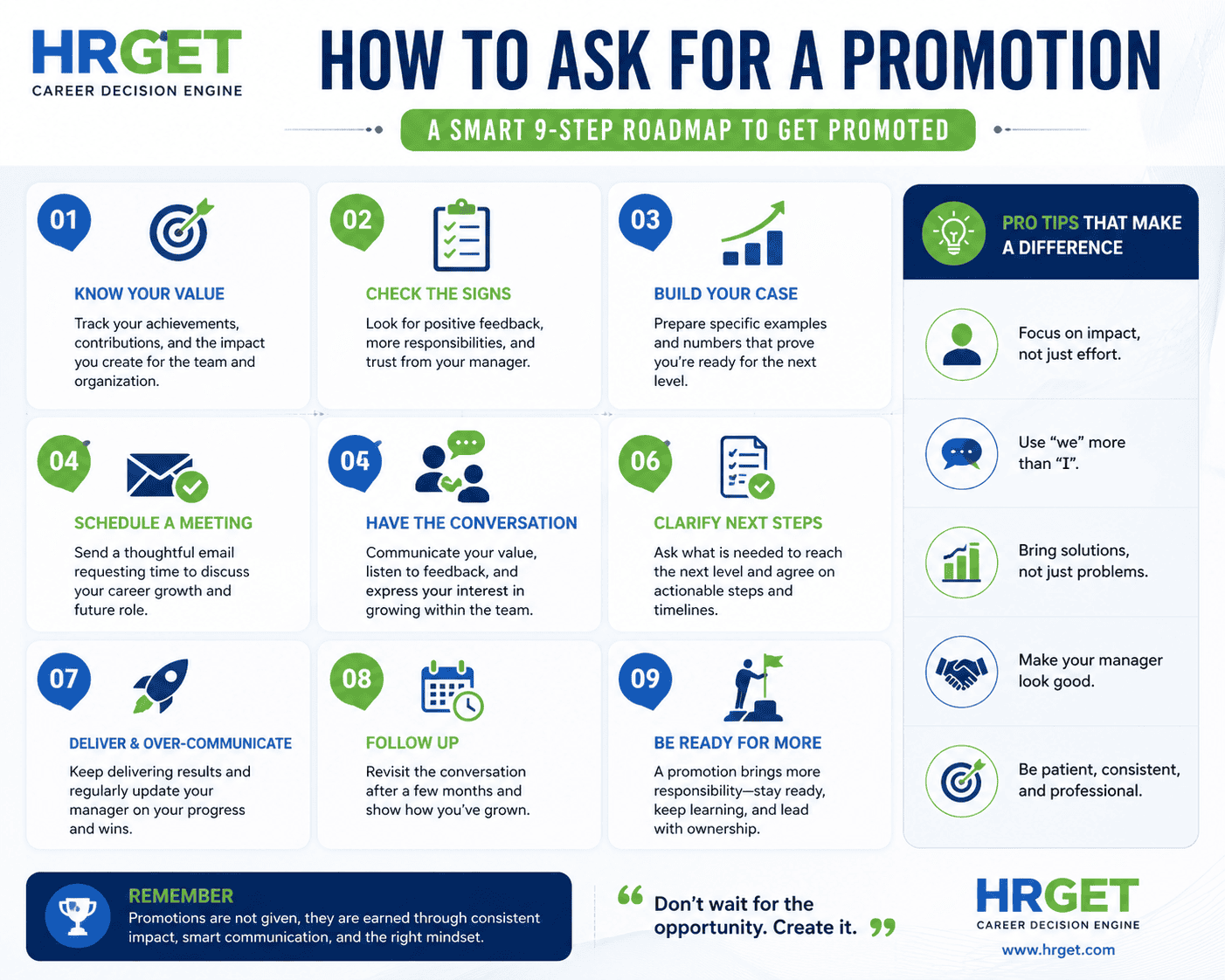
The Promotion Request Email Template (Copy & Personalize)
Here’s a template I’ve refined over dozens of coaching sessions with mid-career professionals across the US, UK, and India. It works. But only if you fill in the brackets with real, specific details — not vague placeholders.
Subject Line
Exploring Growth Opportunities — Would Love 20 Minutes
Hi [Manager’s Name],
I’ve really enjoyed working on [team/project], especially contributing to [specific impact — e.g., “the launch of our APAC pricing model” or “reducing onboarding time by 30%”].
Over the past [X months], I’ve taken on responsibilities such as [example 1, e.g., “leading the cross-functional sprint planning”] and [example 2, e.g., “mentoring two junior analysts”], and I’d like to continue growing my impact within the team.
I’d love to set up some time to discuss what the next level looks like for my role and how I can best position myself for a promotion.
Would you be available sometime this week or next?
Thanks,
[Your Name]
Short. Confident. Zero whining. That’s the formula.
Why Every Line of This Email Works
Let me break down what’s actually happening in that template — because understanding the mechanics helps you personalize it without breaking it.
The Subject Line
“Exploring Growth Opportunities” is neutral enough not to put your manager on the defensive, but specific enough that they know this isn’t a casual check-in. Avoid subjects like “Promotion Discussion” — that immediately creates pressure before they’ve even opened the email.
The Specificity in Paragraph One
“I’ve really enjoyed working on [team/project]” is not just pleasantry. It signals alignment and investment. But the line only works if you fill in the specific impact. “Especially contributing to increasing NPS by 14 points” is infinitely more powerful than “especially contributing to the team.”
The Evidence Block
The second paragraph is your proof of readiness. Two strong examples are better than five weak ones. Prioritize responsibilities that are above your current level — things a person in the next role would typically own.
The Ask
“What the next level looks like for my role” — this framing is collaborative, not confrontational. You’re inviting a conversation about criteria, not issuing a demand. That makes it much easier for a manager to say yes to the meeting.
Real Scenario: What This Looks Like in Practice
Real Scenario
Priya, a product manager at a mid-size fintech in Bengaluru, had been acting as a de facto team lead for eight months after her senior PM left. She’d run three product sprints, mentored a junior PM, and built the Q1 roadmap from scratch — all without a title change. She sent a version of this email on a Tuesday morning. Her manager responded within three hours and scheduled a 1:1 for that Friday. Within six weeks, she had an offer to move to Senior PM at ₹28 LPA, up from ₹19 LPA.
The email didn’t get Priya the promotion — her work did. But the email made sure that work was visible and on record. That’s the whole point.
When to Send Your Promotion Request Email
Timing your promotion ask is almost as important as the ask itself. Here’s what I tell every client.
| Send It When… | Avoid Sending When… |
|---|---|
| You’ve just delivered a measurable win | The company just announced layoffs or a hiring freeze |
| Performance review season is 6–8 weeks away | Your manager is managing a visible crisis |
| You’ve been in role 12–18+ months | You’ve had a recent negative performance review |
| You’ve taken on responsibilities above your pay grade | Budget cycle just closed with no headcount approved |
| A peer at your level just got promoted elsewhere | You’re still new to the team (under 9 months) |
The best promotions I’ve seen happen when the employee makes their ask just before the window — not during it. If your company does annual reviews in December, send the email in October. Give your manager time to actually do something about it.
Common Mistakes That Kill Promotion Conversations
I’ve reviewed hundreds of “why didn’t I get promoted?” situations. The patterns are painfully consistent.
1. Being vague about what you want. “I’m hoping to grow” is not an ask. “I’d like to discuss moving to a Senior [Role] title” is. Managers can’t advocate for what they can’t name.
2. Leading with tenure, not impact. “I’ve been here three years” is the weakest possible argument. Tenure proves loyalty, not readiness. Lead with what you’ve delivered.
3. Making it emotional. The moment your email sounds like a complaint — “I feel like I’ve been overlooked” — you lose leverage. Keep it professional, data-driven, and forward-looking.
4. Emailing on a Friday. Genuinely, this one matters. Friday emails sit unread over the weekend and often get buried by Monday’s avalanche. Tuesday or Wednesday, mid-morning.
5. Not following up. If you don’t hear back in 5–7 business days, send a polite nudge. One sentence: “Just wanted to circle back on my earlier note — happy to find time whenever works for you.” Radio silence is not a no.
What to Do After You Send the Email
The email gets you in the room. Here’s how to make sure you walk out with something concrete.
Prepare your case before the meeting. Come with three to five bullet points of your top contributions — ideally with numbers attached. Revenue influenced, time saved, people managed, deals closed. Specificity is credibility.
Know what you’re asking for. Are you asking for a title change? A salary increase? Both? In the US, a promotion typically comes with a 10–20% salary bump. In India’s IT and startup sector, a move from Manager to Senior Manager can mean ₹5–12 LPA depending on company and city. Know your number before you walk in.
Ask for the criteria. If your manager says “not quite yet,” follow up with: “What does success look like for me to be ready in the next 6 months?” Get it in writing — or at least summarize it in a follow-up email after the meeting.
Smart Strategy
After every promotion-related meeting, send a follow-up email summarizing what was discussed: “Thanks for the time today — just wanted to capture that we agreed on [X] as the key milestones for the next quarter.” This creates accountability without being aggressive, and protects you if the conversation gets conveniently forgotten.
Asking for a Promotion in India vs the US — Key Differences
The core email framework works across both markets, but the cultural nuances matter.
In the US, directness is respected. Framing your ask around market data (“Based on comparable roles in the industry, this level typically comes with a title of…”) is not aggressive — it’s professional. Managers in American corporate culture often appreciate when you’ve done the research.
In India, especially in MNCs and IT companies in Bengaluru, Hyderabad, and Pune, the relationship with your manager matters enormously. The same email works, but the conversation that follows often benefits from a more collaborative tone — framing it as “how do I grow within this team” rather than “I deserve the next title.” That said, the days of waiting to be recognized are fading fast among India’s Gen Z and millennial workforce.
In the UK, subtlety is part of the game. The email template above is already calibrated well for a British professional context — measured, not demanding, focused on the conversation rather than the outcome.
Frequently Asked Questions
Should I ask for a promotion in person or by email?
Start with email to formally initiate the conversation and give your manager time to prepare. The actual discussion should happen in person or via video call. Think of the email as a pre-meeting agenda, not the meeting itself. It shows professionalism and ensures the topic doesn’t get sidelined.
How long should a promotion request email be?
Keep it to three to four short paragraphs — under 200 words total. Your goal is to open a meeting, not make your full business case in writing. Save the detailed evidence for the actual conversation. A long email feels defensive; a concise one feels confident.
What if my manager says no to a promotion?
Ask for specific criteria and a timeline: “What would I need to demonstrate over the next six months to be considered?” Get this in writing after the meeting. A clear set of goalposts turns a “no” into a structured roadmap. If no criteria are forthcoming after two cycles, that’s useful career data too.
How do I ask for a promotion without sounding arrogant?
Frame it as a growth conversation, not a demand. Use language like “I’d love to understand what the next level looks like” rather than “I deserve a promotion.” Focus on contribution and trajectory, not entitlement. The template above is deliberately calibrated to be confident without being combative.
Is it okay to mention salary in the promotion request email?
No — keep salary out of the initial email. Bringing up compensation upfront can make the conversation feel transactional before you’ve even had it. Raise salary expectations during the actual meeting, after your manager has engaged with the idea of promoting you. Lead with growth, follow with compensation.
How many months before a review should I send the promotion email?
Send it six to eight weeks before the formal review cycle. This gives your manager enough runway to actually advocate for you in budget conversations. Sending it during the review period is often too late — decisions may already have been made or headcount allocated elsewhere.
Final Thoughts: Stop Waiting to Be Noticed
Here’s the reality — if you’re reading this, you’ve probably been ready for a promotion for longer than you realize. The gap between being ready and being promoted is almost always the conversation you haven’t had yet.
Asking for a promotion by email isn’t pushy. It’s strategic. It signals self-awareness, ambition, and the kind of proactive ownership that gets people promoted in the first place.
Use the template above. Make it specific. Send it on a Tuesday. And go into that follow-up meeting knowing your numbers.
The worst outcome is a productive conversation about what readiness looks like. The best outcome? A new title and a salary that reflects what you’re actually worth.
→ Once you’ve had the promotion conversation, make sure you’re ready to negotiate. Read our guide on how to negotiate your compensation package to make sure you don’t leave money on the table.

Jonathan Reed: Executive Career Strategist & Leadership Advisor | Former Partner, McKinsey & Company | Executive Coach to Amazon & Unilever Leaders | 18+ Years in Career Strategy
Jonathan Reed spent nearly two decades as a Partner at McKinsey & Company, where he advised organisations on leadership development, talent strategy, and organisational design across the US, UK, and Asia. Since leaving consulting, he has worked as an executive coach to senior leaders at Amazon, Unilever, and a clutch of high-growth scale-ups — helping them navigate promotions, career pivots, and the unwritten rules of visibility and influence at the top. Based between London and New York, Jonathan writes for HRGet.com to give working professionals an honest look at how careers actually scale — and why so many talented people stall without ever knowing why.