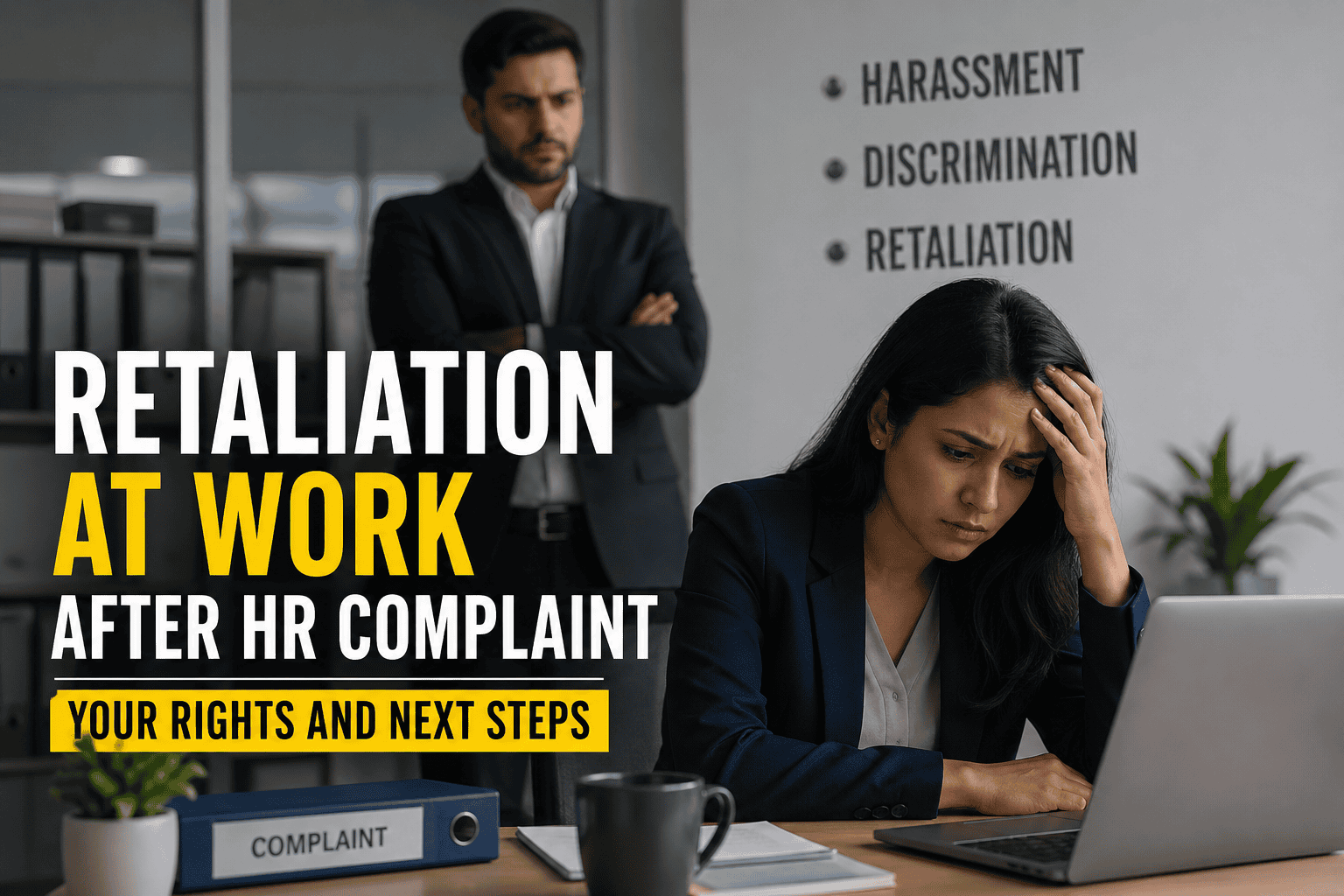
You did the right thing. You reported harassment, discrimination, or a policy violation to HR. And almost immediately after, something shifted.
Your manager turns cold. You’re left off the invite for key meetings. Your last performance review — which was always solid — suddenly has new “concerns.” Or you’re quietly reassigned to a dead-end project that wasn’t there last month.
That’s retaliation at work after an HR complaint. And I’ll be honest — in 20 years of employment law, I’ve seen this pattern dozens of times. It rarely looks like what people expect. It’s almost never the dramatic firing on the same day. It’s slower, more calculated, and much harder to prove if you don’t know what to look for.
This guide will give you a clear picture of what legally constitutes retaliation, what your rights are across the US, India, and UK/Europe, and — most importantly — exactly what to do right now to protect your job, your income, and your future career.
What Is Retaliation at Work?
Workplace retaliation is when your employer takes a negative action against you because you engaged in a legally protected activity. The key word there is “because.” The causal link between your complaint and the punishment is what makes it retaliation — not just the negative outcome itself.
Protected activities typically include:
- Reporting harassment or discrimination to HR
- Filing a formal complaint with a government body (EEOC in the US, Employment Tribunal in the UK)
- Participating in an internal investigation — even if you didn’t initiate it
- Reporting illegal or unethical practices (whistleblowing)
- Requesting legally protected leave (FMLA in the US, maternity leave, etc.)
- Opposing any practice you reasonably believe violates employment law
Here’s what most articles miss: you don’t need to have been right about the original complaint. As long as you filed it in good faith — meaning you genuinely believed a violation occurred — you’re protected against retaliation. That’s a critical distinction that even experienced HR professionals sometimes misunderstand.
What Counts as Retaliation After an HR Complaint?
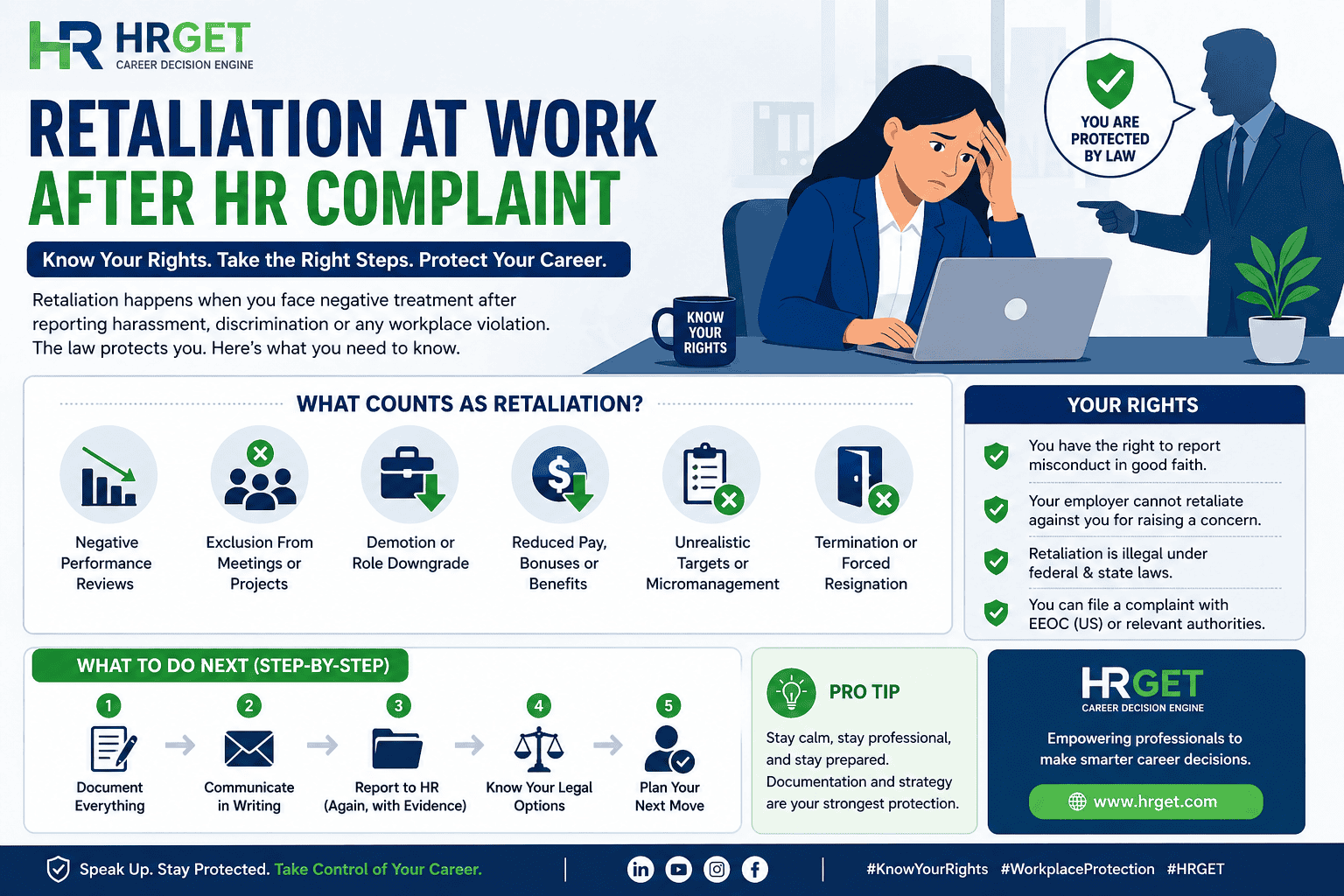
Most people picture retaliation as getting fired. That’s the extreme end. The reality is far more insidious — and it’s precisely because subtle retaliation is harder to prove that employers use it.
In legal terms, any “materially adverse action” that would deter a reasonable person from making a complaint can qualify as retaliation. Courts have consistently held that this goes well beyond termination.
Overt Retaliation (Obvious)
- Termination shortly after your complaint
- Formal demotion or reduction in title
- Salary cut or elimination of bonus
- Forced transfer to an inferior role or location
Subtle Retaliation (Harder to Prove — But Just as Illegal)
- Sudden negative performance reviews with no prior feedback trail
- Being excluded from meetings, projects, or communications you previously had access to
- Micromanagement or unrealistic performance expectations set after your complaint
- Social isolation — teammates stop engaging, invitations dry up
- Undesirable shift changes or assignment of menial tasks below your role
- A manager who starts documenting every minor mistake in writing
- “Culture fit” language used to marginalize you
⚡ The Pattern That Matters
A single awkward interaction after your complaint? Probably not a case. A cluster of negative changes — performance review, exclusion from projects, new micromanagement — all emerging within weeks of your complaint? That’s a pattern. And a pattern is what wins cases.
What Does NOT Count as Retaliation?
Look, I’d be doing you a disservice if I didn’t say this plainly: not every negative outcome after a complaint is retaliation. Understanding the boundary matters — both so you know when you have a real case, and so you don’t waste time and emotional energy on situations that won’t hold up legally.
| Situation | Retaliation? |
|---|---|
| Performance issue documented before your complaint | Generally no |
| Company-wide layoff that includes your role | No (unless timing is suspicious) |
| Policy change affecting your entire team equally | No |
| Constructive feedback, even if blunt | No |
| Negative performance review immediately after complaint, no prior record | Likely yes — document it |
The brutal truth: if you had genuine performance problems before you filed your complaint, your employer has built-in cover. That’s why documentation timing is everything — theirs and yours. This is also why I always tell employees: if you’re planning to file a complaint, make sure you have your most recent positive performance reviews saved somewhere safe first.
Your Legal Rights: US, India & Global View
The law differs significantly depending on where you’re employed. Here’s what you actually need to know — not the textbook version, the practical one.
🇺🇸 United States
Anti-retaliation protections in the US are among the most comprehensive in the world. The Equal Employment Opportunity Commission (EEOC) enforces retaliation protections under Title VII, the Age Discrimination in Employment Act (ADEA), the Americans with Disabilities Act (ADA), and a range of other statutes. The EEOC reported that retaliation remains the most frequently filed charge — accounting for over 55% of all EEOC charges filed in recent years.
Key points for US employees:
- You must file an EEOC charge within 180 days of the retaliatory act (300 days in states with their own anti-discrimination agencies)
- At-will employment does NOT mean employers can retaliate — it’s a common misconception
- The Sarbanes-Oxley Act and Dodd-Frank Act provide additional protections for financial whistleblowers
- OSHA’s anti-retaliation program covers over 25 separate federal statutes including workplace safety complaints
🇮🇳 India
India doesn’t have a single unified retaliation statute — which creates a real gap in enforcement. Protections exist, but they’re fragmented:
- The POSH Act (2013) explicitly prohibits retaliation against complainants of sexual harassment at the Internal Committee stage
- The Whistle Blowers Protection Act (2014) covers public sector employees but its scope in the private sector is narrow
- General labour law protections under the Industrial Disputes Act may apply for unfair dismissal in certain employment categories
Reality check for India-based professionals: enforcement is weaker, internal HR grievance mechanisms are inconsistent, and litigation is slow. That makes documentation and strategic escalation even more critical here than elsewhere. A well-documented internal paper trail is often your only real leverage.
🇬🇧 United Kingdom & Europe
The UK has strong protections under the Employment Rights Act 1996 (covering unfair dismissal and whistleblowing) and the Equality Act 2010. Crucially, victimisation — the UK legal term for what Americans call retaliation — doesn’t require a formal complaint. Even informal reports or witness testimony in someone else’s case can trigger protection.
Across the EU, the EU Whistleblower Protection Directive (2019/1937) — which member states were required to implement by 2021 — significantly expanded anti-retaliation coverage for private sector employees at companies with 50+ staff.
Real Scenario: How Retaliation Actually Happens
📋 Composite Case (Based on Real Patterns)
Priya, a Senior Marketing Manager in Bangalore, files an HR complaint against her director for repeatedly making gender-based comments about her project leadership in team meetings. HR acknowledges the complaint and says it will “look into it.”
Three weeks later: Priya’s Q1 performance review drops from “Exceeds Expectations” to “Meets Expectations” with vague notes about “communication gaps.” She’s removed from a high-visibility campaign she’d been leading. Her director begins copying senior leadership on minor errors she makes in email threads — something he never did before.
What’s actually happening: The director is building a paper trail to justify eventual termination while insulating himself from direct retaliation claims. This is textbook strategic retaliation — not a hot-headed firing, but a slow, orchestrated push-out.
The pattern Priya is experiencing has three phases I see repeatedly in these cases:
- Marginalisation — reduce visibility and access
- Documentation buildup — create a performance paper trail post-complaint
- Managed exit — eventual termination framed as performance-based, not complaint-based
Recognising this pattern early is what lets you get ahead of it. Most employees don’t — and by the time they do, the employer has three months of “documented performance issues” and the employee has nothing.
Smart Strategy: How to Respond Without Destroying Your Career
Here’s where most people go wrong. They either panic and resign immediately — handing the employer a clean exit — or they react emotionally and give management ammunition to label them as “difficult.” Neither is the play.
Your three core goals right now are: protect your income, protect your reputation, and build leverage. Everything else is secondary.
Step 1: Start a Private Documentation Log — Today
Open a private document (not on your work laptop — use personal Google Docs or a notebook) and start logging every incident. Include: exact date and time, what happened, who was present, and what changed compared to before your complaint. Be specific. “My manager was rude” is useless. “On April 14th at 10:15am, my manager told me in front of the team that my quarterly report was ‘not up to standard’ — the first such comment in three years of employment” is evidence.
PRO TIP
Forward important emails to your personal address before they disappear — but first check your employment contract and local law. In most US and UK jurisdictions this is permissible for personal records, but in some companies or countries it can be classified as a data breach. When in doubt, take screenshots instead.
Step 2: Switch to Written Communication
Stop having consequential conversations verbally. After any significant interaction, follow up with a brief email summary. Something like: “Just confirming our discussion — I understand I’ve been reassigned from the Henderson account. Could you share the reasoning in writing so I can plan accordingly?”
This isn’t confrontational. It’s professional. And it forces everything into the written record. Managers who are retaliating hate this — because it creates evidence they’d prefer didn’t exist.
Step 3: Return to HR — But With Documentation
Yes, HR may have let you down once. But now you’re not returning empty-handed. You have a dated log, written exchanges, and a clear timeline showing what changed after your complaint. Frame it precisely: “I want to formally report what appears to be retaliation following my complaint of [date]. I’ve documented a pattern of changes and I’m raising this now to protect both myself and the company from further legal exposure.”
That last phrase — “further legal exposure” — signals that you understand the stakes. It changes the conversation from an upset employee to a potential legal liability.
Step 4: Begin Quiet Exit Planning
This one’s uncomfortable, but necessary. Even in situations where you have a strong legal case and you win — I’ve seen it — your internal brand at that company rarely recovers. People remember who filed complaints. Start updating your CV, refresh your LinkedIn, and reach out to your external network. Do it quietly, do it professionally, and do it now. The worst outcome is being forced out with no options.
Step-by-Step: What to Do Immediately After Retaliation Begins
1
Within 24–48 Hours
Write down every change you’ve noticed since your complaint — include dates, names, and specifics. Save all emails, Slack messages, or written feedback. Do not delete anything. Do not confront anyone.
2
Within 1 Week
Open your private documentation log and start adding structured entries daily. Begin converting verbal conversations to written follow-ups via email. Identify whether the pattern involves just one person or multiple people (the latter signals systemic retaliation).
3
Within 2–4 Weeks
Return to HR (or escalate to Legal, Compliance, or a senior executive) with your documented timeline. Simultaneously, begin your external job search — quietly. Consider a free consultation with an employment lawyer to understand your options.
4
Within 1–3 Months
Make a deliberate decision: stay and formally pursue your legal rights, negotiate an exit package using your documentation as leverage, or exit to a new role on your terms. This decision should be rational, not emotional — weigh financial impact, legal prospects, and your career trajectory.
Mistakes That Can Seriously Damage Your Case
I’ve seen employees with genuinely strong retaliation cases lose — not because the law wasn’t on their side, but because of avoidable mistakes. Don’t make these.
❌ Quitting Immediately
Resigning on emotion removes your leverage entirely. Once you’re gone, the company’s legal exposure drops dramatically. Stay long enough to build your case or negotiate an exit that works for you — a severance agreement, a clean reference, extended benefits.
❌ Venting on Internal Channels
Slack messages, Teams chats, and internal emails are all accessible by IT and HR. Anything you say about your situation in those channels can be used against you. Keep all substantive communications about your case external.
❌ Trusting HR as Your Advocate
HR’s job is to protect the company from legal risk — not to protect you. That’s not cynicism; it’s the actual structure of the function. Engage with HR strategically and document every interaction, but never treat it as a neutral party on your side.
❌ Sending Emotional Communications
An angry email to your manager at 11pm is not just unprofessional — it hands your employer exactly the evidence they need to reframe you as the problem. Every written communication should read as if a judge will see it. Because one day, they might.
❌ Over-sharing With Colleagues
Even well-meaning coworkers gossip. Word gets back to management faster than you’d expect. If you need support, get it from a trusted friend outside the company, a therapist, or an employment lawyer — not your work colleagues.
When to Escalate — And When to Hold Back
Escalation — whether internally to senior leadership, legally to a government body, or publicly through a lawyer — is a significant step. It’s not always the right one. Here’s how I think about it.
| Escalate When… | Hold Back When… |
|---|---|
| You have a clear, documented pattern | It’s a single ambiguous incident |
| Impact is material (role, pay, termination risk) | You’re already planning to leave within 30 days |
| Internal HR has failed to respond or acted in bad faith | You lack any written evidence |
| An employment lawyer confirms you have a viable claim | The retaliation is minor and you can manage it |
In the US, filing an EEOC charge is a prerequisite before you can sue for most federal employment claims. The charge itself often triggers a mediation process — and many cases resolve at that stage without full litigation. In the UK, you’ll need to notify ACAS first before bringing an Employment Tribunal claim.
Can You Sue for Retaliation at Work?
Yes — but here’s what litigation actually looks like, because the movies don’t quite capture it.
To have a viable retaliation lawsuit, you need three things: proof that you engaged in a protected activity (your HR complaint), evidence of an adverse action that followed, and a clear connection between the two. Timing alone — a complaint on Monday, a bad review on Friday — doesn’t automatically prove the connection, but it’s often a significant factor.
What You Can Potentially Recover
- Back pay and lost wages from the point of the adverse action
- Compensatory damages for emotional distress (varies significantly by case)
- Punitive damages (in cases of egregious employer conduct)
- Attorney’s fees (often recoverable in successful employment cases)
- Reinstatement — theoretically possible, rarely practical
The realistic timeline: EEOC charges take an average of 10 months to process. Full litigation, if it gets that far, can take 2–4 years. Most cases settle before trial — often for amounts that feel underwhelming compared to the emotional cost. That’s not a reason not to pursue your rights, but it’s a reason to go in with clear eyes.
💡 The Leverage Strategy (What Smart Employees Actually Do)
Rather than immediately filing legal action, build a documented case, then signal — through a formal written escalation or an attorney’s letter — that you’re aware of your rights and the company’s exposure. Many employers respond to this by opening severance negotiations to avoid litigation. Getting 3–6 months of severance plus a clean reference letter is often a better outcome than a two-year lawsuit.
FAQ: Retaliation at Work After an HR Complaint
How do I prove retaliation at work after an HR complaint?
You need three things: evidence of your protected activity (the complaint itself), evidence of adverse action that followed, and documentation showing the connection between the two — typically through timing and pattern. A private log with dated entries, saved emails, and your performance history before the complaint are your core evidence. Courts and regulatory bodies look for patterns, not isolated incidents.
Can my employer fire me for filing an HR complaint?
Not legally — not because of the complaint. Your employer can still terminate your employment, but they must demonstrate a legitimate, non-retaliatory reason unrelated to your complaint. If the timing is suspicious and there’s no prior performance documentation, that’s a much harder case for them to make. In at-will employment states in the US, this distinction matters enormously.
Is a sudden poor performance review after a complaint considered retaliation?
It can be — especially if the review is sudden, not based on pre-existing documented issues, and appears immediately after your complaint. Courts have consistently held that unexpected negative evaluations following protected activity can constitute retaliation. The more contrast there is between your pre-complaint and post-complaint reviews, the stronger the argument.
Should I go back to HR if I’m experiencing retaliation?
Yes — but strategically. Don’t return empty-handed. Compile your documentation log and timeline first, then file a formal written retaliation complaint referencing specific incidents and dates. Frame it as a legal risk issue for the company, not just a personal grievance. This creates an official paper trail that becomes relevant if you escalate externally.
How long after an HR complaint can retaliation legally occur?
There’s no fixed legal window — retaliation can happen days or months after a complaint. However, courts generally view actions that occur within a few weeks of a complaint as more suspicious than those six months later. The longer the gap, the harder it is to establish the causal connection. If you’re experiencing retaliation, document it immediately regardless of the timeline.
Should I resign if I’m facing workplace retaliation?
Not immediately. Resigning eliminates your leverage and, depending on how it’s handled, could be characterized as voluntary departure — which weakens any subsequent legal claim. Stay long enough to build your documentation, consult a lawyer, and either negotiate a favourable exit or line up your next role. Exit on your terms, not theirs.
Can I file an EEOC charge while still employed?
Yes — and sometimes this is the smartest move. Filing while still employed signals seriousness, starts the clock on the investigative process, and often prompts the employer to reconsider their approach. It doesn’t automatically result in litigation; many EEOC filings lead to mediation or informal resolution. It also protects you further — any termination after an EEOC filing is viewed with even greater scrutiny.
The Bottom Line: Retaliation Is a Test of Strategy, Not Just Resilience
Most employees who face retaliation at work after an HR complaint make the same mistakes: they react emotionally, they trust HR implicitly, and they either quit too soon or stay too long without building any leverage. The professionals who navigate this well are the ones who treat it like a strategy problem — not just a personal crisis.
Document everything. Stay calm in all written communications. Signal — clearly and professionally — that you understand your rights and the company’s legal exposure. Then make a deliberate decision about whether to fight internally, negotiate an exit, or pursue external legal remedies.
In 2026, retaliation protections in the US, UK, and increasingly in India are real and enforceable. But they only work if you’ve laid the groundwork. Start today. Not next week.
If you’re also trying to understand the full scope of what you can report and how, read our guide on how to file an HR complaint effectively — including what HR is actually required to do with your report.
This article is for informational purposes and does not constitute legal advice. Employment laws vary significantly by jurisdiction, and individual circumstances differ. For advice specific to your situation, consult a qualified employment lawyer in your country or region.

Victoria Hale | Former Partner, Freshfields Bruckhaus Deringer | Employment Law Specialist | 20+ Years Advising Multinationals & Executives
Author: Victoria Hale spent over two decades as an Employment Law Partner at Freshfields Bruckhaus Deringer — one of the world’s most prestigious Magic Circle law firms — advising multinational corporations and senior executives on some of the most complex employment disputes in the US and Europe. Her practice covered wrongful termination litigation, executive exits, non-compete enforcement, FLSA compliance, and cross-border workforce restructuring under EU labour law. Now based between London and New York, Victoria writes for HRGet.com to close the gap between legal theory and how employment law actually plays out in the real world — for employees who need to know their rights before it’s too late.