Short answer: Yes — but you can also get fired or sued if you do it wrong.
Here’s the truth most articles won’t tell you about recording conversations at work: it sits in a messy intersection of federal law, state law, company policy, and workplace politics. Even if something is technically legal, it can still destroy your career if handled poorly.
I’ve spent 20 years advising employees and companies on exactly this kind of situation. I’ve seen recordings save people’s wrongful termination cases — and I’ve seen the same tactic blow up spectacularly in someone’s face. The difference is almost never the recording itself. It’s the strategy around it.
This guide breaks it down state-by-state and scenario-by-scenario, so you can make a calculated decision — not an emotional one.
What the Law Actually Says: Federal vs State
Let’s cut through the confusion first, because this is where most people get tripped up.
Under the federal Wiretap Act (18 U.S.C. § 2511), you can legally record a conversation if at least one party to the conversation gives consent. Crucially, that “one party” can be you. So if you’re in the room or on the call, federal law generally permits you to record — without telling anyone else.
Simple enough, right? Here’s the catch: federal law is just the floor. States can — and do — build far stricter rules on top of it. And in most real workplace disputes, state law is what actually determines whether you’ve broken the law, whether your recording is admissible, and whether your employer can take action against you.
On top of that, your employer can layer their own internal policies — and in at-will states, violating a company policy is often all they need to terminate you, regardless of whether the recording was technically lawful.
So the real answer to “can I record conversations at work legally?” is: it depends on three things — your state, your employer’s policy, and the context of the conversation. Let’s work through each.
One-Party vs Two-Party Consent — The Core Distinction
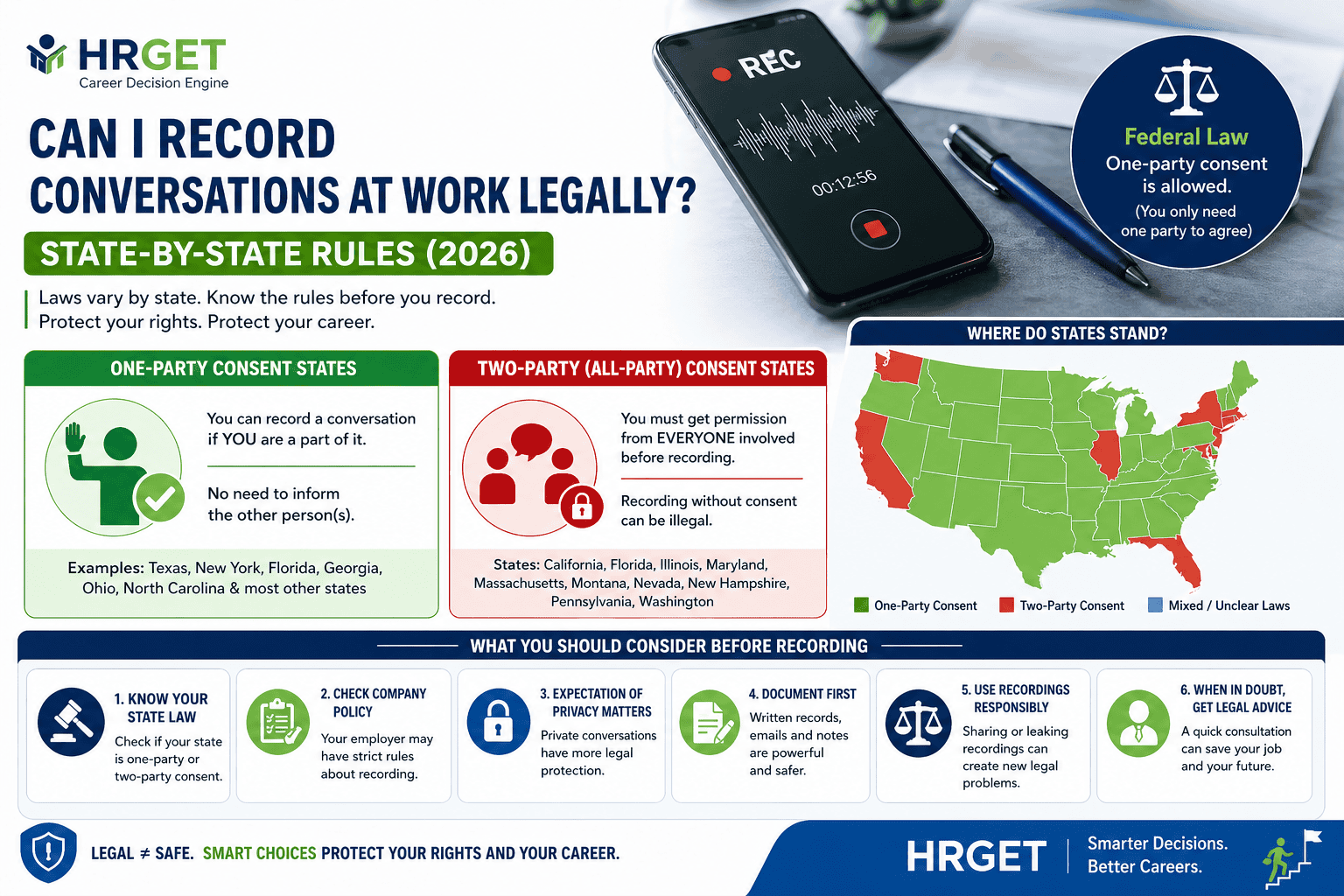
Every state falls into one of two buckets (with a few nuanced exceptions). Understanding which bucket your state is in changes everything.
One-Party Consent States
You can legally record any conversation you’re actively participating in — no need to inform the other parties. You are the “one party” who consents. This is the federal baseline, and the majority of US states follow it.
Two-Party (All-Party) Consent States
Everyone in the conversation must give their consent before you hit record. Secretly recording in these states isn’t just a policy violation — it can be a criminal offense, carrying fines and in some jurisdictions jail time, plus civil liability exposure to everyone you recorded.
This is not theoretical. In California, for example, secretly recording a confidential conversation is a felony under Penal Code 632. In Illinois, violations of the Eavesdropping Act have resulted in real civil judgments against employees. I’ve advised clients who found this out the hard way.
| Factor | One-Party Consent States | Two-Party Consent States |
|---|---|---|
| Can you record secretly? | ✅ Generally yes (if you’re a party) | ❌ No — illegal |
| Criminal risk? | Low (if you’re a participant) | High — potential felony in some states |
| Civil lawsuit risk? | Moderate (depends on context) | High — each recorded party can sue |
| Admissible in court? | Often yes, if obtained properly | Likely excluded if illegally obtained |
| Employer policy still matters? | Yes — you can still be fired | Yes — and you may face criminal charges too |
State-by-State Recording Laws (2026)
Here’s the practical breakdown. Before you record anything at work, confirm which list your state is on.
🔴 All-Party Consent States — Do NOT Record Secretly
In these states, recording without consent from every participant is illegal and can result in criminal charges or civil lawsuits:
California · Florida · Illinois · Maryland · Massachusetts · Michigan* · Montana · Nevada · New Hampshire · Oregon · Pennsylvania · Washington
*Michigan has some nuance — the law prohibits recording “private” conversations, and courts have sometimes allowed recordings in non-private workplace settings. Consult an attorney before recording in Michigan.
🟢 One-Party Consent States — More Flexibility (With Caveats)
You can record conversations you’re actively participating in. Notable states include:
Texas · New York · New Jersey · Georgia · North Carolina · Ohio · Arizona · Colorado · Virginia · Tennessee · Indiana · Missouri · Minnesota · and most remaining states
Note: New York follows one-party consent, but New York City has specific nuances around workplace recording. Always verify with current state statutes — laws do change.
⚠️ Hybrid & Complex Situations
Even in one-party states, context creates complexity. Courts assess whether the recorded party had a reasonable expectation of privacy. A private one-on-one meeting in a closed office carries far more privacy weight than a conversation in an open-plan floor. If you’re recording what would traditionally be a confidential HR or legal conversation, courts in some one-party states have found recordings inadmissible or actionable. When in doubt: get legal advice first.
Real Workplace Scenarios: What’s Safe vs What’s Risky
Let’s make this practical. These are the four situations I see most often — and what the actual risk looks like in each.
Scenario 1: Your Manager Is Harassing or Threatening You
In a one-party consent state, you can generally record this conversation legally. In an all-party state, you can’t — at least not secretly.
Reality check: Even when legal, recording an abusive manager can escalate the situation dramatically if discovered. I’ve seen employees use recordings successfully in EEOC complaints — and I’ve seen others have their entire complaint derailed because the employer pivoted the narrative to the employee’s “covert surveillance.” The recording becomes the story instead of the harassment.
Scenario 2: HR Meeting About a PIP or Termination
This is the scenario where I see the most mistakes. People feel blindsided, they want protection, so they secretly record an HR meeting. High risk across the board — even in one-party states.
Why? HR has almost certainly reviewed your employee handbook with you, which likely contains a no-recording clause. Using a secret recording in a legal dispute when you signed a policy against it opens you to counter-claims that undercut your credibility. Courts don’t love it. A better approach: ask HR to send you written follow-up summarizing what was discussed. That’s a paper trail that actually holds up.
Scenario 3: Recording a Remote Zoom or Teams Meeting
This is a genuine gray area, and it’s becoming more common as hybrid work continues into 2026. Most enterprise platforms have built-in recording notifications — when you start recording, participants get a banner alert. So “secret” recording is functionally impossible on standard enterprise Zoom or Teams.
The legal layer still applies: your physical location determines the state law that governs, not where other participants are dialing in from. If you’re in California on a call with someone in New York, California’s all-party consent law controls your side of the recording. Don’t assume geography works in your favor just because others are in permissive states.
Scenario 4: Recording to Build an Evidence File
I understand the impulse. You’re facing retaliation, discrimination, or a hostile work environment and you want proof before it gets scrubbed. But here’s what most people don’t know: courts care deeply about how evidence was obtained, not just what it contains.
A recording obtained in violation of state law is inadmissible and can get your entire case dismissed. Even in one-party states, a recording obtained through deliberate manipulation — like engineering a conversation to get someone to say something incriminating — can be challenged on authenticity grounds. If you’re building a legal case, talk to an employment attorney before you ever hit record.
Can Your Employer Fire You for Recording at Work?
Yes. Even if the recording was completely legal.
This is the part that surprises people most. In the majority of US states, employment is at-will — meaning your employer can terminate you for any reason that doesn’t violate a protected classification, as long as they don’t have to prove “cause” in the traditional sense. “You violated our recording policy” is a clean, defensible reason to let someone go.
Check your employee handbook. Most companies above 100 employees have a workplace recording policy embedded in their confidentiality or code of conduct sections. It typically reads something like: “Employees may not record conversations, meetings, or communications involving company business without prior written consent from all parties and management approval.”
Violating that clause — even once, even legally under state law — gives your employer grounds to terminate for policy breach. And here’s the ugly irony: if you were planning to use the recording in a retaliation or harassment claim, getting fired for the recording first can actually complicate your case rather than strengthen it.
The Nuance That Most People Miss
There is one important exception: the NLRA (National Labor Relations Act) protects certain concerted activities, including in some cases, workers discussing terms and conditions of employment. Some NLRB precedents have found that blanket no-recording policies violate Section 7 rights when they prevent workers from documenting unlawful labor practices. This is highly fact-specific and has shifted with different administrations. If you believe you’re documenting illegal workplace conduct, an employment attorney — not a Reddit thread — is the right first call.
Smart Strategy: When You Should (and Shouldn’t) Record
Recording should be a last resort — not your first instinct when a meeting goes badly. Here’s how to think about it clearly.
✅ Consider Recording If:
- You’re facing serious ongoing harassment or discrimination — not a one-time conflict
- You’ve already attempted formal escalation and it was ignored or denied
- You are confirmed in a one-party consent state
- You’ve reviewed your employee handbook and there’s no explicit prohibition
- You’ve spoken with an employment attorney who has advised it
❌ Avoid Recording If:
- It’s a performance disagreement or personality conflict — not a legal violation
- You haven’t tried written documentation or formal HR channels first
- You’re in a two-party consent state
- Your company has an explicit no-recording policy
- You’re acting on impulse after a bad meeting
I’ll be direct: most employees who come to me after secretly recording a conversation wish they had done something else instead. Not because the recording was useless — sometimes it was valuable — but because they hadn’t done the groundwork first, and the recording became a liability rather than an asset.
Common Mistakes That Get People in Trouble
Most employees don’t get into legal or career trouble for recording per se. They get into trouble for how they handle the recording before, during, and after.
Mistake 1: Assuming “if it’s legal, it’s safe.”
Legal and safe are not the same thing at work. Your employer operates under contract law, not just criminal law. A legally permissible recording can still be a terminable offense under your employment agreement or company policy.
Mistake 2: Not reading your employee handbook first.
Internal policy is often the first thing HR will pull in any termination dispute. If your handbook prohibits recording and you recorded anyway, that’s an open-and-shut conduct violation regardless of state law.
Mistake 3: Secretly recording HR.
HR professionals are trained to document meetings thoroughly. If you’re recording HR, there’s a reasonable chance they’re already documenting the same conversation — professionally and defensibly. Your secret recording adds risk to you without meaningfully adding to your evidence file.
Mistake 4: Sharing or distributing the recording.
This is where secondary liability piles on. Sharing a recording with coworkers, posting it online, or forwarding it to media without legal counsel can trigger defamation claims, privacy violation lawsuits, and tortious interference claims — even in one-party states. Always get legal advice before sharing a recording with anyone outside a direct legal representation context.
Mistake 5: Using a recording as your opening move.
I’ve watched this play out in cases. Employee records manager. Employee submits complaint. Employer investigates. First question: “How did you obtain this?” Suddenly the conversation is about your conduct, not your manager’s. The focus shifts — every time.
What Actually Protects You Better Than a Recording
Here’s my honest, practitioner view: in 20 years of employment law, the cases that go well for employees are rarely built on covert recordings. They’re built on a disciplined documentation trail.
Written records carry more weight in most employment disputes than audio recordings — and they’re far less legally precarious. Here’s exactly what to build instead:
📋 Build This Documentation Trail — Starting Today
- Email summaries after every significant meeting. Within 24 hours, send a brief email to your manager (and/or HR) saying: “Just to confirm what we discussed today — [summary].” This creates a timestamped, professionally appropriate record that’s admissible in any forum.
- Keep a private incident log. Date, time, location, exact words used, any witnesses present. Store this on a personal device — not company systems. Update it immediately after incidents while details are fresh.
- File formal complaints in writing. Verbal HR complaints are often “remembered” differently by different people. Any complaint worth making is worth making in writing, through your company’s official reporting channel, so there’s a timestamped record of your escalation.
- Preserve relevant emails and messages. Forward anything that documents problematic behavior to a personal email address. If it’s on company systems, assume you can lose access the moment you’re terminated.
This approach is less dramatic than hitting record. But it’s more professional, more legally sound, and significantly less likely to backfire on you. Courts and EEOC investigators find contemporaneous written records more credible than audio files that opposing counsel will spend considerable energy trying to get excluded.
Recording is a defensive tactic. Documentation is a strategic one. If you’re facing a serious workplace situation in 2026, strategy is what wins.
Frequently Asked Questions
Can I record my boss without telling them?
In one-party consent states — yes, legally, if you’re a participant in the conversation. In all-party consent states (California, Florida, Illinois, Pennsylvania, Washington, and others), doing so without their knowledge is illegal. Even in permissive states, check your company’s recording policy first. Legal doesn’t mean consequence-free at work.
Can a workplace recording be used as evidence in court?
Sometimes — but only if it was legally obtained, is authentic, and is relevant to the claim. A recording made in violation of state wiretapping law is typically inadmissible and may result in sanctions against you. Even legally obtained recordings can be challenged on chain-of-custody or manipulation grounds. Always consult an attorney before using a recording as evidence.
Can HR record me without my consent?
HR is subject to the same state wiretapping laws as you. In two-party consent states, they cannot secretly record you either — though they can record with your knowledge. However, HR typically documents meetings through contemporaneous written notes, which is standard practice and carries its own evidentiary weight. Your best response is to do the same.
Can I record a Zoom meeting at work?
Only if your state law permits it, your company policy allows it, and — on most enterprise platforms — all participants are notified. Zoom and Microsoft Teams both display recording notifications by default in enterprise configurations. Attempting to bypass those notifications likely violates platform terms of service and potentially wiretapping statutes. Your physical location determines which state law applies, not where others are calling from.
Can my employer fire me for recording a conversation, even if it was legal?
Yes. In at-will states — which is most of the US — your employer can terminate you for violating company policy, even if that policy is more restrictive than state law. If your employee handbook prohibits recording without prior written consent, that clause is typically enforceable as a condition of your employment contract.
Is secretly recording your boss illegal in California?
Yes. California is one of the strictest all-party consent states. Under California Penal Code 632, secretly recording a “confidential communication” — which most one-on-one workplace conversations qualify as — is a criminal offense. You can face a fine of up to $2,500 per violation and civil liability to each recorded person. Never record covertly in California.
What’s the safest alternative to recording a workplace conversation?
Send a follow-up email summarizing what was discussed within 24 hours of any significant meeting. This creates a timestamped written record that both parties see. Maintain a private incident log on a personal device. File formal complaints in writing through official channels. These methods are more defensible in most legal contexts than audio recordings and carry none of the legal or career risk.
Do the same recording laws apply to phone calls at work?
Yes — and phone calls can get more complex when participants are in different states. Generally, the stricter state’s law prevails. If you’re in New York (one-party) and calling someone in California (two-party), California’s law likely applies to that call. When crossing state lines, assume the stricter standard controls unless your attorney has confirmed otherwise.
The Bottom Line: Strategy Over Emotion
Recording conversations at work legally is possible in most US states — but possible is very different from smart. The law gives you a narrow window. Your employer’s policy, the courts’ view of how evidence was obtained, and the practical reality of workplace politics all conspire to make a covert recording a high-risk move with uncertain payoff.
The professionals who come out ahead in serious workplace disputes — harassment, wrongful termination, discrimination — almost always do so because they built a disciplined evidence trail over time: written records, formal escalations, timestamped documentation. That’s less satisfying in the moment than hitting record. But it’s what actually holds up.
If you’re facing something serious enough that you’re considering recording conversations at work, take one step first: talk to an employment attorney in your state. Most offer free 30-minute consultations. That conversation will tell you more about your real options than any recording ever will.
For a deeper look at building that evidence trail the right way, read our guide on how to document workplace harassment effectively.
For current state wiretapping statutes, refer to the Digital Media Law Project’s state recording guide. For NLRA workplace rights questions, consult the National Labor Relations Board (NLRB.gov). This article reflects legal standards as of April 2026 and is intended for general informational purposes only. Consult a licensed employment attorney for advice specific to your situation.

Victoria Hale | Former Partner, Freshfields Bruckhaus Deringer | Employment Law Specialist | 20+ Years Advising Multinationals & Executives
Author: Victoria Hale spent over two decades as an Employment Law Partner at Freshfields Bruckhaus Deringer — one of the world’s most prestigious Magic Circle law firms — advising multinational corporations and senior executives on some of the most complex employment disputes in the US and Europe. Her practice covered wrongful termination litigation, executive exits, non-compete enforcement, FLSA compliance, and cross-border workforce restructuring under EU labour law. Now based between London and New York, Victoria writes for HRGet.com to close the gap between legal theory and how employment law actually plays out in the real world — for employees who need to know their rights before it’s too late.