
Short answer? It depends — but most people evaluate this decision completely wrong.
At 35, you’re not a blank slate. You have income, responsibilities, maybe a mortgage or a family, and — critically — opportunity cost. Going back to school at 35 isn’t just “learning something new.” It’s a financial, career, and lifestyle trade-off that can either accelerate your next 20 years or quietly set you back a decade.
I’ve spent 18 years advising executives and mid-career professionals on exactly these crossroads — at McKinsey, and as a standalone coach to leaders at Amazon and Unilever. What I’ve seen repeatedly: people either overthink this and never act, or they act emotionally and pay for it for years. This guide gives you the hard cost-benefit analysis so you can decide with clarity, not fear.
The Real Question You Should Be Asking
Most people frame this as: “Is it worth going back to school at 35?”
That’s too vague to be useful. The correct question is:
“Will this specific education increase my lifetime earnings, job security, and career satisfaction enough to justify the cost and time I’m giving up?”
Because at 35, this isn’t an education decision. It’s a capital allocation decision — you’re deciding where to invest the next 2–4 years of your finite working life. That reframe matters enormously.
A 22-year-old going back to school has 40 working years ahead to recoup the investment. You have roughly 25–30. The math is tighter, the stakes are higher, and the decision needs to be sharper.
The Full Cost of Going Back to School at 35
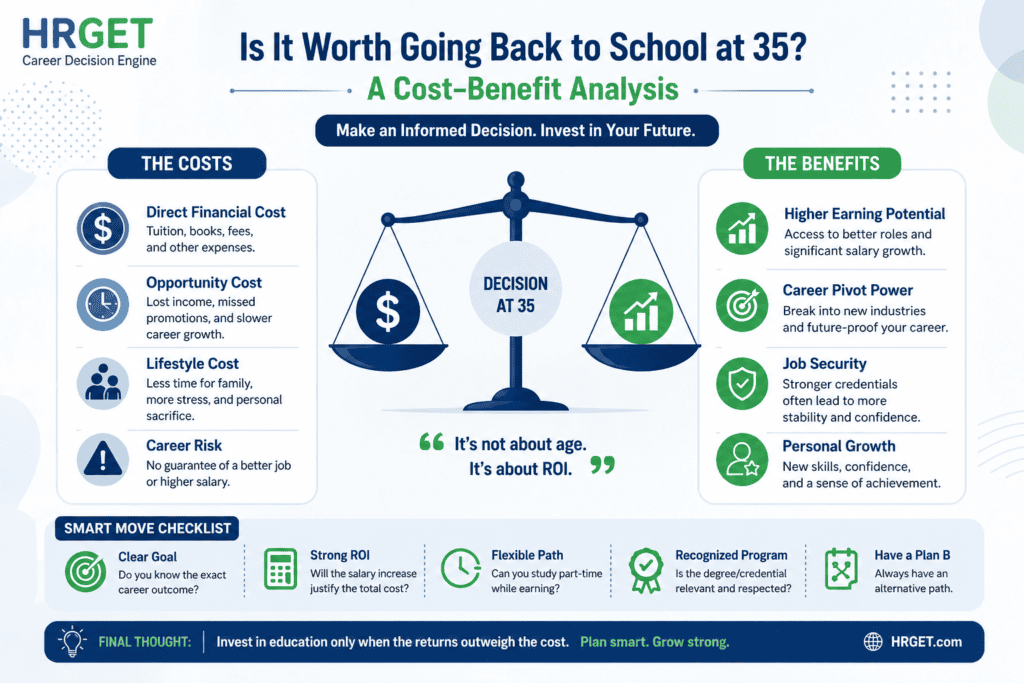
Here’s where most people miscalculate badly. They see the tuition number and stop there. The real cost is much larger — and it’s made up of four distinct layers.
1. Direct Financial Cost
Tuition varies wildly — from $10,000 for an online state school program to $150,000+ for a top-tier MBA. Add books, fees, potential relocation, and in India, programs at IIMs or ISB can run ₹25–35 lakhs for a one-year MBA. That’s the sticker price. It’s just the beginning.
2. Opportunity Cost — Where Most People Fail the Math
This is the cost that nobody puts in a brochure, and it’s the one that matters most.
If you’re earning $80,000/year and step away for two years to study full-time, you’ve immediately incurred $160,000 in lost wages — before you’ve paid a single dollar of tuition. Stack on top of that the promotions you missed, the annual salary increments that didn’t happen, and the compounding effect of those raises over the next 15 years. A “two-year program” can easily represent $250,000–$350,000 in total opportunity cost.
For Indian professionals: if you’re earning ₹20 LPA and pause for two years, that’s ₹40 lakhs in foregone income — before fees. The real price tag on that ₹30-lakh ISB degree is closer to ₹70+ lakhs.
3. Lifestyle Cost
Less quantifiable, but very real. Reduced time with your partner or kids. Increased stress — you’re not 22 anymore, and balancing coursework, family, and possibly a part-time income is genuinely hard. If you borrow to fund this, the debt burden reshapes how you make decisions for years afterward.
4. Career Risk
No degree guarantees a better job. Some industries have real age bias in hiring — I’ve seen it up close. And job market conditions can shift dramatically in two years; the roles that looked promising when you enrolled may be restructured or automated by the time you graduate. This is a genuine risk, not a theoretical one.
| Cost Type | US Example | India Example |
|---|---|---|
| Tuition | $40K – $150K+ | ₹10L – ₹35L |
| Lost Income (2 yrs) | $120K – $200K | ₹30L – ₹60L |
| True All-In Cost | $200K – $350K+ | ₹50L – ₹100L+ |
That “$50K degree” is almost never a $50K decision. Factor everything.
The Real Benefits (Not the Marketing Version)
Let’s cut through the university brochure language. There are real, meaningful benefits — but only in the right conditions.
1. Salary Jump — If the Field Demands It
Certain credentials produce real, measurable salary leverage. A data scientist with a relevant master’s can jump from $75K to $140K+ in the US, or from ₹12 LPA to ₹28–40 LPA in India’s tech hubs. Nursing with an advanced practice degree can push from $65K to $110K+. An MBA from a top-10 school still opens doors in consulting and finance that are otherwise effectively closed. These are the cases where the math works clearly.
2. Career Pivot Power
At 35, switching industries without recognized credentials is genuinely hard. You’re competing with 28-year-olds who have domain-specific experience that took them seven years to build. A degree or professional qualification can reset that playing field — it signals domain competency to hiring managers who otherwise see “career changer” as a risk.
This is especially true for: law, medicine, clinical psychology, architecture, and licensed financial advising. In these fields, the credential isn’t optional — it’s the entry ticket.
3. Job Security in Durable Fields
Healthcare, engineering, and specialized finance roles have structural labor shortages that aren’t going away. If you’re currently in a volatile sector — advertising, media, certain parts of retail — pivoting through education into one of these fields buys you genuine career resilience. That’s a non-financial benefit worth putting on the ledger.
4. The Psychological Benefit — Underrated but Real
I’ll be honest — this one surprises people when I mention it. The confidence that comes from completing a rigorous program, the sense of forward motion after years of stagnation, the peer network you build — these have genuine career value that doesn’t show up in salary data but absolutely shows up in your trajectory. If you’re stuck and the education meaningfully unsticks you, that’s worth something. Just don’t use it as the primary justification.
ROI Scenarios: When It Makes Sense vs When It Doesn’t
Here’s a simple framework I use with clients. Before committing, run your numbers through this mental model:
ROI = (Post-degree annual salary – Current salary) × Working years remaining – Total all-in cost
If the result isn’t significantly positive — rethink it.
| Situation | ROI Outlook |
|---|---|
| Moving into a high-demand field (tech, healthcare, finance) | ✅ High |
| Expected salary increase is 2× or more | ✅ High |
| Degree from a recognized institution with strong alumni network | ✅ High |
| Studying part-time while keeping current job | ✅ High |
| Vague goals (“I just want to learn something new”) | ❌ Low |
| Degree doesn’t directly link to a specific job or salary band | ❌ Low |
| Taking heavy loans with uncertain return timeline | ❌ Low |
| Already earning at the ceiling of your target field | ❌ Low |
Real-Life Scenario: Two 35-Year-Olds, Opposite Outcomes
I’ve advised both types. Here’s the contrast that illustrates everything.
Person A — The Strategic Move
Marketing manager, earning $60K/year. Hates the role, sees data science exploding. Enrolls in a two-year part-time master’s in Data Science — $40K total, keeps her job throughout. Graduates at 37. New role as a junior data scientist at $95K, promoted to mid-level at $125K within 18 months.
Break-even: Under 18 months. Long-term gain: Substantial — she’s on a trajectory to $150K+ by 40.
Person B — The Emotional Decision
Operations director, earning $90K/year. Burned out, wants a change, decides an MBA will “open doors.” Quits job. Spends $120K on a mid-tier MBA over two years. Graduates at 37. Lands a role at $110K — a $20K raise, but with $120K in tuition debt and $180K in lost earnings behind him.
Break-even: 5–7 years. Long-term gain: Marginal. He’d have reached $110K organically through promotions within 3 years — without the debt or the gap.
Same age. Same ambition. Completely different outcomes — because one decision was strategic and the other was emotional.
Smart Strategy: How to Maximize Your Education ROI
If you’ve done the math and the numbers work, here’s how to make sure you squeeze every bit of value out of this investment.
1. Pick Outcome-Driven Education
Before enrolling, you should be able to name: the exact job title you’re targeting, the salary range for that role, and at least five companies that hire graduates from that program. If you can’t answer all three, you’re not ready to commit.
2. Stay Employed If At All Possible
Part-time and online programs have improved dramatically. In 2026, a part-time master’s from Georgia Tech in Computer Science costs around $7,000 total. Coursera’s offerings with top-university backing are increasingly accepted by employers. Staying employed while you study slashes your opportunity cost by 80% and removes the pressure to take the first job offer you get upon graduation.
3. Ask Your Employer First
Many mid-to-large companies offer tuition reimbursement — typically $5,000–$12,000/year in the US — and will accommodate flexible schedules for employees pursuing relevant qualifications. Most professionals never ask. That’s leaving real money on the table. Check your employee handbook or have a direct conversation with HR before you write a single tuition check.
4. Target High-ROI Fields in 2026
The fields with the clearest payoff right now: AI and machine learning engineering, cybersecurity, advanced nursing (NP/CRNA tracks), specialized finance (CFA + data skills), and healthcare technology. These have structural demand that’s insulated from typical economic cycles, and credentials in these areas carry weight with employers in a way that a general management degree increasingly doesn’t.
5. Don’t Confuse Prestige with ROI
A $150,000 MBA from a top-10 school can absolutely pay off — for the right person going into consulting or investment banking where the network and brand matter. The same MBA from a school ranked 50th, with the same $150,000 price tag, often does not. Do not pay top-tier prices for mid-tier institutions. The employer response is simply not equivalent.
Common Mistakes That Cost People Years
I see the same patterns over and over. Recognizing them before you make a decision can save you years of recovery time.
❌ Following Passion Without a Market
Passion matters — but it doesn’t pay student loans. If there’s no clear employer demand for what you’re studying, the passion argument collapses quickly when you’re three years out and still not in the role you imagined.
❌ Treating School as Emotional Escape
If you’re burned out or unhappy at work, education can feel like a legitimate exit. Sometimes it is. But it’s worth pausing to ask: is this actually a career problem, or a workplace/boss/environment problem? The latter doesn’t require a degree — it requires a job change.
❌ Ignoring the Opportunity Cost Entirely
The most common mistake I see. People calculate tuition and think they’ve done the math. They haven’t. Run the full numbers — including lost income, lost progression, and the compounding effect of both.
❌ Overestimating What a Degree Will Do
A degree opens doors — it doesn’t walk through them for you. If you’re expecting a credential to compensate for poor networking, a weak portfolio, or unclear career goals, you’ll be disappointed. The degree accelerates a trajectory that needs to already exist.
❌ Taking Maximum Loans Without a Repayment Plan
Debt at 35 without a clear repayment window reshapes every financial decision you make for years. Have a specific plan — a realistic post-graduation salary, a payoff timeline, and a buffer for the months between graduation and your first offer.
Alternatives That Might Be Better
Before you commit to a degree, seriously pressure-test these alternatives. In many situations, they deliver 80% of the benefit at 20% of the cost.
Professional Certifications
In tech, finance, and project management, certifications from recognized bodies carry genuine weight. A Google Cloud Professional certification, a CFA Level I–III, a PMP, or an AWS Solutions Architect certification can open the same doors as a degree at a fraction of the cost and time. In India, certifications from NASSCOM, SEBI-recognized bodies, or global institutions like PMI are increasingly employer-validated.
Internal Career Switch
If you want to pivot into a new function — say, from marketing to analytics, or from operations to product management — your current company is often the fastest path. You have political capital, context, and relationships there. A lateral move internally, even with a temporary pay hold, can get you into a new role in 6–12 months without a degree, debt, or a career gap.
Freelancing and Portfolio Building
In fields like UX/UI design, content strategy, software development, and data analysis, demonstrated work beats a credential with many employers. Spending six months building a genuine portfolio — real projects, real clients, real outcomes — can be more persuasive than two years of coursework. Platforms like Upwork and Toptal can help you build both experience and income simultaneously.
Structured Online Learning
Coursera’s professional certificates (partnered with Google, Meta, IBM), edX MicroMasters programs, and LinkedIn Learning paths are increasingly accepted by employers as evidence of initiative and skill — especially for roles in tech and data. Many of these cost under $1,000 and can be completed in 3–6 months around a full-time job.
Final Verdict: Is It Worth Going Back to School at 35?
Here’s my honest take after nearly two decades of watching these decisions play out:
| Go Back to School IF… | Don’t Go Back IF… |
|---|---|
| You have a specific, well-researched career target | You’re vague about what you want |
| The salary jump is clear and substantial (2× or more) | The expected salary bump is modest |
| The credential is genuinely required for the role | You’re chasing prestige or escaping a bad situation |
| You can do it part-time without quitting | The financial math doesn’t close within 5 years |
| Employer sponsorship or low-cost program makes it affordable | You’d need large loans with uncertain return |
At 35, a bad education decision is an expensive mistake measured in years — not just dollars. But the right decision, made for the right reasons with the numbers clearly understood? It can absolutely transform your next 25 working years.
💡 Pro Tip Most People Miss
Stop asking “Should I go back to school?” and start asking “What’s the fastest, lowest-cost path to my target role?” Sometimes school is the answer. Often, it isn’t — and finding that out before you enroll is worth far more than any degree.
Frequently Asked Questions
Is 35 too old to go back to school?
No — age isn’t the problem. ROI is the problem. Many professionals successfully pivot at 35, 40, even 45. What matters isn’t your age; it’s whether the education delivers a salary increase or career opportunity that justifies the full cost (tuition plus opportunity cost) within a reasonable timeframe — ideally five years or fewer.
What degree has the best ROI after 35?
In 2026, the clearest ROI comes from tech fields — AI, machine learning, and data science — advanced nursing and healthcare practice tracks, and cybersecurity. An MBA from a top-10 school still delivers strong ROI for roles in consulting, finance, and general management. For Indian professionals, IIM and ISB MBAs still command a salary premium in the domestic job market for the right profiles.
Should I quit my job to study full-time at 35?
Only if the ROI is very strong, the program explicitly requires full-time enrollment, and you have a financial cushion to cover 6–12 months post-graduation before landing an offer. In most cases, part-time or online programs are the smarter path — you preserve income, maintain professional continuity, and reduce financial risk significantly.
How long does it typically take to recover the cost?
For a well-researched decision in a high-demand field, 2–4 years. For a marginal decision — where the salary increase is modest or the degree cost is high — it can stretch to 8–10 years or never fully close. Run your own numbers using the ROI formula above before committing: (Post-degree salary – current salary) × years remaining – total all-in cost.
Is an MBA worth it at 35?
It depends almost entirely on the school and your target role. A top-10 MBA with a clear goal in consulting, finance, or a leadership track at a Fortune 500 company: yes, the ROI is real. A mid-tier MBA with vague goals: the numbers usually don’t close. The brand name and alumni network matter more with MBAs than almost any other degree — choose accordingly.
Can online degrees provide the same career value as in-person ones?
In many fields, increasingly yes — especially in tech, data, and business. Georgia Tech’s OMSCS, for example, is respected by top employers at a fraction of the cost. The exception is fields where the in-person network matters most — investment banking, elite consulting, and medicine. In those areas, the physical program still carries meaningful weight.
What if I regret not going back to school?
Before committing to a degree out of fear of regret, test your genuine interest first: take a single relevant course, build a small portfolio project, or do a 3-month intensive certification. Real appetite survives that test. If you find yourself excited and engaged, you have your answer. If you drop the course or find excuses, you’ve saved yourself years of misdirected effort.
Going back to school at 35 is a decision that rewards precision. The professionals who get it right aren’t smarter or braver — they just asked better questions before they committed. Get clear on your target role, run the full numbers honestly, and make the call from clarity rather than from career anxiety. That’s what separates the Person A outcomes from the Person B ones.
Exploring a broader career change at 35? Our guide breaks down the full playbook — including how to pivot without a degree, lateral moves that work, and the skills that transfer across industries.

Jonathan Reed: Executive Career Strategist & Leadership Advisor | Former Partner, McKinsey & Company | Executive Coach to Amazon & Unilever Leaders | 18+ Years in Career Strategy
Jonathan Reed spent nearly two decades as a Partner at McKinsey & Company, where he advised organisations on leadership development, talent strategy, and organisational design across the US, UK, and Asia. Since leaving consulting, he has worked as an executive coach to senior leaders at Amazon, Unilever, and a clutch of high-growth scale-ups — helping them navigate promotions, career pivots, and the unwritten rules of visibility and influence at the top. Based between London and New York, Jonathan writes for HRGet.com to give working professionals an honest look at how careers actually scale — and why so many talented people stall without ever knowing why.