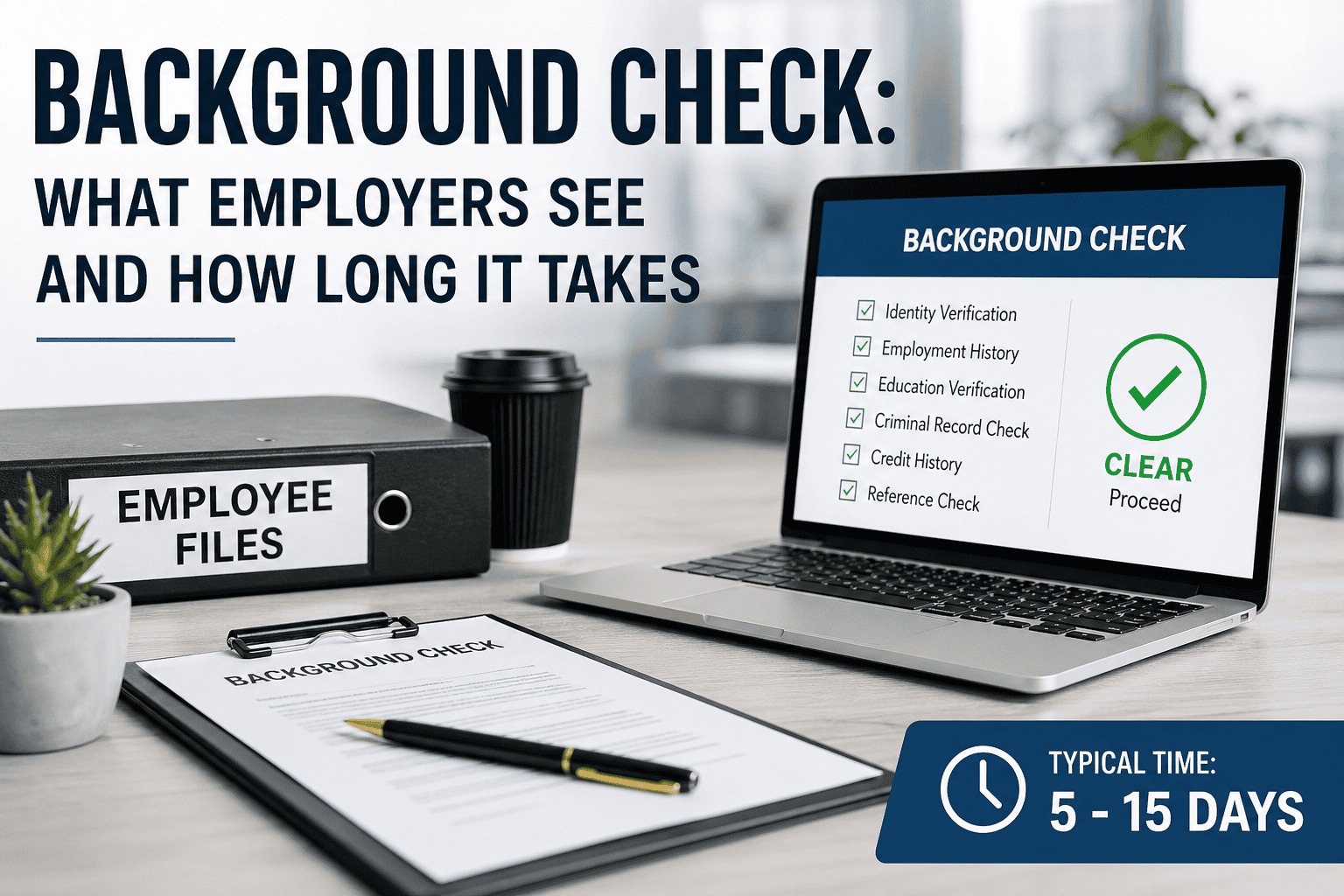
Here’s the truth most candidates don’t realize until it’s too late: a background check can make or break your job offer—even after you’ve aced every interview round. You’ve shaken hands, received the offer letter, and mentally handed in your notice. Then nothing. Radio silence. Two weeks go by.
What does a background check actually show? What exactly are they looking for—and how long does this process drag on? After more than a decade working in HR across tech, banking, and consulting, I can tell you: most candidates have no idea how deep these checks actually go. This guide will fix that.
Quick Answer
A standard employment background check shows identity, employment history, education credentials, criminal records, and (for certain roles) credit history. Most checks complete in 5–10 business days, though international or multi-component checks can take 2–4 weeks. Discrepancies—even minor ones—trigger delays.
What Is a Background Check and Why Employers Run One
A background check is a formal verification process that employers run after extending a conditional job offer. The word “conditional” matters—your offer isn’t final until you clear it.
Employers use third-party screening companies like Sterling, HireRight, First Advantage, or AuthBridge (India) to verify that everything on your resume and application is accurate. They’re not just being cautious. They’re protecting themselves from negligent hiring liability—a legal concept that holds companies accountable if they hire someone with a foreseeable risk record and that person causes harm.
For a senior product manager role at $130K in the US or a VP-level hire at ₹40 LPA in Bengaluru, the cost of a bad hire is enormous. Background checks are the last filter before a company commits to you—so they run them carefully.
Insider View
Most candidates assume background checks are a rubber stamp. They’re not. In 2026, with AI-assisted resume fraud on the rise, employers have quietly tightened verification standards—especially for remote roles where physical document checks aren’t possible. I’ve seen offers rescinded at mid-level roles for date discrepancies that would have passed unnoticed five years ago.
What Employers See in a Background Check
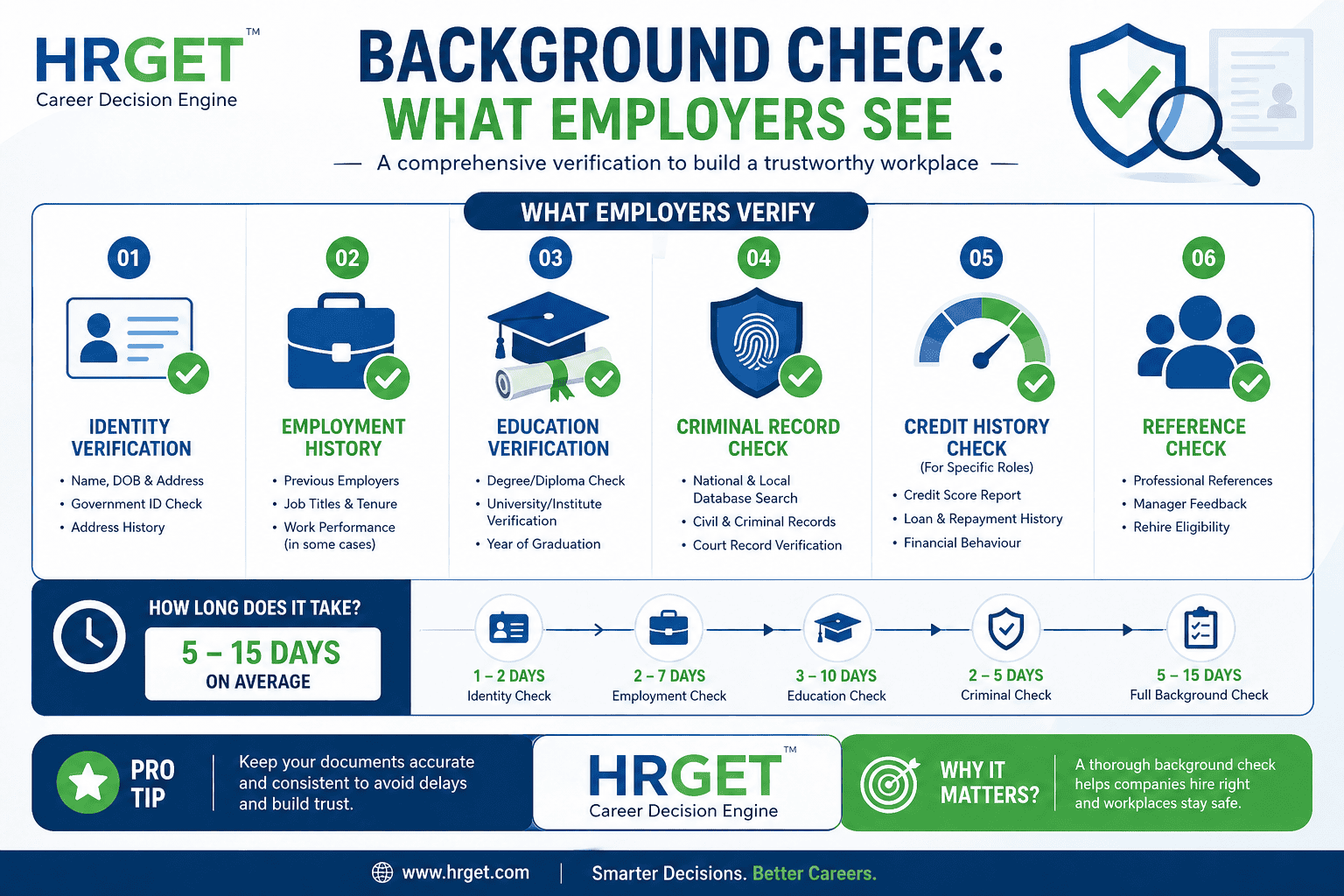
This is where most candidates underestimate the scope. A “background check” isn’t one thing—it’s typically a bundle of individual verifications run simultaneously. Here’s a breakdown of each layer.
1. Identity Verification
The check starts by confirming you are who you say you are. Verifiers cross-reference your name, date of birth, and address against government ID databases—PAN/Aadhaar in India, SSN in the US, National Insurance in the UK. Even small mismatches—using initials instead of your full legal name, or a maiden name vs. married name—can trigger a manual hold.
2. Employment History Verification
This is the most scrutinized layer. Verifiers contact your previous employers’ HR departments to confirm the companies you worked for, your official job titles, and your exact employment dates. In India, salary verification is also commonly included—so the CTC figure you provide needs to match what’s in your appointment letters and payslips.
Here’s what most articles won’t tell you: most companies don’t care if you slightly reframed your responsibilities. What they do care about—and what will fail a check—are fake companies, inflated tenure by more than a few months, and wrong job titles. “Senior Associate” when your letter says “Associate” is a discrepancy. It sounds petty. It isn’t.
3. Education Verification
Degree authenticity, the university’s accreditation status, your graduation year, and your field of study are all verified. Degree mills—institutions that sell unaccredited degrees—are flagged immediately. In India, verifiers often contact the university directly or use the National Academic Depository (NAD) portal. In the US, the National Student Clearinghouse is the standard database.
Fake or unverifiable degrees result in instant offer withdrawal. No second chances, no explanation accepted.
4. Criminal Record Check
Verifiers check local, state/province, and national criminal databases for pending cases, convictions, and sometimes civil judgments. In the US, the Fair Credit Reporting Act (FCRA) governs how criminal records can be used in hiring decisions. Not every record disqualifies you—relevance to the role is the deciding factor. A decade-old misdemeanor won’t automatically kill a software engineering offer. A fraud conviction will absolutely kill a CFO application.
5. Credit History (For Specific Roles)
Credit checks are not universal. They’re standard for finance roles, treasury functions, positions with signatory authority, and some government security clearances. In the US, the FCRA requires explicit written consent before a credit check. High debt loads or defaults can flag someone for roles handling significant financial assets—the logic being financial pressure correlates with fraud risk. Outside those specific role types, most employers skip the credit check entirely.
6. Reference Checks
Many companies still contact former managers—either directly or through a third-party service like SkillSurvey or Checkster. What they’re probing for: performance quality, reason for leaving, rehire eligibility, and whether your stated role matches what your reference remembers. Some enterprise companies now ask references to complete a structured digital form rather than a live call—which means vague or lukewarm references are more visible than they used to be.
| Check Type | What’s Verified | Common For |
|---|---|---|
| Identity | Name, DOB, government ID | All roles |
| Employment History | Companies, titles, dates, (India: salary) | All roles |
| Education | Degree, institution, graduation year | All roles |
| Criminal Record | Convictions, pending cases | All roles |
| Credit History | Debt, defaults, judgments | Finance, exec, gov |
| Reference Checks | Performance, rehire status | Mid–senior roles |
How Far Back Do Background Checks Go?
The lookback window varies by check type, country, and role level. Here’s how it breaks down in practice:
| Check Type | Typical Range | Notes |
|---|---|---|
| Employment History | 5–10 years | Some senior roles request full career history |
| Education | Lifetime | All degrees listed on your resume |
| Criminal Record | 7 years (US standard) | FCRA limits; some states are stricter or more lenient |
| Credit History | 5–7 years | Finance roles may request full credit report |
A note on India specifically: under the DPDP Act 2023, employers must obtain explicit consent before collecting and processing background check data. The lookback window is less legislatively defined than in the US, but industry practice for employment history verification typically covers the last 10 years or your entire career if you’re applying for a director or above role.
Pro Tip
If you’re applying for a senior role (Director and above in any geography), assume a full-career check—not just the last 7 years. Prepare documentation for every employer you’ve ever listed on a CV. The more senior the role, the deeper they dig.
How Long Does a Background Check Take?
This is the question candidates actually need answered while they’re waiting to give notice. Here’s the honest breakdown:
| Component | Typical Duration | What Slows It Down |
|---|---|---|
| Identity Verification | 1–2 business days | Name mismatches, document errors |
| Employment History | 2–7 business days | Unresponsive HR teams, defunct companies |
| Education | 3–10 business days | International universities, closed institutions |
| Criminal Record | 2–5 business days | Court backlog, multiple jurisdictions |
| Credit Check | 1–3 business days | Consent delays |
| Full Package | 5–10 business days | Any of the above compounding |
Cross-border checks—if you’ve worked in the US and India, or across multiple countries—add a compounding delay. Expect 2–4 weeks for international employment or education verification. The bottleneck is almost always outside your control: an HR team at a previous employer that takes days to return a call, a government database under maintenance, or a university that only processes verification requests weekly.
Warning
Don’t give notice at your current job until the background check clears. I’ve seen candidates resign on the strength of a verbal offer, then have the written offer put “on hold” while a check drags for three weeks. Always wait for a clean background check report and a signed formal offer before you resign.
Real Scenario: Offer Delayed by a Small Date Mismatch
Real Scenario
A senior analyst at a fintech firm received an offer from a top-five consulting company. The onboarding timeline was 4 weeks. Everything looked clean—until the background vendor flagged an employment date discrepancy at his previous employer.
On his resume, he had listed his start date as January 2020. His appointment letter showed February 2020. A one-month difference. He’d genuinely forgotten the exact date and rounded to the nearest quarter.
The previous employer’s HR took 8 days to respond to the verification request. The consulting firm put the offer “on hold” pending clarification. His joining date was pushed back by three weeks. He nearly lost the offer entirely when his current manager found out he was leaving earlier than planned.
The lesson: The discrepancy wasn’t fraud. It was a rounding error. But in a formal background check, there’s no such thing as a “close enough” date. Check your appointment letters before submitting your background check forms.
Why Background Checks Get Delayed
Most delays aren’t your fault. But they’re still your problem. Here’s what actually slows things down, in order of frequency:
- Unresponsive HR teams at previous employers — Particularly at larger companies where HR is decentralized. Verification requests go to a generic inbox and sit for days.
- Startups with no formal verification process — If your previous employer was a 15-person startup that no longer exists, proving you worked there requires offer letters, payslips, or LinkedIn corroboration.
- Name mismatches across documents — Your resume says “Vikram Nair,” your Aadhaar says “Vikram Kumar Nair,” and your degree says “V.K. Nair.” All three need to match or you need supporting documentation explaining the variance.
- International education or employment — Verification of degrees from universities in Germany, Canada, or the Philippines adds both time and complexity.
- Court database backlogs — Criminal record searches in some US counties require manual court record pulls, which can take 3–7 extra business days.
Smart Strategy: How to Pass Background Checks Smoothly
You can’t control how fast HR teams respond. But you can eliminate every variable that’s within your control.
- Audit your resume against your documents before you apply. Pull out your appointment letters, relieving letters, and degree certificates. Cross-check every date, every job title, and every company name. Fix discrepancies before a verifier finds them.
- Prepare a document folder before the offer stage. Gather offer letters, experience/relieving letters, payslips for the last 3 months of each job, degree certificates, and transcripts. When the verification form arrives, you can respond same day.
- Inform your previous employers proactively. If you worked at a startup or a company with high HR turnover, reach out to a former manager or HR contact and let them know a verification request is coming. This alone can cut 3–5 days off your timeline.
- Resolve name mismatches in advance. If your name differs across your PAN, Aadhaar, degree, or passport—prepare a name change affidavit or a gazette notification. Don’t let the background check be where this surfaces for the first time.
- Be upfront about anything unusual. Employment gaps, a former company that’s now defunct, a degree from an institution that changed names—disclose these voluntarily when filling in your background check forms. A brief explanation attached to the form prevents a flag from becoming a hold.
Pro Tip
Run a background check on yourself before you start applying for senior roles. Services like Checkr (US), HireRight self-check, or AuthBridge’s candidate portal (India) let you see exactly what a potential employer will see. Fixing a stale database error before your dream offer is infinitely easier than fixing it after.
Common Mistakes That Cost You the Job
I’ve seen offers pulled for things candidates considered trivial. Don’t let any of these be you:
- Listing a job title you aspired to, not the one on your offer letter. “Product Manager” when your letter says “Associate Product Manager” is a verifiable lie—not a white lie. It’s caught every time.
- Rounding employment dates to the nearest year. “2018–2020” when your actual dates are “March 2018–September 2019” creates a months-long discrepancy that looks like tenure inflation.
- Omitting a short stint you left on bad terms. Background checks often cover 7–10 years. Leaving a 4-month role off your resume and application is discovered when the verifier cross-references your SSN or PAN employment history. The omission looks worse than the short stint.
- Using a reference who doesn’t know they’re a reference. An unprepared reference who contradicts your claimed job title or scope of work creates an immediate credibility problem.
- Assuming an old employer can’t be verified. Even companies that have merged, been acquired, or shut down often have their records accessible through HR archives, payroll providers, or employment verification aggregators like The Work Number in the US.
What If Something Negative Shows Up?
A flag on a background check doesn’t automatically end your candidacy. How you handle it determines the outcome.
In the US, the FCRA mandates a two-step process: employers must send you a pre-adverse action notice before rejecting you, giving you the opportunity to dispute inaccurate findings. You have the right to request a copy of the report and challenge errors directly with the consumer reporting agency (Sterling, HireRight, etc.).
For criminal records: many US states and cities have “Ban the Box” laws—which prohibit asking about criminal history on job applications—and require individualized assessment rather than blanket rejection. California, New York, and Illinois have particularly strong protections. An employer in those states must consider the nature of the crime, how long ago it occurred, and its direct relevance to the role before disqualifying you.
In India, there’s no equivalent statutory framework yet—but if a flag arises from an inaccurate database entry, you can provide documentary proof (court order, government certification) to counter it. Having these documents ready in advance is the smartest move you can make.
Warning
Never attempt to coach a reference or fabricate documentation to counteract a background check finding. Employers who catch that—and they do—will report it to other background check vendors. You can end up flagged across the industry. One honest conversation about a past issue is always a better play than a cover-up.
The Bottom Line
A background check is the last hurdle before a company fully commits to you. Most candidates fail it not through deliberate fraud but through careless inconsistencies—rounding dates, using aspirational job titles, omitting short roles. The candidates who sail through are the ones who’ve audited their own documents before the process starts. Do that work now, not when an offer is sitting on the table.
Frequently Asked Questions
What shows up on a background check for employment?
A standard employment background check typically reveals identity verification, past employment history (job titles, dates, companies), educational credentials, criminal records, and—for finance or senior roles—credit history. The exact scope depends on the employer, the role, and your country of employment.
How far back does a background check go?
Employment history is usually checked 5–10 years back. Education is verified for your entire history. Criminal records are typically limited to 7 years in the US under the FCRA, though some states and senior roles allow deeper checks. Credit history typically covers 5–7 years.
How long does a background check take for a job?
Most background checks complete within 5–10 business days. Simple checks can finish in 1–3 days. International checks, unresponsive past employers, or criminal database delays can stretch the process to 2–4 weeks. Providing accurate documents upfront is the biggest factor in keeping timelines short.
Can a job offer be rescinded after a background check?
Yes. An employer can legally withdraw a conditional job offer if the background check reveals disqualifying information—such as a falsified degree, an undisclosed criminal record relevant to the role, or significant discrepancies between your resume and verified history. In the US, the FCRA requires employers to give you a pre-adverse action notice before rejecting you based on background check findings.
Does a background check show salary history?
In India, salary verification is common—many background check vendors contact HR to confirm CTC. In the US, salary history bans now exist in over 20 states, meaning employers cannot legally request or verify your past salary in those jurisdictions. In the UK and UAE, salary verification is less standardized but still practiced at senior levels.
What happens if my background check has a discrepancy?
A discrepancy triggers a flag, not an automatic rejection. The employer typically contacts you for clarification or supporting documents. If the discrepancy is minor (a 2-week date mismatch) and you can explain it, most offers proceed. If the discrepancy suggests deliberate misrepresentation, offers are typically rescinded.
Do background checks include social media screening?
Standard third-party background checks don’t typically include social media. However, many recruiters and hiring managers independently review LinkedIn, Twitter/X, and public profiles. Some enterprise employers use social media screening tools as an add-on. Assuming your public social presence will be reviewed is the safer posture going into any senior job search.
Related reading: Have employment gaps you’re worried will raise flags during a background check?
Read our guide: How to Explain Employment Gaps Without Killing Your Chances — practical scripts for every gap scenario, from layoffs to sabbaticals to caregiving.

Emily Carter is a career coach and former McKinsey talent advisor with 15+ years of experience helping professionals navigate career transitions, promotions, and high-stakes job decisions. She has advised professionals across consulting, technology, finance, and corporate leadership roles on offer negotiations, career positioning, and long-term growth strategy.
Role: Career Coach & Ex-McKinsey Talent Advisor: Focuses on helping professionals make smarter career moves—switching jobs, negotiating offers, and long-term career growth. She blends structured thinking with real-world coaching insights.