

The most effective severance package negotiation tips have nothing to do with asking for more weeks of pay. Your real leverage is in extended healthcare, equity acceleration, title adjustments, reference agreements, and exit date flexibility — terms employers have far more room to approve than additional cash. Negotiate these first, and you’ll often walk away with 2–3x the total value of what you were offered.
Most people walk into a severance negotiation thinking it’s purely about the cash payout. After 18 years advising on severance packages — from regional manager exits to C-suite restructurings at Fortune 500s — I can tell you that’s the single most expensive assumption you can make.
Here’s the truth that most articles on severance package negotiation tips won’t tell you: your base severance check is often the least flexible part of the deal. Companies pre-approve standard formulas — typically 1–2 weeks per year of service — and HR rarely has the authority to move that number without senior sign-off. But the surrounding terms? Those are a different story entirely.
Benefits continuations, equity acceleration, title adjustments, reference language, non-compete scope — these are handled by different budget lines and different decision-makers. And they’re where the real negotiation lives. This guide gives you the full playbook.
Why Severance Negotiation Is Not Just About Money
When a company designs a severance package, it’s thinking in three currencies: risk, cost, and reputation. The legal team is worried about claims. Finance is watching the cash exposure. HR is managing optics internally.
Cash severance sits squarely in the “cost” column. It hits the income statement immediately. That’s why increasing the base payout triggers so much internal friction — it requires budget authorisation that mid-level HR simply doesn’t have.
Non-cash terms are categorised differently. Healthcare continuation is often classified as a benefits expense, not headcount cost. Outplacement services come out of a separate L&D or HR operations budget. Equity acceleration is a finance and equity team decision, not an HR one at most companies. This matters because different decision-makers have different flexibility — and if you know which asks go to which approver, you can negotiate more surgically.
Insider View
I’ve sat in dozens of separation meetings where the employee focused entirely on the check. Meanwhile, the HR director had already pre-approved a 3-month COBRA extension and an outplacement budget — waiting to see if the employee would ask. They often didn’t. Don’t leave that on the table.
The bottom line: you’ll extract more total value — financial, professional, and legal — by treating severance as a multi-term negotiation, not a salary counter-offer.
What Employers Are Actually Willing to Negotiate
Let’s be direct about the landscape in 2026. Most large employers are operating with tighter cost controls than they were three years ago, but that doesn’t mean the package is fixed. It means the flexibility has shifted.
Here’s the general breakdown of what’s typically hard vs. soft in a severance negotiation:
| Term | Employer Flexibility | Why |
|---|---|---|
| Base cash severance (weeks × salary) | Low–Medium | Pre-approved formula, requires budget sign-off |
| Health insurance continuation | Medium–High | Separate benefits budget, lower visible cost |
| Equity vesting acceleration | Medium (tech) / Low (others) | Finance & equity team decision, not HR |
| Job title in final records | High | Costs nothing, managed by HRIS admin |
| Reference letter wording | High | Legal risk management — they want this documented too |
| Non-compete scope/duration | Medium | Legal team must approve, but increasingly scrutinised post-FTC guidance |
| Outplacement services | High | Pre-budgeted at most mid-large companies |
| Exit date | Medium–High | Operationally simple to extend by 2–4 weeks |
The pattern is clear: the further you move from direct cash compensation, the more room companies have to give. That’s your strategic entry point.
10 High-Value Things to Ask For Beyond Money
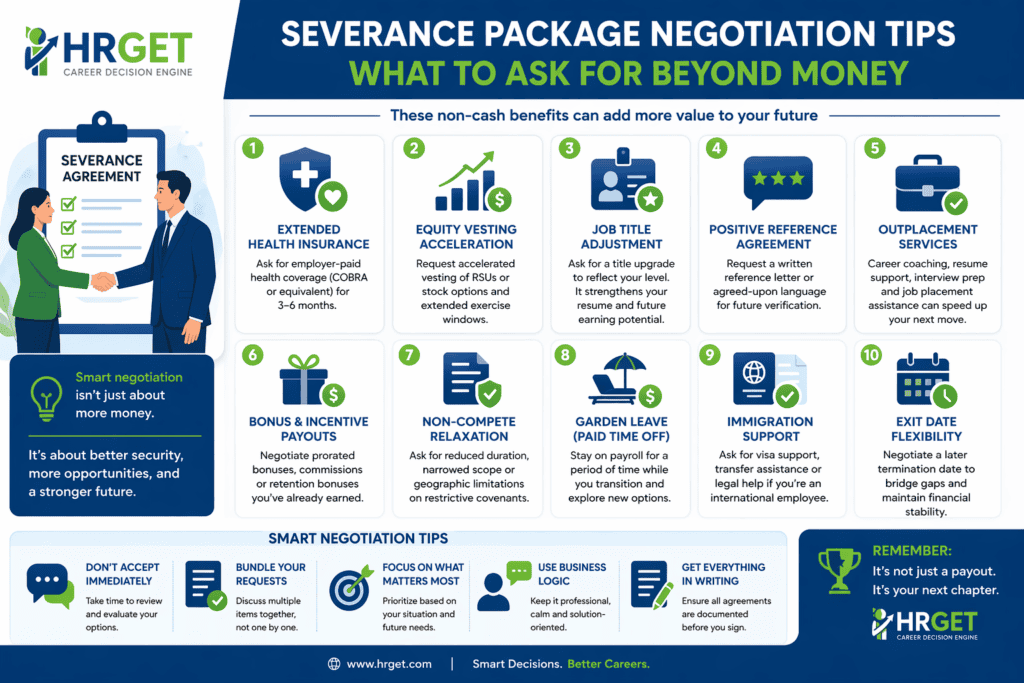
1. Extended Health Insurance Coverage
In the US, losing employer healthcare is genuinely alarming — COBRA premiums average $600–$700/month for individual coverage and over $1,800/month for a family plan in 2026. That can easily consume 30–40% of your severance cash in months one and two.
The smart ask is to have the company continue paying its share of premiums for 3–6 months, rather than COBRA-kicking you immediately. Many companies have pre-approval for this and will offer it if asked. In the UK, this equivalent is maintaining private medical cover for an agreed period post-exit.
“Can we agree to keep employer-paid health premiums in place for 90 days while I transition? I want to make sure this separation is clean and comfortable for both sides.”
2. Equity Vesting Acceleration
If you hold unvested RSUs or stock options — especially at a pre-IPO or publicly traded tech company — this is the highest-value ask on the entire list. The delta between what you’d vest on your scheduled date versus your termination date can be substantial.
Ask for single-trigger acceleration on the next tranche (or full acceleration if you’re senior enough). Also negotiate an extended exercise window for any vested options — the standard 90-day window is often punishingly short, especially if the stock is in a quiet period or you need time to plan taxes. Some companies will extend to 1–2 years for senior departures.
Pro Tip
Before your separation meeting, pull your equity grant agreement and calculate the exact dollar value of the unvested shares at current price. Walk in knowing that number. When you can say “I have approximately $42,000 in unvested RSUs vesting in November” — the conversation changes.
3. Official Job Title Adjustment
This one costs the company nothing and is routinely approved — yet almost no one asks for it. If you’ve been operating at a director level but your title is “Senior Manager,” your last day is the last opportunity to correct that on record.
A title upgrade in your HRIS and official employment records can anchor your next salary negotiation at a higher baseline. Recruiters verify titles. Background checks pull titles. This is a permanent, career-compounding ask.
4. Written Reference Agreement
Most companies have a neutral reference policy — they confirm dates and titles only. That’s fine as a baseline, but you want more than that. Negotiate a specific written reference letter from your manager or a senior leader, plus agreed wording for what HR will say during verification calls.
Get the reference letter drafted and signed before you exit. Verbal promises from a manager who’s been reorged in six months are worthless. The letter needs to be on company letterhead, dated, and signed.
5. Outplacement Services
Most medium-to-large companies have pre-existing contracts with outplacement firms like Lee Hecht Harrison, Right Management, or Challenger, Gray & Christmas. There’s often a per-head budget already allocated for severance cohorts.
A 3-month outplacement engagement typically includes a career coach, resume review, LinkedIn optimisation, and interview preparation. Research consistently shows this shortens the job search by 4–8 weeks for mid-career professionals. If you don’t ask, HR may not mention it — even though it’s budgeted.
6. Pro-Rated Bonus or Incentive Payout
If you’re being let go mid-cycle — whether that’s mid-quarter or mid-fiscal year — you’ve earned a portion of your incentive compensation. Don’t walk away from it by assumption. Push explicitly for a pro-rated bonus based on your tenure through the performance period.
Similarly, if you received a retention bonus with a vesting cliff that’s 6–12 months away, it’s worth asking whether the company will treat you as if you met the cliff. They often won’t, but for employees who were specifically retained during a restructuring, there’s a reasonable argument to be made.
7. Non-Compete Scope Reduction
If you signed a non-compete agreement — common in tech, finance, and sales roles — your post-termination employment options are legally constrained, and in 2026 this matters more than ever given the FTC’s ongoing scrutiny of such clauses. Even if the FTC’s non-compete rule is still working through courts, state-level enforcement is patchy. You need to negotiate this down regardless.
Specific asks that get approved: reduce the duration from 12 months to 6 months; narrow the geographic scope; remove specific competitor names from the restricted list. The key framing is that an overly broad non-compete creates ongoing legal friction for both parties — companies generally prefer a clean exit.
Warning
Never sign a severance agreement without reading the non-disparagement clause carefully. Many include language that prohibits you from describing the circumstances of your departure to future employers — which can hurt you in interviews. Negotiate language that allows you to confirm the reason was a reduction in force or company restructuring.
8. Garden Leave (Paid Employment Bridge)
Rather than an immediate termination date, you remain on payroll as a non-active employee. You’re not expected to work. You continue to accrue benefits and your employment status remains “employed” — which matters both for your resume and for unemployment insurance calculations in some states.
Garden leave is more common in the UK (where it’s standard in senior contracts) but is increasingly used in the US for senior departures. Even 30 days of garden leave buys you meaningful runway. Ask for it directly: “Can we structure my exit with a 30-day garden leave period rather than an immediate termination?”
9. Immigration and Visa Support
If you’re on an employer-sponsored visa — H-1B in the US, Tier 2/Skilled Worker in the UK — your departure has immediate legal implications. Your grace period to find new employment or leave the country is typically 60 days in the US after H-1B termination. That’s not much runway.
Negotiate explicitly for: extended employment status during the job search; company-paid immigration attorney support for transfer or change-of-status filings; and a clear written statement of your visa status upon separation. For visa holders, this isn’t a nice-to-have — it’s the most critical term on the list.
10. Exit Date Flexibility
A later official termination date can affect multiple downstream financial variables: your eligibility for that month’s bonus payment, your healthcare coverage through the end of the month, your tenure for vesting purposes, and your reported employment end date on background checks.
Even pushing your termination from mid-month to end-of-month is worth asking for — it often means an extra month of employer-paid health coverage at no additional direct cash cost to the company. Operational teams generally have no objection to this; it’s an HR admin change.
Real Scenario: Smart vs Weak Negotiation
Real Scenario: Two Exits, Very Different Outcomes
Employee A is a Senior Product Manager at a tech company, laid off with 4 years of tenure. She accepts the initial offer — 8 weeks of pay — without asking any questions. She signs the agreement within 48 hours.
Employee B is in an identical role, identical tenure, same layoff cohort. He asks for 48 hours to review, then schedules a follow-up call with HR. He asks for: 3 months of employer-paid healthcare premiums (approved), acceleration of his November RSU tranche worth ~$38,000 (partially approved — 50% acceleration), a title adjustment from Senior PM to Principal PM in his records (approved, no cost), a written reference letter (approved), and a 30-day garden leave period (approved).
The outcome: Employee A walks away with approximately $30,000 in severance cash. Employee B walks away with $30,000 cash + $19,000 in equity + $5,400 in healthcare savings + a stronger resume. Total value: roughly $54,000 — 80% more than Employee A, without ever asking for more cash.
This isn’t a hypothetical. I’ve seen variations of this play out more times than I can count. The difference is almost never about leverage — it’s about knowing what to ask for.
How to Structure Your Severance Negotiation Strategy
Don’t accept immediately — request review time
Say: “Thank you for walking me through this. I’d like 48–72 hours to review the agreement carefully before responding.” This is professional, expected, and creates negotiating space. If you’re over 40 in the US, you have a legal right to 21 days under OWBPA.
Make a prioritised list before your next conversation
Rank your asks in order of personal financial impact. For most people: healthcare → equity → bonus → title/reference → non-compete. Know what you’re willing to trade against what.
Bundle all requests in a single structured conversation
Don’t send five separate emails. Frame it as: “I’d like to discuss a few elements of the package before I sign — specifically around benefits continuation, equity treatment, and exit date.” Bundling signals organisation and keeps the conversation focused.
Use business logic, not emotion
Framing matters enormously. “I deserve more” triggers defensiveness. “Extending benefits by 60 days would help ensure a smooth transition and is consistent with what I’ve seen in similar exits” is far more effective. You’re solving their problem too: a clean, uncomplicated separation.
Document every agreed term before signing
Verbal commitments from HR aren’t worth anything. If someone says “we can do the healthcare extension,” respond with: “Great — can you add that to the agreement before I sign?” Don’t sign until every term is reflected in the written document.
Common Mistakes That Kill Your Leverage
I’ve watched smart, capable professionals give up significant value in severance negotiations — not because they lacked leverage, but because they made predictable errors. Here are the ones I see most often:
Accepting within 24 hours. The urgency companies create around signing is deliberate. There is almost never a genuine operational reason you need to sign the same day. Taking 48–72 hours doesn’t make you difficult — it makes you careful.
Only pushing on base cash. If you walk in asking for “more weeks,” you’ve signalled that you don’t know how severance negotiations actually work. HR has almost certainly pre-approved cash at a fixed formula. Asking for it to increase triggers an escalation process most HR managers want to avoid.
Getting emotional or adversarial. Being laid off is painful. That’s real. But the negotiation conversation is a business transaction. Every emotional escalation gives the company a reason to shut the conversation down. Stay professional, stay specific, stay solution-oriented.
Ignoring the legal clauses. The release of claims section, the non-disparagement language, the cooperation clause, the forum selection clause — these matter. Read them or have an attorney review them. Signing away wrongful termination claims without realising it is more common than you’d think.
Not negotiating at all. This is still the single most common mistake. Companies expect some form of negotiation on most professional-level separations, especially in 2026 when the job market for mid-career professionals is genuinely competitive. Silence is not humility — it’s just lost value.
The Insider View: What HR Is Actually Thinking
Insider View — Michael Reeves
Here’s what the HR director across the table is actually focused on: a clean exit. They’re not trying to shortchange you. They’re trying to close the file without a claim, a social media complaint, or a messy reference situation that comes back to bite them. The moment you understand their primary objective — risk elimination — you can negotiate far more effectively.
What this means practically:
Legal risk matters more than cost. A senior employee who asks professionally for an extended notice period and a positive reference is giving the company something valuable — the assurance you won’t sue, file an EEOC complaint, or blast them on LinkedIn. That’s worth something to them. Use that leverage professionally.
Seniority genuinely expands your flexibility. At director level and above, HR typically doesn’t control the negotiation — it escalates to a VP of People or CHRO, sometimes legal. These decision-makers have more authority to approve non-standard terms. If you’re senior, ask to speak with someone who has that authority.
Silence is a power move. When you’ve made a request, stop talking. The instinct to fill silence with justification or concession is almost universal — and almost always works against you. Make the ask, say “I’d appreciate your thoughts on that,” and wait.
Everything is negotiable until you sign. This is the most important principle in any severance package negotiation. The moment that signature goes down, the deal is closed. Treat the pre-signature window as the only window you have.
Which Terms Matter Most for Your Situation
Not every ask is equally relevant to every exit. Use this filter to prioritise:
| Your Situation | Top Priority Ask | Why It Matters Most |
|---|---|---|
| Family with dependents | Healthcare continuation (3–6 months) | COBRA premiums can wipe out severance fast |
| Tech employee with RSUs | Equity acceleration + exercise window | Can exceed base severance in value |
| Competitive job market | Garden leave + outplacement | Buys time and tools for a stronger search |
| Senior/director-level exit | Title adjustment + reference letter | Permanent resume & salary anchoring impact |
| Visa/work permit holder | Immigration legal support + status extension | Non-negotiable for legal residency continuity |
| Active non-compete | Scope reduction / duration cut | Determines which jobs you can actually take |
| Mid-cycle departure | Pro-rated bonus | You earned it; don’t assume it’s forfeited |
The Bottom Line
Severance package negotiation isn’t about getting more money — it’s about securing the foundations of your next chapter. The professionals who fare best aren’t the ones who pushed hardest on cash. They’re the ones who understood which terms mattered most for their specific situation and asked for them calmly and specifically.
Your employer expects negotiation. The non-cash terms often have pre-approved flexibility. The only thing standing between you and that value is whether you ask for it — professionally, specifically, and before you sign anything.
FAQ: Severance Package Negotiation Questions
Can you really negotiate a severance package?
Yes — and you should. Most mid-to-senior employees don’t realise the first offer is rarely the final one. Companies build in negotiation room, especially on non-cash elements like benefits continuation, equity terms, and outplacement support. Declining to negotiate is one of the most common and costly mistakes professionals make during a layoff.
What is the most valuable thing to negotiate in a severance package?
It depends on your situation, but for most employees it’s either extended health insurance coverage or equity vesting acceleration. In the US, COBRA premiums average over $1,800/month for family coverage in 2026 — having the company cover that for 90 days is real money. For senior tech employees, unvested RSUs can be worth far more than the cash severance figure.
How long do you have to negotiate a severance package?
Typically 5 to 21 days, depending on your age and jurisdiction. Under the Older Workers Benefit Protection Act (OWBPA) in the US, employees aged 40 and over must receive at least 21 days to consider a severance agreement. You can almost always request a short extension, and doing so signals you’re taking the process seriously — not stalling.
Should you hire a lawyer before signing a severance agreement?
For senior roles, large payouts, or complex legal clauses — yes. An employment attorney can identify waiver language, non-disparagement traps, or overly broad non-compete terms you might miss. A one-hour consultation typically costs $200–$400 and can easily save you thousands. In the UK, some solicitors offer a free initial review of settlement agreements.
What if the company says the severance is non-negotiable?
Push back professionally, but shift your focus to non-cash items. Cash is often genuinely constrained by HR policy — but benefits duration, outplacement, equity timelines, and reference agreements are frequently approved quietly. The phrase “non-negotiable” almost always refers to the base cash formula, not the full package.
Is it risky to negotiate a severance package?
No — if done professionally. Your employment is already ending. The worst realistic outcome is they say no and the original offer stands. The best case is you gain months of healthcare coverage, an accelerated equity tranche, or a title upgrade that boosts your next salary negotiation. The risk-reward calculus almost always favours negotiating.
Can you negotiate a severance package after you’ve already signed?
Generally, no. Once the agreement is executed, it’s legally binding. There are narrow exceptions — if you signed under duress, were given materially false information, or if the agreement contains an unlawful clause — but these require legal advice to pursue. This is exactly why you negotiate before signing, not after.
📄
Related: How Long Do You Have to Negotiate Severance? Your State-by-State Timeline
Know your legal deadlines, OWBPA rights, and how to request more time without damaging the process.

Michael Reeves | Former Senior Counsel, Littler Mendelson | Severance & Restructuring Specialist | 18+ Years in Employment Law
Author bio: Michael Reeves spent nearly two decades as Senior Counsel at Littler Mendelson — one of the world’s largest employment law firms — advising on mass layoffs, corporate restructurings, and severance negotiations for Fortune 500 companies across the US and Europe. He has worked both sides of the table: structuring cost-efficient separation packages for employers and, more recently, helping employees understand exactly where their leverage lies. Based between Chicago and London, Michael writes for HRGet.com to demystify the legal and financial dimensions of layoffs — so employees stop leaving money on the table.