Wrongful termination signs include sudden negative performance reviews after a complaint, termination shortly after protected leave, and being fired while others who committed the same infraction kept their jobs. If any of these apply, do not sign anything yet. Document everything, understand your jurisdiction’s filing deadlines, and consult an employment lawyer — many offer free consultations. Even if you’re unsure, acting as if you have a case gives you leverage most employees never use.
You don’t get fired randomly. At least, that’s what most companies want you to believe.
Here’s the reality: in my two decades of employment law practice, I’ve seen hundreds of terminations that were dressed up as performance issues, restructurings, or “cultural fit” problems — and were none of those things. Many employees are quietly targeted, pushed out, or terminated for reasons that would never survive legal scrutiny. The trouble is, most people don’t recognize the warning signs of wrongful termination until they’ve already signed away their rights.
If you’ve just been fired — or sense it’s coming — this guide will walk you through how to spot the red flags, what to do in the first 72 hours, and how to protect yourself without making the costly mistakes I’ve watched derail otherwise strong cases.
What Is Wrongful Termination?
Wrongful termination happens when your employer fires you for an illegal reason, even when they disguise it as something else entirely — a restructure, a performance issue, an “organizational fit” decision.
The confusion stems from “at-will” employment, which exists in most US states. At-will means your employer can dismiss you for almost any reason — or no reason at all. But that flexibility has hard limits. Employers cannot fire you for reasons that violate federal or state law, or the terms of your own employment contract.
The legal categories that make a termination wrongful are fairly consistent across jurisdictions:
- Discrimination — based on race, gender, age (40+), religion, national origin, disability, pregnancy, or sexual orientation
- Retaliation — for reporting harassment, filing an EEOC complaint, or whistleblowing under Dodd-Frank, Sarbanes-Oxley, or equivalent laws
- Breach of contract — your written employment agreement or employee handbook outlined a disciplinary process that was skipped
- Public policy violations — fired for serving on jury duty, taking FMLA leave, or refusing to commit an illegal act
In the UK and across the EU, “unfair dismissal” laws are broader — employees with two or more years of service have strong protections even without a specific discriminatory act. In India, the Industrial Disputes Act provides protections for workers in certain sectors against termination without cause. The framework differs, but the core principle is the same: employers have limits.
Insider View:
What most legal guides skip is this: companies rarely fire people for explicitly illegal reasons. They build a paper trail first — sudden performance concerns, vague policy violations, restructuring justifications. The illegal reason is underneath. Your job is to show the paper trail was manufactured, not organic.
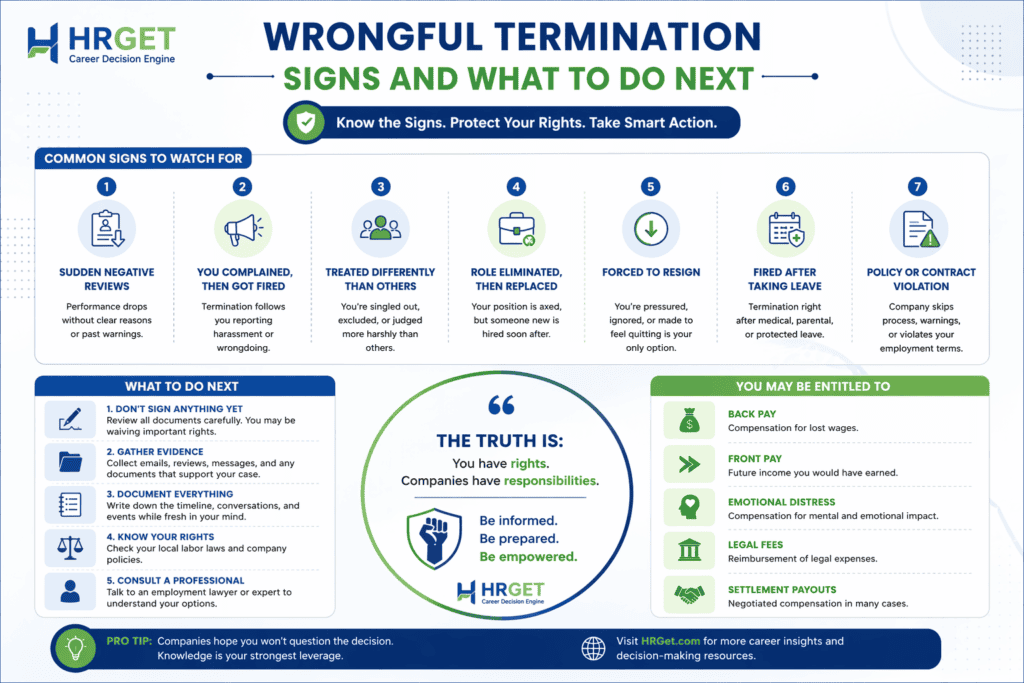
7 Warning Signs You Were Wrongfully Terminated
This is where most people miss what’s actually happening. These signs rarely appear in isolation — the more that apply to your situation, the stronger your case becomes.
1. Sudden Negative Performance Reviews
You’ve had solid performance evaluations for years. Then, seemingly out of nowhere, your reviews turn critical. Feedback becomes vague — “not meeting expectations,” “communication issues,” “lacks strategic thinking” — without specific examples or a prior track record to support it.
This is one of the most common pre-termination patterns I see. Companies build a documented “performance” case to make the firing look justified. If the timeline of negative reviews closely follows a complaint you made, a leave you took, or a protected action you took, that correlation matters legally.
2. You Complained — Then Got Fired
This is the clearest retaliation pattern. You reported harassment to HR. You raised concerns about accounting irregularities. You filed a safety complaint with OSHA. Or you told a manager their behavior was inappropriate. And within weeks or months, you’re out.
Under Title VII and similar laws, retaliation is illegal even if the underlying complaint didn’t result in a formal finding. The protected activity itself — the act of reporting — is what matters. A 90-day window between complaint and termination raises serious questions in any employment tribunal.
3. You Were Treated Differently Than Others
Disparate treatment is a cornerstone of discrimination claims. If a colleague committed the same policy violation and kept their job while you were fired, that’s legally significant. If promotions were consistently given to people outside your protected class. If you were excluded from meetings, projects, or communications in ways others weren’t.
I’d encourage you to think carefully about comparators — people in similar roles, similar performance bands, similar tenure. Their treatment relative to yours forms the backbone of a discrimination argument.
4. Your Role Was “Eliminated” — Then Quietly Refilled
This one is extremely common and frustratingly easy for companies to attempt. You’re told your position is being eliminated due to restructuring or budget cuts. Sounds legitimate. Then, six weeks later, a nearly identical job posting appears — sometimes with a slightly different title, sometimes not.
Courts and tribunals look at this pattern. If the role was genuinely eliminated, it stays eliminated. If it reappears — especially filled by someone outside your protected class — the restructuring justification becomes very difficult to defend.
5. You Were Forced to Resign (Constructive Dismissal)
Not every wrongful termination involves a formal firing. Constructive dismissal — recognized in both US and UK employment law — occurs when your employer makes conditions so intolerable that resignation is the only reasonable option. Think: stripping your key responsibilities without explanation, demoting you publicly, cutting your pay unilaterally, or creating a hostile environment after you filed a complaint.
If you were effectively pushed out, your legal position can be just as strong as if you’d been formally terminated. The key is documenting the conditions that made staying untenable.
6. Termination Shortly After Protected Leave
If you returned from FMLA medical leave, maternity or paternity leave, or disability leave — and were let go within a short window of your return — that timing is a major red flag. The FMLA explicitly prohibits interference with leave rights and retaliation for taking them. The ADA and Pregnancy Discrimination Act add further layers of protection.
In the UK, dismissal related to maternity leave carries some of the strongest employment protections in law. If your leave falls into any of these categories, don’t dismiss the connection.
7. Your Contract or Company Policy Was Violated
Many employees don’t read their employment contracts or employee handbooks carefully enough — which is exactly what companies rely on. If your contract specifies a progressive disciplinary process (verbal warning, written warning, performance improvement plan before termination) and that process was bypassed, you have a contractual claim regardless of the reason given for firing you.
This applies equally in at-will states. The company’s own documented policies, once established, create obligations. When they’re ignored to remove a specific employee, that selective enforcement matters.
Real Scenario: How Wrongful Termination Actually Happens
Real Scenario:
Priya is a senior product manager at a mid-size tech company in Austin. She’s been there four years with strong reviews. In September, she reports her VP for inappropriate comments during a team offsite. HR acknowledges the complaint and says it will be investigated.
Over the next eight weeks: her Q3 performance review drops from “exceeds expectations” to “meets expectations with concerns.” She’s removed from a product launch she’d been leading for six months. Two projects she owns are quietly reassigned. In November, she’s placed on a 30-day Performance Improvement Plan — her first in four years. By December, she’s terminated for “sustained underperformance.”
Company’s version: Performance issue. Reality: Almost certainly retaliation — with a documented paper trail built in the ten weeks between the complaint and the termination.
Priya had the evidence. She’d saved her prior reviews, the complaint email, and written records of the project reassignments. She consulted a lawyer within a week of termination. The case settled before it reached the EEOC — for significantly more than her original severance offer.
This pattern is extremely common. Companies are better at building these cases than employees are at recognizing them. But the paper trail cuts both ways — if you preserve your own documentation, it becomes their liability.
What to Do Immediately After Termination
The 72 hours after termination are where your case is won or lost. Most people get this wrong — they either react emotionally or they comply reflexively, signing whatever HR puts in front of them.
- Do not sign anything immediately. Severance agreements routinely include a waiver of your right to sue. In the US, if you’re over 40, the ADEA requires you be given 21 days to review a severance agreement and 7 days to revoke it after signing. Take the time. A document signed under pressure the day you’re terminated is exactly what the company wants.
- Gather evidence before access is revoked. Your work email, your Slack history, your shared drives — these may be locked within hours. Forward relevant emails to a personal account where permitted by your employment agreement. Screenshot key communications. Save your performance reviews. Preserve any documentation related to your complaint or the circumstances leading to termination.
- Write down everything — now, not later. Memory degrades fast. Write a detailed timeline: dates of conversations, what was said and by whom, when the performance issues started, what happened after any complaint or leave. Include names and job titles. This document becomes critical if you engage a lawyer or file a claim.
- Understand your jurisdiction’s filing deadlines. In the US, EEOC discrimination claims generally must be filed within 180–300 days. UK Employment Tribunal claims have a 3-month limit. India varies by state and sector. These are hard deadlines — missing them forecloses your options entirely.
- Apply for unemployment benefits promptly. Do this regardless of whether you intend to pursue a legal claim. Wrongful termination doesn’t disqualify you from unemployment — you’re almost certainly eligible unless the company argues misconduct, and they’ll need to prove it.
Legal Grounds for a Wrongful Termination Claim
To build a credible claim — or simply to negotiate a better severance package — you need to anchor your situation to a recognized legal ground. Here’s how the major categories map to real evidence:
| Legal Ground | What You Need to Show | Key Laws (US) |
|---|---|---|
| Discrimination | You belong to a protected class; others outside that class were treated more favorably in similar circumstances | Title VII, ADA, ADEA, PDA |
| Retaliation | You engaged in a protected activity (complaint, whistleblowing); adverse action followed within a suspicious timeframe | Title VII §704(a), Dodd-Frank, SOX |
| Breach of Contract | Written agreement or handbook policy established process that was not followed | State contract law |
| FMLA/Leave Retaliation | Termination closely followed protected leave; no legitimate, documented reason for timing | FMLA, ADA, state leave laws |
| Public Policy Violation | Fired for refusing an illegal instruction, jury service, or exercising a statutory right | Varies by state |
| Constructive Dismissal | Working conditions were deliberately made intolerable; resignation was effectively compelled | Implied contract, Title VII |
You don’t need to perfectly categorize your situation on day one. That’s what a lawyer does. What you need is to preserve the evidence that speaks to at least one of these grounds.
Smart Strategy: Build Your Case Even If You’re Unsure
Here’s the mistake I see constantly: employees who sense something was wrong with their termination but assume they don’t have a “strong enough case” and walk away. That’s precisely the outcome the company is counting on.
Pro Tip:
You don’t need to win in court to benefit from having a credible case. If a company believes you might escalate legally, they often increase severance, offer a neutral reference instead of a negative one, and agree to terms that protect your next job search. This leverage disappears the moment you sign a waiver — which is why they want you to sign fast.
Even if you’re genuinely uncertain about whether your termination was wrongful, take these steps regardless:
- Preserve evidence as if you have a case. You can decide later whether to use it. You can’t reconstruct it once access is gone.
- Consult a lawyer before signing your severance agreement. Many employment lawyers offer free initial consultations — a 30-minute call can reframe your understanding of what you’re worth.
- Negotiate from a position of awareness. “I’d like more time to review this with counsel” is a sentence that costs you nothing and signals to the company that you know your rights. Most companies respond to this by being more flexible, not less.
- Don’t rely on HR. HR’s job is to protect the company. That’s not cynicism — it’s their function. They are not your advocate in this situation, no matter how collegial the relationship has been.
Even cases that settle for $20,000–$50,000 in enhanced severance often start from employees who weren’t certain they had a case. Awareness is itself a form of leverage.
Common Mistakes That Destroy Your Case
- Signing documents within hours of termination. You waive legal rights permanently. Companies know most people sign reflexively. The 21-day review period under ADEA exists for a reason — use it, or request equivalent time even if you’re under 40.
- Sending angry emails or confronting HR directly. I understand the impulse. But hostile communications become exhibits that damage your credibility and paint you as difficult. Anything you send after termination can and will be used against you.
- Failing to document before evidence disappears. System access is typically cut within hours. If key emails or Slack conversations exist that support your case, you need to act on day one — not day three when you’ve had time to calm down.
- Waiting too long to consult a lawyer. Filing deadlines are strict. In the US, EEOC charges must typically be filed within 180–300 days of the discriminatory act. Missing this window is not recoverable.
- Trusting verbal promises from HR or management. “We’ll take care of you,” “we’ll give you a great reference,” “this will be treated as a mutual separation” — none of this matters unless it’s in writing. Get every commitment documented before you sign anything.
Should You Hire a Lawyer?
Look — not every wrongful termination case warrants full litigation. But a lawyer’s value isn’t only in the courtroom. It’s in the first conversation.
You should consult an employment lawyer if:
- You suspect discrimination or retaliation was involved
- You lost a senior or high-earning position (the stakes justify the cost)
- You’re being pressured to sign documents quickly
- Your employer violated a written contract or documented HR policy
- Termination closely followed a protected leave, complaint, or legally protected activity
On cost: many employment lawyers in the US work on a contingency basis for discrimination and retaliation claims — meaning they take a percentage of any settlement or award, with no upfront cost. In the UK, employment law firms frequently offer fixed-fee or no-win no-fee arrangements for tribunal claims. Free initial consultations are the norm. There is no financial excuse not to make one phone call.
Warning:
If your termination involved a non-disclosure agreement or non-disparagement clause in the severance package, this is especially important to review with counsel. These clauses are frequently overbroad, and in some US states, certain NDA terms related to workplace harassment are now unenforceable under federal law (SPEAK OUT Act, 2022).
Compensation You May Be Entitled To
If wrongful termination is proven — or credibly asserted in negotiations — the financial outcomes can go well beyond standard severance. Here’s what’s on the table in a strong case:
| Type of Compensation | What It Covers | When It Applies |
|---|---|---|
| Back pay | Lost salary from termination date to settlement or judgment | Most wrongful termination claims |
| Front pay | Projected future income loss if reinstatement isn’t feasible | Senior roles; hostile work environments |
| Emotional distress damages | Compensation for psychological harm caused by the termination | Discrimination and retaliation cases |
| Punitive damages | Penalty imposed on employer for particularly egregious conduct | Intentional discrimination; high-profile retaliation |
| Legal fees | Attorney’s costs, often awarded to prevailing plaintiffs | Title VII and similar federal claims |
| Enhanced severance (negotiated) | Beyond initial offer — obtained through leverage, not litigation | Most cases where a credible claim exists |
In 2026, the median employment discrimination settlement in the US sits somewhere between $40,000 and $250,000 depending on seniority, industry, and strength of evidence — though high-earning roles can produce significantly larger outcomes. The point isn’t to litigate for sport. It’s to understand that walking away from severance you’re owed costs you real money.
Most employees assume that if they got fired, the company must have had a valid reason. Companies count on that assumption. The reality is that wrongful termination — whether rooted in discrimination, retaliation, or a violated contract — is more common than most people recognize, and more actionable than most people attempt. Know the signs. Preserve the evidence. Understand your rights before you sign anything. That’s the sequence that changes outcomes.
Frequently Asked Questions
How do I know if my termination was illegal?
Look for a pattern: sudden negative reviews after a complaint, termination shortly after taking protected leave, or being fired while others with similar performance kept their jobs. If any of these apply, the circumstances warrant a professional review. Don’t dismiss it as coincidence — timing and comparators are exactly what employment lawyers and tribunals look at.
Can I sue my employer for wrongful termination?
Yes, if your termination violates employment law or your contract. In the US, most claims are first filed with the EEOC; in the UK, with an Employment Tribunal. Many cases settle before reaching a courtroom — a strong documented case gives you real leverage at the negotiation table, often without ever filing a formal complaint.
How long do I have to file a wrongful termination claim?
In the US, EEOC discrimination claims must typically be filed within 180–300 days of the termination. UK Employment Tribunal claims must be lodged within 3 months (less one day). In India, timelines vary significantly by state and employment category. Missing these windows almost always kills your case — consult a lawyer before you assume there’s no rush.
What if I already signed a severance agreement?
You may have waived certain rights, but not necessarily all of them. If you signed under duress, without adequate review time, or — if you’re over 40 in the US — without the legally required 21-day review period under the ADEA, a lawyer may be able to challenge the agreement. Don’t assume it’s final until a professional reviews it.
What is constructive dismissal and how does it differ from wrongful termination?
Constructive dismissal happens when your employer makes conditions so intolerable that resignation is effectively your only option — stripping responsibilities, public humiliation, sudden demotion without cause, or creating a hostile environment after a complaint. Legally, it’s treated similarly to wrongful termination in both the US and UK. You weren’t formally fired, but the outcome and your legal standing are comparable.
Can I collect unemployment benefits after wrongful termination?
In most cases, yes. Unemployment is typically denied only when an employee was fired for deliberate, serious misconduct. If you were wrongfully terminated — particularly due to discrimination, retaliation, or restructuring — you’re almost certainly eligible. Apply immediately; delays can affect your benefit start date, and you can pursue a wrongful termination claim simultaneously.
What’s the biggest mistake employees make after wrongful termination?
Acting too fast — specifically, signing documents the same day they’re terminated. Companies present severance agreements quickly precisely because they want to close the legal window before you’ve had time to think or consult anyone. The first 72 hours are critical. Pause, gather evidence, and get at least one professional opinion before making irreversible decisions.
Were you offered a severance package on your way out?
Before you sign, understand what you’re worth — and what you may be giving up.
Read: How to Negotiate Severance Pay (Step-by-Step Guide) →

Victoria Hale | Former Partner, Freshfields Bruckhaus Deringer | Employment Law Specialist | 20+ Years Advising Multinationals & Executives
Author: Victoria Hale spent over two decades as an Employment Law Partner at Freshfields Bruckhaus Deringer — one of the world’s most prestigious Magic Circle law firms — advising multinational corporations and senior executives on some of the most complex employment disputes in the US and Europe. Her practice covered wrongful termination litigation, executive exits, non-compete enforcement, FLSA compliance, and cross-border workforce restructuring under EU labour law. Now based between London and New York, Victoria writes for HRGet.com to close the gap between legal theory and how employment law actually plays out in the real world — for employees who need to know their rights before it’s too late.