
Yes, you can negotiate severance pay — and in most cases, the first offer is not the best offer. Before signing anything, review the full package, identify your leverage, build a written business case, and ask for improvements to cash, healthcare, bonus, equity, and reference language. The biggest mistake people make is signing on the day the agreement lands in their hands.
Legal Notice: This article is general career and HR guidance, not legal advice. Severance laws vary by country, state, contract, and individual situation. For high-value packages, discrimination concerns, retaliation issues, non-competes, or complex equity, consult an employment lawyer before signing.
Being told your job is ending is stressful enough. Being handed a severance agreement and told to “review and sign” it can feel like the floor has just dropped out.
Here’s what I want you to understand before you do anything else: severance pay is often more negotiable than employees believe. Not always, not in every company, and not in every situation — but in a significant number of cases, the first offer is not the final offer. I’ve sat on the employer side of that table for 18 years. I’ve seen the initial package get improved time and again when the employee asked professionally and clearly.
The problem isn’t that employees can’t negotiate. The problem is that most employees negotiate badly — or don’t negotiate at all. They sign from fear. They’re embarrassed to push back. Or they just want the whole painful experience to be over as quickly as possible.
That emotional reaction is completely understandable. It’s also where people lose thousands of dollars, months of healthcare coverage, bonus payouts they’d already earned, and reputational protections that matter for years.
This guide walks you through how to negotiate severance pay the right way — with step-by-step strategy, practical scripts for every scenario, the full list of items beyond cash worth negotiating, and the mistakes I watch people make over and over again.
What Is Severance Pay (and Why It’s More Than Just Money)
Severance pay is compensation an employer offers when your employment ends — typically in a layoff, restructuring, role elimination, or negotiated exit. It often includes a cash payment, but the full package usually covers more than that.
A complete severance package can include:
- A lump-sum cash payment or salary continuation
- Health insurance support or COBRA subsidy
- Bonus or commission treatment for the current period
- Equity vesting acceleration or extended exercise windows
- Unused PTO payout
- Outplacement or career coaching services
- A neutral or positive reference, with agreed language
- Non-disparagement terms (ideally mutual)
- A formal release of legal claims
- Non-compete, non-solicit, and confidentiality terms
Most people think severance is just “a few weeks of extra pay.” That framing costs them money.
Here’s how I explain it to clients: a severance agreement is an exit contract. The company is offering you money and benefits in exchange for something valuable — typically your agreement not to sue, not to speak publicly about internal matters, and to cooperate with the transition. You are giving up real legal rights. That exchange deserves careful thought, not a rushed signature.
Insider View
From the employer’s side, severance is almost never offered out of pure generosity. It exists because the company wants a clean break — no legal claims, no social media complaints, no disruption to clients or remaining employees. The more the company wants a clean break, the more negotiating leverage you have. Understanding that dynamic changes how you approach the conversation entirely.
Can You Actually Negotiate Severance Pay? Here’s the Honest Answer
Yes, in many cases you can negotiate severance pay. The more nuanced answer is that your leverage depends on the specific situation — so your first job is to understand how much of it you have before you ask for anything.
You’re likely to have stronger negotiating leverage if:
- You have long tenure — five, eight, ten or more years
- You were a consistent high performer with documentation to prove it
- The termination was sudden and poorly handled
- The company is asking you to sign a broad release of claims
- Your bonus, commission, or equity treatment is unclear or unfavorable
- You hold sensitive business knowledge or client relationships
- There may be a legal risk — discrimination, retaliation, protected leave, unpaid wages, or inconsistent treatment compared to peers
- The company needs your cooperation on a transition, project handover, or client relationship
You’ll have weaker leverage if the company has a rigid, legally-reviewed standard formula applied to everyone in a large layoff, if you have short tenure, or if there’s documented performance misconduct. But even then — and this surprises many people — non-cash elements of the package may still have room to move.
Pro Tip
Don’t frame your ask as “Can I get more severance?” — that’s a yes/no question that’s easy to shut down. Frame it as “Can we discuss a more complete transition package?” That keeps the conversation open and gives HR flexibility to move on healthcare, bonus, reference language, or timing even when cash is locked.
What Is a Good Severance Package? (Benchmarks by Level)
There’s no single “good” severance figure — it varies enormously by seniority, tenure, industry, and location. But here are the common market patterns I’ve seen across the US, UK, and India:
| Employee Level | Typical Cash Severance | Key Add-Ons to Pursue |
|---|---|---|
| Entry / Junior (0–3 yrs) | 1–4 weeks | Health insurance bridge, PTO payout, neutral reference |
| Mid-Level Professional (3–8 yrs) | 4–12 weeks | Prorated bonus, outplacement, later termination date |
| Senior Manager / Director (8–15 yrs) | 3–6 months | Equity vesting, commission true-up, non-compete removal |
| VP / Executive / C-Suite | 6–18+ months | Acceleration clauses, deferred comp, COBRA, reputation protections |
| India (senior professional, PF/gratuity-eligible) | 1 month/yr per Gratuity Act + negotiated separation amount | Notice pay, earned leave encashment, ESOP treatment, clearance timing |
| UK (statutory redundancy base) | Statutory minimum + contractual enhancement | Notice pay, £30K tax-free threshold planning, reference language |
Here’s a better question than “how many weeks did I get?” — ask yourself: “How many months of real financial runway does this package create?” Two employees can both receive eight weeks of severance but be in completely different situations if one has company-paid healthcare bridged for three months and a prorated bonus owed, while the other loses insurance on day one and forfeits the bonus they nearly earned.
Same headline number. Very different real value. Always calculate total package value, not just the salary weeks.
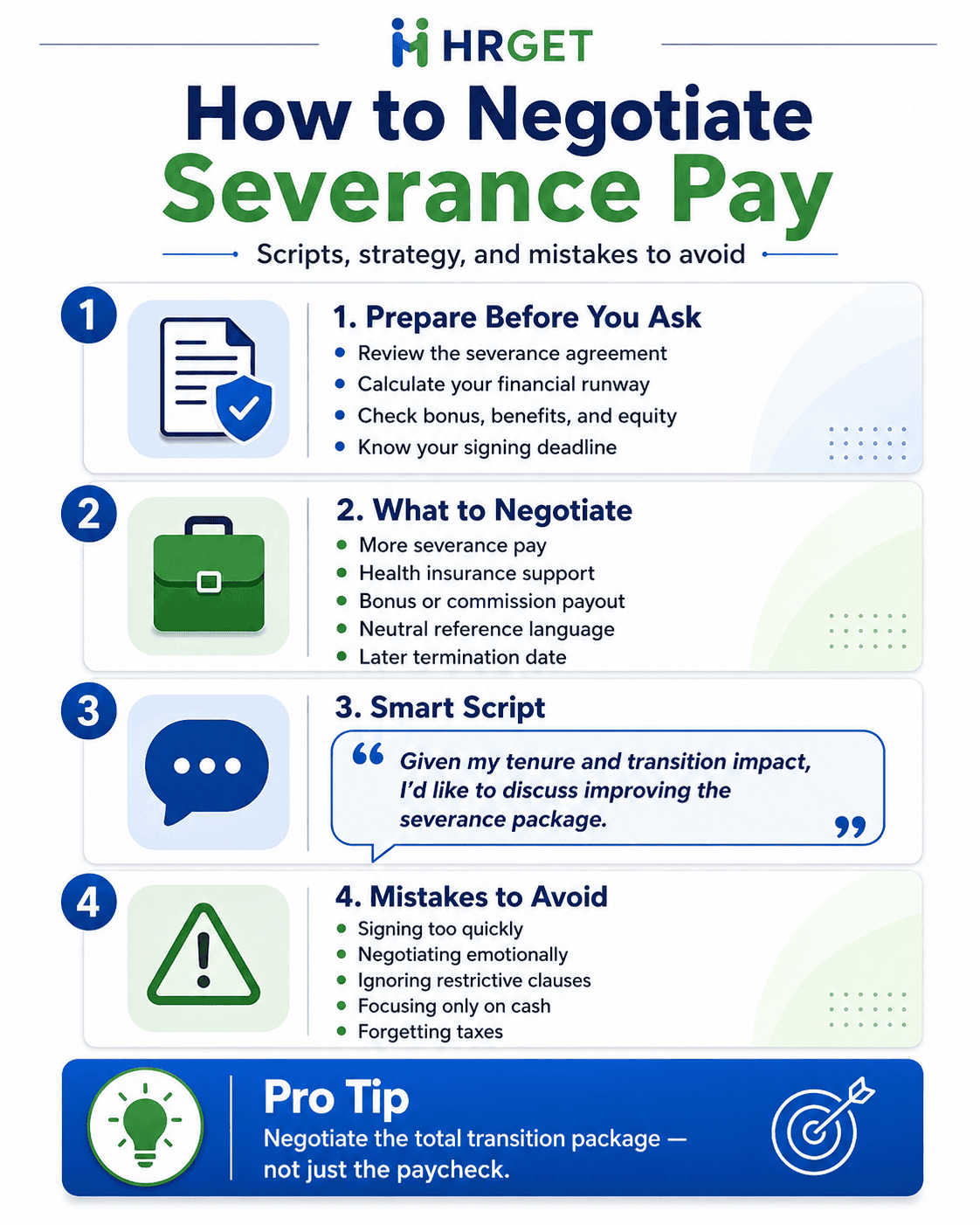
What to Do Before You Respond to Any Severance Offer
Before you negotiate, slow down. Your first move is not to argue — it’s to understand exactly what’s on the table and what the company actually needs from you.
Get the full written agreement — don’t negotiate from a verbal summary
Do not sign during the termination meeting
Identify what the company actually wants from you
Calculate your real financial gap
Warning
Never let HR tell you that you must sign that day for the offer to stand. That pressure tactic is common and often incorrect. In many jurisdictions, certain legal review periods are required. If you’re being pressured to sign immediately, that’s actually a signal to slow down further — and possibly to get legal advice.
How to Negotiate Severance Pay: Step-by-Step
Once you’ve reviewed the offer and done your preparation, here’s how to run the actual negotiation.
Step 1: Stay professional in the first conversation
Your emotional reaction is valid — but negotiation starts from the moment your employment ends. Anger, ultimatums, or threats immediately narrow your options. Instead, use the space between the offer and your response to think clearly.
What to avoid saying in the room: “This is completely unfair.” / “I’ll sue.” / “I need an answer from you right now.”
What actually works: “I appreciate the information. I’d like to review the full written agreement and come back to you with any questions.” Clean. Professional. Buys you time without burning anything.
Step 2: Review the offer line by line — all ten categories
Break the agreement into: (1) cash severance, (2) benefits/healthcare, (3) bonus/commission, (4) equity, (5) PTO and final pay, (6) legal release, (7) post-employment restrictions, (8) reference and reason for separation, (9) transition support, and (10) signing deadline and revocation rights. Most people only think about category one. Strong negotiators review all ten.
Step 3: Set three numbers before you make any ask
Walk into the negotiation knowing your ideal ask, your reasonable ask, and your walk-away minimum. For example: Current offer: 6 weeks. Ideal: 14 weeks. Reasonable ask: 10 weeks. Minimum acceptable: 8 weeks plus healthcare bridge. Your opening request should be ambitious but defensible — not a round number plucked from nowhere.
Step 4: Build a business case, not an emotional appeal
The most effective severance requests are business arguments, not personal pleas. Your case can rest on: long tenure, strong performance record, lack of prior warning, transition work required, bonus or commission you’ve already earned, visa or relocation impact, or the breadth of the legal release you’re being asked to sign.
Effective framing
“Given my seven years with the company, my performance record, the sudden nature of the role elimination, and the scope of the release I’m being asked to sign, I’d like to discuss extending the severance from 6 weeks to 12 weeks.”
That is categorically stronger than “I really need more money.” The first is a proposal. The second is a request for charity.
Step 5: If cash is locked, negotiate the full package
When HR says the cash amount is fixed — and sometimes it genuinely is, especially in large uniform layoffs — immediately pivot to the non-cash elements: healthcare subsidy, bonus or commission review, equity vesting extension, outplacement services, a neutral written reference, a later official separation date, narrowing or removal of non-compete clauses, and mutual non-disparagement. I’ve seen package negotiations where the “locked” cash didn’t move a dollar, but the employee walked away with three months of company-paid COBRA, a prorated bonus, and a written reference confirming the role was eliminated — a meaningful improvement by any measure.
Step 6: Put your request in writing
A written counteroffer is cleaner than a verbal conversation. It creates a record, removes emotional pressure in the moment, allows HR to escalate internally, and forces precision on language. Keep it concise — three to four specific asks, professionally framed. You’re not writing a legal brief; you’re making a business proposal.
Step 7: Make the ask and stop talking
This is where more people fail than you’d expect. They make the request, then immediately soften it: “But I totally understand if that’s not possible…” Don’t do that. Submit the request, send the email, and let the company respond. Silence after a clear ask is leverage. Premature concession is not.
Severance Negotiation Scripts You Can Use Right Now
These scripts are designed to be professional, specific, and easy to adapt. Adjust the bracketed details to your situation.
Script 1: Requesting more severance pay
Email Script — More Cash Severance
Subject: Severance Agreement — Follow-Up
Hi [Name],
Thank you for sharing the severance agreement. I’ve reviewed the terms and would like to discuss whether the package can be adjusted.
Given my [X years] with the company, my performance history, and the sudden nature of the role elimination, I believe a severance period of [X weeks/months] would be more appropriate than the current offer of [current amount].
I’m committed to a professional and smooth transition, and I hope we can reach a package that works for both sides.
Best,
[Your Name]
Script 2: Asking for health insurance support
Email Script — Healthcare Bridge
Hi [Name],
I appreciate the severance package and wanted to raise one specific item. Because the separation creates an immediate gap in healthcare coverage, would the company consider covering or subsidising health insurance costs for [X months] as part of the transition terms?
This would allow me to manage the transition responsibly without an immediate out-of-pocket healthcare burden.
Best,
[Your Name]
Script 3: Requesting prorated bonus or commission payout
Email Script — Bonus / Commission
Hi [Name],
I’d like to clarify the treatment of my bonus/commission under the separation agreement. Based on work completed during the current performance period and results already delivered, I’d like to request that a prorated bonus/commission payout be included in the final package.
Please let me know how this can be reviewed.
Best,
[Your Name]
Script 4: Responding when HR says “This is standard”
Verbal / Email Response
“Thank you — I understand this may be the standard package. Given my specific circumstances, including [tenure / performance record / transition needs / bonus treatment / healthcare impact], I’d appreciate it if the company could review whether an adjustment is possible.”
Script 5: Responding when cash is off the table
Pivot Script
“I understand. If the cash severance amount cannot move, could we discuss other elements of the transition — healthcare support, bonus treatment, outplacement services, equity vesting, or a later separation date?”
Script 6: Asking for a neutral written reference
Reference Language Request
Hi [Name],
As part of the separation agreement, I’d like to include language confirming that future employment verification will state my title, dates of employment, and that my role was eliminated as part of a business restructuring.
This consistency would help ensure accurate, professional employment verification going forward.
Best,
[Your Name]
What Else to Negotiate Besides Cash Severance
This is the section where most people leave serious money on the table. Cash is the headline, but the full package is where the real value often hides.
Health insurance continuation
In the US, losing employer-sponsored health insurance is one of the most painful financial hits of a layoff, particularly for employees with families or ongoing medical needs. Ask whether the company will cover or subsidise COBRA premiums for two to three months, or delay your official termination date to extend coverage. In the UK, the NHS provides coverage regardless — but private health insurance is worth clarifying if your package included it. In India, ask about the group health plan’s exit terms.
Prorated bonus and commission
Don’t assume “not employed on payout date” means you forfeit the bonus. Many bonus plans have discretionary language. Many commission agreements have provisions for deals already closed. Ask for a prorated bonus based on work completed, and for a commission true-up covering closed deals and booked revenue. Sales employees in particular should get the commission treatment in writing — a vague agreement can easily cost ₹5–15 lakhs (or $10K–$40K in the US) in legitimate earnings.
Equity: RSUs, options, and exercise windows
For employees at tech companies or startups, this can dwarf the cash severance in value. Ask specifically about unvested RSU treatment, the stock option exercise window after termination (which some companies extend from 90 days to one year or more in negotiated exits), accelerated vesting provisions, and tax impact on any accelerated shares. Equity is where senior employees most commonly leave significant value behind.
PTO and earned leave
In many US states, accrued PTO is legally considered earned wages and must be paid out. In India, earned leave encashment is similarly protected. In the UK, unused holiday accrues and is payable. Get a written breakdown — don’t accept a vague “it’ll be included in your final paycheck.”
Non-compete and non-solicit terms
This deserves extra attention. A severance package that pays two months but restricts you from working in your industry for six to twelve months may be a financially damaging deal when you run the total numbers. In 2026, non-compete enforceability is under active legislative scrutiny in several US states and at the federal level — know the law in your jurisdiction, and ask to narrow or remove restrictions wherever possible.
Reference language and reason for separation
Ask for written language in the agreement confirming that future employment verification will describe your departure as a role elimination due to business restructuring — not simply “employment ended.” This matters for background checks, unemployment claims, and the narrative you carry into your next job search.
Non-disparagement — push for mutual terms
If you’re agreeing not to speak negatively about the company, the company should make the same commitment about you. One-sided non-disparagement clauses are common in first drafts. Making it mutual is a reasonable ask that HR can usually approve.
Real Scenario: Turning a Weak Offer Into a Better Package
Real Scenario
A product manager at a mid-size tech firm — six years of tenure, consistently strong reviews — had her role eliminated during a restructuring. Initial offer: 8 weeks of severance, no bonus payout, health insurance ending at month-end, standard release, no written reference language.
She didn’t sign that day. Instead, she reviewed the package carefully, calculated her real financial gap (roughly $6,200/month in expenses plus $780/month for a family COBRA plan), identified her leverage (long tenure, broad release, critical transition knowledge on a product launch two months away), and sent a written counteroffer requesting: 16 weeks of severance, 2 months of health insurance subsidy, a prorated Q2 bonus review, neutral reference confirming role elimination, and a 30-day extension of the termination date.
The company declined 16 weeks. They countered with 12 weeks, 6 weeks of healthcare subsidy, a prorated bonus review, and the reference language. She accepted.
The lesson: You don’t need to win everything for the negotiation to be worth it. A professional, well-reasoned counteroffer — made without threats or ultimatums — added roughly $18,000 in real value to her exit.
Common Severance Negotiation Mistakes (And What to Do Instead)
Mistake 1: Signing the same day
This is the single most expensive mistake I see. The moment you sign, your leverage collapses. Take the full review period you’re entitled to. Read everything. Seek advice where needed. No legitimate severance offer evaporates because you took 48 hours to think.
Mistake 2: Letting emotion lead the negotiation
Anger may be completely justified — and it’s real. But it makes you less effective, not more. HR professionals are trained to manage emotional conversations. Your goal is to feel like a business counterpart making a commercial proposal, not a wronged employee demanding satisfaction. The calmer you are, the better the outcome tends to be.
Mistake 3: Making a vague ask without a reason
“Can you do better?” is easy to shut down. “Given my eight years of service, consistent exceeds-expectations reviews, and the broad release I’m being asked to sign, I’d like to discuss increasing the package from 8 weeks to 16 weeks” is a proposal. Frame every ask with a rationale. It’s not begging — it’s positioning.
Mistake 4: Focusing only on cash and ignoring benefits
A slightly better cash figure can be completely wiped out by losing healthcare on day one, forfeiting a bonus you’d already earned, or allowing a broad non-compete to limit your next opportunity. Calculate total package value across all ten categories. A $5,000 difference in cash severance means very little if an equity vesting extension would preserve $30,000 in RSU value.
Mistake 5: Threatening legal action prematurely
If you have a genuine legal issue — discrimination, retaliation, WARN Act violation, unpaid wages — that’s a conversation to have with an employment lawyer, not a card to play impulsively in a tense HR meeting. Casual legal threats rarely improve an offer. A lawyer’s involvement, handled strategically, often does.
Mistake 6: Trusting HR as your advisor
HR can be professional, respectful, and genuinely helpful in a layoff process. But HR represents the company’s interests — not yours. Their job includes managing legal risk, policy compliance, and cost control. You’re responsible for protecting your own position. Understand that dynamic before you ask HR for guidance on whether you should push back.
Mistake 7: Not checking WARN Act or statutory redundancy requirements
In the US, the WARN Act (Department of Labor) requires advance notice for certain mass layoffs and plant closings — and if proper notice wasn’t given, employees may be owed additional pay. In the UK, collective redundancy consultation requirements apply when 20 or more roles are eliminated. If you were part of a large layoff, it’s worth understanding whether these rules were followed.
Mistake 8: Overplaying your hand
Ambitious is good. Unreasonable is counterproductive. If the offer is 4 weeks and you demand 18 months with zero justification, you signal that you’re not serious — and you may invite the company to dig in defensively rather than look for a middle ground. Aim high, stay credible, and leave room for them to feel they’ve made a reasonable compromise.
When to Contact an Employment Lawyer Before You Sign
A lot of people resist getting a lawyer involved because they assume it escalates things unnecessarily. In my experience, the opposite is often true — a well-timed lawyer conversation leads to a better outcome with less conflict, because the issues get framed legally rather than emotionally.
You should strongly consider speaking with an employment lawyer if:
- You are being asked to waive legal claims as part of the agreement
- You’re over 40 in the US and signing a release involving potential age discrimination claims (ADEA rules apply)
- You recently took medical, parental, or other protected leave
- You reported workplace misconduct, harassment, or safety issues before being let go
- You suspect your termination was discriminatory or retaliatory
- Significant bonus, commission, or equity is at stake and treatment is unclear
- A non-compete could realistically restrict your next career move
- You are an executive or senior professional with a high-value package
- You were given an unusually short deadline to sign
- You were part of a mass layoff and question whether WARN Act or statutory redundancy rules were followed
A lawyer doesn’t automatically mean a lawsuit. More often, an employment attorney helps you understand exactly what rights you’re signing away, identifies language improvements you should request, and — if there is genuine legal exposure for the employer — helps you leverage that appropriately rather than impulsively.
Verdict
The cost of a one-hour employment law consultation is almost always worth it for any severance package over $20,000 / £15,000 / ₹15 lakhs, or any agreement that includes a broad release, a non-compete, or unclear treatment of equity or deferred compensation. It’s risk management, not escalation.
Full Severance Negotiation Email Template
Complete Email Template
Subject: Severance Agreement — Request to Discuss Terms
Hi [Name],
Thank you for sharing the severance agreement. I appreciate the company’s support during this transition.
After reviewing the terms carefully, I’d like to discuss whether the package can be adjusted to better reflect my tenure, contributions, and the transition impact.
Specifically, I’d like to request:
- An increase in severance from [current offer] to [requested amount], given my [X years] of service and performance history
- Continued healthcare support through [date or X months]
- Review of bonus/commission eligibility for the current performance period
- Written confirmation in the agreement that future employment verification will state that my role was eliminated due to organisational restructuring
I believe these adjustments would reflect a fair and practical transition package. I’m fully committed to a professional handover and would like to close this process on good terms.
Please let me know if we can discuss this further.
Best regards,
[Your Name]
Before You Sign: A Final Checklist
Most people approach severance negotiation too late, too emotionally, or too narrowly. You now know how to negotiate severance pay differently.
Before you sign anything, walk through these questions honestly:
- Do I fully understand what legal rights I’m giving up by signing this release?
- Does the cash create enough financial runway for a realistic job search?
- What happens to my healthcare — and have I accounted for that cost?
- Has my bonus, commission, and equity treatment been clearly addressed?
- Are there post-employment restrictions that could limit my next role?
- Is the reference language specific, neutral, and in writing?
- Should I speak with an employment lawyer before signing?
- Have I made a professional written request for improvements?
The best severance negotiators I’ve seen aren’t aggressive. They’re prepared. They understand their value. They know what the company wants from them. They ask clearly, they stay professional, and they don’t sign away rights without fully understanding the tradeoff.
A severance agreement is not just the end of a job. Handled well, it becomes the financial bridge to your next opportunity — and sometimes the start of a much better one.
Frequently Asked Questions
Can I negotiate severance after being laid off?
Yes, in many cases you can negotiate severance after being laid off — especially before you sign the severance agreement. Your leverage depends on tenure, performance, company policy, legal risk, and what the employer wants from you in exchange for the release of claims. Acting before you sign gives you the strongest position, so don’t let anyone pressure you into signing on the day the agreement is presented.
How much severance pay should I ask for?
A reasonable starting point is one to two weeks per year of service for standard employees, with senior managers and executives often negotiating three to six months or more. If offered 6 weeks, requesting 10–14 weeks with a clear justification based on tenure and performance is defensible. Always calculate real financial runway — accounting for healthcare costs, taxes, and any bonus or equity forfeited — not just headline weeks.
Can an employer withdraw a severance offer if I negotiate?
It is possible but uncommon when you negotiate professionally. Most employers expect a counteroffer. What damages offers is an emotional, threatening, or unrealistic approach — not a calm, well-reasoned written request. Keep your tone businesslike, anchor your ask in legitimate grounds (tenure, performance, transition impact), and the risk of withdrawal is low.
Is severance pay taxable?
In most jurisdictions, yes. In the US, the IRS treats severance as wages subject to federal income tax withholding, Social Security, and Medicare contributions. In the UK, the first £30,000 of a genuine redundancy payment is typically tax-free, with amounts above that taxed as income. In India, gratuity has specific tax exemptions under the Income Tax Act. Always plan your finances on your net after-tax figure, not the gross amount stated in the agreement.
What else can I negotiate besides cash severance?
Health insurance continuation or subsidy, prorated bonus or commission payout, equity vesting treatment, unused PTO payment, outplacement and career coaching support, a neutral written reference confirming role elimination, mutual non-disparagement language, removal or narrowing of non-compete clauses, and a later official termination date are all legitimate negotiating points — and often easier for the company to approve than additional cash.
Should I hire a lawyer for severance negotiation?
Consider an employment lawyer if you are waiving legal claims, you suspect discrimination or retaliation, you are over 40 in the US signing an ADEA waiver, a non-compete could restrict your next role, significant equity or commission is at stake, or the package is high-value. A lawyer doesn’t mean a lawsuit — they often help you negotiate better language, avoid signing away rights, and understand exactly what the release covers.
What should I say when negotiating severance?
Keep it factual and professional: “Given my [X] years with the company, performance history, and the scope of the release I’m being asked to sign, I’d like to discuss increasing the severance package from [current offer] to [requested amount]. I’m committed to a professional transition and hope we can reach a fair agreement.” Avoid ultimatums, emotional language, or premature legal threats.
How long do I have to sign a severance agreement?
It depends on your jurisdiction and situation. In the US, employees over 40 waiving age discrimination claims under the ADEA are generally entitled to at least 21 days to review the agreement, and 7 days to revoke after signing, per EEOC guidance. In the UK, ACAS recommends a minimum of 10 days for settlement agreements. Never sign on the day the agreement is presented — take the full review period you are legally and practically entitled to.
Calculate Your Severance Value
Use our Severance Pay Calculator to estimate your package based on tenure, salary, and location — and see whether your offer meets market standards.

Michael Reeves | Former Senior Counsel, Littler Mendelson | Severance & Restructuring Specialist | 18+ Years in Employment Law
Author bio: Michael Reeves spent nearly two decades as Senior Counsel at Littler Mendelson — one of the world’s largest employment law firms — advising on mass layoffs, corporate restructurings, and severance negotiations for Fortune 500 companies across the US and Europe. He has worked both sides of the table: structuring cost-efficient separation packages for employers and, more recently, helping employees understand exactly where their leverage lies. Based between Chicago and London, Michael writes for HRGet.com to demystify the legal and financial dimensions of layoffs — so employees stop leaving money on the table.


This blog is not just about the content, but also the community it fosters I’ve connected with so many like-minded individuals here