Constructive dismissal is one of the most financially consequential situations a professional can face — and one of the most misunderstood. You haven’t been fired. You’ve just been handed an impossible situation and told, implicitly, to leave. Every week I speak with professionals who resigned under these exact circumstances and walked away from compensation they were fully entitled to claim.
The hard truth? Employers count on you not knowing your rights. This guide changes that. You’ll understand exactly what constructive dismissal means in 2026, how to recognise it before it’s too late, and the precise legal steps you need to take — whether you’re in the US, UK, or India.
What Is Constructive Dismissal?
Constructive dismissal — sometimes called constructive discharge in the US — occurs when an employer fundamentally breaches your employment contract or creates working conditions so intolerable that a reasonable person in your position would feel they had no choice but to resign.
Legally, the key word is fundamental. Not every inconvenience or difficult manager qualifies. But when an employer slashes your pay without consent, demotes you arbitrarily, or permits sustained harassment — that’s a different matter entirely.
Here’s the core legal concept that matters most: your resignation is treated as a dismissal. You quit, but the law may regard it as the employer terminating you. That distinction is worth thousands — sometimes hundreds of thousands — of pounds, dollars, or rupees in compensation.
In the UK, this falls under the Employment Rights Act 1996. In the US, it’s primarily governed by Title VII, the ADEA, and equivalent state statutes. In India, it’s addressed under the Industrial Disputes Act and related state labour legislation. The legal label changes; the underlying principle does not.
⚖️ Insider View:
In my experience advising both employers and senior executives, constructive dismissal claims are often the most defensible employee claims — when documented well. Employers frequently underestimate how damaging their internal paper trail is once it reaches a tribunal or court. Don’t assume they have the stronger position simply because they’re the employer.
Key Signs You’re Being Forced Out
The most common mistake professionals make is treating each incident in isolation. One bad performance review doesn’t constitute constructive dismissal. But five related incidents over three months almost certainly does. Courts and tribunals look for a pattern — a consistent course of conduct that amounts to a repudiation of your contract.
Watch for these in combination:
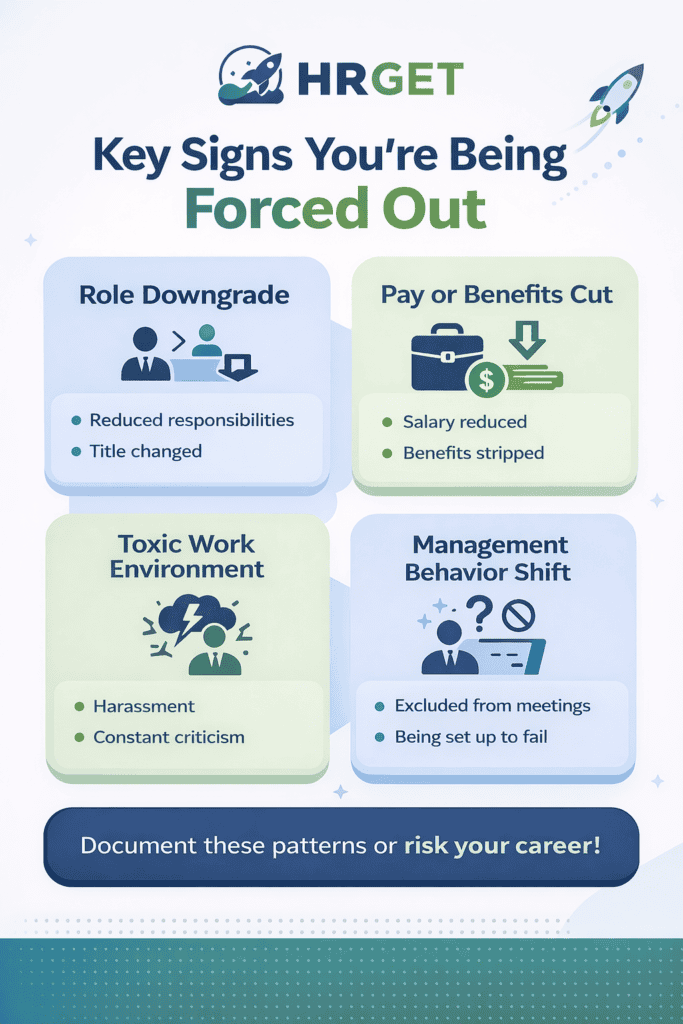
Unilateral Changes to Pay or Role
Your employer removes a significant portion of your responsibilities, demotes you to a lower title, or reduces your salary — without your written consent. This is the clearest-cut form of constructive dismissal. If your offer letter said one thing and reality now says another, that gap is your legal foundation.
Sustained Hostile or Toxic Behaviour
Persistent bullying, harassment, or discrimination that HR has been notified about and failed to address. This includes being excluded from meetings relevant to your role, constant undermining in front of peers, or being openly set up to fail with unachievable targets.
Forced Relocation or Drastic Schedule Changes
Being told to relocate offices with two weeks’ notice when your contract specifies otherwise, or having your working hours shifted dramatically without agreement — these are contractual breaches the law takes seriously.
The “Managed Out” Pattern
This is subtler and, frankly, more common among senior professionals. Your bonus disappears “due to restructuring.” You’re removed from the leadership mailing list. Your one-on-ones with the CEO stop. A junior colleague is brought in and cc’d on all your communications. No single act is definitive, but the trajectory is unmistakeable. I’ve seen this pattern more times than I can count.
⚠️ Warning:
One difficult conversation or a single bad month doesn’t give you a constructive dismissal claim. You need to demonstrate that the employer’s conduct was sustained, serious, and — crucially — that you didn’t accept or accommodate it. Every time you sign off on a change without protest, you weaken your position.
Constructive Dismissal vs. Wrongful Termination
These two concepts are routinely confused, even by people who’ve been through one of them. They’re legally distinct — and confusing them can lead you to pursue the wrong claim or miss the right one entirely.
| Factor | Constructive Dismissal | Wrongful Termination |
|---|---|---|
| Who ends employment | Employee resigns — but under duress | Employer fires the employee |
| Core legal basis | Employer breached the employment contract | Employer fired without legal justification |
| Proof required | Working conditions were objectively intolerable | Termination violated law or contract terms |
| Common triggers | Demotion, pay cuts, harassment, forced role changes | Discrimination, retaliation, contract breach on firing |
| Compensation potential | High — includes lost wages, severance, distress | High — includes back pay, reinstatement, damages |
| Typical jurisdiction (UK) | Employment Tribunal under ERA 1996 | Employment Tribunal — unfair dismissal claim |
In practice, many professionals have grounds for both claims simultaneously — particularly if the forced resignation was linked to a protected characteristic (age, gender, race, disability). An employment solicitor can assess which path offers the stronger position and higher compensation ceiling.
Real Scenario: How It Actually Plays Out
📋 Real Scenario:
The Setup: A Senior Engineering Manager at a mid-sized US tech firm — eight years in, strong performance record, $165K base — noticed a shift after a new CTO joined. Over four months: her direct reports were reassigned without explanation, she was excluded from the new CTO’s leadership roundtables, her annual bonus was reduced by 60% (“budget constraints”), and she was asked to report to a director two levels below her previous peer group.
What she did wrong initially: She accepted each change quietly, hoping things would stabilise. By month four, she had implicitly ratified several of the contractual changes — weakening her claim.
What turned it around: She consulted an employment attorney before month five and sent a formal letter to HR documenting the pattern and stating clearly she did not accept the changes to her role and compensation. Three months later, she exited with a $95,000 settlement — severance, bonus make-whole, and COBRA coverage — without filing a single court claim.
The lesson: The formal objection letter was the pivotal move. It established she had not accepted the breach — which is the single most important legal requirement in a constructive dismissal claim.
Your Legal Options — US, UK, and India
The legal framework differs significantly by jurisdiction. Here’s what you’re actually working with in 2026:
United States
There’s no single federal “constructive dismissal” statute — the concept is built through case law and applies most powerfully when linked to a protected characteristic. File with the EEOC within 180–300 days (depending on state) before pursuing a civil lawsuit. In at-will states, standalone constructive discharge claims are harder without a discrimination angle. California, New York, and Illinois offer significantly stronger employee protections.
United Kingdom
This is where the concept has the clearest statutory foundation. Under the Employment Rights Act 1996, you can bring an unfair dismissal claim to the Employment Tribunal — but you must have at least two years of continuous employment, and you must file within three months less one day of your resignation date. Miss that window and your claim is extinguished. No exceptions, no extensions (save for exceptional circumstances).
India
Indian labour law is fragmented across central and state legislation. Under the Industrial Disputes Act 1947, “retrenchment” definitions can cover constructive dismissal-type situations, particularly for workmen. For non-workmen and senior management, remedies are largely contractual. The rise of state-level Industrial Relations Codes under the 2020 labour code reforms is gradually clarifying this — but enforcement remains inconsistent. Bangalore, Hyderabad, and Mumbai-based professionals at tech MNCs often have stronger recourse through arbitration clauses in their employment agreements.
💡 Pro Tip:
In the UK, before resigning, send a grievance letter to your employer formally raising the issues. This isn’t just good practice — it creates the paper trail that tribunals expect to see. A resignation without a prior grievance letter significantly weakens your constructive dismissal case, even when the underlying facts are strong.
Step-by-Step Action Plan Before You Quit
This is the section most articles get wrong. They tell you to “document everything” and leave it there. Here’s the sequence that actually matters:
- Start a contemporaneous log immediately. Date-stamped notes of every incident, email screenshots, performance review copies, and any written communication around role or pay changes. Courts and tribunals give significant weight to records made at the time, not reconstructed later.
- Review your employment contract and offer letter. Identify the specific clauses being breached — job title, reporting structure, remuneration, location, duties. Vague feelings don’t win claims; specific contractual language does.
- Raise a formal written grievance. Email HR and your direct line manager — or their manager if HR is complicit — clearly stating the specific issues and that you consider them a breach of your contract. This step is non-negotiable in the UK and strongly advisable in all jurisdictions.
- Give the employer a reasonable chance to remedy the breach. This matters enormously in UK tribunal cases. If you resign the day after raising a grievance, tribunals may find you acted prematurely. Allow the formal process to run — typically 2–4 weeks.
- Consult an employment lawyer before resigning. Even a one-hour consultation (typically £200–£400 in the UK, $300–$500 in the US) can mean the difference between a £20,000 tribunal award and a £90,000 negotiated settlement. The consultation pays for itself many times over at senior levels.
- Resign with a detailed resignation letter. Your letter should reference the specific breaches, cite your prior grievance(s), and explicitly state that you are resigning in response to those breaches — not voluntarily. This letter becomes a core exhibit in any subsequent claim.
- File your claim within limitation periods. UK: 3 months less one day. US EEOC: 180–300 days. Don’t assume you have more time than you do.
Compensation You May Be Entitled To
Let’s be direct about the financial reality — because this is ultimately why the legal distinction matters.
In the UK Employment Tribunal, a successful constructive unfair dismissal claim can yield a basic award (capped statutory calculation based on age and service) plus a compensatory award currently capped at the lower of one year’s gross pay or £115,115 (2026 figure). Discrimination claims carry no compensatory cap — which is why the discrimination angle matters so much if applicable.
In the US, federal discrimination-linked constructive discharge claims can recover back pay, front pay (future lost earnings), compensatory damages for emotional distress, and attorney’s fees. At senior executive levels, $100,000–$500,000+ settlements are not uncommon when the facts are strong and well-documented.
In India, monetary remedies for non-workmen are largely driven by contractual notice periods, gratuity entitlements, and negotiated severance. Senior professionals at MNCs increasingly negotiate exits that include full notice period pay, variable pay pro-ration, and accelerated ESOP vesting — none of which happen automatically; all of which require you to know your position and ask.
⚖️ Insider View:
The most underused lever in constructive dismissal situations — across all jurisdictions — is pre-resignation negotiation. Most employers will offer a significantly improved exit package when they understand you have a documented claim, an employment lawyer briefed, and a clear limitation clock ticking. Filing a tribunal or court claim is often not the goal; it’s the credible threat that produces results. Use it strategically.
Common Mistakes That Kill Your Case
I’ve seen strong claims collapse entirely due to avoidable errors. These are the ones that come up most often:
Resigning without documenting the reason
If your resignation letter says “personal reasons” or “to pursue other opportunities,” you’ve just handed the employer a defence. Your letter must explicitly connect your resignation to the employer’s conduct.
Continuing to perform under the new terms without objection
Working under a salary cut for six months without written protest is legally interpreted as acceptance of the new terms. You can lose your claim not by resigning, but by staying too long without formally objecting.
Waiting until you’re completely broken to act
The emotional and professional toll of a hostile environment is real — but the longer you wait, the harder it becomes to establish that the situation was truly intolerable. Act while the evidence is fresh and the timeline is tight.
Ignoring the internal grievance process
In the UK, tribunals can reduce your award by up to 25% if you failed to follow the ACAS Code of Practice on grievance procedures. In every jurisdiction, failing to give the employer a chance to fix the problem undermines your credibility.
Venting on social media or to colleagues
Anything you post or say can be used against you. Confidentiality provisions in settlement agreements exist for a reason — and employers will use evidence of indiscretion to reduce what they’re willing to pay.
Smart Strategy: Stay or Leave?
Here’s the honest answer: it depends on one thing — leverage. Not emotions. Not pride. Leverage.
Stay, and build your position, if: The breach is relatively recent and remediable, you haven’t yet raised a formal grievance, your claim would benefit from more documented evidence, or an internal resolution might deliver a clean exit with a reference and enhanced package.
Leave, strategically and with counsel, if: The breach is fundamental and ongoing, the employer has rejected your grievance, your health or career trajectory is genuinely deteriorating, or the litigation clock in your jurisdiction is running out.
The goal — and I say this having worked both sides of the table — is never the tribunal hearing itself. It’s rarely the courtroom. The goal is to position yourself so that a negotiated exit that protects your finances, your reference, and your next role becomes the path of least resistance for both parties. Get that positioning right, and you rarely need to fight publicly.
📖 Related Reading: Wrongful Termination: Your Rights and How to Build a Case — understand how constructive dismissal intersects with unlawful firing, and what additional claims may be available to you.
Frequently Asked Questions
What is the legal definition of constructive dismissal?
Constructive dismissal occurs when an employer fundamentally breaches an employee’s contract — through unilateral pay cuts, significant role changes, harassment, or a hostile work environment — leaving the employee no reasonable option but to resign. Legally, that resignation is treated as a termination, enabling the employee to pursue compensation claims.
How do I prove constructive dismissal?
You need to show three things: (1) there was a fundamental breach of your employment contract, (2) you resigned in direct response to that breach, and (3) you didn’t affirm the breach by continuing to work under the new conditions without objection. Written documentation — emails, grievance letters, pay records — is essential. Without it, your case rests on your word against the employer’s.
Can I claim constructive dismissal after resigning?
Yes — that’s precisely how it works. You resign first, then bring the claim. The critical issue is whether your resignation was clearly linked to the employer’s conduct. A resignation letter that states your reasons and references prior complaints gives you a much stronger starting position than one that offers no explanation.
How long do I have to make a constructive dismissal claim?
In the UK, you have three months less one day from the date of your resignation to file at an Employment Tribunal — this is a hard deadline with very limited exceptions. In the US, EEOC charges must typically be filed within 180 days (or 300 days in states with their own agencies). India’s timeframes vary by legislation and type of claim; consult a local employment lawyer promptly.
Is a salary cut constructive dismissal?
A unilateral, significant salary reduction — one your employer imposed without your agreement — is one of the strongest forms of contractual breach underpinning a constructive dismissal claim. The key word is “unilateral.” If you signed a new agreement or accepted the change in writing, you’ll face a harder argument. If you never agreed, you have solid footing — provided you objected promptly.
Should I talk to HR or an employment lawyer first?
Both — but in sequence. Raise the issue with HR first, because doing so demonstrates good faith and creates the paper trail tribunals expect. Then consult a lawyer before taking any further action, especially before resigning. HR’s job is to protect the company, not you. Your lawyer’s job is to protect you. Know the difference before you walk into either conversation.
Can I negotiate a settlement instead of going to tribunal?
Absolutely — and for most professionals at the mid-to-senior level, this is the smarter path. A well-documented constructive dismissal claim creates genuine legal exposure for the employer. That exposure is your negotiating leverage. Many cases settle through a solicitor-drafted settlement agreement (UK) or separation agreement (US) that includes enhanced severance, reference terms, and confidentiality on both sides — without any public filing.
Does constructive dismissal affect my ability to claim unemployment benefits?
In the UK, if your constructive dismissal claim is accepted, you are generally treated as having been dismissed — which preserves your entitlement to Universal Credit and Jobseeker’s Allowance. In the US, eligibility for unemployment benefits after a resignation depends on state law, but many states recognise constructive discharge as “good cause” for quitting, making you eligible. Document your reasons clearly when filing.
The Bottom Line on Constructive Dismissal
Constructive dismissal is a serious legal concept that protects professionals from being silently pushed out of jobs they’ve earned. It’s not a loophole or a technicality — it’s the law recognising that a resignation under duress is functionally identical to a termination.
What separates professionals who recover financially from those who don’t isn’t the strength of their underlying case — it’s whether they documented it, objected formally, and took legal advice before resigning. Most people do none of those things. They leave quietly, tell themselves it wasn’t worth the fight, and spend the next six months wondering if they left money on the table. They usually did.
If you believe you’re facing constructive dismissal, start your documentation today. Raise the grievance in writing. Speak to an employment lawyer before you hand in your notice. The legal clock only starts when you resign — but your leverage starts the moment you understand your position.

Victoria Hale | Former Partner, Freshfields Bruckhaus Deringer | Employment Law Specialist | 20+ Years Advising Multinationals & Executives
Author: Victoria Hale spent over two decades as an Employment Law Partner at Freshfields Bruckhaus Deringer — one of the world’s most prestigious Magic Circle law firms — advising multinational corporations and senior executives on some of the most complex employment disputes in the US and Europe. Her practice covered wrongful termination litigation, executive exits, non-compete enforcement, FLSA compliance, and cross-border workforce restructuring under EU labour law. Now based between London and New York, Victoria writes for HRGet.com to close the gap between legal theory and how employment law actually plays out in the real world — for employees who need to know their rights before it’s too late.