
Most professionals working in Europe have spent their entire careers negotiating salaries in the dark. You accept an offer without knowing whether your colleague in the next desk earns 20% more. You ask for a raise and get a vague “budget constraints” reply — with nothing concrete to push back on. The EU Pay Transparency Directive is about to change that power dynamic permanently.
This isn’t just another EU compliance headline. The directive gives employees specific, enforceable rights to request salary data, challenge unexplained pay gaps, and enter every compensation conversation armed with actual evidence — not gut feeling.
After working with HR teams across Europe for years, I’ll tell you what nobody else is saying clearly: most employees will squander this opportunity because they won’t know exactly what to ask, when to ask it, or how to use the answer. This guide fixes that.
What the EU Pay Transparency Directive Actually Is
The EU Pay Transparency Directive (Directive 2023/970/EU) was adopted by the European Parliament and Council in May 2023. EU member states have until June 2026 to transpose it into national law — meaning the rights it creates will begin taking legal effect across France, Germany, Spain, the Netherlands, Poland, and every other member state within that window.
The directive was built on a specific problem: the EU’s gender pay gap has hovered around 13% for over a decade, largely because companies could keep compensation structures opaque. Hidden salary ranges, unwritten promotion criteria, and the old taboo against discussing pay kept that gap alive. The directive attacks all three.
But here’s the thing: while the directive’s stated goal is pay equity, its practical effect is much broader. It gives every employee — regardless of gender — new leverage. Because once salary structures are visible, every underpaid professional benefits, not just those affected by gender discrimination.
Insider View:
HR teams I’ve spoken with across Germany and the Netherlands are already quietly running internal pay audits — before the law forces them to. They know that when employees gain access to benchmarking data, the first wave of raise requests will come from people who’ve been underpaid for years and simply never had the evidence. The smart companies are getting ahead of that by adjusting now. That’s your signal: the opportunity for early movers is real.
Exactly What Employees Can Request (And What They Can’t)
This is the section most articles get wrong by being too vague. Let’s be specific about what the directive actually entitles you to ask for.
What you CAN request as an employee
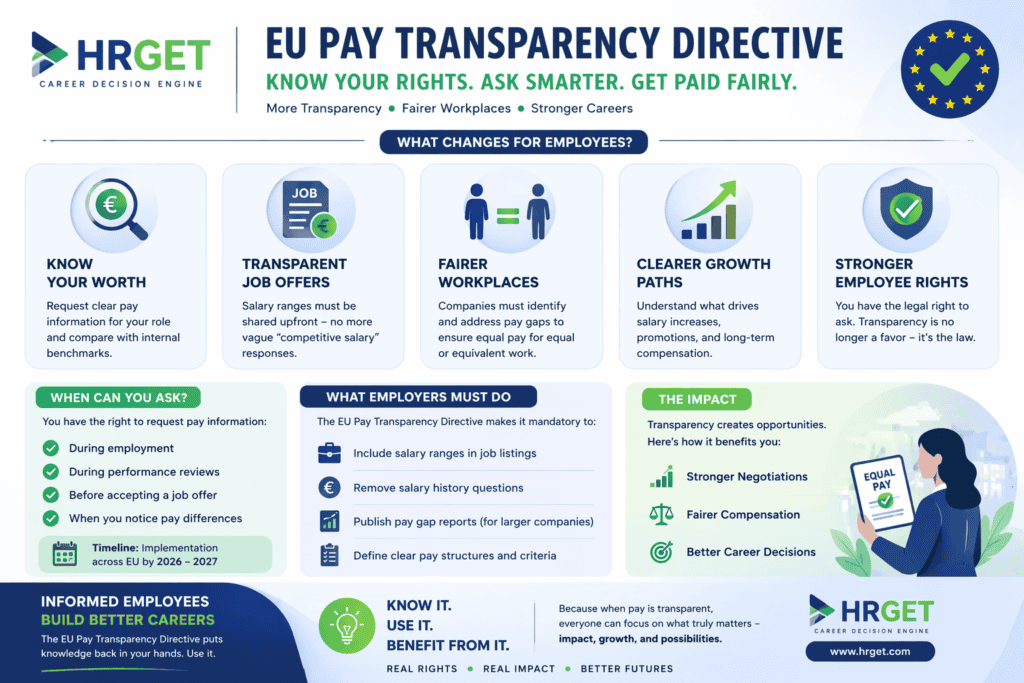
1. Average pay levels for comparable roles. You can request information about the average pay level of colleagues who perform the same work or work of equal value — broken down by gender. This applies to employees in roles with similar responsibilities, skills, and seniority, even if their job titles differ slightly.
2. Pay progression criteria. You’re entitled to ask your employer what criteria determine salary increases. If your company uses performance ratings, competency frameworks, or tenure-based bands, those criteria must be documented and shared on request. No more “it’s at management discretion.”
3. Salary range for your current role. Once the directive is implemented in your country, you can request the formal pay band for your position — the floor and the ceiling — and understand where you sit within it.
4. Gender pay gap data (for larger companies). Companies with 100 or more employees will be required to publish pay gap reports periodically. You’re entitled to this information, and if the gap exceeds 5% and can’t be justified by objective, gender-neutral criteria, the employer is legally required to conduct a joint pay assessment.
What you CANNOT request
You cannot request the individual salary of a specific colleague. The directive carefully protects personal data — what you get is aggregated or anonymised data across a defined group of workers, not a named breakdown. If your company has fewer than five employees in a comparable group, that data may be withheld entirely to protect individual privacy.
When You’re Allowed to Ask — And When Timing Matters Most
The directive gives you standing to request pay information at any point during your employment. But “legally allowed” and “strategically optimal” are two very different things.
Legally, you can submit a request any time — and your employer is required to respond within a reasonable timeframe (most national implementations are expected to set a 60-day response window). Your employer cannot retaliate against you for making a request. Retaliation — including demotion, exclusion from projects, or a hostile management response — is explicitly prohibited under the directive.
Strategically, though, timing changes everything. Here are the moments where requesting and using pay data has the highest impact:
- Before your annual performance review. You want the data in hand at least 4–6 weeks before your formal review cycle, so you have time to build your case rather than improvise in the room.
- After a significant project delivery. Your leverage is highest when you’ve just delivered visible results. Pair that with pay benchmarking data and you have both a performance case and a market case.
- When you’re about to be promoted. If your manager has signalled a promotion is coming, requesting pay band data before the formal offer is made lets you negotiate the compensation package rather than just accepting the first number offered.
- When you have an external offer. Combining internal pay data with a competing offer creates maximum leverage — you’re showing both what the market pays and what internal equity suggests you should earn.
Pro Tip:
Don’t make your first pay data request in the middle of a salary negotiation. Request the data a quarter in advance, study it, and build your case around it. Walking into a negotiation with benchmarking data you received three months ago looks methodical and confident. Asking for data mid-conversation looks reactive and emotional.
What Employers Are Legally Obligated to Disclose
Beyond what you can request, the directive creates proactive obligations — things employers must do without being asked.
Salary ranges in job advertisements
Starting from the directive’s implementation date in each country, employers must include a salary range in job postings before the first interview. This isn’t a soft suggestion — it’s a hard requirement. The range must reflect the actual pay band for the role, not a deliberately wide range designed to obscure real expectations.
For job seekers, this is enormous. The “what are your salary expectations?” trap — which has historically anchored candidates to their previous (often lower) salary — effectively disappears. You walk into every conversation knowing the range first.
Prohibition on salary history questions
Employers cannot ask candidates about previous salary during the hiring process. This removes one of the most persistent mechanisms that perpetuates pay inequality — the practice of offering people marginally more than they earned before, rather than what the role actually warrants.
Regular pay gap reporting
Companies with 100 or more employees must report gender pay gap data to national authorities on a defined schedule. For companies with 250+ employees, annual reporting is expected. This data becomes accessible — meaning external scrutiny from employees, unions, and regulators increases significantly.
Joint pay assessments when gaps exceed thresholds
If a company’s pay gap exceeds 5% and the employer cannot justify it through objective, gender-neutral criteria, the directive requires a formal joint pay assessment — conducted with employee representatives. This isn’t just internal — findings must be reported to national authorities.
| Obligation | Who It Applies To | Effective From |
|---|---|---|
| Salary range in job ads | All employers | National transposition date (by June 2026) |
| No salary history questions | All employers | National transposition date |
| Pay gap reporting (basic) | 100+ employees | 3 years after transposition |
| Annual pay gap reporting | 250+ employees | From transposition date |
| Joint pay assessment | Employers with gap >5% | Triggered by reporting findings |
| Employee right to pay data | All employers | National transposition date |
Job Seekers vs. Current Employees: Who Wins More?
Both groups benefit, but in different ways — and honestly, most commentary focuses on job seekers while underselling the advantage for existing employees.
If you’re job hunting: The upfront salary range requirement is a game-changer for negotiation. When a company posts a band of €55,000–€75,000 for a product manager role in Amsterdam, you can anchor your conversation around the upper end of that range with legitimate justification. You’re no longer guessing whether your “ambitious” ask is even within budget. The prohibition on salary history questions also means you can’t be lowballed based on what a previous employer paid you in a lower cost-of-living city or at an earlier career stage.
If you’re already employed: This is where most of the long-term value sits. Existing employees who request pay benchmarking data, discover they’re below the median for their role, and use that evidence in performance reviews stand to make the most significant salary corrections. A data-backed request to correct a 15% underpayment is a fundamentally different conversation to a gut-feeling request for “more money.”
| Situation | Key Benefit | How to Use It |
|---|---|---|
| Applying for a new job | Salary range disclosed upfront; no salary history questions | Anchor negotiation to the top third of the published range |
| Currently employed, suspecting underpayment | Right to request average pay for comparable roles | Use gap as the basis for a formal raise request |
| Up for promotion | Right to know pay progression criteria | Align your performance narrative to the published criteria before the conversation |
| Returning from career break | No salary history anchor; fresh benchmarking available | Reset to current market rate rather than old compensation |
Real Scenario: Using Pay Data to Correct a Pay Gap
Real Scenario:
Profile: Marta, 34, Senior UX Designer at a 300-person tech firm in Warsaw. She’s been in the role for three years, received “exceeds expectations” ratings in her last two performance cycles, but her salary has increased only 4% over that period — below the EU inflation rate. She suspects she’s underpaid relative to colleagues in similar roles but has no hard evidence.
Step 1: Marta formally requests pay level information for UX Designer roles at her grade under the directive. HR responds within 45 days with aggregated data showing the median pay for her role and grade is 18% above her current salary.
Step 2: She also requests the pay progression criteria — and discovers that consistent “exceeds expectations” ratings are formally linked to annual increases of 6–8% under the company’s own framework. Her 4% increase violated the company’s own documented policy.
Step 3: She schedules a meeting with her manager two months before performance review season. She presents both data points — the market gap and the internal policy misalignment — calmly and without accusation. She frames it as a correction, not a complaint.
Result: Marta receives a 14% increase at her next review, bringing her to the lower end of the median band. Her manager acknowledges the discrepancy was a “historical oversight.”
Notice what Marta didn’t do: she didn’t complain vaguely, didn’t threaten to leave, and didn’t make it personal. She used data, and she used it quietly and early. That’s the playbook.
Smart Strategy: How to Use This Without Damaging Your Career
Look, I’ve seen employees get exactly the right information and then use it in exactly the wrong way. Having leverage and knowing how to apply it are two different skills. Here’s how to do this without torpedoing your relationships at work.
Frame it as professional alignment, not grievance
The difference between “I think I’m being paid unfairly” and “I’d like to understand how my compensation aligns with internal benchmarks under the new transparency framework” is enormous. The first opens a conflict. The second opens a conversation. Always choose the second.
Build a three-part case before you speak
Before any compensation conversation, assemble: (1) your internal pay benchmarking data, (2) external market data from sources like Glassdoor or LinkedIn Salary for your role and city, and (3) a clear articulation of your contributions over the past 12 months. Three data sources, not one. That’s when the case becomes difficult to dismiss.
Request via email, not verbally
When you formally request pay information under the directive, do it in writing. This creates a paper trail and starts the clock on the employer’s response obligation. A verbal request is too easy to ignore or reframe later.
Give your employer room to correct quietly
Most pay discrepancies aren’t the result of deliberate bad faith — they’re historical inertia. If you bring the data to your manager privately and give them the opportunity to escalate internally before making it a formal issue, you’re more likely to get a faster resolution and preserve the working relationship. Escalate formally only if informal channels fail.
Warning:
Don’t use pay transparency data as a bluff. If you request benchmarking information and find you’re actually paid at or above the median, resist the temptation to still push for a large increase using the request as implied leverage. Employers will see through this quickly, and it will undermine your credibility for future conversations. The directive works best when used with genuine data, not theatrics.
Common Mistakes That Will Backfire
Mistake 1: Treating the directive as an instant entitlement. The directive gives you the right to information — it doesn’t automatically entitle you to higher pay. You still need to make a compelling case. The data is your evidence; the argument is still yours to make.
Mistake 2: Requesting data and then doing nothing with it. I’ve seen professionals request salary benchmarks, confirm they’re underpaid, and then not act on it because they felt uncomfortable having the conversation. The data is worthless without follow-through. Set a deadline for yourself: within 30 days of receiving the data, you need to have a conversation.
Mistake 3: Going public before going private. Some employees, upon discovering a significant pay gap, immediately escalate to HR or threaten legal action. Unless there’s clear evidence of systemic discrimination, try the direct route with your manager first. Escalation is a tool of last resort — not a first move.
Mistake 4: Ignoring national implementation timelines. The directive’s rights don’t activate on the same date across every EU country. Germany, France, Sweden, and Poland may all implement the rules on different schedules within the 2026 window. Check your country’s specific transposition timeline before making a formal request — your employer’s obligations depend on it.
Mistake 5: Conflating pay transparency with pay equality. The directive makes pay structures visible. It doesn’t guarantee equal pay overnight. Use it as a tool to negotiate, not as a legal trump card that automatically resolves every disparity. Enforcement mechanisms exist but take time.
Frequently Asked Questions
Can I ask my employer what specific colleagues earn under the EU Pay Transparency Directive?
No. The directive protects individual salary data as personal information. What you can request is aggregated data — the average pay for employees doing comparable work at your grade or level, broken down by gender. You won’t receive anyone’s individual salary figure, only the group average that establishes whether a pay gap exists in your category.
Does the EU Pay Transparency Directive apply to all companies in Europe, including small businesses?
Most provisions apply to all EU-based employers, including small businesses, particularly the requirements around salary ranges in job ads and no salary history questions. However, formal pay gap reporting obligations are tiered by company size: annual reporting kicks in for employers with 250 or more employees, with a lighter regime for companies between 100 and 249 employees. Firms below 100 employees face fewer reporting requirements but still must honour individual employee data requests.
When does the EU Pay Transparency Directive take effect in each EU country?
EU member states must transpose the directive into national law by 7 June 2026. However, implementation timelines vary — some countries may legislate earlier. Once your country’s law is enacted, the new rights apply immediately for job advertisements and employee data requests. Pay gap reporting requirements for large employers are phased in over three years after transposition.
Can my employer refuse to provide salary benchmarking data if I request it?
Once the directive is transposed in your country, your employer cannot refuse a legitimate request for pay level information for comparable roles. They may need time to gather and format the data — most national implementations are expected to set a 60-day response window — but refusal or unreasonable delay is a violation. You have the right to escalate to the relevant national equality body if your employer does not comply.
Does the EU Pay Transparency Directive help employees returning from parental or career breaks?
Yes, significantly. The prohibition on salary history questions means you cannot be anchored to a pre-break salary level. Combined with access to current internal pay benchmarks, returning employees can negotiate based on the role’s actual market rate rather than the salary they last earned — potentially years ago in different market conditions. This is one of the directive’s most underappreciated practical benefits.
What should I do if I discover I’m being paid significantly below the average for my role?
First, document the data you received formally. Then build a complete case: your pay benchmark data, external market comparables, and a clear record of your performance and contributions. Request a meeting with your manager — framed as a discussion about compensation alignment — and present the data calmly and professionally. Give your employer 30–60 days to respond with a concrete plan. If the gap isn’t addressed, escalate to HR with the same documented evidence.
Does the EU Pay Transparency Directive apply to remote workers employed by EU companies but working from outside the EU?
The directive applies to employees working within EU member states. If you’re employed by an EU-registered company but based outside the EU, your rights depend on your employment contract’s governing law and jurisdiction. Workers employed in an EU country retain full rights regardless of their nationality. If you’re a non-EU resident working remotely for an EU company under a contract governed by non-EU law, the directive’s protections may not automatically apply — seek legal advice specific to your contract.
The Bottom Line on Pay Transparency Rights
The EU Pay Transparency Directive doesn’t hand you a pay rise. It hands you the information that makes a pay rise possible to justify, argue for, and win. That’s a meaningful but important distinction.
Professionals who understand exactly what they can request — pay level data for comparable roles, pay progression criteria, the formal salary band for their role — and who use that information strategically, at the right moment, and with the right framing, will come out of the next two years significantly better compensated than those who treat it as abstract news.
The directive’s 2026 implementation window is already in motion. HR teams at major European employers are auditing their pay structures now. The question is whether you’ll be positioned to act when the data becomes available to you — or whether you’ll let the opportunity pass because you weren’t sure what to ask for.
Start by knowing your number. Then build your case. The EU Pay Transparency Directive gives you the evidence; what you do with it is up to you.
Ready to Use This in Your Next Negotiation?
Knowing your pay gap is step one. Knowing how to negotiate it closed is step two. Read our in-depth guide on how to negotiate a salary increase effectively — including the exact framing and timing strategies that experienced HR professionals respond to.

Emily Carter is a career coach and former McKinsey talent advisor with 15+ years of experience helping professionals navigate career transitions, promotions, and high-stakes job decisions. She has advised professionals across consulting, technology, finance, and corporate leadership roles on offer negotiations, career positioning, and long-term growth strategy.
Role: Career Coach & Ex-McKinsey Talent Advisor: Focuses on helping professionals make smarter career moves—switching jobs, negotiating offers, and long-term career growth. She blends structured thinking with real-world coaching insights.