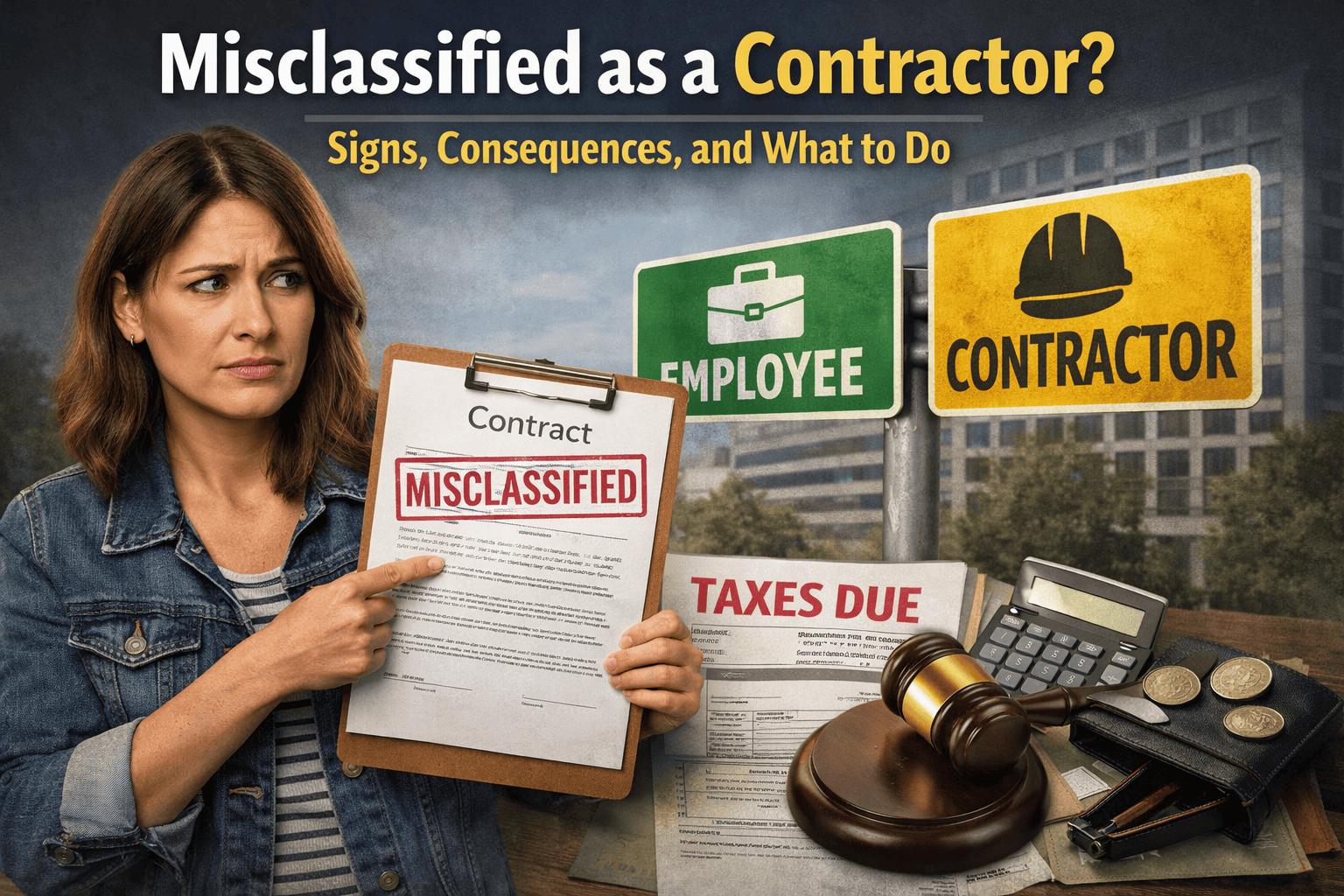
You show up every morning at 9. You report to a manager. You use the company laptop, log into their Slack, and get a regular bi-weekly deposit. But somewhere on that deposit slip — or in your contract — you’re called an independent contractor.
If that description sounds familiar, there’s a real chance you’ve been misclassified as a contractor. And I don’t say that lightly. After 15 years on the HR side of the table — managing teams, auditing payroll structures, and sitting in on legal reviews — I’ve watched this exact situation cost workers thousands of dollars they never got back.
Worker misclassification isn’t always intentional. Sometimes companies are sloppy. Sometimes they’re cutting corners. But the financial and legal impact on you is the same either way: higher taxes, zero benefits, no overtime, and no unemployment safety net if things go sideways.
This guide will walk you through exactly how to recognize contractor misclassification, what it’s costing you right now, and the specific steps to fix it — whether that’s a quiet internal conversation or a formal claim with the IRS.
What “Misclassified as a Contractor” Actually Means
Let’s get this straight from the top: worker classification isn’t about what title your contract gives you. It’s about the economic reality of your working relationship.
Being misclassified as a contractor means your employer has labelled you as an independent contractor — legally and for tax purposes — even though the actual nature of your work relationship qualifies you as an employee under labor law.
In the US, three government agencies have overlapping jurisdiction here: the Internal Revenue Service (IRS), the Department of Labor (DOL), and state labor boards. Each uses slightly different tests, but they all circle the same core question: who controls the work?
True independent contractors run their own businesses. They set their rates, choose their hours, work for multiple clients simultaneously, and use their own tools. If none of that describes your situation — if you’re functionally embedded in a company’s operation but just happen to be labelled a contractor — that’s a classification problem.
In 2026, the US Department of Labor’s updated independent contractor rule (effective since 2024) places even greater emphasis on “economic dependence.” If you depend on one company for substantially all your income, that’s a strong indicator of employment — regardless of what your contract says.
Warning Signs You’ve Been Misclassified as a Contractor
Here’s what I’ve seen trip people up: they assume that because they signed a contractor agreement, the classification is settled. It’s not. Courts and agencies look at working conditions, not paperwork.
Run through these honestly:
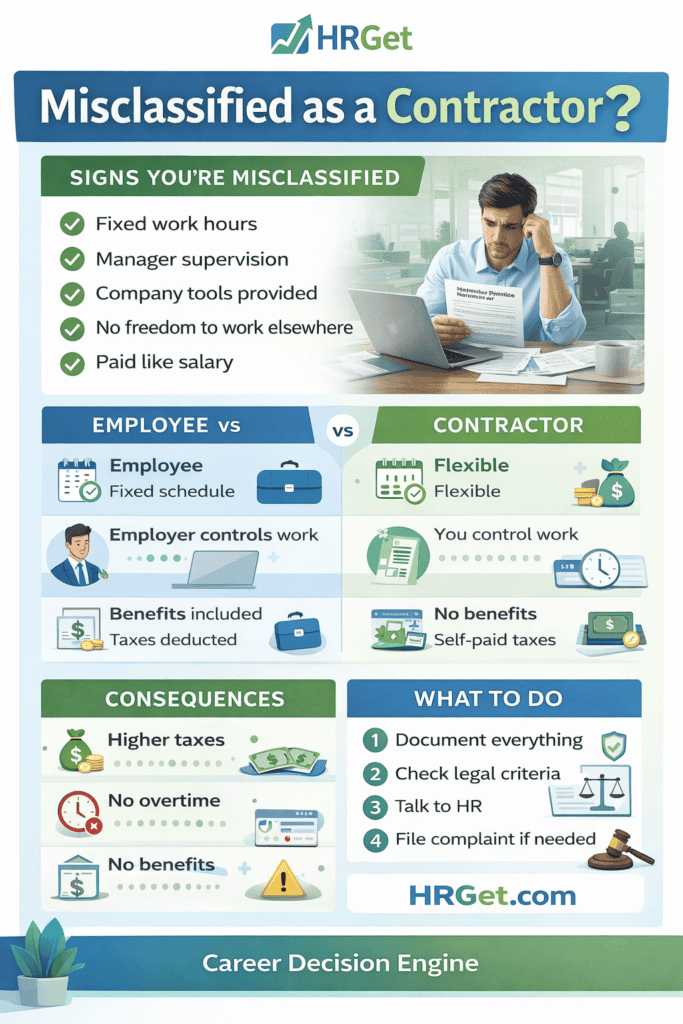
Your Hours Are Set by the Company
Real contractors choose when they work. If your employer says “you need to be available 9–6 Monday to Friday” or requires you to attend regular team meetings, that’s behavioral control — and it points toward employment.
You Use Company-Provided Equipment
A laptop, email account, internal systems, a company phone — if your tools come from the employer, that’s a signal the IRS explicitly looks for under its common law control test. Independent contractors typically invest in their own equipment.
You Report to a Manager Daily
Contractors deliver outcomes. Employees follow instructions. If someone inside the company assigns you tasks, reviews your daily output, or has direct performance conversations with you, that’s a supervisory relationship — not a client relationship.
You’re Locked Out of Working for Others
Exclusivity clauses are a massive red flag. A legitimate contractor serves multiple clients. If your agreement says you can’t work for anyone else in your industry, you’re being treated like an employee without the employee rights.
Your Pay Arrives Like a Salary
Weekly or bi-weekly fixed payments that don’t vary based on deliverables or project completion? That’s employee compensation structure, not contractor invoicing.
Your Work Is Central to the Business
Courts look at whether the work is integral to the company’s core operations. If you’re doing engineering, sales, customer support, or operations — not a one-off project — that integration strongly suggests employment.
If three or more of these apply to your situation, you’re past the “maybe” zone. This warrants a serious look at your classification status — and potentially a formal review.
Employee vs. Contractor: The Core Legal Differences
Before you act on anything, understand exactly what’s at stake. The classification difference isn’t just a label — it determines your entire legal standing as a worker.
| Factor | True Employee | True Independent Contractor |
|---|---|---|
| Work Control | Employer directs how & when work is done | Worker controls method and schedule |
| Tools & Equipment | Provided by employer | Worker supplies own tools |
| Multiple Clients | Typically exclusive | Works for multiple clients simultaneously |
| Tax Handling | Employer withholds payroll taxes | Worker pays full self-employment tax (15.3%) |
| Benefits Eligibility | Health, PTO, retirement contributions | None from client company |
| Overtime Protection | Covered by FLSA (1.5× after 40 hrs/week) | Not covered |
| Unemployment Insurance | Eligible if terminated | Not eligible |
| Anti-Discrimination Laws | Fully protected (Title VII, ADA, etc.) | Limited or no protection in many states |
Look at the tax row carefully. If you’re classified as a contractor, you pay 15.3% self-employment tax on top of income tax. An employee only pays half that — the employer covers the other half. On a $70,000 annual income, that difference alone is roughly $5,350 a year coming directly out of your pocket.
Real Scenario: How Misclassification Happens in Practice
Priya joined a Series B startup in Bangalore as a “contract product manager” in early 2024. She worked 9-to-6, attended daily standups, managed a team of three engineers, used the company’s Jira and Notion accounts, and received a fixed monthly payment via TDS-deducted invoices.
Eighteen months later, when the startup did a restructure and asked her to leave with two weeks’ notice, she had no legal recourse. No severance entitlement. No unemployment claim. And she’d been paying double the tax load of her colleagues doing identical work — because they’d been converted to payroll employees six months earlier.
The company’s reason for keeping her as a contractor? “Hiring freeze.” The legal reality? She qualified as an employee under India’s Contract Labour (Regulation and Abolition) Act.
This pattern plays out across industries — tech startups, marketing agencies, logistics platforms. Companies use contractor status to avoid employer-side costs: payroll taxes, EPF contributions, gratuity, health benefits. In the US context, that’s Social Security contributions, Medicare, state unemployment insurance.
The decision is rarely about your role. It’s about their cost structure. And that’s exactly why the legal frameworks give workers like Priya a path to reclassification.
What Contractor Misclassification Is Costing You
Let’s put actual numbers to this, because vague statements about “financial impact” don’t motivate action. Real dollars do.
The Tax Hit
As mentioned: US contractors pay the full 15.3% self-employment tax. An employee only pays 7.65% — the employer covers the rest. On a $80,000 income, you’re paying roughly $6,100 more per year than an employee in the same role. Over three years of misclassification? That’s $18,000+ in excess taxes — potentially refundable if you win a reclassification claim.
Lost Overtime
The Fair Labor Standards Act (FLSA) requires employees to be paid 1.5× their regular rate for hours beyond 40 per week. Contractors? Not covered. If you regularly worked 50-hour weeks at a $45/hour equivalent rate, that’s $675/week in unpaid overtime — over $35,000 a year you’re owed.
No Benefits
Health insurance employer contributions typically run $6,000–$14,000 per year in the US. Add employer 401(k) matching (commonly 3–5% of salary), paid leave accrual, and disability coverage. The total benefits gap between a contractor and an employee at the same income level often exceeds $20,000 annually.
No Unemployment Protection
If you’re let go as a contractor, you can’t file for unemployment. An employee losing the same job might collect $400–$700/week in state unemployment benefits for up to 26 weeks. That’s a potential $18,000 safety net that doesn’t exist for you.
No Legal Protections Against Termination
Employment discrimination laws — Title VII, the ADA, ADEA — generally don’t apply to contractors. If your “contract” is terminated in circumstances that would constitute wrongful termination for an employee, you have significantly weaker legal footing.
A worker misclassified for 2–3 years at a $75,000 equivalent income could be owed $40,000–$80,000 when you combine unpaid overtime, excess taxes, and missed benefits. That’s not hypothetical — it’s the basis of class-action settlements the DOL has enforced against gig platforms and staffing companies alike.
What to Do If You’re Misclassified (Step-by-Step)
Here’s the part most articles skim over — the actual mechanics. Don’t rush this. Done properly, reclassification claims have real financial upside.
Document everything before you do anything else. Pull together: emails showing task assignments and schedules, pay records, work tools provided by the employer, org charts placing you within their structure, exclusivity clauses in your contract. This is your evidentiary foundation.
Run yourself through the IRS common law test. The IRS looks at three categories: behavioral control (does the company control how you work?), financial control (does the company control the business aspects of your job?), and the type of relationship (are there employee-type benefits, written contracts, permanency?). If you fail as a contractor on two or more — file IRS Form SS-8.
Check your state’s classification standard. Many states use the stricter “ABC test” — notably California (AB5 law), New Jersey, and Massachusetts. Under the ABC test, the burden is on the company to prove you’re a contractor, not on you to prove you’re an employee. This is significantly more favorable to workers.
Raise it internally — carefully, and strategically. Before filing anything externally, consider a private conversation with HR framed as a compliance question, not an accusation. Say: “I’ve been reviewing my working arrangement and wanted to understand how our structure aligns with current IRS guidance.” Many companies quietly reclassify to avoid the legal exposure. Some will negotiate a settlement.
File Form SS-8 with the IRS if the internal route fails. This is a formal determination request. The IRS will review your working relationship and issue a ruling on your classification. This also creates an official record — important if you later pursue back-pay claims.
File a wage complaint with the Department of Labor. If overtime pay is involved, the DOL Wage and Hour Division handles FLSA misclassification complaints. There’s no cost to file, and the DOL has broad investigative authority.
Consult an employment attorney. If the amounts involved are substantial — and they often are — an employment lawyer can evaluate a civil suit for back wages, unpaid benefits, and potentially punitive damages. Many work on contingency for misclassification cases, meaning no upfront cost to you.
FLSA overtime claims have a 2-year statute of limitations (3 years for willful violations). State claims vary. Don’t sit on this — every month you delay is a month of potential recovery you may lose.
Smart Strategy: Using Misclassification as Leverage
Here’s where I’ll give you the perspective most career sites won’t. If you’re planning to leave the company anyway — or if you’re already on shaky ground — misclassification is leverage. Real leverage.
Companies know their classification risk. Legal and finance teams review it regularly. The moment you indicate — professionally, credibly — that you understand your rights and are prepared to pursue a determination, the calculus shifts. You’re no longer just a contractor walking out the door. You’re a potential DOL investigation trigger.
How to Use This Strategically
Before filing anything externally, calculate your claim. Estimate unpaid overtime (hours worked beyond 40/week × 1.5× your hourly equivalent), excess self-employment taxes paid (roughly 7.65% of annual income per year), and the approximate value of benefits you didn’t receive.
Then have a direct conversation — ideally through an attorney or via a formal letter — offering the company a choice: reclassify you as an employee going forward (with appropriate back-pay settlement), or you proceed with formal regulatory filings.
I’ve seen this resolve quietly in the worker’s favor more often than you’d expect. Companies with 50+ “contractors” doing employee work have enormous consolidated exposure — and settling with one person quietly is far cheaper than a DOL investigation or class action.
If you’re in a company that uses contractors at scale — think gig platforms, staffing-heavy startups, agencies — your case is stronger than you think. Regulators don’t just look at individual situations; they look for patterns. A company with 200 “contractors” all doing the same embedded work is a pattern. That’s leverage for you and for any group of similarly situated workers who want to pursue a collective claim.
Common Mistakes That Kill Misclassification Claims
These aren’t theoretical — they’re the exact things I’ve watched workers do that undermined otherwise strong cases.
Mistake 1: Assuming the Contract Settles It
“I signed a contractor agreement” is the single most common reason people don’t pursue valid claims. It doesn’t matter. Courts and the IRS assess the actual working relationship, not the document label. A contract cannot override labor law.
Mistake 2: Quitting Immediately
The moment you quit, you lose access to documentation, colleagues who can corroborate your claims, and the ongoing nature of the relationship that strengthens your case. If you’re seriously considering a claim, stay employed while you build your evidence file.
Mistake 3: Waiting Too Long
The 2-year FLSA clock is real. People spend months “thinking about it” and then find their most financially significant period of misclassification is outside the recovery window. Act within 6 months of recognizing the problem.
Mistake 4: Framing It as a Personal Grievance
When you raise this internally or file a complaint, make it a compliance issue — not a personal complaint about your manager or pay. “This arrangement may not align with IRS guidelines” is a legal observation. “My boss treats me like an employee but doesn’t pay me like one” is a complaint. The first gets taken seriously; the second gets managed.
Mistake 5: Forgetting the Tax Recovery Angle
Even if you don’t pursue a full wage claim, you may be entitled to a refund on excess taxes paid. IRS Form SS-8 and a corrected W-2 (or 1099 adjustment) can recover the employer’s share of Social Security and Medicare taxes you paid out of pocket. This alone is often worth $3,000–$7,000 per year of misclassification.
FAQ: Misclassified as a Contractor
Can I sue my employer for misclassifying me as an independent contractor?
Yes. You can file a civil lawsuit to recover unpaid wages, overtime pay, and the value of benefits you were denied. Many employment attorneys handle these cases on contingency — no upfront cost. You can also file through the DOL’s Wage and Hour Division or your state labor board. Courts have awarded significant back-pay damages in misclassification cases, particularly where the violation was willful.
Will I face retaliation for reporting misclassification?
Federal law prohibits retaliation against workers who file wage complaints or cooperate with investigations. The FLSA’s anti-retaliation provisions cover filing complaints, initiating proceedings, or testifying. If your “contract” is terminated shortly after you raise a classification concern, that timing can itself be evidence of retaliation — which carries additional legal remedies.
How much back pay can I recover if I was misclassified?
Recovery depends on duration, your pay rate, hours worked beyond 40 per week, and the benefits gap. A worker misclassified for 2 years at $70,000/year equivalent — regularly working 50-hour weeks — could realistically recover $30,000–$60,000 in combined overtime, excess taxes, and benefits. Willful violations under the FLSA allow 3 years of back-pay recovery plus liquidated damages (doubling the award).
Does contractor misclassification apply outside the US?
Yes — India, the UK, and the UAE all have their own classification standards. In India, the Contract Labour (Regulation and Abolition) Act and Supreme Court judgments on “workman” status apply. The UK uses a three-tier system: employee, worker, and contractor — and “workers” (a middle category) have significant rights including holiday pay and minimum wage. The UAE Labour Law similarly addresses dependent work relationships. If you’re based outside the US, local employment counsel is essential.
Does signing a contractor agreement mean I can’t claim employee rights?
No. A signed contractor agreement does not override labor law. Both the IRS and the courts assess the actual economic reality of the working relationship — not the label in the contract. If your day-to-day working conditions resemble employment, the agreement title is legally irrelevant. This is a settled legal principle consistently upheld in US courts.
What is IRS Form SS-8 and should I file it?
Form SS-8 (Determination of Worker Status for Purposes of Federal Employment Taxes) is a formal request asking the IRS to determine whether you should be classified as an employee. Filing it opens an official investigation and can result in a binding determination letter. It’s particularly useful if your employer is unresponsive to internal escalation. The process typically takes 6–12 months, but the determination applies retroactively. You can file it at IRS.gov.
How long does a misclassification claim take to resolve?
It depends on the route. An internal negotiation might resolve in weeks. An IRS SS-8 determination typically takes 6–12 months. A DOL Wage and Hour complaint varies by caseload — often 3–9 months for straightforward cases. Litigation in federal court can run 1–3 years. Most cases that don’t go to trial resolve through settlement, which is typically faster. Having strong documentation accelerates every pathway.
The Bottom Line
If you’ve been misclassified as a contractor, you’re not just dealing with a paperwork technicality. You’re losing money — in taxes, in overtime, in benefits, and in legal protections — every single month the situation continues.
The framework to fix it exists. The IRS, the DOL, and state labor boards all have established processes. And in 2026, with the DOL’s updated independent contractor rule tilting further toward worker protection, your legal footing is stronger than it’s been in years.
Start with the self-audit: run through the six warning signs, calculate your rough exposure, and gather your documentation before you say a word to anyone at the company. Then decide whether to escalate internally, file formally, or both.
Most people who act on this are surprised by how much they recover — and how quickly the company cooperates once they realize you know your rights.
Related Reading: If your misclassification situation is tied to a layoff or sudden contract termination, read our guide on your rights when laid off — it covers severance, final pay timelines, and what to document before your last day.

Michael Reeves | Former Senior Counsel, Littler Mendelson | Severance & Restructuring Specialist | 18+ Years in Employment Law
Author bio: Michael Reeves spent nearly two decades as Senior Counsel at Littler Mendelson — one of the world’s largest employment law firms — advising on mass layoffs, corporate restructurings, and severance negotiations for Fortune 500 companies across the US and Europe. He has worked both sides of the table: structuring cost-efficient separation packages for employers and, more recently, helping employees understand exactly where their leverage lies. Based between Chicago and London, Michael writes for HRGet.com to demystify the legal and financial dimensions of layoffs — so employees stop leaving money on the table.