

You just got the call. Or maybe the meeting invite with HR and your manager — the one with no agenda. Either way, you’re staring at a severance number and wondering: is this actually fair?
Most employees never question their severance pay. They’re too rattled by the news to run the math. And honestly, companies count on that.
After 15+ years in HR — and having personally structured severance packages for hundreds of employees — I can tell you this: the difference between someone who understands their severance calculation and someone who doesn’t can easily be ₹2–5 lakh or $5,000–$15,000. This severance pay calculator guide breaks down exactly how to estimate your payout, what benchmarks actually look like in 2026, and where you have room to push back.
Severance Pay Calculator
What Is Severance Pay (And What It Isn’t)
Severance pay is compensation your employer offers when they end your employment — usually through layoffs, restructuring, or position elimination. It’s not the same as your final paycheck, unused PTO payout, or notice period pay. Those are separate.
Here’s what trips people up: in the US, no federal law requires private employers to pay severance. The Department of Labor is clear — severance is a matter of agreement between employer and employee. India’s Industrial Disputes Act covers “retrenchment compensation” for certain workers, but most private-sector professionals operate under company policy, not statute.
So why do companies pay it? Three reasons. Legal risk reduction (they want you to sign a release). Employer brand protection (word gets around). And transition support — which, let’s be real, is the least of their concerns.
The one exception worth knowing: New Jersey’s WARN Act actually mandates one week of severance per year of service for qualifying mass layoffs. It’s the only US state that does this. If you’re in NJ and your company just did a large-scale layoff, that’s not generosity — it’s the law.
The Severance Pay Formula: How Companies Actually Calculate It
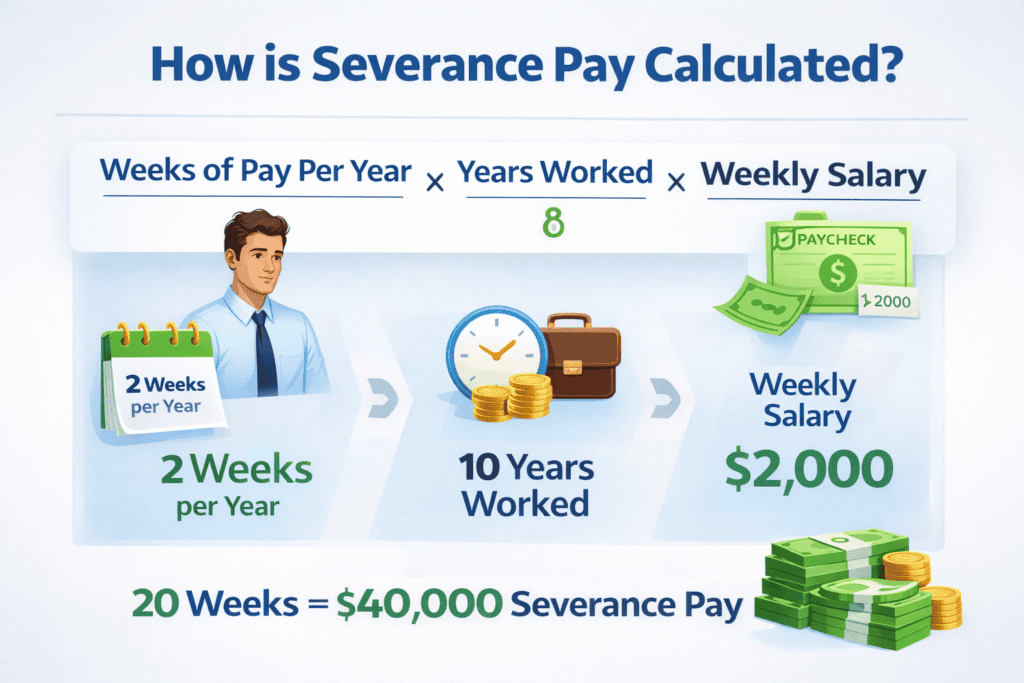
The core severance pay formula used by most companies in 2026 is straightforward:
Severance Pay = (Weeks of Pay per Year of Service) × (Years Worked) × (Weekly Salary)
That “weeks per year” multiplier is where everything varies. And that’s where most people get shortchanged — because they don’t know what’s normal.
Here’s how the multiplier typically breaks down by company type:
Conservative employers (small/mid-size companies): 1 week per year of service, often capped at 8–12 weeks total.
Market standard (most mid-to-large companies): 2 weeks per year, capped at 16–26 weeks. This is the benchmark I’d use as your starting point in any negotiation.
Generous packages (Big Tech, MNCs, finance): 3–4 weeks per year, sometimes with a minimum floor of 12 weeks regardless of tenure. These packages often include additional perks — continued health insurance, bonus payouts, accelerated stock vesting.
For federal government employees in the US, the formula follows a specific statutory structure under 5 U.S.C. §5595: one week per year for the first 10 years, then two weeks per year after that, with an age adjustment factor for workers over 40. The lifetime cap is 52 weeks.
Pro Tip: Your “weekly salary” in the formula should be your base salary divided by 52. Don’t let HR calculate it using a lower number — some companies try to exclude bonuses, commissions, or allowances from the base. If your offer letter or CTC structure includes these as guaranteed components, push back.
Severance Pay Calculator: Quick Reference by Tenure
Use this quick-reference table to estimate your severance range. Match your years of service against the company type:
| Years of Service | Conservative (1 wk/yr) | Market Standard (2 wks/yr) | Generous (3–4 wks/yr) |
|---|---|---|---|
| Less than 1 year | 2–4 weeks (floor) | 2–4 weeks (floor) | 4–12 weeks (floor) |
| 1–3 years | 1–3 weeks | 2–6 weeks | 3–12 weeks |
| 3–5 years | 3–5 weeks | 6–10 weeks | 9–20 weeks |
| 5–10 years | 5–10 weeks | 10–20 weeks | 15–40 weeks |
| 10+ years | 10–12 weeks (cap) | 20–26 weeks (cap) | 30–52 weeks |
How to convert weeks to money:
Take your annual base salary, divide by 52. That’s your weekly rate. Multiply by the weeks from the table.
Quick example: You earn $95,000/year (roughly $1,827/week). You’ve been at the company 6 years. At market standard (2 weeks per year), that’s 12 weeks × $1,827 = $21,924 gross severance.
For India: If your CTC is ₹24 LPA, your weekly rate is approximately ₹46,150. At 2 weeks per year with 5 years of tenure, you’re looking at 10 weeks × ₹46,150 = ₹4.6 lakh gross severance.
These are starting points. What you actually walk away with depends on factors I’ll cover next.
Real-World Severance Calculations (3 Scenarios)
Theory is nice. But let me show you how this plays out in the real world — because severance is rarely just a formula.
Scenario 1: Mid-Level Marketing Manager (US, SaaS Company)
Profile: 4 years tenure, $110K base salary, laid off during a restructuring. Initial offer: 4 weeks (1 week per year — conservative end). Weekly rate: $2,115.
That’s $8,460 gross. For someone who’ll need 2–3 months to land a comparable role in 2026’s market, that barely covers one month’s expenses in a major metro.
What they did: Pointed out that the company’s own handbook referenced “up to 2 weeks per year” and asked for the standard calculation. Also negotiated 3 months of COBRA coverage (worth roughly $5,400 in the US) and a positive reference letter.
Final package: 8 weeks pay + COBRA + reference = roughly $22,300 in total value. Almost triple the initial cash offer.
Scenario 2: Senior Engineer (India, US-Based MNC)
Profile: 6 years tenure, ₹40 LPA base, laid off in a team-wide reduction. Initial offer: 12 weeks (2 weeks per year — market standard). Weekly rate: ₹76,920.
That’s ₹9.23 lakh gross. Not bad on paper. But here’s what most people miss in India — MNCs often have internal flexibility beyond the “policy” number, especially for senior individual contributors.
What they did: Asked HR to clarify how the calculation was determined. Referenced industry benchmarks (2–3 weeks per year for Big Tech in India). Highlighted a pending performance bonus and unvested RSUs.
Final outcome: 18 weeks cash + prorated bonus + 3 months accelerated RSU vesting. Total value: approximately ₹18 lakh. That’s nearly double.
Scenario 3: Junior Analyst (UK, Financial Services)
Profile: 2.5 years tenure, £38,000 salary.
In the UK, employees with 2+ years of continuous service are entitled to statutory redundancy pay. The calculation is age-based: half a week’s pay for each full year under 22, one week for each year aged 22–40, and one-and-a-half weeks for each year aged 41+. Weekly pay is capped (currently around £700).
Statutory minimum: Roughly £1,400. But the employer offered a contractual redundancy package of 4 weeks — about £2,920. Not great, but the employee negotiated an additional month of notice pay and outplacement support.
Key takeaway: In the UK, statutory redundancy is a floor, not a ceiling. Your contract and negotiation determine the actual number.
What Changes Your Severance Number
Your severance isn’t just tenure × formula. Several factors shift the number — sometimes dramatically.
Role level matters more than you think. A director or VP-level exit almost always involves a negotiated package. At the executive level, severance is typically expressed in months of salary (6–18 months) rather than weeks per year. If you’re in a senior role and they’re offering the standard formula, you’re likely being underpaid.
Company type sets the baseline. Startups tend to offer lower cash severance but may accelerate equity vesting. MNCs and public companies have more structured (and often more generous) policies. Government roles follow statutory formulas with little room for negotiation.
Layoff context creates leverage. Mass layoffs typically mean standardized packages — harder to negotiate individually, but the presence of a group gives you WARN Act protections (in the US) and collective bargaining potential. Individual terminations, on the other hand, are often more negotiable because the company has more legal exposure.
Legal risk is your biggest hidden lever. If your exit involves anything that could be construed as discrimination (age, gender, disability, pregnancy), retaliation for whistleblowing, or breach of contract — you have significant negotiating power. Companies know this, even if they don’t say it. This is exactly why they ask you to sign a release of claims in exchange for severance.
Geography shifts everything. The US has the weakest statutory protections — severance is almost entirely voluntary. India varies by company. The UK has statutory redundancy pay. EU countries generally have the strongest protections, with mandatory consultation periods, notice requirements, and minimum payouts. Don’t compare your US package to a friend’s UK package and vice versa.
The Insider View: What HR Won’t Tell You About Severance
I’ve sat on the other side of this table hundreds of times. Here’s what actually happens behind the scenes.
Severance budgets have a floor and a ceiling. When HR prepares a layoff, finance signs off on a total severance budget. The “standard” offer you receive is usually calculated at the floor — the minimum acceptable amount the company expects most employees to accept. There’s almost always room between that floor and the ceiling.
How much room? In my experience, 20–40% above the initial offer is realistic for most professional roles. For senior positions with legal complexity, I’ve seen packages double.
Companies assume most people won’t negotiate. And they’re right. Roughly 60–70% of employees accept the first offer without pushback. The remaining 30–40% who do negotiate almost always get more. Not because companies are evil — but because the initial offer is designed to be accepted quickly, not to be the maximum fair amount.
The release of claims is the real currency. Your severance isn’t a gift — it’s a transaction. The company is buying your signature on a document that says you won’t sue them. If you have potential claims (and many people do without realizing it), that signature is worth more than the standard formula.
Timing pressure is a negotiation tactic. If HR tells you the offer expires in 48 hours, know this: for employees aged 40+, the Older Workers Benefit Protection Act (OWBPA) legally requires a minimum of 21 days to review the agreement (45 days in a group layoff), plus a 7-day revocation period after signing. Even for employees under 40, courts evaluate whether a waiver was “knowing and voluntary” — and signing under pressure weakens the agreement’s enforceability.
Don’t let urgency override your judgment. A few days of review has never cost someone their severance offer.
Smart Strategy: How to Negotiate a Better Package
Most people either accept immediately or get emotional. Neither works. Here’s a five-step approach that consistently gets results.
Step 1: Buy yourself time. The moment you receive the offer, say: “Thank you. I’d like some time to review the severance terms before responding.” That’s it. No drama. No counter-offer yet. Just time.
Step 2: Ask how the number was calculated. This is the most underrated move in severance negotiation. Email HR and ask: “Can you help me understand how this severance amount was determined?” This does two things — it signals that you’re informed and paying attention, and it forces transparency. If the policy is “2 weeks per year” but they offered 1 week, you now have a documented basis to push back.
Step 3: Anchor to market benchmarks. Use a specific reference: “Based on industry standards for my role and tenure, I’d expected closer to [X] weeks. Is there flexibility to align the offer with market norms?” Don’t pull a number from thin air. Use the calculator table above or reference your company’s own handbook.
Step 4: Negotiate beyond cash. This is where most people leave value on the table. Think about extended health insurance (COBRA in the US can cost $600–$2,000/month — even 3 months of employer-paid coverage adds thousands). Accelerated RSU or stock option vesting. Prorated bonus for the current period. Outplacement services. A positive reference letter. Non-compete clause removal or reduction.
Step 5: Stay professional throughout. No threats. No anger. No guilt trips. The people across the table are doing their jobs, and they’ve likely been through this conversation fifty times this week. Calm, informed, and specific — that’s the energy that gets results.
Common Severance Mistakes That Cost You Money
I’ve watched smart professionals make these mistakes over and over. Don’t be one of them.
Accepting the first offer without reading the full agreement. I’m not just talking about the dollar amount. Severance agreements often include non-compete clauses (which can block your next job), non-disparagement provisions (which limit what you can say), and broad waivers of claims you might not even know you have. Read every page. Better yet, have an employment attorney review it — especially if the package exceeds $10,000 or includes restrictive covenants.
Ignoring the non-cash components. Health insurance continuation alone can be worth $6,000–$21,000 over 18 months in the US (that’s the full COBRA cost including the employer’s share). Unused PTO payouts are mandatory in states like California, Colorado, Montana, and Nebraska — regardless of severance. RSU acceleration could be worth more than your entire cash severance. Add it all up before you evaluate the offer.
Comparing your package to a friend’s anecdote. “My friend got 6 months” is not a benchmark. Your friend might have been at a different company, in a different role, with a different legal situation. Use market data and your company’s own policies, not cocktail-party comparisons.
Signing under pressure when you’re over 40. If you’re 40 or older, federal law gives you 21 days (or 45 in a group layoff) to review, plus 7 days to revoke after signing. Any employer that pushes you to sign faster is either uninformed or hoping you don’t know your rights.
Forgetting the tax impact. Your gross severance and your net severance are two very different numbers. More on that below.
Taxes on Severance Pay: What You’ll Actually Take Home
This trips up almost everyone. You calculate your gross severance, mentally spend it, and then get hit with a tax bill that takes 30–40% off the top.
In the US: Severance is taxed as supplemental wages. If paid as a lump sum, the federal withholding rate is a flat 22%. If the total supplemental wages for the year exceed $1 million, the rate on the excess jumps to 37%. On top of that, you owe Social Security tax (6.2% up to the wage base — estimated at $176,100 for 2026), Medicare (1.45%, plus 0.9% surtax above $200,000), and state income tax (ranging from 0% in Texas, Florida, and a few others, to over 9% in California and Oregon). Add it all up and you could lose 30–40% of your gross severance to taxes.
In India: Severance pay is generally taxed as income under the head “Salary.” Retrenchment compensation under the Industrial Disputes Act gets partial exemption under Section 10(10B), but this applies primarily to workmen — not most private-sector professionals. For non-exempt severance, it’s taxed at your regular slab rate. If you receive a large lump sum, it could push you into a higher bracket for the year.
In the UK: Statutory redundancy pay is tax-free. Non-statutory (contractual) severance pay has a £30,000 exemption — anything above that is taxable as earnings.
Quick tip: If you have a choice between lump sum and salary continuation, model both scenarios with a tax advisor. In some cases, spreading the payments across two tax years significantly reduces your effective rate.
For a detailed breakdown of your net severance after withholding, check our Severance Tax Calculator.
FAQ: Severance Pay Calculator
What is the standard severance pay per year of service?
The most common benchmark is 1–2 weeks of pay per year of service. Conservative companies offer 1 week per year. Market standard is 2 weeks. Big Tech and MNCs in finance often go up to 3–4 weeks. Executive packages typically use months rather than weeks as the multiplier.
Is severance pay legally required?
In the US, no federal law mandates severance for private-sector employees. New Jersey is the only state that requires actual severance pay for qualifying mass layoffs under its WARN Act. In the UK, statutory redundancy pay is legally required after 2 years of continuous service. In India, retrenchment compensation is required under the Industrial Disputes Act for eligible workers, but most private-sector professionals rely on company policy.
Can I negotiate my severance package?
Yes — and you should. Severance offers from private employers are almost always negotiable. Your leverage increases if you have long tenure, are in a senior role, have potential legal claims, or if the layoff creates compliance risk for the employer. Even standardized packages in mass layoffs can have individual flexibility, especially for non-cash components like insurance and equity.
How is severance pay taxed in the US?
The IRS treats severance as supplemental wages. Lump-sum payments are withheld at a flat 22% federal rate. You’ll also owe Social Security tax, Medicare tax, and applicable state income tax. The effective tax rate on severance often lands between 30–40%, depending on your total income and state of residence.
Does severance pay affect unemployment benefits?
It depends on your state and how the severance is structured. Some states delay unemployment benefits during the severance payout period if it’s paid as salary continuation. Lump-sum payments may not affect eligibility in some states. Check your state’s specific rules — this is one area where the details matter enormously. Read our full guide on whether severance affects unemployment.
What should I look for in a severance agreement before signing?
Beyond the dollar amount, review these carefully: non-compete clauses (scope and duration), non-disparagement provisions, intellectual property assignments, confidentiality obligations, and the release of claims. If you’re 40 or older, confirm the agreement meets OWBPA requirements — including the 21-day review period (45 days for group layoffs) and 7-day revocation window.
Is severance different from notice period pay?
Yes. Notice period pay compensates you for the contractual notice period your employer is required to provide (or pay in lieu of). Severance is additional compensation offered on top of notice pay as part of your separation package. In India, these are often conflated — make sure your offer letter distinguishes between the two.
When should I hire a lawyer for severance negotiation?
If your package exceeds $10,000 (or ₹5 lakh), includes a non-compete, involves potential discrimination or retaliation claims, or if you’re a senior employee with equity at stake — get legal advice. An employment attorney typically charges $500–$2,000 for a severance review, which is a fraction of what they can help you recover.
The Bottom Line
Here’s what I want you to take away from this severance pay calculator guide: your severance package is one of the few moments in your career where a single conversation — informed by the right numbers — can add thousands of dollars or lakhs of rupees to your bank account.
Most people don’t treat severance as negotiable. They’re stressed, they’re emotional, and they just want the whole thing to be over. Companies know this. The ones who take 48 hours, run the math, and ask the right questions almost always walk away with a better deal.
Calculate your number using the formula and benchmarks above. Compare it to what you’ve been offered. And if there’s a gap — close it.
Next step: Use our Severance Tax Calculator to estimate what you’ll actually take home after withholding. And if you’re actively negotiating, read our step-by-step guide on how to negotiate a layoff severance package.
Disclaimer: This calculator and guide provide estimates based on common industry practices. Severance pay varies by employer, contract, and jurisdiction. This is not legal or financial advice. Consult an employment attorney or tax professional for guidance specific to your situation.

Victoria Hale | Former Partner, Freshfields Bruckhaus Deringer | Employment Law Specialist | 20+ Years Advising Multinationals & Executives
Author: Victoria Hale spent over two decades as an Employment Law Partner at Freshfields Bruckhaus Deringer — one of the world’s most prestigious Magic Circle law firms — advising multinational corporations and senior executives on some of the most complex employment disputes in the US and Europe. Her practice covered wrongful termination litigation, executive exits, non-compete enforcement, FLSA compliance, and cross-border workforce restructuring under EU labour law. Now based between London and New York, Victoria writes for HRGet.com to close the gap between legal theory and how employment law actually plays out in the real world — for employees who need to know their rights before it’s too late.