
Getting two job offers at the same time sounds like a dream. Until you actually have to choose — and the clock is ticking.
Most professionals fall into the same trap: they reduce this entire decision down to a salary comparison and call it a day. Offer A pays ₹28L, Offer B pays ₹25L, so Offer A it is. Six months later, they’re miserable, underchallenged, or quietly looking again.
I’ve seen this play out dozens of times — and after 15+ years working in HR and advising professionals across India, the US, and the UK, the pattern is almost always the same. The person who “won” the higher salary often lost on every other dimension that actually determines career satisfaction and long-term earning power.
This offer comparison checklist will walk you through every factor that actually matters — compensation, growth, manager quality, company risk, and lifestyle fit — so you can make a decision your future self won’t regret.
Why Comparing Two Offers Is Harder Than It Looks
Here’s the thing — a job offer isn’t a single number. It’s a bundle of at least five distinct variables, each of which can dramatically affect your life one to three years from now.
Those five variables are: compensation, growth trajectory, work environment, company risk, and personal alignment. When you only optimize for one of them, you’re essentially making a decision with 80% of the data missing.
There’s also a psychological trap at play. When you’re deciding between two offers, your brain naturally anchors to the most legible number — the base salary. Everything else (equity, manager quality, commute, burnout risk) gets mentally treated as secondary, even when it shouldn’t be.
And in 2026’s job market — where hybrid work is the norm, ESOP structures vary wildly, and startups can go from Series B to shutdown in 18 months — the stakes of getting this wrong are genuinely high. A bad offer decision doesn’t just cost you comfort. It can cost you two years of growth you’ll never get back.
The solution is structure. Which is exactly what this checklist gives you.
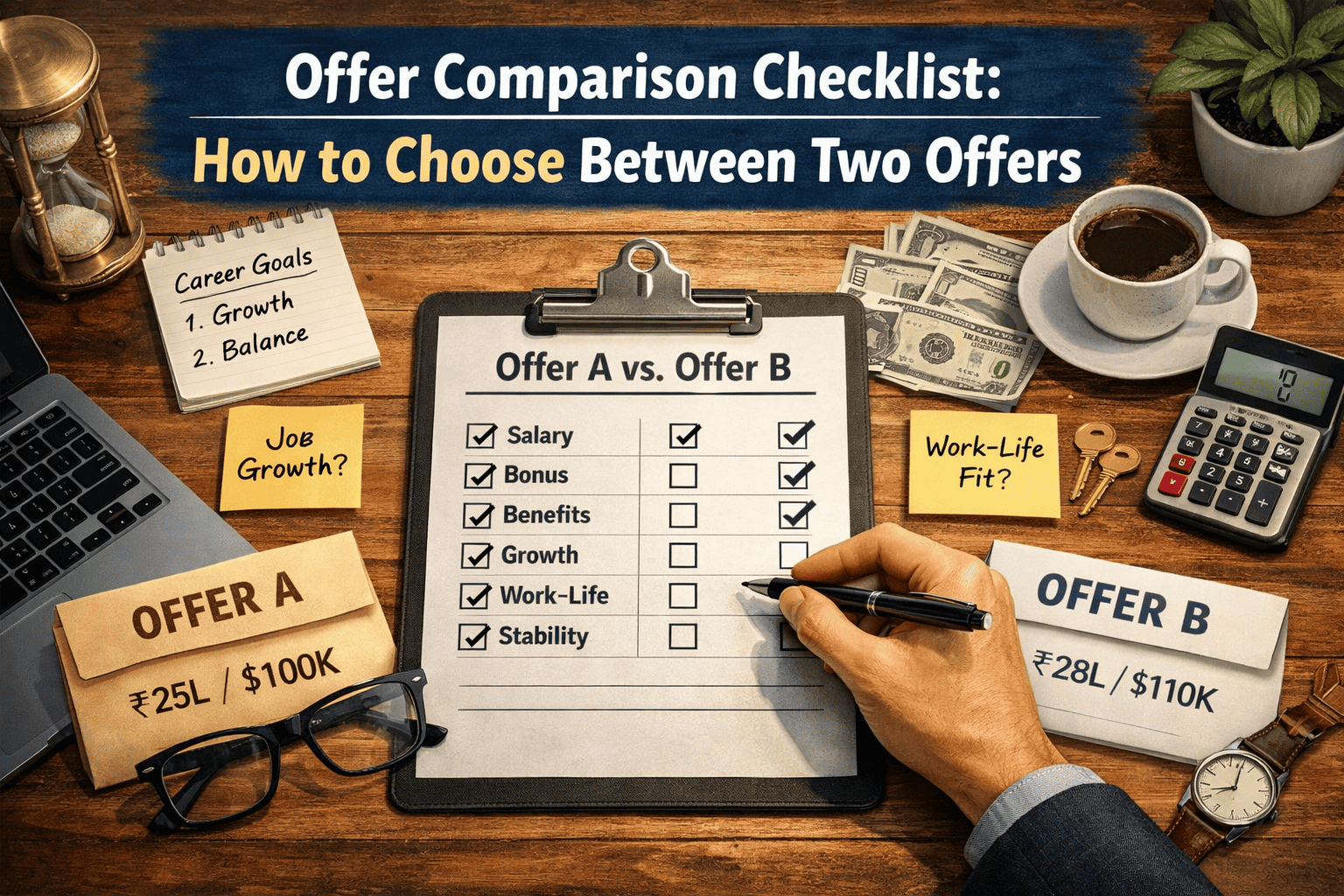
The Offer Comparison Checklist (All 7 Dimensions)
Before you run any comparisons, pull out both offer letters and go through this checklist systematically. You’ll use this again in the weighted scoring section later.
1. Compensation
- Base salary (annual)
- Performance bonus — is it guaranteed or discretionary?
- Stock options or ESOPs — what’s the vesting schedule?
- Health insurance coverage (self, spouse, parents?)
- Provident fund, gratuity, and retirement contributions
- Joining bonus — and any clawback clause?
2. Role and Scope
- Is the title reflective of actual seniority?
- What decisions will you own independently?
- How much cross-functional exposure does this role offer?
3. Growth Potential
- What’s the realistic promotion timeline?
- Will this role build skills that are in high demand in 2–3 years?
- How strong is this company’s brand on your resume?
4. Work-Life Balance
- Expected working hours — and is overtime culture normalized?
- Remote, hybrid, or fully in-office?
- Commute time (one-way and weekly impact)
5. Company Stability
- Is the company profitable, or burning through funding?
- Any layoffs in the last 12–18 months?
- How is the broader industry trending?
6. Manager and Team
- Did the hiring manager seem invested in your development?
- What’s the team’s average tenure? (High attrition is a red flag.)
- Who will you work with most closely — and did they seem collaborative?
7. Long-Term ROI
- Where does this role realistically take you in 3 years?
- What’s the ceiling — in title, compensation, and influence?
Salary vs Total Compensation: What the Numbers Really Say
Let me show you how dramatically a surface-level comparison can mislead you.
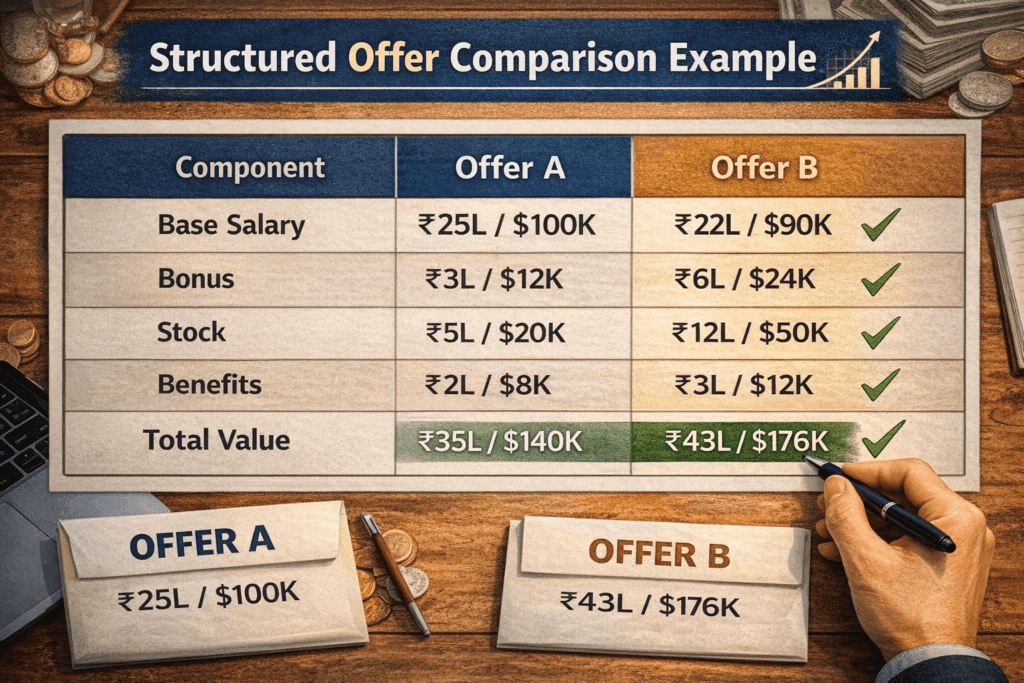
Say you have two offers: Offer A at ₹28L and Offer B at ₹24L. Most people pick Offer A and move on. But look at what happens when you break down the full picture:
| Component | Offer A | Offer B |
|---|---|---|
| Base Salary | ₹28L | ₹24L |
| Annual Bonus | ₹2L (discretionary) | ₹5L (contractual) |
| ESOPs (4-yr vest) | None | ₹20L pool |
| Health Insurance | Self only | Self + family (₹1.5L value) |
| Work-from-Home | 3 days/week | Full remote |
| Annualized Total Value | ~₹30L | ~₹35.5L |
Offer B — the one with the “lower” salary — is actually worth ₹5.5L more per year. And if those ESOPs are in a growth-stage company with a realistic exit, you’re looking at a much bigger delta.
The lesson: always convert both offers into annualized total compensation before comparing. Factor in the probability of the bonus (not just the maximum), the realistic value of equity, and the monetary equivalent of benefits like remote work and health coverage.
For US-based professionals, the same logic applies: a $105K offer with 15% bonus potential, full remote, and $20K in annual RSUs often beats a $120K offer with a 5% discretionary bonus and daily commute into a city. Run the math. Every time.
Career Growth and Future Market Value
This is where high performers consistently make better decisions than average ones. They’re not just asking “what does this job pay?” They’re asking “what will I be worth after two years in this role?”
Those are very different questions.
A role that builds skills in AI, product analytics, or international sales management right now can increase your market value by 40–60% in 24 months — even if the base salary starts modestly. On the other hand, a high-paying role that keeps you doing the same work in a shrinking industry is quietly depreciating your market value every year.
Ask yourself three things for each offer:
Will this role make me more hireable? Think about the skills you’ll develop, not just the responsibilities listed in the JD.
Does the company’s brand carry weight? A two-year stint at a company known for rigorous talent standards — a Bain, a Google, a top-tier hospital network — opens doors for a decade. Brand matters more early-career, less so after 8–10 years when your own track record does the talking.
What’s the promotion trajectory? Ask directly in the interview: “What does the path from this role to the next level typically look like, and in what timeframe?” If they can’t answer with specificity, that tells you something.
Insider Insight: I’ve watched people take a 15–20% pay cut to join a role with genuine stretch opportunities — and come out earning double within three years. The compounding effect of high-growth roles is real, and it’s something most offer comparison frameworks undervalue completely.
Work-Life Balance and Lifestyle Fit
Regret from this category is the most common — and the most preventable.
Nobody writes “expected to answer Slack messages at 11pm” in an offer letter. But that’s often exactly what you’re signing up for, and the clues are there if you look for them.
During the interview process, pay attention to when the hiring manager sends emails, what time they scheduled your calls, and how they describe the team’s workload. Ask outright: “What does a typical Tuesday evening look like for someone in this role?” The answer — or the discomfort with the question — tells you a lot.
Beyond hours, think about the hidden lifestyle costs that don’t show up in the offer letter:
A 90-minute daily commute (each way) translates to roughly 750 hours per year — the equivalent of nearly 19 full working weeks spent sitting in traffic or on a train. Priced at your hourly rate, that’s a significant hidden cost. Full remote saves you that time and, often, ₹80K–₹1.5L in annual commuting expenses.
This doesn’t mean always choose the remote job. It means factor it in explicitly. If Offer A requires five days in-office in Gurgaon and Offer B is full remote, that difference has real monetary and lifestyle value that belongs in your comparison.
And sustainability matters. A role that burns you out in 14 months isn’t a career move — it’s an expensive detour.
Company Stability and Risk Analysis
Don’t skip this step, especially if one offer is from a startup or a company that’s been in the news for restructuring.
In 2025–2026, both the tech sector and several consumer-facing industries saw significant layoff waves — including companies that looked perfectly stable from the outside. Evaluating company risk isn’t pessimistic, it’s professional.
Here’s a quick framework for assessing stability:
For funded startups: When was the last funding round, and at what valuation? How much runway do they have? Are they growing revenue, or just user numbers? Series B and below with no clear path to profitability carries meaningful risk in the current funding climate.
For large companies: Look at their last 12–18 months. Any major layoffs, leadership exits, or business unit shutdowns? A large company going through structural transformation can be just as risky as a startup — sometimes riskier, because the warning signs take longer to surface.
For public companies: A quick look at their quarterly earnings calls (publicly available) will tell you more than any recruiter conversation. Revenue trend, gross margin, and management commentary on hiring plans are all signal-rich.
If one offer carries meaningful risk, you should be compensated for it — either through a higher base, a guaranteed bonus, or equity that reflects the upside. If the risky offer isn’t offering any of that, the risk-reward ratio simply doesn’t work in your favor.
Manager and Team Quality: The Most Underrated Factor
I’ll be direct: this single factor has a greater impact on your job satisfaction, growth speed, and mental health than almost everything else on this list.
A great manager will sponsor your career, give you stretch projects, shield you from organizational politics, and help you grow faster than any structured program ever could. A bad manager will micromanage, take credit for your work, leave you out of critical conversations, and make every Monday feel like a punishment.
You can evaluate manager quality before accepting, if you ask the right questions:
“Can you walk me through the last time a team member came to you with a problem? How did you handle it?” — This reveals their instinct: are they problem-solvers or blame-shifters?
“What’s the most recent promotion you advocated for on your team?” — Managers who invest in their people can usually name someone specific and recent.
“What’s the team’s attrition like over the last year?” — High voluntary attrition from a small team is almost always a manager problem, not a company problem.
Also, if you can, talk to people who’ve worked with this manager before. LinkedIn makes it fairly easy to find former colleagues from their team. A 15-minute call with someone who reported to them is worth more than five rounds of interviews.
Real Scenario: Offer A vs Offer B
Here’s a situation I walked a client through recently (details changed for privacy).
Priya, 31, Product Manager in Bangalore: Two offers on the table after a competitive search.
Offer A — Large MNC: ₹32L base, stable company, recognized brand, clear structure, no equity, office five days a week, conservative growth culture, known internally as a place people “plateau” at mid-level.
Offer B — Series C startup: ₹26L base, ₹6L contractual bonus, ESOPs worth ₹30L over four years (realistic exit potential), full remote, high-ownership role building a new product vertical, manager with a strong track record of promoting ICs to leads.
On the surface: Offer A wins on salary. On total compensation: roughly equal in year one. On three-year trajectory: Offer B is not even close.
Priya took Offer B. Two years in, she’s been promoted once, leads a team of four, and is tracking to ₹45L+ at her next role based on the scope she’s built. If she’d taken Offer A, she’d likely still be at ₹34–35L with a narrower skillset.
The math works when you extend the timeline.
Smart Strategy: The Weighted Scoring Method
If you’re stuck — and many people genuinely are — this method removes emotional bias from the equation.
Step 1: Assign weights to each factor based on your current priorities.
| Factor | Suggested Weight |
|---|---|
| Total Compensation | 25% |
| Career Growth & Learning | 25% |
| Work-Life Balance | 20% |
| Company Stability | 15% |
| Manager & Team Quality | 15% |
Adjust these weights based on your situation. If you have a young family and stability is non-negotiable, bump that to 25% and reduce growth to 15%. If you’re early-career and single, flip the emphasis toward growth and learning.
Step 2: Score each offer on each factor from 1 to 10.
Step 3: Multiply each score by its weight and sum the totals.
The offer with the higher weighted score is almost always the right choice — because you’ve already decided in advance what matters most to you, before emotion entered the picture.
One more thing: if you finish the scoring and feel a strong pull toward the lower-scoring offer, that’s also useful data. It tells you there’s a factor you underweighted — maybe personal excitement about the work, or a relationship with a colleague. Go back and adjust the weights honestly, then re-run.
Common Mistakes People Make When Comparing Offers
Mistake 1: Comparing base salaries only. You already know this one. Total compensation, not base salary, is the number that matters. Don’t let this one get you.
Mistake 2: Letting urgency override analysis. Recruiters sometimes pressure candidates with artificial deadlines. “We need an answer by Friday” is occasionally real, but often it’s a tactic. You’re typically entitled to 5–7 business days to decide, and most reasonable companies will grant an extension if you ask professionally.
Mistake 3: Not negotiating both offers. Once you have two offers, you have leverage — and most people don’t use it. You don’t need to bluff or be aggressive. A simple “I have another offer at a similar level, and I’d like to see if there’s any flexibility on [base/bonus/equity]” is entirely professional and often effective. Even a 5–8% increase on a ₹25L package is ₹1.25–2L per year, compounding over every future negotiation.
Mistake 4: Ignoring your gut about the manager. If something felt off during the interview — evasiveness, dismissiveness, an inability to describe their team’s work clearly — trust that. Rational frameworks matter, but so does pattern recognition from the interview process.
Mistake 5: Making the decision alone. Talk to people who know your field, your risk tolerance, and your longer-term goals. A mentor, a former colleague, or even a career advisor can surface blind spots you genuinely cannot see from inside the decision.
Final Decision Framework
When everything is analyzed and you still need a clear rule to land on:
Choose the offer that maximizes your total value in 3 years — not just your total compensation today.
That means choosing the role that builds the skills, relationships, and track record that will make you worth significantly more in your next negotiation. Salary is a lagging indicator of career decisions made 2–3 years earlier. Make the right call now, and the salary follows.
A few contextual shortcuts:
If you’re under 30 and relatively early in your career, lean toward growth, ownership, and learning over stability and salary. The downside risk of a wrong choice is recoverable. The opportunity cost of slow growth in your twenties is not.
If you’re in your mid-thirties with financial commitments — mortgage, family, dependents — stability and total compensation matter more. This isn’t risk aversion, it’s appropriate prioritization.
If both offers genuinely feel equal after doing the analysis, choose based on manager quality. Of all the variables, that one has the most direct impact on your day-to-day experience and your speed of growth. It’s the tiebreaker that rarely gets the credit it deserves.
Pro Tip — Use One Offer to Improve the Other: Before you formally accept anything, go back to your preferred company with your secondary offer in hand. You don’t need to lie or exaggerate — just say, “I have another offer at [X level/compensation], and I’d love to join your team if we can close the gap.” This conversation takes five minutes and can add ₹2–5L or $10–15K to your final package. There’s almost no downside to trying.
Frequently Asked Questions
How do I compare two job offers objectively when I’m emotionally attached to one?
Use the weighted scoring method. Assign percentages to each factor — compensation, growth, stability, lifestyle, manager quality — before you score either offer. When you decide what matters most before looking at the numbers, you’re far less likely to let attachment distort the analysis. If you still feel pulled toward the lower-scoring offer after scoring, go back and check whether you underweighted a factor that genuinely matters to you.
Should I always choose the higher-paying job offer?
No — and the gap in total compensation is often smaller than it appears once you account for equity, bonus structure, benefits, and lifestyle factors like remote work. More importantly, growth trajectory affects your earning power for the next 10 years. A role that builds high-demand skills and expands your scope can easily outpace a higher-base but low-growth role within 18–24 months.
How much time should I take to decide between two job offers?
A minimum of 48–72 hours, ideally 5–7 business days. If a recruiter is pressuring you to decide within 24 hours, that itself is a yellow flag about how the company treats candidates (and employees). Most companies will grant a reasonable extension if you ask professionally — something like “I want to give this the consideration it deserves. Could I have until [specific date]?” almost always works.
Can I negotiate after verbally accepting a job offer?
Technically yes, but it’s not advisable and can seriously damage your relationship with the hiring team before day one. Always negotiate before you accept. Once you’ve said yes — even informally — the employer has mentally moved on. If you come back asking for more, it signals that your word isn’t reliable. Negotiate when you have maximum leverage: after the offer is on the table, before you’ve committed.
What if both job offers seem equally good after comparing?
Go deeper on manager quality and team culture. Request a 30-minute call with a potential peer or team member — most companies will accommodate this. The daily experience of working under a specific manager, in a specific team dynamic, matters more than any spreadsheet comparison. If you’re still stuck, choose the role that builds a skill set you’re genuinely excited to develop over the next two years.
How do I evaluate startup equity when comparing offers?
Ask the company: the strike price, the current 409A valuation (for US companies) or last-round valuation, the total shares outstanding, and the most recent liquidation preference structure. From there, you can calculate your ownership percentage and model a conservative vs. optimistic exit scenario. Be realistic — most startup equity never fully materializes. Treat it as upside, not guaranteed compensation, unless the company is at a late stage with a credible near-term exit path.
Is a big company brand name always worth accepting a lower offer?
Early career (first 5 years), yes — brand name accelerates your credibility with future employers and can justify a 10–15% salary trade-off. Mid-career and beyond, much less so. At that point, your portfolio of projects, the scope of your most recent role, and your network matter far more than the logo on your previous employer’s letterhead. Evaluate brand name as a factor, but don’t let it override growth, compensation, or manager quality.
The Offer You Choose Shapes the Career You Build
Here’s the blunt truth after years of watching professionals navigate this exact decision: the best offer is almost never the one with the biggest number in the base salary column.
It’s the one that makes you more valuable, more capable, and more in-demand 36 months from now. That’s the offer comparison checklist you should be running — not salary vs salary, but future self vs future self.
Take the time to do this properly. Use the weighted scoring framework. Look at total compensation, not just base. Talk to people on the team. And before you finalize anything, have that negotiation conversation — you have leverage right now that you won’t have after you sign.
Your future self is watching this decision. Make it count.
Related read: How to Negotiate a Job Offer Without Losing It — a step-by-step guide to getting more from any offer, even when you think you’ve hit the ceiling.