Quick Verdict: BambooHR vs Rippling vs HiBob (2026)
If you don’t want to read the full breakdown, here’s the straight answer:
- Best for simplicity (US teams under 300): BambooHR
- Best all-in-one platform (HR + IT + Finance): Rippling
- Best for global teams and culture: HiBob
For most mid-sized companies (100–500 employees): US-only → BambooHR. Multi-country → HiBob. Automation-heavy with IT needs → Rippling.
One thing I’ll say upfront after migrating teams through three different HRIS platforms over 15 years: if you have any plans to go global, don’t start with BambooHR. The migration pain is real and expensive. More on that below.
Table of Contents
- The Real Reason This Comparison Is Harder Than It Looks
- What Each Platform Actually Costs (No Vendor Spin)
- BambooHR vs Rippling vs HiBob: Key Differences
- Best HRIS by Use Case
- Feature-by-Feature Breakdown: Where Each One Wins
- Global Payroll and International Teams: The Dealbreaker
- Real Scenario: Three Companies, Three Different Right Answers
- Common Mistakes When Choosing an HRIS
- The Insider View: What HR Leaders Say After 12 Months
- The 60-Second Decision Framework
- Final Recommendation (Brutally Honest)
- FAQ: BambooHR vs Rippling vs HiBob
The Real Reason This Comparison Is Harder Than It Looks
Here’s the thing nobody tells you upfront: BambooHR, Rippling, and HiBob aren’t really competing for the same buyer. They just look like they are because they all call themselves “HR software.”
BambooHR was built for simplicity. It’s the Honda Civic of HR software — reliable, affordable, gets you from point A to B without a manual. Rippling was built for automation junkies. It’s more like a Tesla — powerful, tightly integrated across HR, IT, and finance, but you’d better be comfortable with some complexity. HiBob was built for culture-first companies. Think of it as the platform for the VP of People who cares as much about employee engagement surveys as they do about payroll accuracy.
The problem? Most comparison articles treat these three like interchangeable products and just line up checkboxes. That’s lazy, and it leads to bad decisions.
I’ve watched a 200-person SaaS company pick BambooHR because it was cheapest, only to rip it out 14 months later when they expanded to the UK and realized the payroll situation was a nightmare. I’ve also seen a 60-person marketing agency spend $50K/year on Rippling modules they barely used, when BambooHR would’ve been perfect.
Your company profile — not a feature list — should drive this decision. But let’s start with the thing everyone actually wants to know first.
What Each Platform Actually Costs (No Vendor Spin)
None of these vendors publish clean, all-in pricing. All three require a sales call. But I’ve pulled together data from Vendr negotiation reports, OutSail pricing analyses, and verified buyer reviews to give you realistic numbers.
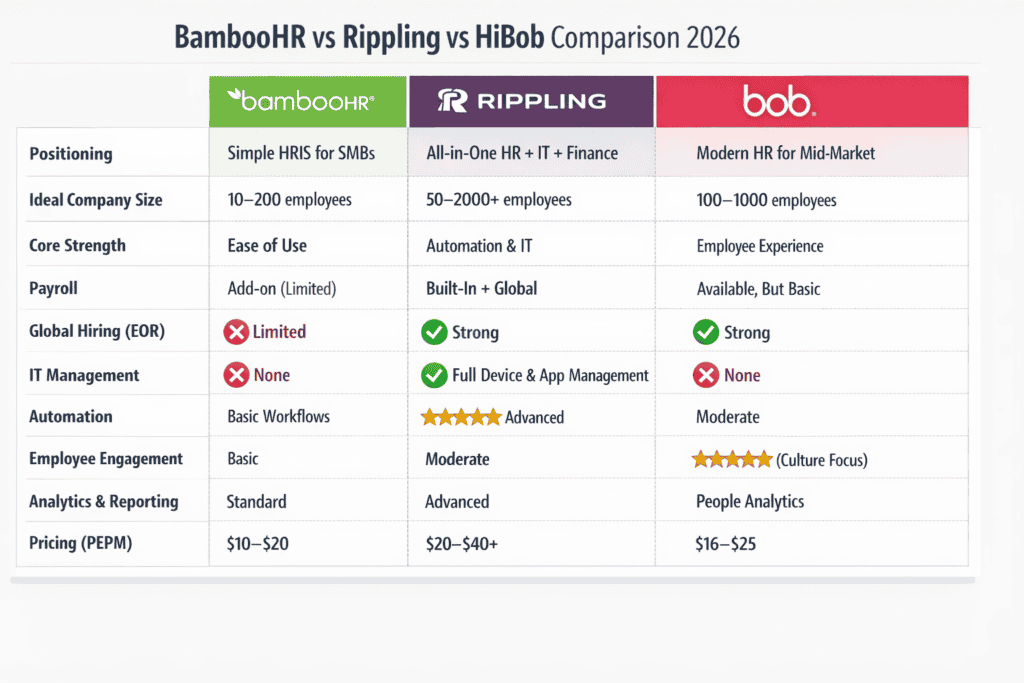
BambooHR runs three tiers. Core starts around $10 per employee per month (PEPM), Pro jumps to roughly $17 PEPM, and Elite sits near $25 PEPM. Sounds reasonable — until you add payroll ($6–8 PEPM extra), benefits admin ($4–6 PEPM), and time tracking. A fully loaded BambooHR stack for a 200-person US company lands somewhere between $24,000 and $60,000 per year.
The upside? BambooHR offers month-to-month contracts. No annual lock-in. There’s a 7-day free trial and even a 15% nonprofit discount. The downside: multiple reviewers in 2025–2026 reported roughly 30% price hikes on legacy plans, which caught some long-term customers off guard.
Rippling anchors everything on its Unity platform at $8 PEPM plus a $35/month platform fee. Each module — payroll, benefits, IT management, spend management — adds $4–12 PEPM on top. The realistic total? Somewhere between $21 and $50 PEPM depending on what you turn on. Vendr data shows that a 100-person company running HR plus payroll plus benefits plus IT management pays roughly $42,000 per year.
Rippling requires annual contracts with minimum seat commitments. Average buyers negotiate about 15% off list price. VC-backed startups can get six free months — that’s a genuine perk if you qualify.
HiBob quotes $16–25 PEPM for the core platform. Smaller teams under 100 sometimes see $8–12 PEPM. Add performance management ($3–5 PEPM) and time tracking ($2–4 PEPM) and you’re looking at $38,000–$60,000 per year for 200 employees. Contracts run 12–36 months. No free trial. And implementation fees are the steepest of the three — typically 10–20% of your first-year contract value.
| BambooHR | Rippling | HiBob | |
|---|---|---|---|
| Base PEPM | $10–25 | $8 (platform) | $16–25 |
| Realistic total PEPM | $10–30 | $21–50 | $16–30 |
| Contract terms | Month-to-month | Annual | 12–36 months |
| Free trial | 7 days | No | No |
| 200-employee annual cost | $24K–$60K | $50K–$120K | $38K–$60K |
Pro Tip: Don’t compare base prices. Compare total cost of ownership for your specific module stack. Rippling’s $8 PEPM base is misleading if you need five modules at $8–12 each. Always request a written quote for your exact headcount and module needs before signing anything.
BambooHR vs Rippling vs HiBob: Key Differences
Before diving into the details, here’s the quick-scan breakdown:
| Category | Winner | Why |
|---|---|---|
| Ease of Use | BambooHR | Minimal training needed, 4.8-star mobile app |
| Automation | Rippling | 150+ pre-built workflows, IT + HR triggers |
| Global Payroll | Rippling | Native payroll in 7 countries, EOR in 80 |
| Pricing Flexibility | BambooHR | Month-to-month, no lock-in |
| Culture & Engagement | HiBob | Kudos, Clubs, social feed, 95% adoption |
| All-in-One Stack | Rippling | Only platform covering HR + IT + Finance |
| People Analytics | HiBob | Real-time DEI, retention, attrition dashboards |
| System of Record (Global) | HiBob | Multi-language, multi-currency, 60+ payroll integrations |
The short version: Simple → BambooHR. Powerful → Rippling. Global + Culture → HiBob.
Best HRIS by Use Case
Choose BambooHR if:
You’re a US-centric company under 300 employees, your HR team is 1–5 people upgrading from spreadsheets, and you value fast setup with zero learning curve. BambooHR’s month-to-month flexibility is rare in this market and genuinely valuable for startups unsure of their trajectory.
The reality check: Great starter HRIS, but you’ll likely outgrow it. Multiple Gartner Peer Insights reviewers report evaluating replacements past 300 employees.
Choose Rippling if:
You want HR, IT, and finance on a single platform and you’re tired of juggling five different tools. Rippling is the only option here that manages device provisioning, app access, and identity management alongside HR and payroll. If your CTO is involved in the HRIS decision, that’s usually a sign Rippling’s the right fit.
The reality check: Powerful but expensive when fully loaded. The learning curve is steeper than either competitor, and phone support is only available for accounts with 150+ employees.
Choose HiBob if:
You have a distributed, multinational workforce and culture is a strategic priority — not just an HR buzzword. HiBob was built global-first, connects to 60+ payroll providers through its Payroll Hub, and its engagement tools (Kudos, Clubs, Shoutboards) make employees actually want to open the HR platform.
The reality check: Longest implementation timeline (6–8 weeks standard), and the performance management module isn’t as deep as specialist tools like Lattice or 15Five.
Feature-by-Feature Breakdown: Where Each One Wins
Rather than hitting you with a 30-row feature matrix, let me focus on the five areas where these platforms genuinely differ.
Payroll is where the gap is widest. Rippling offers native payroll in seven countries (US, Canada, UK, Ireland, France, Australia, India), manages contractors across 185+ countries, and handles 50+ currencies. BambooHR’s payroll is US-only native — it recently added Xero integrations for UK, Australia, and New Zealand, and an EOR partnership with Remote for 90+ countries, but none of that is native. HiBob launched native US payroll in January 2026 (powered by Gusto’s engine) and has native UK payroll through its Pento acquisition. For everything else, its Payroll Hub connects to 60+ third-party providers.
IT management is Rippling’s secret weapon — and it’s something neither BambooHR nor HiBob even attempt. Rippling manages device provisioning, app access (SSO/SCIM across 600+ SaaS tools), and identity management. When you fire someone in Rippling, their laptop gets locked and their app access gets revoked in the same workflow. That’s genuinely powerful for companies with even moderate IT complexity.
Culture and engagement tools are HiBob’s stronghold. Kudos, Clubs, Shoutboards, employee surveys, and a social-media-inspired interface that drives 95% adoption in the first month — those aren’t gimmicks. For companies where employee experience is a board-level priority, HiBob’s approach to making HR feel less like a compliance tool and more like a team platform is legitimately differentiated.
Analytics and reporting is another area where HiBob leads. Real-time dashboards covering headcount, retention, DEI, and attrition, plus an AI-powered “Analyze My Report” feature. Rippling’s analytics span HR, IT, and finance data in unified views. BambooHR offers custom reports and HR benchmarks, but power users consistently cite depth limitations.
Mobile app quality goes to BambooHR — 4.8 out of 5 on the App Store with 12,000+ ratings. That’s the highest in the HRIS category. HiBob’s mobile app is notably weaker than its desktop experience, which is a real frustration for distributed teams.
Global Payroll and International Teams: The Dealbreaker
If your company has employees in more than one country — or plans to within the next 18 months — this section should drive your decision more than anything else.
Rippling is the clear global leader. Native payroll in seven countries, EOR in 80, contractor management in 185+. It received Electronic Money Institution approval in the UK in September 2025 and opened offices in Dublin and Sydney.
HiBob was built global-first. While native payroll only covers the US and UK, its Payroll Hub connects to 60+ providers worldwide. EOR partnerships with Multiplier, Oyster, and Remote extend its reach to 180+ countries. Multi-language support, country-specific leave policies, and multi-currency compensation make it ideal for multinational mid-market companies.
BambooHR has expanded — its June 2025 EOR partnership with Remote covers 90+ countries, and Xero integrations added UK/Australia/NZ payroll. But multi-entity and multi-country structures aren’t natively supported.
Look — I’ve helped three companies migrate from BambooHR to HiBob specifically because of international gaps. If you’re US-only and plan to stay that way for 3+ years, BambooHR is fine. But if there’s even a chance you’ll hire in London or Bangalore within the next two years, start with a global-ready platform now. Migration costs eat any savings you got from choosing the cheaper option.
Real Scenario: Three Companies, Three Different Right Answers
Company A: 85-person US marketing agency, one office in Austin. The People Ops team is two people. They’re upgrading from spreadsheets and Gusto. They need onboarding, PTO tracking, basic performance reviews, and payroll. No dedicated IT team.
Right answer: BambooHR Pro. Cost would be roughly $1,700–$2,000/month with payroll add-on. Month-to-month flexibility means no commitment anxiety. The 4.8-rated mobile app keeps the field team connected. They’d be live in 3–4 weeks.
Company B: 220-person SaaS company, engineers in US, India, and UK. They’re using five different tools for HR, payroll, IT provisioning, and expense management. The CTO wants one platform.
Right answer: Rippling. It’ll cost roughly $80K–$100K/year for the full stack. But collapsing five vendors into one, getting native payroll in all three countries, and automating IT offboarding saves real operational time.
Company C: 350-person creative services firm, distributed across 12 countries. Culture is everything. The Chief People Officer wants an HRIS that feels like a consumer app. They already have good payroll providers in each country.
Right answer: HiBob. The Payroll Hub connects to their existing providers. The culture tools (Kudos, Clubs, social feed) give distributed employees a shared digital home. Multi-currency compensation management handles pay reviews across all 12 entities. Implementation takes 6–8 weeks, but the long-term fit is the strongest.
There is no universal winner. Only the right fit for your specific situation.
Common Mistakes When Choosing an HRIS
Mistake #1: Choosing based on today’s headcount, not next year’s. BambooHR is brilliant at 80 employees. At 350, multiple Gartner reviewers report evaluating replacements. If you’re growing 40%+ per year, factor in where you’ll be in 18 months.
Mistake #2: Ignoring total cost of ownership. Rippling’s $8 PEPM base looks cheapest on paper. But once you add payroll ($8), benefits ($6), IT ($8), and time tracking ($8), you’re at $38+ PEPM. Always model the fully loaded cost.
Mistake #3: Underweighting implementation effort. Rippling averages 2.5 weeks. BambooHR targets 4–6 weeks. HiBob runs 6–8 weeks for standard deployments and 8–12 for complex ones. If you need to go live before open enrollment, this timeline matters more than any feature comparison.
Mistake #4: Forgetting about contract flexibility. BambooHR’s month-to-month contracts are rare in this category. Rippling locks you into annual commitments. HiBob requires 12–36 months. If your company might pivot or get acquired, contract terms are a material financial risk.
Mistake #5: Treating the demo as the product. Every HRIS demo is gorgeous. What matters is month six — when you need a custom report that doesn’t exist. Ask for references from companies at your headcount and industry, not the vendor’s hand-picked showcases.
The Insider View: What HR Leaders Say After 12 Months
I’ve talked to enough People Ops leaders to spot the patterns. Here’s what you hear after the honeymoon period ends.
BambooHR users at month 12: “We love how easy it is — managers actually use it without training. The mobile app is the best I’ve seen. But we’re hitting walls with reporting, and the ATS is too basic for our hiring volume.”
Rippling users at month 12: “The automation is incredible — we built 40 workflows in the first quarter. But pricing keeps creeping up as we add modules, and phone support is only for accounts above 150 employees.”
HiBob users at month 12: “Our employees actually like opening the HR system. The analytics are strong. But performance management feels underbaked compared to Lattice, and the mobile app needs work.”
Rippling currently leads on review platform ratings — 4.8 on G2 with over 14,000 reviews, versus 4.4 for BambooHR and 4.5 for HiBob. It was named G2’s #1 Best HR Software Product for two consecutive years. But ratings don’t tell the whole story. BambooHR’s scores are stable but flat. HiBob’s are trending upward — it crossed 1,900 five-star G2 reviews in September 2025 and is gaining serious mid-market momentum.
The 60-Second Decision Framework
Stop agonizing. Ask yourself three questions:
Question 1: Are you US-only, or do you have (or plan) international employees? US-only → BambooHR or Rippling. International → Rippling or HiBob.
Question 2: Does your company need unified HR + IT + Finance, or just HR? Unified ops → Rippling (nothing else comes close). Just HR → BambooHR or HiBob.
Question 3: Is employee experience and culture a board-level priority? Yes → HiBob. No → BambooHR (simplicity) or Rippling (power).
That’s really the decision tree. Everything else — pricing tiers, specific features, integration counts — is noise compared to these three structural questions.
Final Recommendation (Brutally Honest)
Here’s the truth after evaluating these three platforms across dozens of real implementations:
BambooHR is the safest short-term choice. Lowest risk, fastest time-to-value, and the only one that won’t penalize you with a long contract if things change. If you’re under 200 employees, US-only, and just need HR to work — this is your pick.
Rippling is the smartest long-term investment. The HR technology market is projected to grow from $43.66 billion to $95.95 billion by 2034, and Rippling’s $16.8 billion valuation and $450M Series G signal they’re building the operating system for that future. If you want one platform that grows with you across HR, IT, and finance — accept the higher price and steeper learning curve.
HiBob is the best strategic HR platform. If your Chief People Officer cares about employee experience, DEI analytics, and building a culture that distributed teams actually feel connected to — HiBob is the only one of these three designed with that vision from day one. Its Mosaic acquisition and Bob Finance launch signal a company expanding from HR into the full people-and-finance stack.
Don’t optimize for price. Optimize for where your company will be in 18 months. And read the contract before you sign it.
If none of these three fit: consider Deel for global contractor-heavy hiring, Gusto for teams under 50, or Workday if you’re moving into enterprise territory (1,000+ employees).
Looking at HRIS options from the employee side? Read our guide on how to compare job offers with different benefits to make sure your new employer’s HR stack actually serves you. And if you’re evaluating best HR software for small business (2026), we’ve got a dedicated deep-dive for teams under 50.
FAQ: BambooHR vs Rippling vs HiBob
Which is better: BambooHR, Rippling, or HiBob? There’s no single winner. BambooHR is best for simplicity and US-only teams under 300. Rippling wins on automation and all-in-one HR + IT + Finance. HiBob leads for global, culture-forward mid-market companies. Your company’s size, geography, and IT complexity determine the right choice.
How much does BambooHR actually cost per employee? BambooHR’s base tiers run $10–$25 PEPM, but payroll, benefits, and time tracking are separate add-ons at $4–8 PEPM each. A fully loaded stack typically costs $15–30 PEPM. For a 200-person company, expect $24,000–$60,000 per year depending on which modules you need.
Is Rippling worth the price? Yes — if you actually use multiple modules. Rippling’s value comes from consolidating HR, IT, payroll, benefits, and spend management into one system. If you only need basic HR and payroll, Rippling is overkill and you’ll overpay. If you’re running 3+ separate tools today, the consolidation ROI is real.
Is HiBob good for mid-sized companies? HiBob’s sweet spot is 100–1,000 employees. It supports 4,400+ customers managing over 804,000 employees globally. It’s particularly strong for multinational companies that value employee engagement, people analytics, and a modern user experience. It’s less ideal for US-only companies under 100.
Which is best for global companies? Rippling leads on native global payroll (seven countries, EOR in 80). HiBob is the better global system of record — connecting to 60+ payroll providers via its Payroll Hub with multi-currency compensation and country-specific compliance built in. Many global companies use HiBob as the HRIS and a separate global payroll provider.
How long does HRIS implementation take? Rippling averages 2.5 weeks for straightforward deployments. BambooHR targets 4–6 weeks with a dedicated project manager at no charge. HiBob requires 6–8 weeks standard and 8–12 weeks for complex configurations.
Can I switch from BambooHR to HiBob or Rippling later? Yes, and it’s a common migration path. Companies often start with BambooHR, then migrate to HiBob (for global expansion) or Rippling (for unified operations) past 300 employees. Budget 4–8 weeks and data cleanup effort for the transition.
What’s the best HRIS for companies with employees in multiple countries? For native global payroll, Rippling leads. For companies that already have local payroll providers and want a global system of record with multi-currency compensation and country-specific leave policies, HiBob is the strongest fit.