Victoria Hale
Employment Law Partner — Former Partner at Freshfields Bruckhaus Deringer | London & New York | 20+ years advising on wrongful termination, notice obligations, executive exits, and workplace compliance across India, UK, and the US.
Notice period buyout in India sounds deceptively simple: you resign, pay for the unserved days, and join your new company on time. Clean deal, right?
Rarely. In the 20 years I’ve spent advising professionals through employment exits, the notice period buyout is consistently one of the most misunderstood transactions in an Indian employee’s career. What looks like a straightforward salary deduction on day one can quietly become a tax liability, a cash flow crisis, or a stalled relieving letter six weeks later.
This guide covers everything you need to know: what notice period buyout actually means legally in India, when employers can refuse it, how the calculation is done (and how to dispute it), who pays whom, the real tax picture, and the exact mistakes that cost professionals thousands of rupees every year.
Disclaimer: This article is for general career and HR guidance. For advice on your specific situation, consult a qualified employment lawyer or chartered accountant.What Is Notice Period Buyout in India?
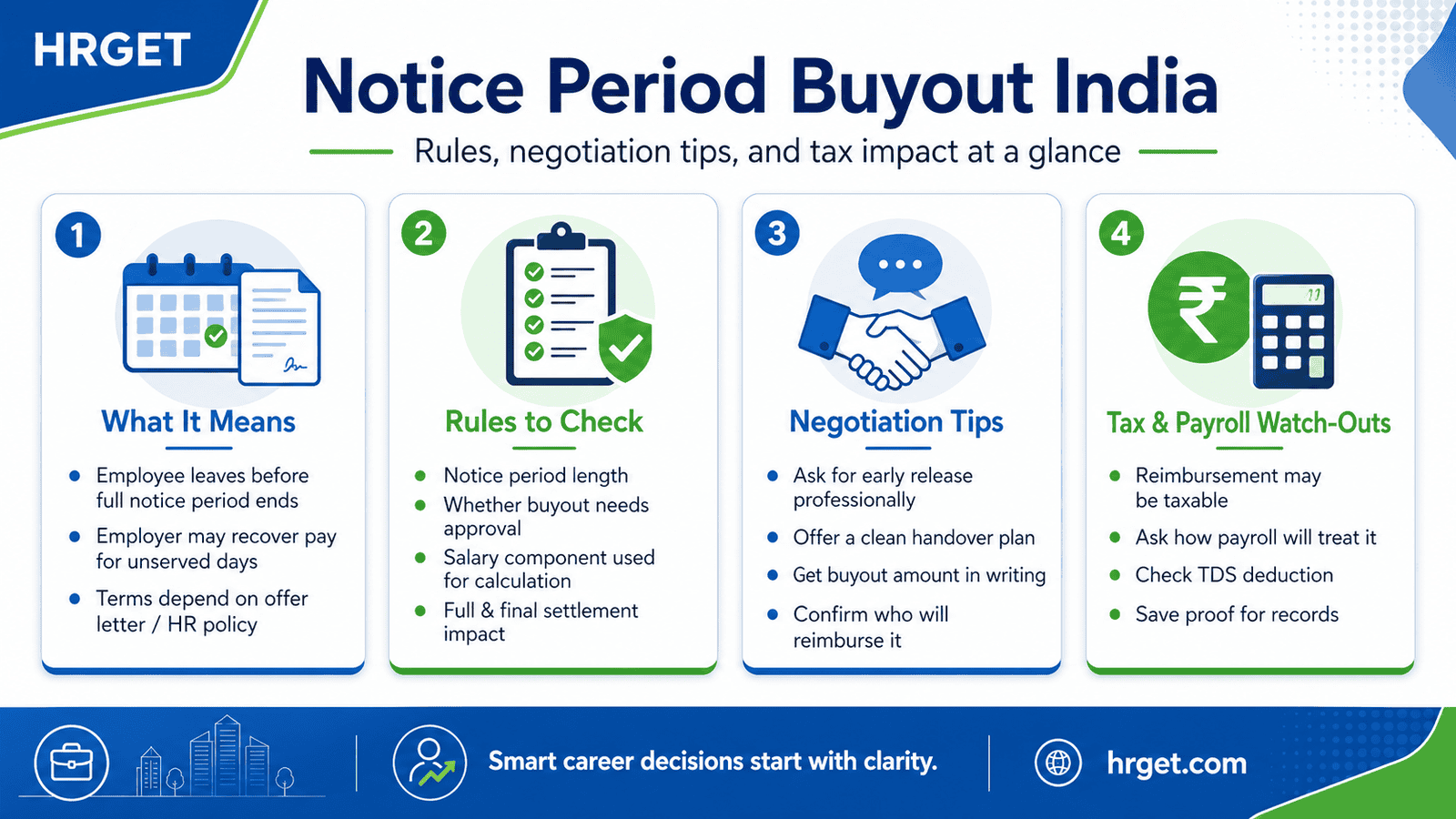
Notice period buyout in India means an employee pays the employer an amount equivalent to the unserved portion of their notice period in exchange for early release from employment. Instead of physically working through the full notice period, you compensate the company for the days you won’t serve.
A quick example to ground this:
📋 Example
Your employment contract requires a 90-day notice period. You serve 30 days but need to leave early. Your employer requires payment for the remaining 60 days’ salary as notice pay recovery. That payment is your notice period buyout.
This payment goes by several names in Indian HR practice:
- Notice pay recovery
- Salary in lieu of notice
- Shortfall notice payment
- Notice period adjustment
- Early release payment
The concept originates from your appointment letter, employment contract, or the company’s separation policy. The legal basis, the calculation method, and who gets to approve it — all of that flows from these documents. Which is exactly why you need to read them before you resign, not after.
Is Notice Period Buyout Legal in India?
Yes — notice period buyout is generally valid in India, provided it is stipulated in the employment contract or company policy. But there’s a distinction most employees miss entirely.
Your employer can typically recover money for the unserved notice period if your contract permits it. What they generally cannot do is force you to physically remain in employment against your will — that would border on bonded labour, which is constitutionally prohibited under Article 23 of the Indian Constitution.
The Gujarat Authority for Advance Ruling on GST (2020) addressed this in the context of notice pay recovery: where notice pay recovery is contractually stipulated, the employer may pursue the contractual remedy but cannot compel the employee to serve notice against their will.
The practical translation:
⚠ What this means for youYou generally cannot be forced to keep working. But your employer can create financial and documentation consequences — delayed FnF, withheld relieving letter, negative exit remarks — if you leave without following the agreed process. Your exit strategy must be documented, not emotional.
Also worth noting: India doesn’t have a single central statute governing notice period recovery for private sector workers the way the UK has the ERA 1996. It falls under the Indian Contract Act, 1872, and the specific terms of your appointment letter. State-specific Shops & Establishments Acts may also apply, particularly in Maharashtra, Karnataka, and Tamil Nadu — worth checking if your employer operates under that framework.
Can an Employer Refuse Notice Period Buyout?
Yes. And this surprises a lot of people. Many employees assume that because the offer letter says “salary in lieu of notice,” the company must release them. That’s not always how it works.
Look carefully at the wording. Some contracts say either party may terminate by giving notice or salary in lieu. Others say the company may, at its discretion, waive the notice period. That one word — “may” — changes everything.
Common reasons employers refuse or delay buyout approval:
- You’re handling a critical client delivery or production release
- Knowledge transfer is incomplete or hasn’t started
- A pending audit, compliance cycle, or appraisal process
- You hold privileged system access or confidential client data
- Your manager hasn’t signed off on early release
- There is an active bond, training agreement, or retention commitment
- HR policy mandates business unit head approval before any early release
Before you negotiate with your new employer, first confirm your current company’s exit policy in writing. Ask HR or check your appointment letter. Do not rely on what a colleague says happened when they resigned. Policies differ by grade, location, and the year the contract was signed.
Here’s the thing that catches professionals off guard: even if your contract allows buyout, you may still need formal written approval from your manager and HR before it’s processed. I’ve seen cases where employees assumed approval was coming, told the new employer they’d join in 30 days, and then the release got held up for six weeks. That’s a very uncomfortable position to be in.
How Notice Period Buyout Is Calculated in India
There’s no uniform formula across Indian companies. The calculation depends entirely on your employment contract and HR policy. But the most common structure is:
📐 Formula
Buyout Amount = Salary Component × Unserved Days ÷ Monthly Days
Most companies use 30 days as the monthly denominator, regardless of the actual month length.
Worked example:
- Monthly salary used for calculation: ₹1,50,000
- Notice period required: 90 days
- Notice served: 45 days → Shortfall: 45 days
- Buyout: ₹1,50,000 × 45 ÷ 30 = ₹2,25,000
Simple enough. But the real dispute is almost always about which salary component goes into that formula.
| Salary Component Used | Who It Benefits | Common In |
|---|---|---|
| Basic salary only | Employee (lower payout) | Manufacturing, PSUs, older contracts |
| Basic + DA | Slightly employee-favorable | Government-adjacent roles, older private firms |
| Gross monthly salary | Employer (higher payout) | IT services, MNCs, startups |
| Fixed monthly CTC | Employer (highest payout) | Senior roles, BFSI, consulting |
| Salary as defined in appointment letter | Depends on contract wording | Varies widely |
In most Bengaluru and Hyderabad IT companies, gross salary is the default. At a ₹24 LPA fixed salary, the difference between basic-only and gross calculation on 60 unserved days can easily be ₹1.5–2 lakh. That’s real money.
💡 Ask This Before You Resign“For notice period recovery, is the calculation based on basic salary, gross salary, or fixed monthly CTC as per my appointment letter?” One question. Could save you ₹50,000 to ₹2,00,000 depending on your seniority.
Who Pays the Notice Period Buyout?
There are three models. Understanding which one applies to your situation — before you resign — prevents the biggest cash flow mistakes.
Model 1: Employee Pays the Old Employer Directly
The simplest structure. You request early release; the old employer deducts the shortfall amount from your full and final settlement or asks for a separate bank transfer. Common when the new employer doesn’t offer reimbursement, or when you’re negotiating independently.
Model 2: New Employer Reimburses After Joining
The new company agrees to cover your buyout and reimburses you after you submit the FnF statement and payment proof. This sounds ideal. But “reimburse” doesn’t automatically mean tax-free.
The new employer’s payroll team may treat the reimbursement as taxable joining income, deducting TDS — even if HR called it a “reimbursement.” We’ll get into that shortly. The point is: the promise HR makes and what payroll does are sometimes two different things.
Model 3: New Employer Structures It as a Joining Bonus
Some companies, especially in BFSI and product companies in 2026, package it as a sign-on bonus or one-time joining allowance. This is fully taxable. If the joining bonus comes with a clawback clause (common: repay if you leave within 12–18 months), you’ve taken on both a tax liability and a contractual one.
✅ Smart Strategy: What to Get in Writing from the New Employer
- Exact amount they’ll cover
- Reimbursement timeline (after FnF, after first paycheck?)
- Documents required (FnF statement, payment proof, bank transfer receipt)
- Whether TDS will be deducted on the reimbursed amount
- Whether it appears as salary, bonus, or reimbursement in Form 16
- Whether a repayment/clawback clause applies
Don’t rely on what the recruiter said over the phone. Get it in the offer letter or a follow-up email from HR. Verbal promises have a strange way of evaporating after joining.
Tax Impact of Notice Period Buyout in India
This is where employees get genuinely blindsided. And I’ll be direct: the tax treatment of notice period buyout in India is not clean. There’s no single Income Tax provision that resolves this neatly for everyone.
Here’s the situation that plays out repeatedly:
📋 The Tax Mismatch Problem
Old employer recovers ₹2,00,000 as notice pay from FnF.
New employer reimburses ₹2,00,000 — but treats it as taxable salary and deducts TDS.
Result: You pay tax on money you effectively never enjoyed. The old employer doesn’t reduce your taxable salary by ₹2,00,000 in Form 16, and the new employer adds ₹2,00,000 to your gross salary.
Tax experts have consistently flagged that notice pay recovery doesn’t fall cleanly under Section 16 deductions of the Income Tax Act, which means employees often can’t automatically offset the recovered amount against salary income. The final outcome depends on how both employers structure the transaction in their payroll systems.
Your tax result depends on:
- Whether the old employer reduces taxable salary by the recovered amount in Form 16
- Whether the new employer treats reimbursement as salary, bonus, or expense reimbursement
- Your tax regime (old vs new regime) and applicable slab rate
- Whether you can claim relief under Section 89 or take any ITR-level position
- Whether you have the right supporting documents to defend any claim
Six Questions to Ask the New Employer’s Payroll Team
- Will this reimbursement be treated as taxable income?
- Will TDS be deducted? At what rate?
- How will it appear in my Form 16?
- Is it classified as joining bonus, salary, or expense reimbursement?
- Is there a clawback clause if I leave within 12 months?
- What documents do I need to submit from my previous employer?
If HR says “don’t worry, it’ll be sorted,” that’s not an answer. HR negotiates the offer. Payroll determines how it appears in your tax record. Ask payroll directly — before you resign.
GST on Notice Period Recovery: The Confusion Explained
Some companies — particularly mid-sized firms with aggressive tax advisors — have tried to charge 18% GST on notice pay recovery, arguing it’s a “service” provided by the employee (tolerating early exit). This caused considerable confusion across Indian HR departments from 2018 onwards.
CBIC Circular No. 178/10/2022-GST settled this, at least in principle. The circular clarified that salary forfeiture or bond recovery for early employee exit is generally not payment for “tolerating an act” as a taxable supply under GST. It’s a contractual deterrent — a consequence of early exit — and not automatically subject to GST.
In plain terms: your employer should not casually add 18% GST on notice pay recovery unless the specific facts and agreement clearly support a taxable supply.
💡 If Your Employer Adds GSTAsk politely in writing: “Could you please share the basis for charging GST on notice pay recovery, given CBIC Circular No. 178/10/2022-GST?” You’re not being confrontational. You’re asking for a documented tax position. Any legitimate finance team should be able to provide one.
Keep a copy of this exchange. If GST is removed after your query, that’s a sign the charge wasn’t defensible to begin with. If the company maintains the charge, escalate to your CA before paying.
How to Negotiate Notice Period Buyout Smartly
Most people negotiate notice period badly. They either beg, panic, or lead with “my new company needs me in 30 days.” That never works. Your current employer has zero interest in your new employer’s urgency. They care about risk, continuity, and handover.
Here’s the five-step approach that actually works — and I’ve seen it reduce or even waive notice period costs for professionals across IT, BFSI, and consulting:
Step 1: Give a Clean, Professional Resignation
Don’t open with conflict. Formally state your last working day per policy, then request early release separately. Example resignation line:
“As per my employment terms, my notice period is 90 days. I request consideration for early release after 45 days, subject to business approval and completion of transition.” This is non-threatening, documented, and leaves negotiation room.
Step 2: Attach a Transition Plan
Managers approve early release when their risk drops. Prepare a handover plan covering current projects, pending deliverables, document handover, access transfer, client dependencies, and a knowledge transfer schedule. Send it within 48 hours of resignation. This turns you from “flight risk” to “responsible professional leaving on good terms.”
Step 3: Ask for a Partial Waiver First
Don’t go straight for a full waiver. Ask for a middle ground: “If business permits and transition is smooth, I’d appreciate a waiver or reduction of the remaining notice recovery.” Many managers can approve a partial waiver when they’re satisfied with the handover. Full waiver requests often get rejected on principle.
Step 4: Be Honest With the New Employer
“My release depends on business approval. I can request early release, but I won’t create documentation risk with my current employer.” This makes you look mature and reliable. A new employer who respects this will wait a reasonable period. One who pressures you to do something risky is itself a red flag.
Step 5: Get Everything in Writing Before You Leave
You need written confirmation of: approved last working day, buyout amount, salary component used for calculation, GST status (if any), method of recovery (FnF deduction or separate payment), relieving letter timeline, experience letter timeline, and FnF settlement date. Verbal agreement is not agreement.
Real Scenario: The Hidden Cost of a “Company-Paid” Buyout
🔍 Real Scenario
Priya works at a Pune-based IT services firm. Fixed salary: ₹24 LPA. Notice period: 90 days. She receives an offer from a Bengaluru product company — 35% hike — with a joining date in 30 days.
Her old employer agrees to release her after 30 days but recovers 60 days of gross salary: approximately ₹4,00,000, deducted from FnF.
The new company says it will reimburse ₹4,00,000 after joining. Priya is relieved.
Then payroll emails her: the ₹4,00,000 reimbursement will be treated as part of her CTC in month one, with TDS deducted at 30% (she’s in the highest slab). She receives ₹2,80,000 net. Meanwhile, her old FnF was reduced by ₹4,00,000 gross.
Net position: Priya is out ₹1,20,000 in real cash. Plus she’s now in a new role with a clawback clause she didn’t read.
The right question isn’t “Will they pay my buyout?” It’s “After tax, TDS, timing, and clawback risk, what does this actually cost me?”
This scenario plays out across Bengaluru, Hyderabad, and Mumbai every week in 2026. The hike looks big. The buyout “coverage” sounds generous. And then the numbers hit payroll and the real picture emerges.
Common Mistakes Employees Make With Notice Period Buyout
Mistake 1: Resigning Before Reading the New Offer Letter
Your offer may say “immediate joining preferred” without guaranteeing buyout coverage. Check before you submit your resignation. Once it’s in, the leverage shifts.
Mistake 2: Assuming Buyout = Automatic Release
Many contracts make early release subject to manager and HR approval. Confirm whether buyout is your right or a discretionary benefit. These are two very different legal positions.
Mistake 3: Not Asking Which Salary Component Is Used
Basic vs. gross salary can shift the buyout amount by 40–60% at senior levels. Ask HR for the exact formula in writing before you commit to any joining date.
Mistake 4: Ignoring the TDS on Reimbursement
A reimbursed buyout may still be taxed. If you’re in the 30% slab, ₹4 lakh reimbursement becomes ₹2.8 lakh in hand — while your old FnF absorbed the full ₹4 lakh. Ask payroll specifically how it will appear in Form 16.
Mistake 5: Burning Bridges After Resignation
Some people stop engaging after they resign. That’s a mistake. Your relieving letter, background verification report, FnF settlement, and future reference calls are all still in the hands of the people you’re checking out on mentally. Stay professional until the last day.
Mistake 6: Not Saving Every Document
Keep personal copies of: resignation email, acceptance email, early release approval, buyout calculation email from HR, FnF statement, Form 16 from both employers, all payslips, reimbursement confirmation from new employer, and joining bonus/buyout terms. These matter during ITR filing and during background verification — sometimes months later.
Notice Period Buyout Request Email Template
Use this template when formally requesting early release and initiating the buyout process. Adapt it to match your contract’s specific terminology.
Subject: Request for Early Release and Notice Period Buyout Consideration
Dear [Manager Name],
I am writing to formally submit my resignation, with my last working day as per my employment terms being [full notice date]. I also wish to request early release consideration, subject to business approval, completion of knowledge transfer, and the applicable notice period recovery process.
As per my contract, my notice period is [X days]. I am requesting to be released on [preferred last working day]. I am fully committed to completing a structured handover and am preparing a detailed transition plan covering my current responsibilities, pending deliverables, documentation, and access transfer.
I request your guidance on:
1. Whether early release is approved subject to transition completion
2. The notice period recovery amount and salary component used for calculation
3. Whether GST is applicable, and if so, the basis for the same
4. The full and final settlement timeline and process
5. The expected dates for my relieving letter and experience letter
I want to ensure this exit is handled professionally and in line with company policy. Please let me know the next steps at your earliest convenience.
Regards,
[Your Name]
[Employee ID] | [Designation] | [Department]
Final Checklist Before You Commit to a Notice Period Buyout
If you can’t answer all of these with confidence, you’re not ready to confirm an early joining date to your new employer.
- What is my official notice period as per my appointment letter?
- Is notice period buyout allowed, or is it subject to manager/HR approval?
- Has my approved last working day been confirmed in writing?
- Is buyout calculated on basic salary, gross salary, or fixed monthly CTC?
- Will GST be charged? If yes, what is the contractual basis?
- Will the buyout amount be deducted from FnF or paid separately?
- Has the new employer confirmed reimbursement in writing?
- Will TDS be deducted on the reimbursed amount? At what rate?
- Is there a clawback clause if I leave the new company within 12–18 months?
- Will my relieving letter and experience letter be issued within an agreed timeline?
FAQ: Notice Period Buyout in India
1. What is notice period buyout in India?
Notice period buyout means paying your employer a salary-equivalent amount for the days of your notice period you won’t serve, so you can exit early. The amount is specified in your employment contract or HR policy and is commonly called notice pay recovery or salary in lieu of notice.
2. Can my employer refuse my notice period buyout request?
Yes. If your contract or policy says early release is subject to approval, the employer can refuse based on business need, project dependency, or incomplete knowledge transfer. This is especially common for roles handling critical client deliveries, system access, or ongoing compliance cycles. Always confirm whether buyout is a right or a discretionary approval.
3. Is notice period buyout taxable in India?
It can be. If your new employer reimburses the buyout amount, payroll may classify it as taxable salary or a joining bonus and deduct TDS accordingly. The tax outcome depends on how both employers report the transaction in Form 16. Ask your new employer’s payroll team before assuming it’s tax-neutral.
4. Is GST applicable on notice period recovery?
Generally no. CBIC Circular No. 178/10/2022-GST clarified that salary recovery for early employee exit is typically not consideration for “tolerating an act” and is not automatically a taxable supply under GST. If your employer charges GST, ask for the written tax basis referencing this circular before paying.
5. Is notice period buyout calculated on basic salary or gross salary?
It depends on your specific employment contract. Some companies use basic salary (lower amount, employee-favorable), while others use gross monthly salary or fixed CTC (higher amount, employer-favorable). Always ask HR for the exact formula in writing before accepting any joining timeline from your new company.
6. Can a new employer pay my notice period buyout?
Yes, and this is common in competitive hiring. However, confirm whether the amount is taxable, whether TDS applies, and whether a repayment clause exists if you leave the new company early. Ask for all terms in the offer letter or a written HR confirmation — not just a recruiter’s verbal assurance.
7. What happens if I leave without serving notice or paying buyout?
Your employer may withhold your full and final settlement, delay or deny your relieving letter and experience letter, and flag the exit in background verification. In some cases, they may pursue recovery through legal channels if the amount is significant. Handle exits formally — the short-term inconvenience of the notice period is far less costly than a disputed background check.
8. Should I choose notice period buyout or serve the full notice?
Choose buyout only when the new opportunity is strong enough to justify the financial, tax, and documentation risk — and when you have written clarity from both employers on the terms. If the new employer isn’t covering the buyout and the financial hit is significant, serving your full notice may be the safer choice, especially if it protects your FnF, tax position, and professional reputation.
The Bottom Line on Notice Period Buyout in India
Notice period buyout in India is a legitimate and useful exit tool — but it’s never the free transaction it looks like at first glance. The buyout amount, the salary component used in the calculation, the tax treatment of any reimbursement, the GST question, the FnF timing, and the relieving letter risk all feed into a picture that can look very different from what HR promised on the phone.
The smartest professionals I’ve worked with don’t just ask, “Can I leave early?” They ask: “What will this cost me financially, legally, and professionally — and do I have everything in writing?” That’s the only way to use notice period buyout without it quietly damaging your salary, your tax position, or your career standing.
If you’re also navigating your full and final settlement during this process, read our guide on Full and Final Settlement in India: What You’re Actually Owed — it covers FnF timelines, deductions, disputes, and how to chase delayed settlements without burning bridges.

Victoria Hale | Former Partner, Freshfields Bruckhaus Deringer | Employment Law Specialist | 20+ Years Advising Multinationals & Executives
Author: Victoria Hale spent over two decades as an Employment Law Partner at Freshfields Bruckhaus Deringer — one of the world’s most prestigious Magic Circle law firms — advising multinational corporations and senior executives on some of the most complex employment disputes in the US and Europe. Her practice covered wrongful termination litigation, executive exits, non-compete enforcement, FLSA compliance, and cross-border workforce restructuring under EU labour law. Now based between London and New York, Victoria writes for HRGet.com to close the gap between legal theory and how employment law actually plays out in the real world — for employees who need to know their rights before it’s too late.