
Organizational Psychologist & Workplace Behavior Advisor | Former BCG Consultant | HBR Research Contributor | London & Boston · 15+ Years
Burnout isn’t fixed by a weekend off. If it were, you wouldn’t be here — and I wouldn’t be writing this after spending 15 years watching high performers quietly fall apart in organizations that called themselves “great places to work.”
Here’s the uncomfortable truth: most burnout advice is shallow because it treats symptoms, not systems. You don’t need another “self-care Sunday.” You need a structured burnout recovery plan that actually resets how you work, think, and make career decisions — before the damage becomes irreversible.
This guide goes deeper than anything you’ll find in a LinkedIn post. Think of it as a frank debrief from an organizational psychologist who has seen burnout destroy careers, derail promotions, and — more often than people admit — quietly end marriages.
What Burnout Actually Is (and Why Breaks Don’t Work)
Burnout is not just “feeling tired.” The World Health Organization classifies it as an occupational phenomenon — not a lifestyle inconvenience — defined by three core dimensions: emotional exhaustion, depersonalization (cynicism toward your work), and a genuine sense that your efforts produce nothing meaningful.
In practical terms, it looks like this: you used to care deeply about your work. Now you stare at your inbox and feel nothing. Or worse — dread. You’re putting in the hours, but the output is hollow. Meetings feel pointless. Praise from your manager bounces off you. You can’t tell whether you’re burnt out or just bored or just bad at your job. That confusion itself is a symptom.
So why doesn’t a week off fix it? Because rest is a recovery tool, not a structural solution. When you return from leave, the same workload is waiting. The same manager. The same impossible expectations. The same culture that rewarded you with more responsibility every time you delivered. Your nervous system got a brief reprieve, but the system that broke you is completely intact. Within two weeks — often less — you’re back at the same baseline of exhaustion.
Key Insight
In organizational psychology, we describe burnout as a system failure, not an individual one. The workplace ecosystem — workload distribution, management quality, autonomy levels, psychological safety — created the conditions. You didn’t choose to burn out. The system selected you for it.
That framing matters enormously, because it shifts your recovery strategy from “I need to be more resilient” to “I need to change what this environment is asking of me.” Those are very different interventions.
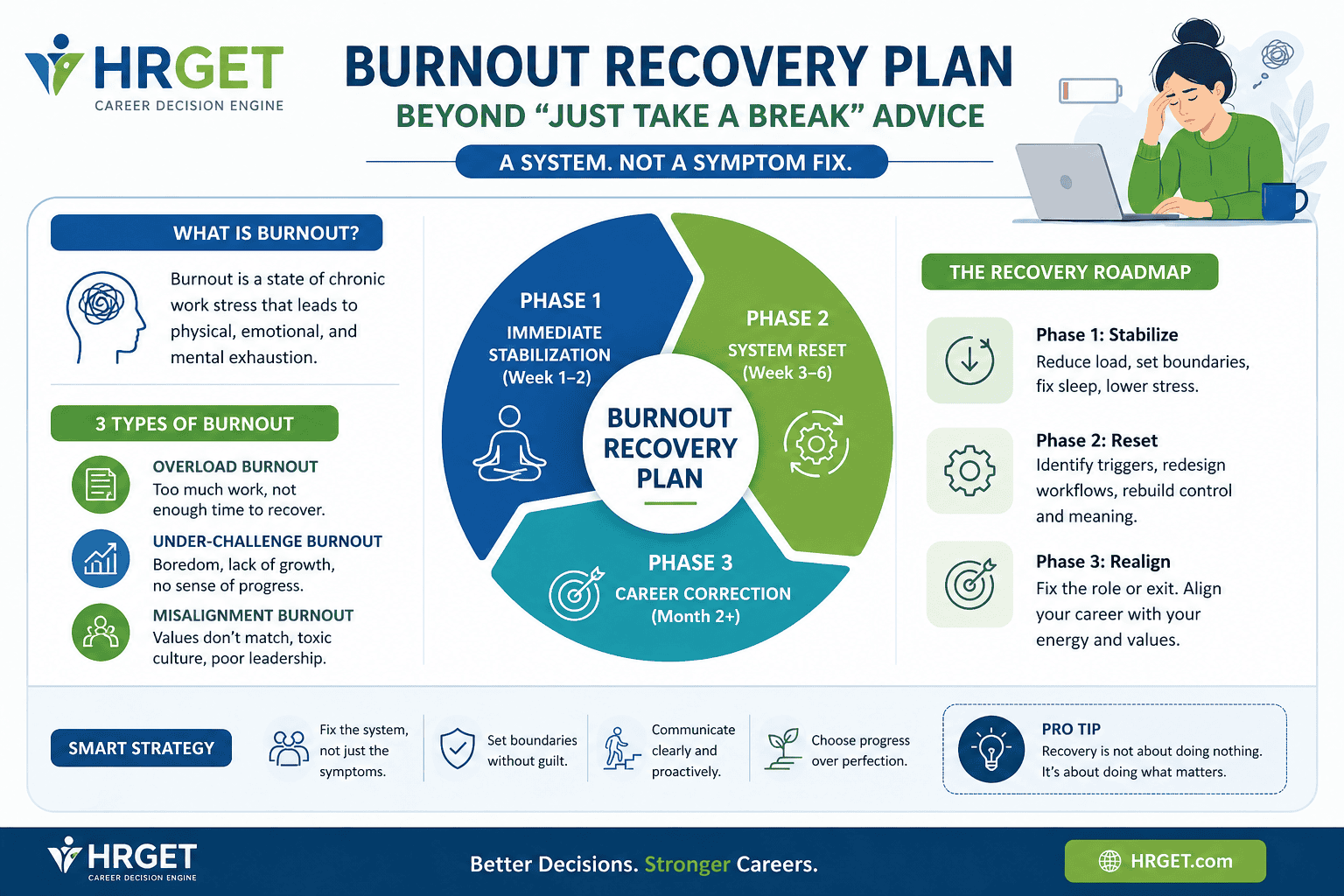
The 3 Types of Burnout (Most People Misdiagnose This)
One of the most common reasons burnout recovery plans fail is that people treat every burnout the same way. They don’t. Misdiagnosing your type leads to wrong interventions — you try to rest when you need to move, or you switch jobs when the problem was within your control all along.
| Burnout Type | Core Signal | What Doesn’t Help | What Actually Helps |
|---|---|---|---|
| Overload Burnout | Too much, too fast, no recovery time | More productivity hacks | Workload reduction, delegation, protected recovery time |
| Under-Challenge Burnout | Work feels boring, growth has flatlined | Taking a sabbatical | Role expansion, new projects, career pivot |
| Misalignment Burnout | Values conflict with company culture | Changing your mindset | Environment change — often a new employer |
Overload burnout is the most recognized — you’re running at 130% capacity for months. Deadlines stack on deadlines. You skip lunches, answer Slack at 11 PM, and sacrifice weekends without anyone explicitly asking you to. You can often recover from this within your current role if you aggressively restructure your workload and set hard boundaries.
Under-challenge burnout is sneaky and frequently mistaken for laziness. You’re not overwhelmed — you’re underwhelmed. The work stopped stretching you two years ago and now it just feels like going through motions. Rest won’t help this. What you need is stimulus, challenge, and growth trajectory. That usually means a role change, not a break.
Misalignment burnout is the most serious — and the most common in high-paying corporate environments. Your personal values are in direct conflict with how the organization operates. Leaders say they value work-life balance but reward 80-hour weeks. They claim psychological safety but punish dissent. This kind of burnout rarely resolves without an environment change. You can’t therapize your way out of a toxic system.
Real Scenario: The High Performer Trap
Real Scenario
Priya, 34, Senior Product Manager at a Bangalore tech firm (₹28 LPA): Priya was consistently in the top 10% of her performance reviews. She shipped products on time, mentored junior PMs, and became the person leadership called first when something needed saving. By Year 3, she was managing the workload of two PMs after a round of “efficiency restructuring.” Her compensation increased 12%. Her workload increased roughly 60%. She started dreading Monday mornings from Friday afternoon. When she finally took two weeks off, she came back and cried in the bathroom on Day 1. She didn’t have a motivation problem. She had a structural one.
I want to be blunt here: high performers burn out faster, not slower. That’s counterintuitive, but it’s what the research consistently shows — and what I’ve observed across dozens of organizational assessments. Here’s the cycle:
- You deliver consistently, so more work gets assigned to you
- Expectations increase silently — the bar simply moves up
- Recognition doesn’t scale at the same rate as workload
- You stop saying no because saying yes has always been the winning move
- Now you’re working harder than peers for marginally better outcomes
- The exhaustion becomes chronic, and the cynicism sets in
This is structural burnout — and it requires structural intervention. The 3-phase framework below is specifically designed for it.
Phase 1: Immediate Stabilization (Week 1–2)
Phase 1 — Stop the Damage
Before you can reset anything, you have to stop the bleeding. Most people skip this phase and go straight to “fixing things” — which requires cognitive energy you currently don’t have. Week 1 is about damage control, nothing more.
1. Cut Non-Essential Work — Aggressively
Here’s something most professionals find genuinely surprising when they finally audit their own time: 20–30% of what they’re doing on any given week is not tied to any meaningful outcome. It’s habitual. It’s performative. It’s what you’ve always done, not what actually needs doing.
Sit down with a blank page and list every recurring task and obligation. Then ask, for each one: if I stopped doing this tomorrow, what actually breaks? The things that don’t break immediately — delegate, deprioritize, or drop them entirely. Don’t negotiate with yourself on this.
2. Introduce Energy Boundaries — Not Just Time Limits
Most boundary-setting advice focuses on time (“leave at 6 PM”). But burnout is an energy problem, and energy doesn’t care about clocks. What you actually need are energy protection rules: No meetings before 10 AM if mornings are your peak creative window. No Slack notifications after 7 PM. At least one 90-minute deep work block per day that is truly uninterrupted. These aren’t luxuries — they’re the minimum conditions for sustainable cognitive performance.
3. Fix Sleep Before Everything Else
Burnout recovery without adequate sleep is physiologically impossible. Your brain’s prefrontal cortex — responsible for judgment, emotional regulation, and strategic thinking — cannot function under chronic sleep debt. Target 7–8 hours with consistent sleep and wake times, even on weekends. I know that sounds basic. It is basic. And almost nobody in burnout is actually doing it.
4. Reduce Cognitive Load Radically
Common Trap
A burnt-out person’s instinct is often to optimize harder — read more self-help, download a new productivity app, build a morning routine. Resist this. When your cognitive reserves are depleted, adding decision complexity accelerates the drain. Simplify everything. Fewer choices, more routines, minimal multitasking. Recovery is not a self-improvement project — it’s triage.
Phase 2: System Reset (Week 3–6)
Phase 2 — Fix the Root
Once you’ve stabilized — sleep is better, the most draining tasks are gone, and you’re not running purely on adrenaline — it’s time for the harder work. This is where most burnout recovery plans stop being self-care and start being strategic.
1. Identify Your Actual Burnout Trigger
Go back to the three types from earlier and be ruthlessly honest: Is this overload? Under-challenge? Misalignment? You might find it’s a combination — many professionals have a primary driver and a secondary one. Write it down. Name it specifically. “I’m burnt out because my workload doubled after the restructuring and my manager is conflict-avoidant, so I’ve absorbed work that should have been redistributed” is far more useful than “work is hard.”
2. Redesign Your Work Structure
Stop reacting and start controlling. The shift sounds simple but requires discipline. Batch your meetings to two or three concentrated windows each week rather than letting them scatter through every day. Build recurring deep work blocks on your calendar and treat them as immovable. Introduce a weekly planning ritual — 30 minutes every Monday morning — where you decide what the week’s priorities actually are, rather than letting your inbox decide for you.
3. Rebuild a Sense of Control
Loss of autonomy is the single most consistent predictor of burnout severity in the research literature. When you feel like work happens to you rather than through you, the exhaustion compounds. Rebuilding control doesn’t require a promotion or a new job — it requires specific behavioral changes: learning to say “no” to new requests as a complete sentence, negotiating deadlines rather than accepting them passively, and setting explicit expectations with stakeholders about your bandwidth. Each small act of agency counteracts the learned helplessness that burnout creates.
4. Reintroduce Meaning
Burnout systematically kills the sense of purpose that made you good at your job in the first place. In this phase, it’s worth asking yourself honestly: does this work matter to you? Not whether you’re good at it, not whether it pays well — does it actually mean something? If the answer is yes, the system around it needs to change. If the answer is no, that’s a signal that Phase 3 requires serious attention.
Phase 3: Career Correction (Month 2+)
Phase 3 — Face the Decision
This is the phase most people avoid. It requires looking honestly at whether your current environment can support the recovery you need — or whether it fundamentally can’t. There are three options, and only you can determine which applies.
Option A: Fix Within Your Current Role
This works when the burnout is primarily workload-driven and your manager is receptive. Request a formal conversation about priorities and bandwidth — frame it as a sustainability issue, not a personal complaint. “I want to make sure my output quality stays high. To do that, I need to align on what actually needs my attention versus what can be redistributed or deprioritized.” Most reasonable managers will respond to this. If yours doesn’t, that tells you something important.
Option B: Internal Move
Often underutilized. If the company itself isn’t the problem — if you believe in the mission, the culture is healthy, but your specific role or team is a poor fit — an internal transfer can reset the situation without the disruption of a job change. This works particularly well for under-challenge burnout, where a lateral move into a more stimulating function can reignite engagement.
Option C: External Switch
Required when the burnout is culture- or values-driven. No amount of resilience, boundary-setting, or mindfulness will fix a fundamentally dysfunctional environment. If the organization consistently rewards overwork, punishes honesty, or has leadership that creates psychological unsafety — your recovery plan needs to include an exit strategy. This isn’t defeat. It’s diagnosis followed by the correct treatment.
Brutal Truth
If your burnout is culture-driven, you cannot fix it alone. The system will reconstitute itself every time. Plan your exit carefully — not impulsively — but plan it.
Build a Career Safety Net Before You Move
Regardless of which option you choose, now is the time to update your resume, reconnect with your professional network, and get a realistic read on the external job market. In India’s tech hubs, senior product roles at comparable seniority currently command ₹22–35 LPA; in the UK, £70K–£110K for the equivalent. In the US, $110K–$160K in major markets. Knowing your market value gives you leverage — whether you’re negotiating internally or preparing to leave. A professional who understands their market worth makes better decisions under pressure.
Smart Strategy: Fix Root Causes, Not Symptoms
Here’s the pattern I’ve seen play out dozens of times in organizations across the UK, US, and India: a high performer burns out, takes leave, returns, and burns out again within six months. Sometimes faster. Not because they didn’t rest — they did. Because they returned to the same environment with the same behaviors and the same implicit agreement with their employer about what they’d tolerate.
Sustainable burnout recovery requires two changes happening simultaneously: a system change (workload, environment, role design) and a behavior change (how you respond to demands, how you protect your energy, where you place your limits). Either one alone is insufficient. Rest without system change leads to re-entry burnout. System change without behavior change means the same patterns will reconstitute in the new environment.
Pro Tip
The most high-leverage behavior change for burnout recovery isn’t meditation or journaling. It’s learning to communicate about your capacity before it’s depleted. Proactive conversations about workload are exponentially more effective — and less career-risky — than reactive ones after you’ve hit the wall.
Common Mistakes That Keep You Stuck
1. Waiting Too Long to Acknowledge It
Burnout compounds. What’s manageable at 6 months becomes clinical by 12. The professionals who recover fastest are the ones who name what’s happening early and act before it becomes a crisis. The professionals who struggle most are those who spent a year telling themselves they were “just tired” or “going through a rough patch.”
2. Trying to Push Through It
Pushing through works for temporary difficulty. It actively worsens burnout. When your cortisol levels are chronically elevated and your emotional reserves are empty, forcing output creates a debt your body will eventually collect — through illness, emotional breakdown, or a performance collapse that’s harder to explain to a future employer than “I took a deliberate recovery period.”
3. Ignoring Career Misalignment
No amount of self-care fixes a wrong career path. If you’re a creative professional trapped in a purely operational role, or a systems-thinker stuck in reactive work with no strategy involvement — rest won’t solve that. The mismatch between what energizes you and what your job requires is a structural problem requiring a structural answer.
4. Failing to Communicate Boundaries
Silence reads as acceptance in corporate environments. If you’re absorbing unreasonable workloads, missing deadlines silently, or working unsustainable hours without flagging it, the organization has no reason to change anything. Communicating clearly — professionally, without drama — is not complaining. It’s data. Give your employer the data they need to make better decisions about resource allocation. If they ignore it, that’s also data.
5. Over-Optimizing Productivity During Recovery
You don’t need more productivity hacks. You need fewer unnecessary tasks. There is a meaningful difference between the two, and burnt-out high achievers almost always reach for optimization as a comfort response — it’s familiar, it feels productive, and it lets you avoid the harder question of whether the volume of work itself is the problem.
Practical Weekly Recovery Plan
| Timeframe | Focus | Key Actions |
|---|---|---|
| Week 1 | Stop the damage | Cut 20–30% of non-essential work. Fix sleep schedule. Reduce meeting load. |
| Week 2 | Boundaries in place | Introduce energy rules (no Slack after 7 PM, deep work blocks). Simplify decisions. One protected rest day. |
| Week 3–4 | Root cause diagnosis | Identify burnout type. Redesign weekly workflow. Rebuild control through proactive communication. |
| Week 5–6 | System restructure | Negotiate workload or role adjustments. Reintroduce meaningful work elements. Evaluate role fit honestly. |
| Month 2+ | Career-level decision | Decide: fix in role, internal move, or external exit. Build career safety net. Align work to energy, not just salary. |
Frequently Asked Questions
How long does burnout recovery actually take?
Most professionals see meaningful improvement within 4–8 weeks if they make real structural changes — not just rest. Severe burnout, particularly where it’s been building for over a year, can take 3–6 months for full recovery. The timeline depends almost entirely on how quickly you address the root cause, not just the symptoms.
Can burnout go away without changing jobs?
Yes — if the burnout is workload-driven and your manager is receptive to adjustment, full recovery is possible in your current role. However, if the cause is cultural misalignment, toxic leadership, or deep values conflict, recovery almost always requires an environment change. Identifying your burnout type first makes this decision clearer.
Is burnout a mental health condition?
Burnout overlaps with depression and anxiety but is classified by the WHO as an occupational phenomenon — meaning it’s work-context-specific rather than a general mental health diagnosis. That said, prolonged untreated burnout can develop into clinical depression. If you’re experiencing persistent low mood, hopelessness, or inability to function, please speak with a mental health professional.
Should I tell my manager I’m burned out?
Yes — but frame it as a performance sustainability issue, not a personal admission of weakness. Try: “I want to flag that my current workload isn’t sustainable for the quality of output you’d expect from me. I’d like to align on priorities.” This gives your manager actionable information without creating unnecessary vulnerability. Most good managers will respond constructively.
What if my company ignores my burnout?
Then your recovery plan needs to include an exit strategy. An organization that consistently ignores clear signals of unsustainable workload is telling you something important about how it values its people. Document your communications, explore the external market, and begin building financial runway if possible before making a move.
Can burnout affect long-term salary growth?
Significantly. Unchecked burnout causes performance decline, which directly affects promotion timelines, performance ratings, and market positioning. Senior professionals who burn out and don’t address it often find themselves plateaued for 2–3 years while peers move ahead. Early intervention protects both your health and your earning trajectory.
Is burnout more common in high-paying jobs?
In my experience and in the research: yes. Tech, consulting, investment banking, and senior leadership roles show disproportionately high burnout rates — precisely because high performers are selected into high-demand environments and then rewarded with additional responsibility. High compensation often masks burnout because people feel they “can’t complain.” They can. And should.
The Bottom Line
“Just take a break” is advice for people who’ve never actually studied burnout — or lived through serious burnout of their own. Real recovery from workplace burnout requires three things operating together: a structural change to your environment, a behavioral change in how you engage with demands, and the career-level honesty to decide whether your current situation can actually support you.
If you don’t fix the system, the system will break you again. That’s not pessimism — it’s organizational psychology in plain language.
If you’re in a role where burnout has been weaponized — where you’ve been quietly pushed out through impossible standards — read our guide on recognizing and responding to quiet firing before making your next move.

Organizational Psychologist & Workplace Behavior Advisor (Former consultant with Boston Consulting Group, research contributor aligned with Harvard Business Review)
Dr. Amelia Grant is an organizational psychologist specializing in burnout, toxic workplaces, leadership behavior, and employee mental resilience. She writes practical, research-backed workplace guidance for modern professionals.