
If you’ve been Googling “what are the highest paying jobs in India in 2026?” — here’s the honest answer most career sites won’t give you:
It’s not about the job title. It’s about industry positioning + skill scarcity + leverage. Two people with the same “Software Engineer” title can earn ₹8 LPA… or ₹1.2 Cr+. That gap isn’t luck — it’s strategy.
I’ve spent 18 years advising professionals at McKinsey, Amazon, and Unilever on career moves. The pattern in India’s highest-earning careers is consistent and learnable. This guide breaks down real salary ranges across 15 high-paying industries in India for 2026 — plus a practical playbook to actually get into them.
Quick answer: The best paying jobs in India right now are in tech (product companies), investment banking, management consulting, AI/data science, and specialist medicine — with senior professionals consistently earning ₹50 LPA to ₹2 Cr+.
What Actually Drives High Salary in India?
Before we get into lists, let me give you the mental model that matters. Salary in India — as anywhere — is not based on effort. It’s based on market value, and market value is driven by a predictable set of factors.
Here’s what separates ₹8 LPA professionals from ₹80 LPA ones:
| Driver | What It Means | Salary Multiplier |
|---|---|---|
| Revenue Impact | Your work directly grows or protects the business | 2–5x |
| Skill Scarcity | Skills fewer than 1% of the market possess | 3–8x |
| Decision Authority | You make calls — not just execute them | 2–4x |
| Global Demand | US/EU market benchmarks your compensation | 4–10x |
| Leverage & Scale | Tech or finance amplifies your individual output | 3–6x |
The professionals earning ₹1 Cr+ in India almost always combine at least three of these drivers. That’s the formula — not credentials, not years of experience.
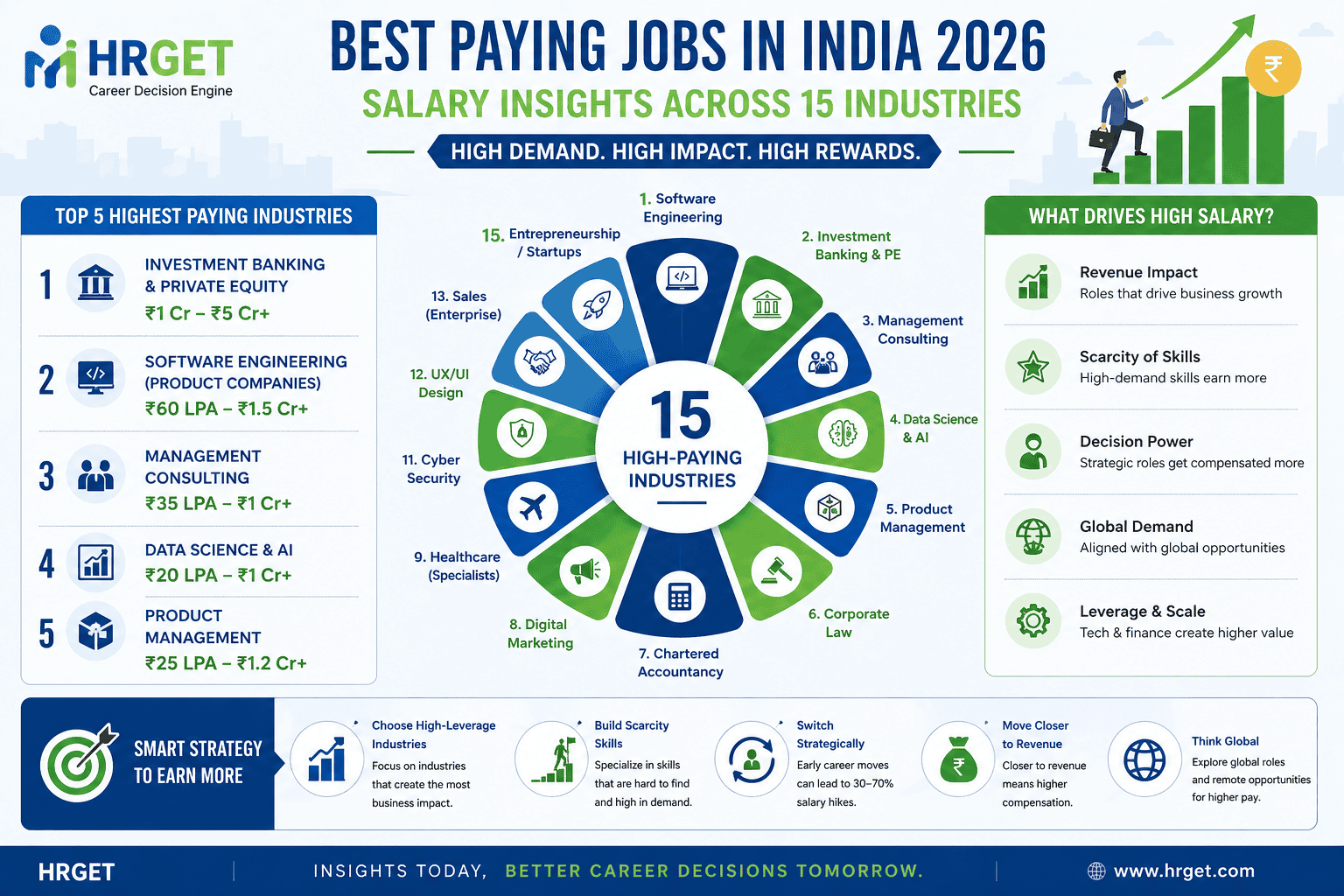
Top 15 Best Paying Jobs in India (2026)
These are realistic salary bands — not aspirational figures pulled from LinkedIn. Entry = 0–3 years, Mid = 4–8 years, Senior = 9+ years or specialised expertise.
1. Software Engineering (Product Companies)
Entry: ₹10–25 LPA | Mid: ₹25–60 LPA | Senior: ₹60 LPA – ₹1.5 Cr+
Top roles: Backend Engineer, Distributed Systems Engineer, Staff / Principal Engineer
Why it pays: Direct impact on product scalability and revenue. A Staff Engineer at a Series C startup in Bengaluru can earn ₹80–1.2 Cr in total comp including ESOPs.
2. Investment Banking & Private Equity
Entry: ₹12–30 LPA | Mid: ₹30–80 LPA | Senior: ₹1 Cr – ₹5 Cr+
Top roles: Investment Banker, PE Associate, M&A Analyst
Reality check: The hours are brutal — 70 to 100 hours a week at the analyst level. But no other career in India gives you this kind of earning trajectory this early. An Associate at Goldman Sachs Mumbai or Kotak IBD at the 5-year mark routinely crosses ₹60–80 LPA.
3. Management Consulting
Entry: ₹15–35 LPA | Mid: ₹35–90 LPA | Senior: ₹1 Cr+
Top firms: McKinsey, BCG, Bain (MBB), Kearney, Strategy&
Why it pays: High-value decision-making plus client billing rates that justify premium compensation. MBB MBA hires in Delhi/Mumbai start at ₹30–40 LPA all-in — and that’s day one.
4. Data Science & AI / ML
Entry: ₹8–20 LPA | Mid: ₹20–50 LPA | Senior: ₹50 LPA – ₹1 Cr+
Hot skills: Machine Learning, LLMs / AI Systems, Data Engineering, MLOps
2026 trend: AI specialisation is pushing salaries sharply upward. Professionals who can build and deploy LLM-powered products — not just run models in notebooks — are commanding ₹40–70 LPA even at 4–5 years of experience.
5. Product Management
Entry: ₹12–25 LPA | Mid: ₹25–60 LPA | Senior: ₹60 LPA – ₹1.2 Cr+
Best-paying sectors: Fintech, SaaS, consumer internet (Zomato, Razorpay, CRED, PhonePe scale)
Why it pays: The PM owns product success, which is a direct proxy for business value. A Director of Product at a Series D fintech in Mumbai earns ₹80 LPA–₹1.2 Cr including equity.
6. Corporate Law
Entry: ₹8–18 LPA | Mid: ₹20–50 LPA | Senior: ₹50 LPA – ₹2 Cr+
High-paying niches: M&A advisory, corporate compliance, international arbitration
Insider note: Top-tier firm Partners at AZB, Cyril Amarchand, or Shardul Amarchand in Delhi/Mumbai earn ₹1.5–3 Cr+. The gap between a good firm and a great firm here is enormous.
7. Chartered Accountancy (Big4 & CFO Track)
Entry: ₹7–15 LPA | Mid: ₹15–40 LPA | Senior: ₹40 LPA – ₹1 Cr+
Top earners: CAs placed at Big4 (Deloitte, KPMG, EY, PwC) or on CFO tracks at listed companies. A CFO at a mid-sized listed firm earns ₹60–1.2 Cr including ESOPs. The median CA earns far less — this bracket is for those who specialise and move into high-value advisory.
8. Digital Marketing (Performance & Growth)
Entry: ₹5–12 LPA | Mid: ₹12–35 LPA | Senior: ₹35 LPA – ₹80 LPA+
High-paying niche: Performance marketing (paid ads at scale), SEO leadership, and growth roles at D2C or SaaS companies. A VP of Growth at a funded startup can clear ₹60–80 LPA. Generic “digital marketer” roles stay stuck below ₹15 LPA.
9. Healthcare (Specialist Doctors)
Entry: ₹10–20 LPA | Mid: ₹20–60 LPA | Senior: ₹60 LPA – ₹2 Cr+
Top specialties: Cardiothoracic surgery, interventional radiology, neurosurgery, and cosmetic surgery. Private hospital specialists in Mumbai and Bengaluru with established practices regularly earn ₹1–2 Cr. The catch: 10–14 years of post-MBBS training before these numbers become realistic.
10. Aviation (Commercial Pilots)
Entry: ₹15–30 LPA | Mid: ₹30–80 LPA | Senior: ₹80 LPA – ₹2 Cr+
Key barrier: Training costs ₹60–80 lakh upfront. But a Captain with 10+ years at IndiGo or Air India earns ₹80–1.5 Cr in base plus allowances. With Indian aviation expanding aggressively through 2030, pilot demand far outpaces supply.
11. Cybersecurity
Entry: ₹8–18 LPA | Mid: ₹18–45 LPA | Senior: ₹45 LPA – ₹1 Cr+
Demand spike driver: Rising digital security threats plus India’s DPDPA 2023 compliance requirements are creating a genuine talent shortage. CISOs and senior security architects at large enterprises and GCCs (Global Capability Centres) are crossing ₹80 LPA.
12. UX/UI Design (Top-Tier Product Companies)
Entry: ₹6–15 LPA | Mid: ₹15–35 LPA | Senior: ₹35–70 LPA+
Where the ceiling breaks: Design leadership at product companies like Swiggy, Razorpay, or Atlassian India. A Staff Designer or Design Manager at a well-funded product company earns ₹45–70 LPA. Freelance agency work rarely crosses ₹20 LPA at senior level.
13. Enterprise / B2B SaaS Sales
Entry: ₹6–15 LPA | Mid: ₹15–50 LPA | Senior: ₹50 LPA – ₹2 Cr+
The real picture: Base is modest. Commission is where the money lives. A Senior Account Executive at a US-headquartered SaaS company selling into enterprise accounts can take home ₹70–1.2 Cr in a strong year. India is increasingly a source market for global enterprise sales talent.
14. Government Services (IAS, IPS, PSU Leadership)
Entry: ₹8–15 LPA equivalent | Senior: ₹20–40 LPA + perks
Beyond the salary: The true compensation for IAS officers includes housing, transport, staff, and effective purchasing power that often doubles the nominal figure. CMD roles at large PSUs like ONGC, NTPC, or BHEL carry ₹35–50 LPA plus perquisites. Not for income maximisers — but high-value by lifestyle standards.
15. Entrepreneurship / Funded Startups
Entry: ₹0–10 LPA (founder salary) | Mid: ₹10–50 LPA | Success case: ₹1 Cr+ (equity)
The honest math: Most founders take below-market salaries for 3–5 years. The payoff is equity — and it’s binary. But serial entrepreneurs who’ve had one exit often land CXO roles at funded companies paying ₹80 LPA–₹1.5 Cr in cash alone. Highest risk, highest upside.
Industry-Wise Salary Snapshot: Quick Comparison
Here’s how the top industries stack up for a mid-career professional (5–8 years experience) in a Tier 1 Indian city in 2026:
| Industry | Entry | Mid | Senior | Ceiling |
|---|---|---|---|---|
| Tech (Product Co.) | ₹10–25L | ₹25–60L | ₹60L–1Cr | ₹1.5Cr+ |
| Investment Banking | ₹12–30L | ₹30–80L | ₹1–3Cr | ₹5Cr+ |
| Management Consulting | ₹15–35L | ₹35–90L | ₹1Cr+ | ₹3Cr+ |
| AI / Data Science | ₹8–20L | ₹20–50L | ₹50L–1Cr | ₹1.5Cr+ |
| Product Management | ₹12–25L | ₹25–60L | ₹60L–1Cr | ₹1.2Cr+ |
| Enterprise Sales | ₹6–15L | ₹15–50L | ₹50L–1Cr | ₹2Cr+ |
| Healthcare (Specialist) | ₹10–20L | ₹20–60L | ₹60L–1.5Cr | ₹2Cr+ |
Real Scenario: ₹6 LPA vs ₹60 LPA — Same Start, Different Choices
Let me share a story I’ve seen play out dozens of times in different forms. Two engineers — let’s call them Arjun and Priya — graduate from the same NIT in 2018. Both start at ₹6 LPA at IT services companies. Fast forward to 2026.
Arjun — ₹14 LPA in 2026
- Stayed at the same services company
- Focused on delivery, not craft
- Got consistent 10–12% raises
- No specialisation, no niche
- Switched once — to another services company
Priya — ₹62 LPA in 2026
- Moved to a product startup in year 2
- Built system design + backend scaling expertise
- Changed employers every 2–3 years (strategically)
- Built a GitHub portfolio and technical brand
- Got a Staff Engineer offer at a Series C fintech
Same degree. Same starting salary. Completely different strategies. Here’s what Priya did that Arjun didn’t: she treated her career as a product to be built — with a market positioning strategy, not just annual increments.
The insider view: When I talk to hiring managers at Razorpay, Meesho, or Groww about what separates ₹15 LPA from ₹60 LPA engineers — it’s almost never raw coding skill. It’s system-level thinking, communication, and the ability to demonstrate business impact.
Smart Strategy: How to Move Into High-Paying Roles
Here’s what actually works — not the generic “upskill yourself” advice you’ve read a hundred times.
1. Choose the Right Industry Before Choosing the Right Role
Most people pick a job title and then look for companies. That’s backwards. Pick an industry with structural salary upside first — tech product companies, finance, consulting, AI — and then identify where you can enter.
A solid engineer at an IT services firm earning ₹15 LPA can move to a product startup at ₹25–30 LPA without an MBA — if they reframe their experience around product impact, not delivery metrics.
2. Build Scarcity Skills, Not Just Popular Skills
A skill that 200,000 people have won’t pay you ₹60 LPA. Scarcity skills in 2026 include: LLM engineering, distributed systems at scale, enterprise revenue sales, M&A financial modelling, and clinical specialties in underserved surgery areas.
The test: If you search for the skill on Naukri and see 50,000+ job listings with minimal candidates, that’s a commodity. If you see 3,000 listings with a shortage tag, that’s where you want to be.
3. Switch Strategically — Not Frequently
In India’s current market, the biggest salary jumps happen at job switches — not through internal promotions. But frequency matters. Switching every 18 months starts to signal instability. Switching every 2.5–3 years with a clear narrative of growth? That’s the sweet spot.
The benchmark: each switch should yield a minimum 30–40% CTC increase. If it doesn’t, either negotiate harder or wait for a better opportunity.
4. Optimise Total Compensation — Not Just Base Salary
This is where most people in India leave serious money on the table. ESOPs at a pre-IPO company, joining bonuses, performance bonuses, and retention grants can add 30–100% on top of base salary. A ₹35 LPA base at a Series B company with 0.15% equity could be worth ₹1.5–3 Cr at exit. Learn to read term sheets, not just offer letters.
Common Mistakes That Keep Salaries Low
I’ve seen brilliant professionals stall at ₹12–18 LPA for years because of preventable mistakes. These are the most common ones:
❌ Mistake 1: Loyalty to a company that’s not loyal to you
Internal raises in India average 8–12%. Market switches average 30–50%. Staying loyal to a company that won’t match market rate is the most expensive career mistake you can make.
❌ Mistake 2: Optimising for title, not industry
A “Senior Manager” at a legacy manufacturing firm earns ₹18 LPA. A “Product Manager” at a funded fintech earns ₹35 LPA. The title sounds more impressive in the first case. The salary tells the real story.
❌ Mistake 3: Treating CTC as the only negotiable number
If a company won’t move on base salary, negotiate joining bonus, variable component, ESOP cliff timing, or remote flexibility. Most professionals never ask — and leave lakhs on the table.
❌ Mistake 4: Building breadth instead of depth too early
Being a generalist feels safe. But markets pay a premium for depth. In the first 8 years of your career, specialise aggressively. Generalist moves make sense after you’ve established expertise that commands premium positioning.
❌ Mistake 5: Following peers instead of market signals
If everyone in your friend group is going into one field, that’s often a signal the market is getting crowded. The best paying jobs in India in 2026 reward early movers — people who bet on AI roles in 2021 are now earning 3–4x their peers who waited.
Frequently Asked Questions
What is the highest paying job in India in 2026?
Investment banking and private equity professionals at senior levels earn the highest salaries — ₹1 Cr to ₹5 Cr+. Among non-finance roles, Staff Engineers at product companies and senior management consultants also regularly cross ₹1 Cr in total compensation including equity.
Which field has the best salary growth in India?
AI and Machine Learning have the steepest salary growth curve in 2026. Professionals with 4–6 years of genuine ML engineering experience — especially in LLM deployment and production AI systems — are seeing 40–60% year-on-year compensation increases as demand far outpaces supply.
Can you earn ₹1 Cr salary without an IIT or IIM degree?
Yes — and it happens more than you’d think. Enterprise sales, entrepreneurship, specialty medicine, and senior tech roles at product companies all have clear paths to ₹1 Cr+ without premium institution backgrounds. Skill, track record, and strategic job switches matter more than pedigree beyond the first 3–4 years.
Which city in India pays the highest salaries?
Bengaluru leads for tech and startup roles, with Mumbai and Hyderabad close behind. Mumbai dominates finance, consulting, and corporate law. Delhi/NCR is strongest for government advisory and consulting. Bengaluru tech salaries often run 15–25% higher than equivalent roles in Pune or Chennai.
What is the average salary of a software engineer in India in 2026?
The average masks wide variation. At IT services companies (TCS, Wipro, Infosys), mid-career engineers earn ₹8–15 LPA. At product companies (Flipkart, Razorpay, PhonePe), the same experience level commands ₹25–45 LPA. The gap is driven entirely by company type, not job title.
How do I move from ₹15 LPA to ₹30 LPA in India?
The fastest path is a lateral switch to a higher-paying industry — not a promotion within your current company. Build one scarce skill, get a competing offer in hand, and use it to negotiate. Most professionals double their salary within 18–24 months this way. The key is external benchmarking, not internal patience.
Your Next Move
The best paying jobs in India in 2026 are not mysteries — they’re patterns. Tech product companies, investment banking, management consulting, AI specialisation, and enterprise sales consistently produce the highest salaries. But access to those roles doesn’t come from hoping — it comes from deliberate positioning.
Pick your target industry. Identify the scarcity skills that industry rewards. Build them with intent. And switch when the market — not your employer — determines your worth.
If you’re ready to negotiate your next offer with real leverage, read our guide on how to negotiate salary in India — what HR managers don’t tell you.

Jonathan Reed: Executive Career Strategist & Leadership Advisor | Former Partner, McKinsey & Company | Executive Coach to Amazon & Unilever Leaders | 18+ Years in Career Strategy
Jonathan Reed spent nearly two decades as a Partner at McKinsey & Company, where he advised organisations on leadership development, talent strategy, and organisational design across the US, UK, and Asia. Since leaving consulting, he has worked as an executive coach to senior leaders at Amazon, Unilever, and a clutch of high-growth scale-ups — helping them navigate promotions, career pivots, and the unwritten rules of visibility and influence at the top. Based between London and New York, Jonathan writes for HRGet.com to give working professionals an honest look at how careers actually scale — and why so many talented people stall without ever knowing why.