Compensation & Salary
By Daniel Carter — Director of Compensation & Benefits (Ex-Mercer, PwC clients) | 15+ years | New York / London · Updated April 2026
If you think your salary is your pay, you’re already leaving money on the table. Your base salary is just one slice of what your employer actually puts toward you. The rest—bonuses, stock, benefits—can quietly double your real compensation, or destroy it if you don’t read the fine print. This guide breaks down every component so you can evaluate offers intelligently and negotiate with confidence.
What Is Total Compensation (And Why It Matters)
Here’s the thing most professionals don’t realize until it’s too late: comparing jobs by base salary is like judging a restaurant by the price of its entrée. You’re ignoring the service charge, the drinks, and whether dessert is included.
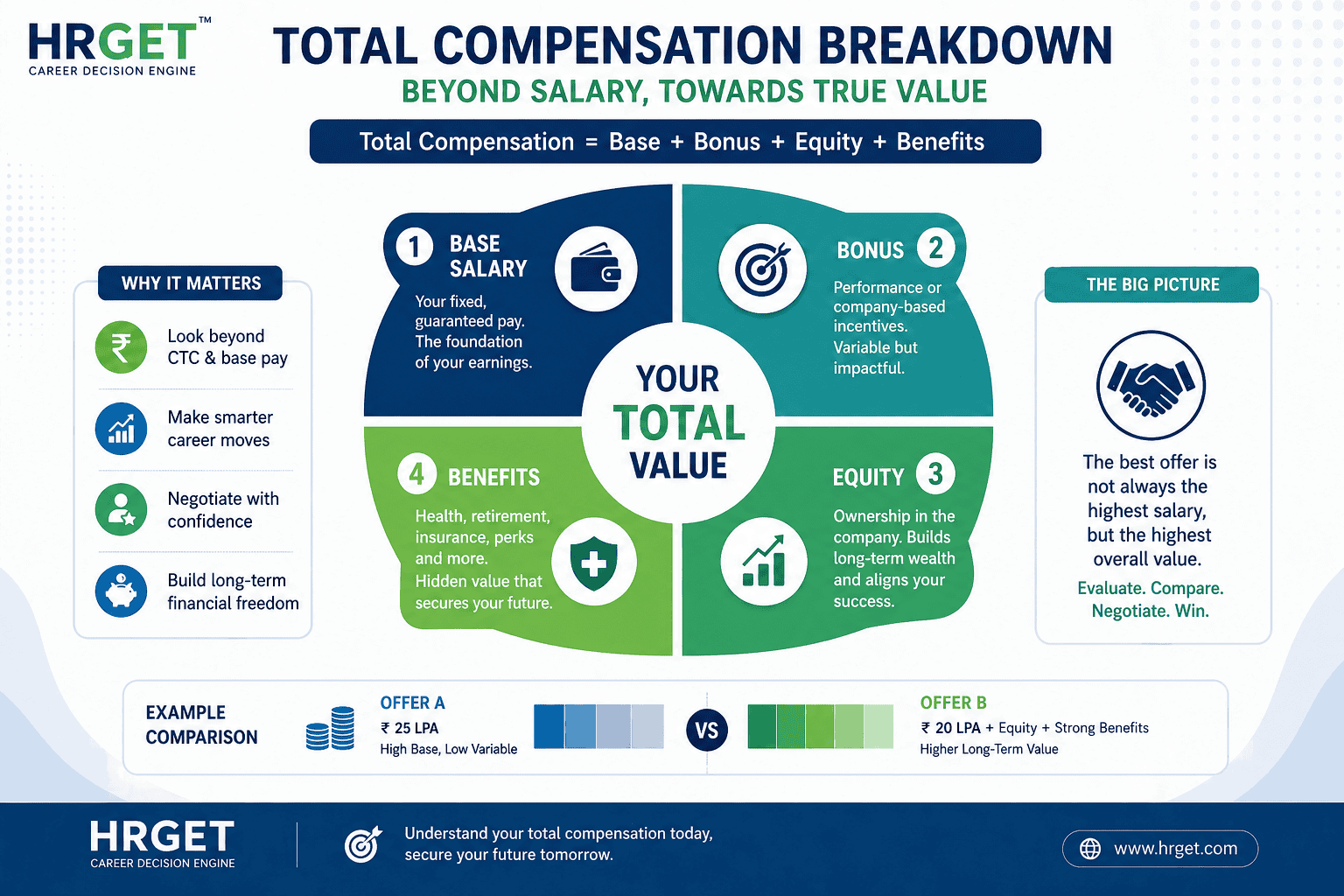
Total compensation is the complete financial picture of what your employer pays you—directly and indirectly. It includes your base salary, any variable bonuses, equity in the company, and the full package of benefits you receive. In 2026, with tech companies restructuring pay mixes, Indian startups going heavy on ESOPs, and MNCs in the UK and UAE competing aggressively on benefits, understanding this distinction isn’t optional—it’s essential.
Here’s a clean breakdown of what total compensation covers:
| Component | Type | Predictability |
|---|---|---|
| Base Salary | Cash | Fixed & Guaranteed |
| Performance Bonus | Cash | Variable — conditional |
| Joining / Retention Bonus | Cash | One-time, often with clawback |
| RSUs / ESOPs | Equity | Variable — market-dependent |
| Health Insurance | Benefit | Fixed value, indirect |
| Retirement (PF / 401k) | Benefit | Fixed contribution |
| Learning, Wellness, Perks | Benefit | Variable |
I’ve sat across from candidates who turned down offers with ₹5L less in base salary—only to realize six months later that the “lesser” offer had ₹12L in vesting equity and a health plan worth another ₹4L annually. They made an expensive mistake, and I’ve watched it happen repeatedly over 15 years in compensation consulting.
Your goal isn’t the highest salary. It’s the highest risk-adjusted total compensation.
Base Salary: The Foundation (But Not the Whole Story)
Base salary is your fixed, predictable monthly income—the number that hits your bank account reliably regardless of how the company performs or how your quarter went. It’s the bedrock of your financial life, and it matters for reasons beyond the obvious.
In India, your basic salary (typically 40–50% of CTC) directly determines your Provident Fund contribution and your gratuity entitlement. In the US, your base is what lenders use to calculate your mortgage eligibility. In both markets, it’s the number future employers most often anchor their starting offers to when you switch jobs.
But here’s the honest truth: base salary is safe, not scalable. It grows by increments—typically 8–15% on promotion or job change. It’s taxed as ordinary income. And it has no upside beyond what’s explicitly agreed. For professionals who want to build genuine wealth over a 10-year horizon, base salary alone won’t get you there.
Watch out for inflated CTC structures in India. Some companies pad their CTC with components like meal allowances, leave travel allowance (LTA), or performance-linked pay that may not land in your account every month. Always ask for the “in-hand monthly salary” alongside the CTC figure—they can differ by 20–30%.
That said, base salary matters enormously when you’re early in your career, have financial commitments like a home loan or family dependents, or are evaluating a role at a company where equity is uncertain. Don’t dismiss it—just don’t treat it as the whole story.
Bonus Structure: The Most Misunderstood Component
I’ll be honest—bonuses are the component I see candidates misread most often. They see “20% performance bonus” in an offer letter and mentally add that full amount to their expected income. That’s a mistake.
There are three distinct types of bonuses, and they work very differently:
Performance Bonus is tied to individual targets, team outcomes, or company-wide metrics. Typically 10–30% of base salary, it’s paid annually or semi-annually. The critical word is “target”—most performance bonuses are structured around achieving 100% of your KPIs. Underperform or get caught in a bad quarter and you may receive 40–60% of the stated amount. Check whether the company has paid at target levels in the last three years before banking on it.
Joining Bonus (Sign-on) is a one-time payment made to help you transition—sometimes to compensate for unvested equity you’re leaving behind. These often come with a clawback clause: if you leave within 12–18 months, you may need to repay part or all of it. Always read this clause carefully before signing.
Retention Bonus is paid after you stay for a defined period—usually one to three years. It’s designed to keep you through a critical project or transition. Attractive on paper, but it can also trap you if you’re unhappy and waiting for the payout.
Pro Tip from Daniel: When evaluating a performance bonus, ask the recruiter: “What percentage of employees in this role received their full target bonus last year?” If they hesitate or can’t answer, that’s data. Great companies are transparent about payout history—because they have a good story to tell.
The smart way to model bonuses in your offer comparison: apply a probability discount. Count only 60–70% of the stated bonus figure when calculating your expected annual income. If you receive 100%, you’re pleasantly surprised. If you receive 60%, you’re not caught short.
Equity (RSUs & ESOPs): Where Real Wealth Gets Built
This is the section where high-income professionals separate from genuinely wealthy professionals. Equity compensation is the single biggest lever that can transform a solid career into financial independence—or evaporate quietly if you’re not paying attention.
Two forms dominate the market in 2026:
RSUs (Restricted Stock Units) are grants of company shares that vest over time—typically on a four-year schedule with a one-year cliff. When you receive 1,000 RSUs from a company trading at $100, that’s $100,000 in equity—but only if you stay through the vesting schedule and only if the stock price holds. RSUs are taxed as ordinary income when they vest, so factor that in.
ESOPs (Employee Stock Option Plans), common in Indian startups and pre-IPO companies, give you the right to buy shares at a fixed “strike price.” If the company’s valuation rises, the difference is your gain. If it doesn’t—or if the company folds before an IPO—the options can expire worthless. This is real risk. I’ve seen professionals in Bengaluru startups hold options worth crores on paper, only to watch them evaporate when a funding round fell through.
| Factor | RSUs (Public Co.) | ESOPs (Startup) |
|---|---|---|
| Risk Level | Moderate | High |
| Liquidity | High (can sell) | Low (until IPO/exit) |
| Tax Event | On vesting | On exercise & sale |
| Upside Potential | Moderate | Very High |
| Downside Risk | Stock drops | Total loss possible |
Before accepting an offer with significant equity, ask four questions: What’s the vesting schedule and cliff? What’s the current valuation, and what would it need to be at IPO/exit for your equity to be meaningful? Has the company done a recent secondary or ESOP buyback for employees? And what happens to unvested equity if you’re laid off?
These aren’t aggressive questions—they’re due diligence. Any good company will answer them without flinching.
Benefits: The Hidden Value Most People Dismiss
Benefits are where companies quietly differentiate their packages—and where most candidates leave money on the table by not quantifying them.
Let me put some numbers to it. A robust corporate health insurance plan with ₹5L coverage and cashless hospitalization across major cities has a real market value of ₹25,000–₹40,000 per year if you were to buy it privately. In the US, employer-sponsored health insurance can represent $10,000–$18,000 in annual value. A 401k with 4% employer match on a $90K salary is $3,600 a year—money you’re simply not getting at a company with no match.
The benefits that actually move the needle:
- Health insurance — Coverage amount, network quality, family vs. individual, dental and vision inclusion
- Retirement contributions — PF employer contribution (India), 401k match rate (US), pension scheme (UK)
- Paid leave — Number of annual leave days, sick leave policy, parental leave generosity
- Learning & development budget — ₹50K–₹2L/year at top companies, covering certifications, courses, conferences
- Remote work flexibility — The avoided commute cost and time savings are real economic value
- Wellness perks — Gym reimbursements, mental health support, EAP programs
Here’s the insider truth: companies with slightly lower headline salaries often deliver significantly higher total value once benefits are quantified. A startup offering ₹28L CTC with no benefits can lose badly to a ₹24L offer from an MNC with full family health cover, generous PF, and 25 days of leave. Don’t compare apples to oranges.
Real Scenario: Two Offers, One Very Wrong Decision
📋 Meera’s Story — Senior Product Manager, Bengaluru
Meera received two offers simultaneously after interviewing for six weeks. Offer A was from a large MNC: ₹25L base, ₹2L performance bonus, no equity, and basic health cover. Offer B was from a Series C startup: ₹20L base, ₹5L target bonus, ₹12L in ESOPs vesting over four years, and a comprehensive benefits package including family health insurance and a ₹1L learning budget.
Meera chose Offer A. “The base was higher, and the startup felt risky,” she told me later.
Eighteen months on, the startup raised a $40M Series D. The ESOPs Meera declined had tripled in paper value. Her learning budget at the MNC? Frozen. Her bonus? Paid at 60% of target due to macro headwinds. The actual income gap after four years, conservatively modelled, was over ₹35L in Meera’s favour had she taken Offer B—even discounting the equity by 50%.
She didn’t make a bad decision. She made an uninformed one. That’s the only kind worth worrying about.
Total Compensation Calculation Framework
Here’s the framework I use when advising professionals on offer comparisons. It applies whether you’re evaluating a ₹15L role in Pune or a $150K package in Chicago.
REALISTIC TOTAL COMPENSATION =
Base Salary
+ (Bonus × probability factor — use 0.65 as default)
+ (Annual equity value × probability factor — use 0.50–0.70)
+ Quantified benefits value
≠ CTC or stated package
Applied to the two offers in Meera’s scenario:
| Component | Offer A (MNC) | Offer B (Startup) |
|---|---|---|
| Base Salary | ₹25L | ₹20L |
| Bonus (×0.65) | ₹1.3L | ₹3.25L |
| Equity/year (×0.60) | — | ₹1.8L |
| Benefits (quantified) | ₹0.8L | ₹2.2L |
| Realistic Annual Value | ₹27.1L | ₹27.25L |
At base case, the offers are nearly identical in realistic value—but Offer B has significant upside if the company grows, and meaningfully better benefits. The decision looks very different once you do the math.
Smart Strategy: How to Evaluate Any Job Offer
When you receive an offer, don’t ask “What’s the salary?” Ask: “Can you walk me through the total compensation breakdown?” That single question signals that you’re a sophisticated professional, and it gives you everything you need.
Here’s a five-step evaluation process you can run through in 30 minutes:
- Separate fixed from variable. What is guaranteed regardless of company or personal performance? That’s your safety net.
- Apply probability discounts. Treat bonus at 60–70% of target. Treat startup equity at 50% unless there’s a recent secondary or clear IPO path.
- Assign a rupee/dollar value to every benefit. Health insurance, PF contribution, leave encashment, learning budget—all of it. These aren’t perks; they’re compensation.
- Model the 3–4 year trajectory. Where does your equity vest? When does the retention bonus pay out? Is there a promotion cycle? Short-term thinking loses to long-term thinking almost every time.
- Compare risk-adjusted total value—not CTC. Two offers that look different on a headline number often look similar (or even reversed) once properly modelled.
One more thing: If you have a competing offer, use it to negotiate the structure of compensation—not just the base. Ask for a higher joining bonus, an accelerated vesting cliff, or additional RSU grants. Most candidates only think to negotiate salary. Sophisticated candidates negotiate the whole package.
Common Mistakes That Cost You Lakhs (or Thousands)
After 15+ years advising professionals across compensation decisions, I keep seeing the same five errors:
1. Treating bonus as guaranteed income. If you’re structuring your EMIs or rent commitments around receiving 100% of your performance bonus every year, you’re overexposed. Budget on base. Treat bonus as upside.
2. Ignoring equity entirely because it feels uncertain. Yes, equity carries risk. But the asymmetry is in your favour at a growing company—limited downside (you’d still earn your salary), meaningful upside. Ignoring it is risk aversion that costs you more than it saves.
3. Not reading the clawback clause on your joining bonus. I’ve seen professionals pay back ₹8–10L because they left a role 11 months in. The clause was in the offer letter. Nobody read it.
4. Discounting benefits as “soft” value. A company covering your family health insurance under a ₹10L policy isn’t doing you a favour—it’s paying you. Add it up.
5. Comparing this year’s offer without considering the compounding effect. A slightly lower base today at a company with strong promotion cycles and equity refresh grants can put you ₹50L ahead in five years compared to a higher base with no growth path.
Pro Tips From HR Experts
A few pieces of advice I give consistently to professionals evaluating offers or preparing to negotiate:
- Always get the compensation breakdown in writing before you resign from your current role. Verbal commitments about bonus targets or equity refresh don’t hold up.
- Ask about bonus payout history for the last two to three years. Any recruiter at a well-run company will have this data and be willing to share it.
- When negotiating, pick your battle: base salary, joining bonus, or equity—you’ll rarely win all three simultaneously. Understand which matters most for your specific financial situation and go hard on that one.
- For ESOPs in Indian startups, ask specifically whether there has been any secondary transaction or ESOP buyback in the last 18 months. This tells you whether the equity has real near-term liquidity or is just paper value.
- In the UK and UAE, employer pension contributions and end-of-service gratuity (UAE) are significant components that candidates routinely undervalue. A 5% employer pension contribution on a £70,000 salary is £3,500 annually—don’t leave it out of your model.
Frequently Asked Questions
What is included in total compensation?
Total compensation includes everything your employer provides: base salary, variable bonuses (performance, joining, retention), equity (RSUs, ESOPs/stock options), and non-cash benefits like health insurance, retirement contributions, paid leave, and learning budgets. The sum of all these components—not just base—represents your real annual earning from a role.
Is a bonus considered part of your salary?
No. Bonus is a variable, conditional component—separate from your fixed base salary. While some companies include variable pay in a quoted CTC figure, it’s not guaranteed income. Performance bonuses depend on individual, team, and company results. Always model bonus at a discount (60–70% of target) when comparing offers or planning personal finances.
Should I choose a higher salary or more equity?
It depends on your financial obligations and risk tolerance. If you have fixed commitments—a home loan, family expenses, limited savings buffer—a higher base provides stability. If you have financial headroom and believe in the company’s growth trajectory, equity can deliver 3–10× the return of a salary difference over four years. For mid-career professionals with some savings, a modest base trade-off for strong equity is often worth it.
How do I calculate total compensation accurately?
Add your base salary, then multiply your target bonus by 0.65 (probability discount), add your annual equity value multiplied by 0.50–0.70 depending on company stage, and finally quantify your benefits in cash terms. The result is your realistic annual compensation—more accurate than CTC for comparison purposes.
What percentage of salary is a good bonus target?
Typical performance bonuses range from 10–30% of base salary for individual contributors, 20–40% for managers, and 40–100%+ for senior leadership and sales roles. In India’s tech sector, 15–20% at target is standard. In the US for software roles, 10–20% is common at non-FAANG companies, while FAANG-adjacent firms often run higher. Always ask whether the target has been paid in full in recent years.
Are RSUs and ESOPs taxable in India?
Yes. In India, RSUs are taxed as perquisites (income) at the time of vesting—at your applicable income tax slab. Additionally, if you sell the shares later, any gains are subject to capital gains tax (short-term or long-term depending on holding period). ESOPs are taxed at exercise and again at sale. Factor in a 30–34% effective tax rate on RSU value at vesting for high earners.
What is a clawback clause in a joining bonus?
A clawback clause requires you to repay your joining bonus (partially or fully) if you leave the company before a specified period—typically 12–18 months. The repayment amount is often prorated: leave at month 10 of a 12-month clawback, you may owe 2/12ths of the bonus. Always read this clause before accepting an offer with a sign-on component.
Can I negotiate total compensation, not just salary?
Absolutely—and you should. Many professionals only negotiate base salary, leaving significant value on the table. You can negotiate the joining bonus amount or its clawback period, the initial RSU grant size, the performance bonus target percentage, benefits like additional leave or a learning budget, and even the equity vesting cliff. Use a competing offer to create leverage across the entire structure, not just one number.
The Bottom Line: Play the Whole Game
Most professionals negotiate salary. Smart professionals negotiate total compensation. The difference, over a five-year career horizon, is often measured in lakhs or six-figure dollar amounts—not a rounding error.
Your total compensation breakdown is the real number to optimize. Understand every component, discount the uncertain ones honestly, quantify the benefits you usually ignore, and evaluate offers over a three to four year horizon. That discipline alone will put you ahead of 90% of the professionals you’re competing with—without working a single extra hour.
If you’re preparing for a negotiation, read our guide on how to negotiate compensation packages strategically—it covers the specific language and sequencing that gets results in real salary conversations.
Want to run the numbers on a real offer?
Use the HRGet Total Compensation Calculator →Compare two offers side-by-side with probability-weighted equity and benefits valuation.

Eleanor Whitmore | Former Partner, Mercer | Advisor, World Economic Forum | 20+ Years in Global Compensation
Author bio: Eleanor Whitmore has spent over two decades shaping how the world’s leading organisations pay, retain, and reward talent. As a former Partner at Mercer and an advisor to World Economic Forum working groups on the Future of Work, she has designed compensation frameworks for Fortune 500 companies across the US, UK, Europe, and emerging markets. Based between London and New York, Eleanor writes for HRGet.com to translate boardroom-level pay strategy into actionable guidance for working professionals navigating real compensation decisions.