
Losing your job is stressful enough. Losing it without any clarity on what you’re legally entitled to? That’s where most IT professionals in India get completely blindsided.
Here’s the uncomfortable reality: IT company layoffs in India have surged since 2022, affecting engineers, project managers, and senior architects alike. And in nearly every case I’ve worked on — having advised on hundreds of terminations and redundancies across multinationals and Indian tech firms — the employees who walked away with the best outcomes weren’t the ones with the strongest legal case. They were the ones who understood exactly what they were entitled to before they signed anything.
This guide will tell you precisely what Indian labour law says about IT layoffs, what your employer is legally obligated to do, and — critically — how to protect yourself financially and professionally when the axe falls. No vague generalities. Let’s get into it.
Understanding IT Layoffs in India: Why the Label Matters
Walk into any HR meeting at an Indian IT company in 2026 and you’ll hear the same sanitised vocabulary: “role redundancy,” “business restructuring,” “cost optimisation,” “performance realignment.” These phrases are deliberately vague — and that vagueness is not accidental.
Here’s the thing most employees miss: the term your company uses to describe your exit determines your legal rights. Courts and labour authorities don’t care what the PowerPoint said during your exit meeting. They care about classification.
Your exit will fall into one of four legal categories — each carrying very different entitlements:
- Layoff: Temporary or permanent cessation of work due to business reasons — not your performance.
- Retrenchment: Permanent termination of employment for economic or organisational reasons. This is the word the law actually uses.
- Termination: Exit driven by misconduct or performance failure.
- Forced Resignation: You’re pressured to “voluntarily” quit — a common and often legally questionable tactic.
Why does this matter? Because a company that labels a mass layoff as “termination for performance” can avoid severance, weaken your legal footing, and harm your future employability. Getting this classification right — or pushing back against the wrong one — can be worth months of salary.
Are IT Employees Protected Under Indian Labour Law?
Short answer: yes — but not in the way most people assume, and definitely not equally.
Indian labour law was built around a concept called the “workman” — broadly, a non-managerial, non-supervisory employee. Most senior IT professionals (think: engineering leads, project managers, architects, delivery heads) don’t cleanly fit this definition. And that gap is where companies find their leverage.
Under the Industrial Disputes Act, 1947, “workmen” have strong protections: mandatory notice, retrenchment compensation, and in some cases, government approval before mass layoffs. But if you’re a software engineer making ₹18 LPA with supervisory responsibilities, you may not qualify as a “workman” — and therefore may not be entitled to IDA protections automatically.
That said, you’re not unprotected. You still have meaningful coverage through:
- Your employment contract (your single most important document)
- The applicable State Shops and Establishments Act
- Principles of natural justice (no arbitrary or coerced exits)
- Your company’s own HR policies (which become binding if documented)
I’ll be direct: for most IT employees in India, your rights flow more from your contract than from statute. That’s precisely why reading your offer letter carefully — ideally before the layoff meeting — is so important.
Key Laws Governing IT Layoffs in India
1. Industrial Disputes Act, 1947 (IDA)
The IDA is the backbone of Indian layoff law — but its applicability to IT professionals is narrower than most people think. Under this Act, a “workman” being retrenched from a company with 100+ employees requires government permission before termination can proceed. Retrenchment compensation is mandated at 15 days’ average pay for every completed year of continuous service.
You’re more likely to qualify as a “workman” under IDA if your role is genuinely non-supervisory: think QA testers, junior coders, data entry operators, or support staff. Senior engineers and above? The courts will look at actual job function, not just your title. If you make hiring decisions, manage P&L, or define strategic direction, you’re likely excluded.
2. Shops and Establishments Act (State-Level)
This is the law that actually covers most IT employees across India’s tech hubs — and it’s different in every state. Broadly, it governs notice periods, termination procedures, and minimum working conditions for commercial establishments (which includes IT companies registered as such).
Key variations at the states where IT is concentrated:
- Karnataka (Bengaluru): Karnataka Shops and Commercial Establishments Act, 1961 — requires one month’s notice or salary in lieu for employees with more than six months of service.
- Telangana (Hyderabad): Telangana Shops and Establishments Act — similar notice provisions, with protections against arbitrary termination.
- Maharashtra (Pune / Mumbai): Maharashtra Shops and Establishments Act, 2017 — notice periods scale with service length: 30 days for 1–5 years, 90 days for 10+ years.
- Tamil Nadu (Chennai): Tamil Nadu Shops and Establishments Act, 1947 — minimum notice of one month applies.
The takeaway: wherever your office is registered, there is a minimum notice obligation. Companies cannot simply walk you out the door on Day 1 without triggering a legal payment obligation.
3. Your Employment Contract (The Most Important Document in the Room)
I’ve said this to every client I’ve worked with: your offer letter is your real legal shield. It defines the notice period, the termination trigger conditions, whether severance applies, and the exit procedure.
Courts in India routinely prioritise contractual terms over assumptions or verbal assurances. If your contract says “90 days’ notice or salary in lieu,” that clause is enforceable. If it says the company may terminate “without cause” with 30 days’ notice — that’s the floor, and you should be pushing for more.
Pull out your offer letter right now. Read the termination clause. That’s where your negotiation starts.
Notice Period: What Are You Legally Entitled To?
This is where the biggest financial disputes happen — and where companies most frequently cut corners, hoping employees won’t push back.
In a standard Indian IT employment contract, notice periods run between 30 and 90 days. Senior roles (band 5 and above at major IT firms) often carry 90-day clauses. When a company decides to lay you off, they have two lawful options: have you serve the full notice period, or pay you the equivalent salary in lieu of notice. What they cannot legally do is show you the exit without doing either.
In practice, IT companies in India frequently try three things that cross the line:
- Asking for an immediate exit with a partial payout (“we’ll pay 15 days”)
- Pressuring you to resign, which technically nullifies their notice obligation
- Offering a settlement that lumps notice pay and severance together — deliberately obscuring what you’re actually receiving
Don’t accept any of this without scrutiny. If your contract mandates 60 days’ notice, you are legally entitled to 60 days of base salary if asked to leave immediately. No exceptions, no goodwill gestures.
One thing worth knowing: notice pay calculations are typically based on your basic salary, not your CTC. Confirm this in your contract before negotiating a number.
💡 Pro Tip: Get It in Writing Before You Go
If your company tells you verbally that they’ll pay your notice period, that assurance is worth nothing without documentation. Before you walk out of the exit meeting, ask for the termination letter and a written confirmation of the settlement amount. Companies that resist this are usually planning to pay less than they’re legally obligated to.
Severance Pay: Reality vs. What You Expect
Let me be blunt about this because most articles aren’t: severance pay is not a legal right for the majority of IT employees in India. Unless you qualify as a “workman” under IDA, your severance entitlement comes entirely from what’s written in your employment contract — or what you’re able to negotiate.
That said, here’s how the market actually operates in 2026:
| Company Type | Typical Severance Offered |
|---|---|
| Tier-1 MNC (Google, Microsoft, Amazon India) | 3–6 months salary + extended benefits |
| Large Indian IT (TCS, Infosys, Wipro) | 1–3 months salary, notice pay included |
| Mid-size IT / Product companies | 0–2 months, variable by role seniority |
| Startups (funded) | 1–2 months, often negotiable |
| Startups (cash-strapped) | Minimal or zero — protect yourself early |
You have real leverage to negotiate severance — beyond any contractual floor — when the layoff is sudden, when no transition time was provided, when you were asked to resign rather than being formally terminated, or when the company has a documented history of similar exits. These are not just moral arguments; they’re negotiating positions that HR departments have responded to.
One critical note: if you’ve completed five or more years of continuous service, you are entitled to gratuity under the Payment of Gratuity Act, 1972 — regardless of why you’re leaving. The formula is straightforward: Last drawn basic salary × 15 / 26 × number of completed years. Don’t let this get buried in the exit conversation.
Termination vs. Layoff: A Difference That Costs (or Saves) You Lakhs
Companies exploit the confusion between these two classifications more than any other tactic I’ve seen. Here’s the distinction, laid out plainly:
| Factor | Layoff / Retrenchment | Termination for Cause |
|---|---|---|
| Reason | Business decision — role eliminated, restructure, cost cuts | Performance failure or misconduct |
| Severance eligibility | Higher — especially if IDA applies | Lower or zero |
| Reputational impact | Neutral — widely understood in today’s market | Can raise red flags with future employers |
| Legal protections | Stronger — contract and statute both apply | Weaker — employer has stronger justification |
| Background check risk | Low — company typically confirms “laid off” | Medium-high — “terminated” is a red flag phrase |
The tactic to watch for: companies often relabel mass layoffs as “performance-based terminations” to reduce severance liability and shield themselves from legal challenge. If you were never on a PIP (Performance Improvement Plan), never received formal written warnings, and your team is simultaneously losing multiple people — that’s a layoff, not a termination. Push back, in writing, and insist on the correct classification.
Real Scenario: What Actually Happens in That Meeting
📋 Real Scenario: Rahul’s Exit
Rahul, a 34-year-old senior software engineer at a mid-size Bengaluru IT company, is called into a conference room on a Tuesday afternoon. His manager and an HR business partner are already seated. Within four minutes, he’s told his role is being eliminated as part of a “global restructuring.” HR slides a document across the table — a resignation letter, pre-filled with his name. They say it’s “standard process” and ask him to sign so his full-and-final can be released quickly. Rahul, caught off guard and anxious about his EMI, signs. He later discovers he forfeited two months of notice pay and any severance entitlement — because he “voluntarily resigned.”
What Rahul should have done: asked for 24 hours to review the documents, requested a written termination letter (not a resignation), and confirmed the settlement amount in writing before signing anything.
This scenario plays out in Indian IT every single week. The pressure in that room is real — but silence and time are your most valuable tools. You are under no legal obligation to sign anything on the spot.
What Companies Often Get Wrong (And How You Benefit)
Even well-resourced IT companies make procedural errors during layoffs — and those errors create negotiating leverage for you. In my experience advising on restructurings at Fortune 500 firms, these are the four most common violations:
1. Forcing resignation under duress. Asking an employee to sign a pre-drafted resignation is not “voluntary.” If a court finds that consent was coerced — through pressure, threats of a negative reference, or deliberate misinformation — the resignation can be voided. Document everything said in that meeting, including exact phrases used.
2. Skipping notice pay. If your contract mandates a 60-day notice period and the company walks you out immediately, they owe you 60 days of basic salary. This is not discretionary. Firms that offer “goodwill” amounts below that threshold are banking on your ignorance.
3. Misclassifying the exit as performance-based. No written warning? No PIP? No documented performance issues? Then calling your exit “performance-related” is procedurally indefensible and opens the company to challenge. Request in writing that the exit be recorded as “role redundancy” or “retrenchment.”
4. Delaying full-and-final settlement. You are entitled to your outstanding salary, encashment of earned leave, any applicable bonus components, and gratuity (if 5+ years). Settlements delayed beyond 45 days without reason are legally challengeable.
Your Rights Checklist: What to Verify Before You Sign Anything
Before any document is signed at your exit, confirm that each of the following has been addressed in writing:
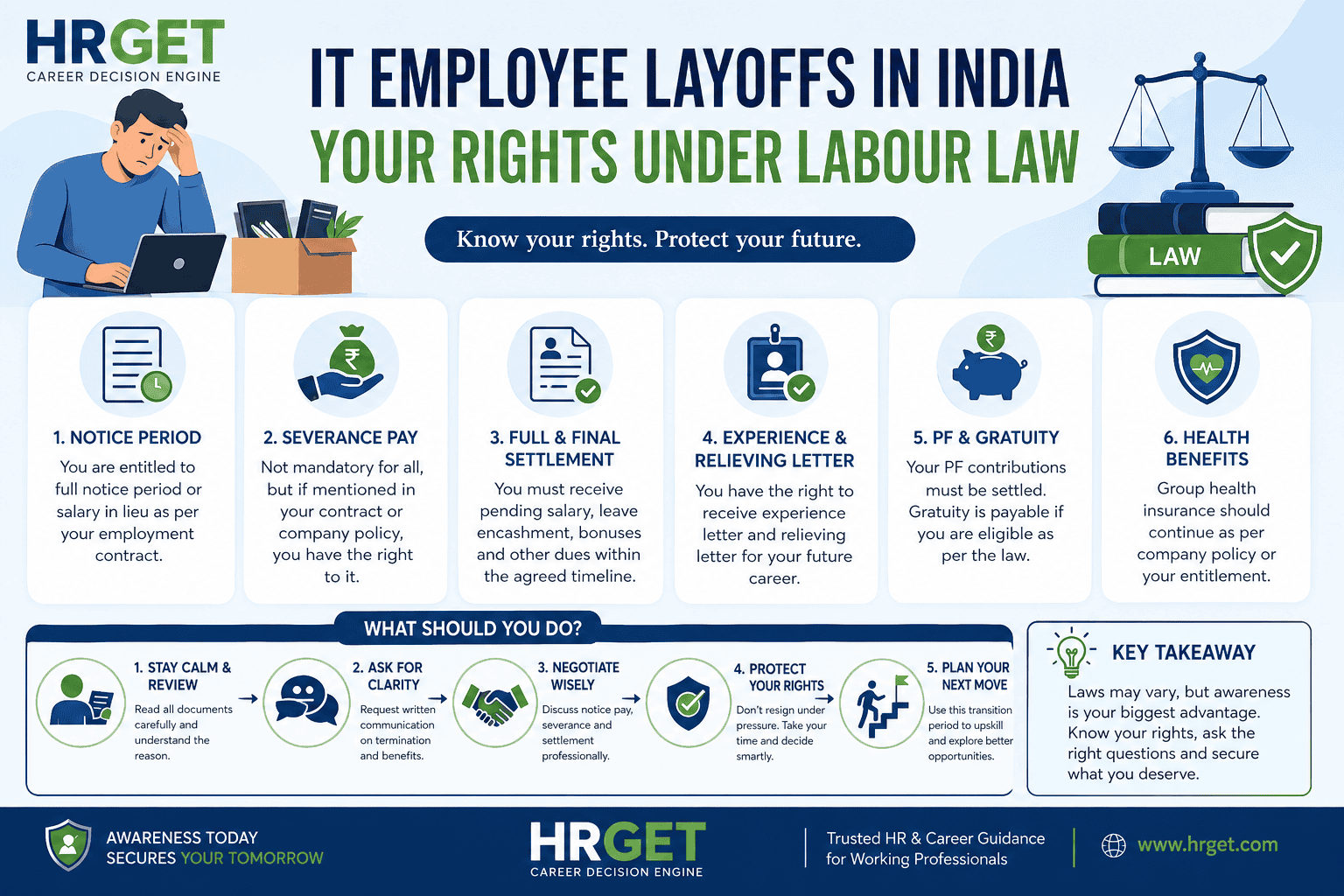
- Notice period has been fully honoured — or salary in lieu has been confirmed in writing
- Severance amount (if applicable per contract or negotiated) is documented
- Exit classification is recorded correctly as layoff / retrenchment — not termination for cause
- Relieving letter will be issued (confirm the exact date and format)
- Experience letter confirming your role, tenure, and designation
- Full-and-final settlement timeline is stated (typically 30–45 days)
- PF contribution status and UAN transfer process is confirmed
- Gratuity payment confirmed if you have 5+ years of service
- Health insurance continuation or COBRA equivalent (if applicable to your plan)
- Any ESOP / RSU vesting cliff or accelerated vesting clause is addressed
Print this list. Take it into that exit meeting. Companies that see a prepared employee negotiate very differently.
Smart Strategy: How to Respond When the Layoff Hits
⚡ Smart Strategy: The 5-Step Response Framework
Step 1 — Stay calm, but don’t be passive. Emotional reactions kill negotiation. Take a breath. You don’t need to respond to anything in that first meeting except to say: “I’d like to review the documentation before I sign anything.”
Step 2 — Do not resign on the spot. If you resign, you may forfeit your notice pay entitlement, your eligibility for severance, and your right to contest the exit classification. Let them terminate you formally if they’re going to. The difference between “resigned” and “laid off” on your record matters more than most people realise.
Step 3 — Request everything in writing. Ask for: (a) the written termination letter with a stated reason, (b) the detailed settlement computation, and (c) the expected F&F timeline. If HR hesitates on any of these, that tells you something important.
Step 4 — Negotiate your package. Use notice period, transition goodwill, market conditions, and company reputation as your levers. If your manager values your handover, that’s leverage. If the company just had positive earnings, that’s leverage. Don’t leave the table without asking for more than you’re initially offered — companies budget above the first offer.
Step 5 — Protect your future. Before you finalise the exit, confirm that your reference contact will be neutral (name only, dates only) and that no negative language appears in your HR record. Get this confirmed in writing. A single phrase in your exit documentation can cost you a future opportunity.
Common Mistakes That Cost IT Employees Lakhs
⚠ Mistakes That Surrender Your Leverage
❌ Accepting the first offer. Employers in India routinely expect employees to counter. The first severance offer is rarely the final one. A polite, reasoned counter — citing your notice period entitlement, tenure, and the abruptness of the exit — almost always moves the number.
❌ Signing the NDA or settlement agreement without reading it. Some exit NDAs contain clauses preventing you from discussing your exit, working for competitors (beyond your employment NCA), or even disclosing the settlement amount to a lawyer. Read every line. Ask for 48 hours minimum.
❌ Making decisions while angry. The exit meeting is designed to move quickly. Anger and embarrassment cloud judgment. The employee who asks for time and returns the next day with a clear head almost always negotiates a better outcome than the one who reacts in the moment.
❌ Dismissing legal options without exploring them. You don’t need to file a case to use legal leverage. Simply stating “I’d like to have a lawyer review this before I sign” changes the dynamic of negotiation entirely. Companies respond to informed employees — not aggressive ones, but informed ones.
FAQs: IT Company Layoffs India
Is severance pay mandatory in India for IT employees?
No — severance is not automatically mandated for most IT professionals under Indian law. For employees who qualify as “workmen” under the Industrial Disputes Act, retrenchment compensation of 15 days’ pay per year of service applies. For all others, severance depends on what’s written in your employment contract. However, notice pay is a separate entitlement and is legally mandatory regardless of severance status. Always negotiate — market practice at reputable firms is 1–3 months.
Can a company in India terminate an IT employee without notice?
Only under two conditions: (1) your employment contract explicitly allows termination without notice (rare, and often legally contestable), or (2) the company pays you full salary in lieu of the contractual notice period. An immediate exit with no payout violates your employment contract and is challengeable under state Shops and Establishments law. Collect proof of the exit date and any communications to document any violation.
Should I resign if my company asks me to during a layoff?
Almost never — unless you’ve fully reviewed the financial implications. Resigning surrenders your right to contest the exit classification, may eliminate severance entitlement, and removes your unemployment-related claims. Companies ask employees to resign because it’s cheaper and cleaner for them, not for you. Insist on a formal termination or retrenchment letter. If there’s pressure to resign, document it — that pressure itself may constitute coercion, which is legally significant.
Can I take legal action against my employer for an unfair layoff in India?
Yes, especially if your notice period wasn’t honoured, you were coerced into resigning, your contract terms were violated, or your exit was wrongly classified as performance-based without documented justification. Filing a complaint under the relevant Shops and Establishments Act, or pursuing a civil claim for breach of contract, are both viable routes. Consult an employment lawyer before signing any settlement — legal consultation alone often shifts what the company is willing to offer.
What is full and final settlement in India — and how long does it take?
Full and final (F&F) settlement is the complete financial closure of your employment. It includes: outstanding salary up to your last working day, earned leave encashment, any applicable performance bonus (prorated or full, per your contract), gratuity (if 5+ years), and deductions like notice period recovery or loans. Most Indian IT companies complete F&F within 30–45 days of your last working day. If it extends beyond 60 days without explanation, you can formally escalate to your state’s labour department.
Will an IT layoff affect my future job prospects in India?
Not materially — if you manage the exit documentation correctly. The 2022–2024 global tech layoff wave normalised this across Indian hiring teams. Most recruiters and hiring managers understand business-driven layoffs completely. What matters is that your exit is classified correctly (not “terminated for cause”), your relieving letter is clean, and your experience letter accurately reflects your role and tenure. Control the narrative proactively — your next employer will ask why you left, and “role made redundant in restructuring” is a complete, professional answer.
Am I entitled to gratuity if I was laid off before completing five years?
Generally, no. The Payment of Gratuity Act requires five continuous years of service for eligibility. However, there are exceptions: if an employee dies or becomes permanently disabled, gratuity is payable regardless of tenure. Additionally, some companies include voluntary gratuity provisions in their HR policies or ESOP frameworks that may apply at earlier tenures — check your employee handbook carefully. If you’re close to the five-year mark, it may be worth negotiating the exit date to cross the threshold.
Final Takeaway: Your Protection Is Negotiated, Not Automatic
Here’s what 18 years of working through restructurings across India and the UK has taught me: in Indian IT layoffs, the outcome you get is almost never the outcome you’re automatically entitled to. The law gives you a floor. Your contract defines the walls. But the ceiling? That’s entirely determined by how prepared and composed you are when you walk into that exit meeting.
Most employees sign too quickly, accept too little, and walk away having left months of compensation on the table. Don’t be that person. Know your notice entitlement. Ask for the right exit classification. Read before you sign. And if something feels wrong, it probably is — get a second opinion before the ink dries.
If you were asked to resign rather than being formally laid off — or if your notice pay hasn’t been settled correctly — read our detailed guide on how to negotiate a severance package before your next conversation with HR. The steps there will directly apply to your situation.

Michael Reeves | Former Senior Counsel, Littler Mendelson | Severance & Restructuring Specialist | 18+ Years in Employment Law
Author bio: Michael Reeves spent nearly two decades as Senior Counsel at Littler Mendelson — one of the world’s largest employment law firms — advising on mass layoffs, corporate restructurings, and severance negotiations for Fortune 500 companies across the US and Europe. He has worked both sides of the table: structuring cost-efficient separation packages for employers and, more recently, helping employees understand exactly where their leverage lies. Based between Chicago and London, Michael writes for HRGet.com to demystify the legal and financial dimensions of layoffs — so employees stop leaving money on the table.