
You got the offer. Great salary, solid role — maybe even the career jump you’ve been working toward for two years.
Then reality hits: you can’t join on the date they’ve proposed.
Maybe you have a 60-day notice period in India. Maybe you’re relocating from another city. Maybe — and this is more valid than most people admit — you just need two weeks to decompress before walking into a new environment.
Now you’re stuck thinking: “If I ask to negotiate my start date, will they pull the offer?”
Here’s what 18 years of working in hiring, restructuring, and executive career strategy has taught me: negotiating your start date is normal. Accepting one that doesn’t work for you is what causes problems — for both sides.
Done correctly, requesting a later start date doesn’t make you look difficult. It makes you look professional, self-aware, and like someone who takes transitions seriously. This guide gives you the exact framework, scripts, and real-scenario language to negotiate your job start date confidently — without risking the offer.
Why Negotiating Your Start Date Matters More Than You Think
Most candidates make the same mistake: they accept the proposed start date without question because they don’t want to rock the boat right out of the gate.
I’ve seen this backfire in two ways. Either the candidate joins stressed, under-prepared, and with bridges burned at their previous employer — or they ask for more time after accepting, which is far more disruptive than raising it upfront.
A start date that doesn’t work for you creates real downstream damage:
- You exit your current role in a rush, damaging a professional relationship you’ll need for references
- You arrive at the new job mentally depleted from a chaotic handover
- You miss the first 30-day window — the most important period for making an impression — because you’re running on empty
- You create unnecessary resentment before Day 1 even begins
On the flip side, a well-negotiated start date lets you exit professionally, prepare properly, and walk in ready to perform. And here’s the thing most career articles won’t tell you: employers care far more about how you show up on Day 1 than how quickly you arrive.
When It’s Actually Smart to Delay Your Start Date
Let’s be clear — this isn’t about stalling. It’s about being realistic with yourself and the employer. Here are the situations where requesting a later start date is not just acceptable, but genuinely the right move.
Serving Your Notice Period in Full
In India, notice periods of 30–90 days are standard — and in many sectors, enforced contractually. In the UK and parts of Europe, statutory notice can run 4–12 weeks depending on tenure. Walking out early isn’t just an ethical issue; it can trigger financial penalties or block your relieving letter, which creates problems with your new employer’s background check.
Honoring your notice period is a signal of professional integrity. Most experienced hiring managers respect it — because they know they’d want the same from their own departing employees.
Managing a Responsible Transition
If you’re leading a critical project, managing a team, or sitting on institutional knowledge that won’t transfer cleanly in a week — staying longer isn’t weakness. It’s leadership. Frame it exactly that way when you raise it with the new employer, and it becomes a positive signal rather than an obstacle.
Relocation Time
Moving cities — let alone countries — isn’t a weekend errand. Finding housing, arranging schooling for children, coordinating a household move: these are legitimate logistical realities. A new employer asking you to relocate and join in two weeks is setting you up to fail. Asking for four to six weeks to settle properly is entirely reasonable.
Taking a Personal Reset (More Important Than You Think)
I’ll be honest — this one gets underestimated constantly. Research in organizational psychology consistently shows that employees who take even a short break between roles perform better in their first 90 days. The mental load of wrapping up one job, switching contexts, and immediately absorbing a new environment is genuinely taxing. A 1–2 week buffer can improve your performance measurably — and that benefits the company as much as it benefits you.
Background Check or Documentation Delays
Sometimes the delay isn’t even in your control — verification timelines, visa processing, or waiting on a relieving letter from a previous employer can all push your earliest possible joining date. This is a straightforward, blameless explanation that any reasonable HR team will accept.
The Psychology: What Hiring Managers Actually Think When You Ask
Here’s where most candidates get it wrong. They assume that negotiating a start date signals “I’m not that excited about this role.” That assumption is almost always incorrect.
When a candidate asks to push back a start date, what an experienced hiring manager actually evaluates is this:
- Are they being transparent with us?
- Are they communicating like a professional?
- Do they appear reliable and organized?
A candidate who raises this clearly, early, and with a specific date answers all three questions in the affirmative. They look trustworthy. They look like someone who plans ahead and communicates proactively — exactly the kind of person you want on your team.
What does make you look difficult? Vague answers, repeated date changes, a demanding tone, or raising it only after the offer letter has been signed. The request itself is almost never the problem. The execution is everything.
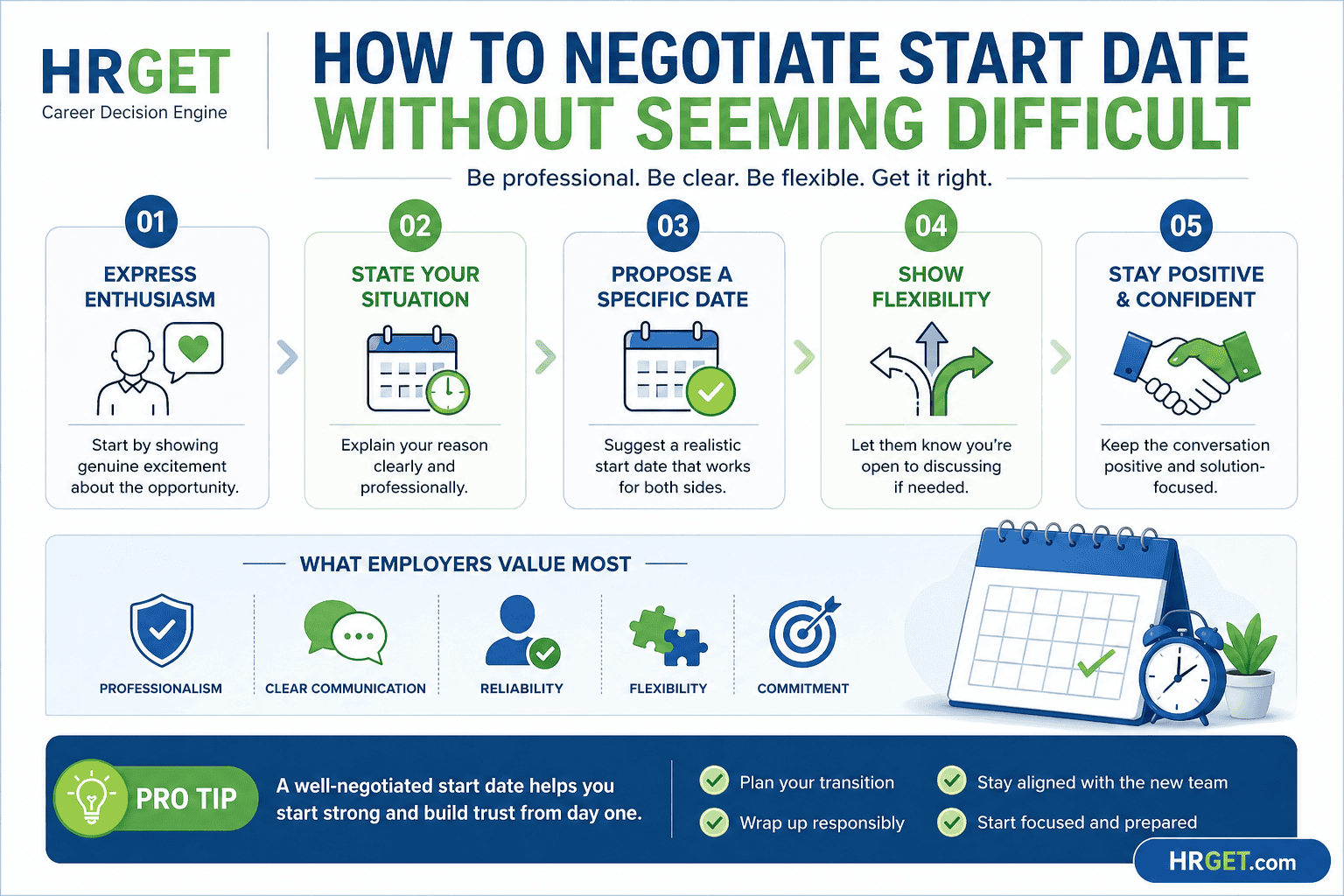
How to Negotiate Your Start Date: Step-by-Step Script
The biggest mistake candidates make here is over-explaining. They turn a simple, professional request into a lengthy justification that sounds apologetic and anxious. Keep it clean. Keep it confident.
Step 1: Lead With Enthusiasm
Always anchor the conversation in your genuine excitement about the role. This frames everything that follows as a practical logistics question, not a negotiation posture.
| What to Say | Why It Works |
|---|---|
| “I’m really excited about this opportunity and looking forward to joining the team.” | Establishes your commitment before introducing the ask. Removes the “are they actually interested?” question. |
Step 2: State the Situation — Briefly
One sentence. Two at most. No detailed backstory, no emotional context, no over-explaining. The goal is to give them enough to understand without making it feel complicated.
“I want to ensure a clean transition in my current role and hand over responsibly.”
Step 3: Propose a Specific Date
This is non-negotiable. Do not say “a few weeks later” or “sometime in March.” Give a concrete date. Vagueness signals that you haven’t thought it through — and that’s what creates friction.
“Based on that, I’d like to propose a start date of March 15.”
Step 4: Signal Flexibility
This one line removes most of the friction from the conversation. It shows that you’re not issuing an ultimatum — you’re collaborating toward a solution.
“I’m happy to discuss if there’s a preferred timeline on your side.”
Full Script (Ready to Use)
“I’m really excited about the opportunity and looking forward to joining. I want to ensure a smooth transition in my current role and wrap up responsibly. Based on that, I’d like to propose a start date of [DATE]. Of course, I’m flexible and happy to align with what works best for your team.”
That’s it. Four sentences. Confident, professional, and leaves zero room for misinterpretation.
Real Scenarios: What to Say in Each Situation
Scenario 1: You Have a 30–90 Day Notice Period
“I have a notice period I want to honor in full to ensure a professional exit. I’d like to propose a start date of [DATE] — that gives me enough time to transition my responsibilities cleanly.”
In India especially, this is the most common situation. Most mid-to-senior roles carry 60–90 day notice clauses. Any competent hiring manager knows this — and if they’re hiring in that market, they’ve planned for it.
Scenario 2: You Want a Break Between Roles
Be honest, but frame it professionally. Don’t say “I need to decompress.” Say this:
“I’d like to take a short break between roles so I can start with full focus and energy. I’d propose [DATE] as my start date — I’ll be fully prepared and ready to contribute from Day 1.”
Scenario 3: You’re Relocating
“Since I’ll be relocating for this role, I’d need a few weeks to manage the move and settle in properly. I’d suggest [DATE] — that gives me enough runway to be fully set up and focused from the start.”
Scenario 4: They Want an Immediate Joiner
This is where it gets delicate. Some job descriptions explicitly say “immediate joiners preferred.” Don’t panic — that’s often an aspirational statement, not a hard deadline. Here’s how to handle it:
“I understand the urgency and I’m absolutely committed to joining. At the same time, I want to ensure a clean exit so I can start without loose ends. I can aim for [earliest realistic date] — would that timeline work for your team?”
You’ve acknowledged their need, committed to joining, and given a concrete date. That’s a professional answer to a high-pressure ask.
Smart Strategies That Make the Negotiation a Win-Win
Beyond the scripts, here are the strategic moves that separate candidates who negotiate start dates successfully from those who create friction.
Offer Early Engagement While You’re Still at Your Current Role
This is the move most people don’t think of. If you’re pushing the start date by four to six weeks, offer to stay connected in the interim — join an onboarding call, review a strategy document, meet a few team members virtually. It signals commitment and makes the wait feel productive for both sides. This one move can turn a “that’s too long” response into a “sounds good.”
Raise It During the Offer Stage, Not After Signing
The timing matters enormously. Raising the start date before you sign is a negotiation. Raising it after you sign is a problem. The moment you have an offer in hand — even verbally — that’s your window. Use it.
Anchor Your Ask in Logic, Not Emotion
| Weak Framing | Strong Framing |
|---|---|
| “I need time because I feel burned out.” | “I want to ensure a proper handover and arrive fully prepared.” |
| “I just need some personal time.” | “I’m relocating and need a few weeks to settle before I can be fully operational.” |
| “Can I start a bit later?” | “I’d like to propose April 7 as my start date — here’s why that works best.” |
Don’t Over-Negotiate This
This is not salary negotiation. You don’t have the same leverage, and pushing too hard signals the wrong priorities. Make one clear, reasonable ask. If they push back, either meet them halfway or accept their timeline. Don’t go back and forth three times on a start date — that’s what actually makes you look difficult.
What I’ve Seen From the Hiring Side
I’ve been on the hiring side of this conversation dozens of times. Here’s a real example that illustrates the difference.
Candidate A accepted the offer, said they could join within two weeks. Then delayed once. Then delayed again. Each time, a different reason. By the time they actually joined, the team had mentally moved on, and their first 90 days were plagued by that initial credibility hit.
Candidate B said upfront: “I have a 45-day notice period I want to honor. I’ll be joining on [date] — that’s firm.” They joined exactly on that date, came in prepared, and had a strong first quarter.
Guess which candidate was still with the company two years later? Guess which hiring manager still recommends the second person to colleagues?
Honesty and precision on start dates is a trust-building signal. Use it as one.
Common Mistakes That Actually Make You Look Difficult
The request to negotiate your start date is almost never the problem. How it’s handled is. Avoid these:
Being Vague About Your Timeline
“I might need a bit more time” tells a hiring manager nothing and creates more questions than it resolves. Give a date. If you’re unsure, give a range — but lean toward the specific end of that range.
Changing Your Proposed Date More Than Once
This is the real red flag. One clear request is professional. Two date changes after the offer is signed starts to feel like bad faith — and it will follow you into your first few months at the company.
Framing It as a Demand Rather Than a Request
“I can only join after two months” — with no flexibility signaled, no explanation offered — lands poorly. Even if two months is genuinely what you need, the framing matters. “I’d like to propose” always outperforms “I can only.”
Over-Explaining Personal Details
Your hiring manager doesn’t need to know about your family situation, your health, your living arrangements, or your emotional state. One professional reason is enough. Keep the rest private — oversharing creates awkwardness and sometimes inadvertently raises concerns the employer didn’t have before.
Bringing It Up After the Offer Is Fully Executed
If you sign the offer letter and then ask to change the start date, you’ve broken the first agreement of the relationship. That’s a hard position to recover from. Raise it before signing — always.
What If They Say No?
Some companies genuinely need urgent joiners. The role has been vacant for months, a team is understaffed, or there’s a project kicking off that can’t slip. Here’s how to handle a firm “no” without burning the relationship — or making a bad decision.
Option 1: Negotiate a Middle Ground
If you asked for six weeks and they want two, propose four. A genuine willingness to meet halfway almost always produces an acceptable outcome for both sides. Most employers expect a counter — they’re not issuing a final answer.
Option 2: Offer Partial Availability Before Your Official Start
Some candidates have had success offering to attend onboarding sessions, strategy meetings, or planning calls remotely before their physical join date. This gives the company meaningful access to you while you’re still finishing your notice period — a creative win-win that works particularly well for knowledge-intensive roles.
Option 3: Treat the Response as a Culture Signal
Here’s the one most people don’t consider: if a company refuses to accommodate a reasonable notice period — one that any professional with integrity would want to honor — that tells you something important about how they’ll treat you as an employee. A company that respects professional norms during hiring will almost always respect them during your tenure. One that doesn’t? You’ve just seen the preview.
I’m not saying walk away every time they push back. But I am saying: weight that data point seriously before you accept terms that don’t work for you.
Pro Tip: Your First 30 Days Matter More Than Your Start Date
Here’s the perspective shift that changes how most people think about this entire conversation: no one at your new company will remember two years from now whether you joined on March 1 or April 7. They will remember whether you were sharp, prepared, and effective in your first quarter.
If a two-week delay means you can exit gracefully, recharge mentally, and walk into that first week with genuine clarity and energy — that’s a performance investment. The cost of arriving depleted and distracted is far higher than the cost of joining slightly later.
Negotiate the time you actually need. Then use it well.
Frequently Asked Questions
Is it okay to negotiate start date after accepting a job offer?
You can, but it’s significantly harder and more disruptive once the offer is signed. The ideal window is during the offer negotiation stage — before you’ve formally accepted. Raising it afterward isn’t impossible, but it creates friction and can affect the trust dynamic with your new employer from day one. When in doubt, raise it early.
How much of a delay in start date is typically acceptable?
Two to four weeks is almost universally accepted without question. Four to eight weeks is common for mid-to-senior roles, especially in markets with long notice periods like India and the UK. Anything beyond 60 days needs a strong, specific reason — and in some cases, companies at that point will simply move to the next candidate rather than hold a slot that long.
Can a company revoke a job offer because I asked to negotiate the start date?
Rarely, and almost never for a reasonable, well-communicated request. Revocations happen when a candidate appears unreliable — repeated date changes, vague responses, or a demanding tone. If you ask once, clearly, with a specific date and reasonable explanation, the overwhelming majority of employers will engage constructively. The offer revocation risk is essentially zero for a professional ask.
Should I explain personal reasons when asking to delay my start date?
Keep it professional, not personal. “I want to ensure a clean handover at my current role” is sufficient for most situations. You don’t need to explain family logistics, health, or emotional state — and doing so often introduces concerns the employer didn’t have. One clear, professional reason is enough. Save the personal details for your inner circle.
What should I say if HR is pressuring me to join sooner?
Stay calm and grounded. Don’t get defensive, don’t over-explain, and don’t agree to something that isn’t realistic for you. A good response: “I understand the urgency and I want to make this work. I also want to ensure a smooth transition so I can start fully committed. I can aim for [earliest realistic date] — does that work?” That response acknowledges their need without abandoning yours.
Does negotiating a start date make me look less committed to the new role?
No — when handled correctly, it does the opposite. A candidate who negotiates professionally signals that they’re organized, take commitments seriously, and communicate proactively. These are exactly the traits employers want. What signals low commitment is vague communication, repeated changes, or arriving clearly unprepared because you rushed the transition.
Can I negotiate start date for a job that says “immediate joiner preferred”?
“Immediate joiner preferred” is often aspirational language, not a hard requirement. Most companies advertising this will still consider strong candidates with a 3–4 week notice period. State your earliest realistic date, explain briefly why, and signal flexibility. In many cases, the right candidate at four weeks beats a mediocre candidate available tomorrow.
What’s the best way to ask for a later start date via email?
Keep it brief, specific, and warm. Lead with excitement about the role, state the constraint in one sentence, propose a concrete date, and signal flexibility. Avoid lengthy explanations — a concise, confident email reads as more professional than an over-justified one. Match the tone of the communication your employer has used with you throughout the process.
Final Takeaway
Companies don’t lose good candidates because they ask to negotiate start dates. They lose them because of poor communication, repeated changes, and a sense that the candidate isn’t reliable.
If you’re clear, specific, and show genuine flexibility — you won’t come across as difficult. You’ll come across as someone who thinks ahead, communicates professionally, and takes transitions seriously. That’s exactly who a smart employer wants to hire.
Negotiate the start date you actually need. Use that time well. Walk in prepared. The rest takes care of itself.
Related reading: Before you finalize your start date, make sure you’ve reviewed every element of the offer itself — including salary, equity, and benefits. See our guide on how to negotiate a job offer from a position of strength.

Jonathan Reed: Executive Career Strategist & Leadership Advisor | Former Partner, McKinsey & Company | Executive Coach to Amazon & Unilever Leaders | 18+ Years in Career Strategy
Jonathan Reed spent nearly two decades as a Partner at McKinsey & Company, where he advised organisations on leadership development, talent strategy, and organisational design across the US, UK, and Asia. Since leaving consulting, he has worked as an executive coach to senior leaders at Amazon, Unilever, and a clutch of high-growth scale-ups — helping them navigate promotions, career pivots, and the unwritten rules of visibility and influence at the top. Based between London and New York, Jonathan writes for HRGet.com to give working professionals an honest look at how careers actually scale — and why so many talented people stall without ever knowing why.