

By Jonathan Reed | Executive Career Strategist & Leadership Advisor | Former McKinsey Partner | Updated April 2026
If you’re a Product Manager asking yourself “Am I being paid fairly for my level?” — you’re asking exactly the right question. And the answer is almost always more complicated than a simple salary survey can tell you.
Here’s what 18 years of executive coaching and career advisory work has taught me: product manager salary growth is not a straight line. It lurches. It jumps massively at specific transitions — and flatlines dangerously if you stay in the wrong role at the wrong time.
The gap between a Senior IC and a Director isn’t just a title change. In total compensation terms, it can be $100K–$150K per year. And the VP tier? That’s an entirely different wealth-building conversation.
This guide breaks down product manager salary by level in the US for 2026 — from Associate PM to VP — with the real numbers, the IC vs leadership decision framework, and the strategies that actually move the needle. Let’s get into it.
The core insight: Your salary doesn’t grow because you work harder. It grows because your scope of impact expands. The fastest way to earn more as a PM isn’t a raise — it’s a level transition.
Product Manager Salary Overview (US 2026)
Let’s start with the landscape. Product Management continues to be one of the highest-compensated non-engineering roles in the US tech industry. That hasn’t changed in 2026 — if anything, the premium for experienced PMs has widened as companies tighten headcount and demand more from fewer people.
When I say “total compensation” here, I mean base salary + annual bonus + annualized equity (RSUs). Stock is not optional at mid-to-senior levels — it’s often 30–50% of your real earnings, especially at public tech companies.
| Level | Base Salary | Total Compensation (TC) |
|---|---|---|
| Associate PM (APM) | $90K – $120K | $100K – $140K |
| Product Manager (PM) | $110K – $150K | $130K – $180K |
| Senior PM | $140K – $190K | $170K – $250K |
| Principal / Staff PM (IC) | $170K – $220K | $200K – $300K |
| Director of Product | $180K – $250K | $220K – $400K |
| Senior Director / Head of Product | $220K – $300K | $300K – $500K |
| VP of Product | $250K – $400K | $350K – $800K+ |
Notice the pattern: the steepest compensation jumps happen after Senior PM — not before. The APM-to-PM-to-Senior PM progression is relatively gradual. But the moment you cross into Director territory, you enter a completely different pay band.
That inflection point is the most important career decision you’ll make as a product professional. We’ll come back to it.
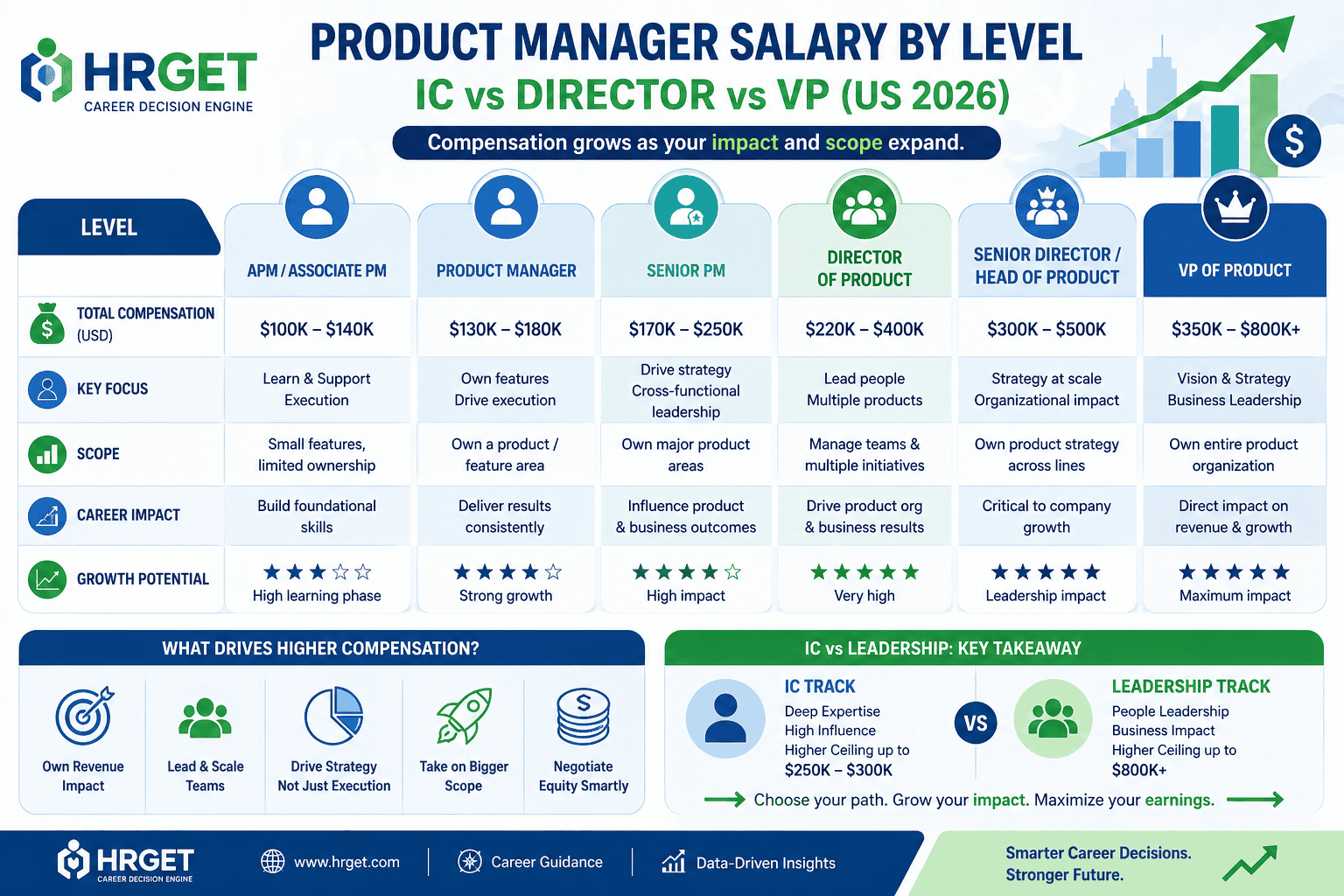
IC vs Director vs VP: What Actually Changes (And Why It Affects Pay)
Most articles stop at “Directors manage people.” That’s true but it misses the real reason compensation diverges so sharply between IC and leadership tracks.
Here’s the honest framework: companies pay for scope of leverage. An IC PM leverages their own execution. A Director leverages a team’s execution. A VP leverages an entire product organization — and by extension, the company’s revenue trajectory.
The wider the leverage, the higher the comp ceiling. It really is that simple.
| Factor | IC (PM / Sr PM) | Director of Product | VP of Product |
|---|---|---|---|
| Scope | Feature / Product Area | Multiple Teams & Lines | Entire Product Org |
| Primary Lever | Execution quality | People & strategy | Business outcomes |
| Risk Exposure | Low | Medium | High |
| Comp Structure | Salary + modest bonus | Salary + bonus + stock | Heavy equity-weighted |
| TC Ceiling | ~$300K | ~$400K | $800K+ |
One thing worth calling out: the equity shift at VP level is dramatic. I’ve worked with VP-level PMs at mid-size public tech companies where base salary was $280K but annual equity grants were $400K+. If you’re evaluating a VP offer and only looking at base, you’re reading the wrong number.
Product Manager Salary by Level: The Detailed Breakdown
Let’s go level by level with context that salary surveys typically leave out.
Associate Product Manager (APM)
Base Salary: $90K – $120K | Total Compensation: $100K – $140K
This is the entry point — and at major tech companies like Google, Meta, or Microsoft, APM programs are competitive and well-compensated. You’re not being paid for impact yet; you’re being paid for potential and trainability.
APMs typically own limited surface area: a specific feature, a single user flow, or a well-scoped experiment. The equity component at this level is usually a 4-year RSU grant that won’t feel significant until year 3 or 4. Focus on shipping well and building internal credibility — that drives your next promotion faster than anything else.
Product Manager (PM)
Base Salary: $110K – $150K | Total Compensation: $130K – $180K
You own a product area and are expected to drive outcomes — not just ship features. This is where the PM title means something real. You’re working cross-functionally with engineering, design, data, and often with sales or marketing too.
Here’s something I tell every PM I coach at this level: this is the stage where most people plateau for 2–3 years longer than they should. Not because they lack skill, but because they optimize for “doing good work” rather than “owning visible outcomes.” Your manager can’t advocate for your promotion if they can’t point to measurable business impact. Start tracking your metrics deliberately.
Senior Product Manager (Sr PM)
Base Salary: $140K – $190K | Total Compensation: $170K – $250K
At Senior PM, you own major product areas and you’re expected to bring strategy — not just execution. You’re influencing roadmap decisions, pushing back on stakeholders with data, and likely mentoring more junior PMs informally.
This is the critical fork point. Senior PM is the last level before the career path splits. Do you go deeper as an IC — Principal, then Staff PM? Or do you move into people management toward Director? That decision has long-term compensation implications of $200K–$500K over the following decade. We’ll unpack it properly in the next section.
Principal / Staff Product Manager (IC Track)
Base Salary: $170K – $220K | Total Compensation: $200K – $300K
The Principal PM path exists at larger tech companies — Google, Meta, Amazon, Salesforce, and their peers. You carry no people-management responsibility, but your influence spans multiple teams. You’re setting product strategy for entire domains, often advising Director-level leaders.
I’ll be honest: only around 10–15% of PMs ever reach this level. It requires exceptional depth, strong executive presence, and the ability to operate at Director-equivalent scope without the org chart authority. If you’re at a company that has this ladder, it’s a legitimate alternative to the management track — just go in knowing the ceiling.
Director of Product
Base Salary: $180K – $250K | Total Compensation: $220K – $400K
This is where compensation jumps meaningfully. You’re managing multiple PMs, owning multiple product lines, and being held responsible for business outcomes — not feature delivery. The shift from “shipping” to “ensuring the right things ship through others” is significant, and most first-time Directors underestimate how different the day-to-day feels.
Equity grants get larger here too. At a mid-size public tech company, a Director-level new hire can expect an RSU package worth $150K–$250K over four years — on top of base and bonus. That’s real money that doesn’t show up in “salary” searches.
Senior Director / Head of Product
Base Salary: $220K – $300K | Total Compensation: $300K – $500K
You own org-level product decisions at this tier. Strategy, hiring, budget, and organizational design are all on your plate. At mid-size companies, “Head of Product” at this level often means you’re functionally the top product leader with a VP above you or no one.
VP of Product
Base Salary: $250K – $400K | Total Compensation: $350K – $800K+
At VP level, you own the entire product strategy and its relationship to company revenue. You’re in the room when board-level decisions get made. The role carries genuine organizational risk — you can be removed if the product org misses targets — and compensation reflects that.
Stock is no longer supplementary at this level — it’s the primary wealth-building vehicle. I’ve seen VP of Product packages at Series C+ startups where base was $280K but the equity grant was valued at $800K–$1.2M over four years. Evaluating an offer at this tier without modeling the equity carefully is a significant financial mistake.
Real Scenario: The IC vs Director Decision at Senior PM
The situation: Marcus is a Senior PM at a mid-size SaaS company, earning $185K TC. He’s been in the role for two years, owns a growing product area, and has been offered two paths internally.
Option A — Stay IC, move to Principal PM: Salary grows to ~$210K base over 18 months. Strong equity refresh likely. No management responsibility. He continues to own what he’s good at. TC ceiling: around $260K–$280K within 2–3 years.
Option B — Transition to Director: Base jumps to $230K immediately. Full equity grant. Manages a team of 4 PMs. TC range: $300K–$380K in year one. But he now needs to learn people management, performance conversations, and strategic planning at a level he hasn’t operated before.
What I’d advise: If Marcus genuinely enjoys cross-functional influence and has any leadership energy, take Option B — but only if the company provides real support for the transition. First-time Directors who are dropped into the role without mentorship or coaching often fail within 18 months. The comp jump is real, but so is the learning curve.
The lesson isn’t “Director is always better.” It’s that the decision should be deliberate — not a default, not something you drift into because a promotion was offered.
Where Product Managers Earn the Most in 2026
Geography still matters — even in a remote-forward market. Here’s the honest breakdown of where product manager salary by level runs highest.
| Market | Senior PM TC | Director TC | Notes |
|---|---|---|---|
| San Francisco Bay Area | $220K – $300K | $350K – $500K | Highest absolute TC; CoL offsets gains |
| Seattle | $200K – $270K | $310K – $450K | Amazon effect drives up benchmarks |
| New York | $185K – $260K | $290K – $420K | FinTech and media companies top payers |
| Austin | $160K – $220K | $240K – $360K | Rising fast; better CoL ratio than SF |
| Remote (US-based) | $170K – $240K | $260K – $400K | Depends on company’s location-based pay policy |
Remote work has compressed the geographic gap somewhat — but not eliminated it. Many large tech employers still apply location-based pay adjustments, meaning a remote PM hired at a “Tier 2 city” rate will earn less than a Bay Area counterpart at the same level, even working identical roles. Always clarify the pay band tier in any remote offer negotiation.
IC vs Leadership Track: Which Pays More Long-Term?
This is the question I get more than almost any other. And the honest answer isn’t a simple “management pays more.” It depends on how far you’re willing to go and what you’re actually good at.
Short-Term (0–5 Years from Senior PM)
The IC path often feels faster in the short run. Promotions to Principal PM can happen in 18–24 months if you’re performing well. The management path involves a transition period — typically 6–12 months where you’re earning at the same level but taking on significantly more responsibility before the comp adjustment lands.
Long-Term (5–10 Years from Senior PM)
This is where the paths diverge sharply. A Principal PM at a top tech company can comfortably reach $280K–$320K TC and stay there for years. But the ceiling is real — very few IC PMs break $350K without moving into a Staff or Distinguished PM role that barely exists outside FAANG.
A Director who moves to Senior Director, then VP, is in a structurally different compensation conversation — $500K, $700K, $800K+ in total comp is achievable at scale-stage companies. More importantly, the equity upside at VP level can generate genuine wealth in a way that even a well-compensated IC track cannot.
The honest summary: If stability and deep product mastery matter more to you, the IC path is genuinely excellent — and underappreciated. If maximum earnings and organizational influence are your goals, the leadership track wins decisively over a 7–10 year horizon. Neither is wrong. Both require conscious intent.
Smart Strategy to Maximize Your Product Manager Salary
Skills are table stakes. Here’s what actually moves compensation — based on patterns I’ve seen across hundreds of PM careers.
1. Optimize for Scope, Not Just Title
A PM owning growth or monetization at a $500M revenue company earns more than a “Senior PM” at the same company owning a low-traffic internal tool. Your title matters less than the business surface you’re responsible for. If you’re not tied to a revenue-critical metric, engineer a path toward one.
2. Switch Companies Strategically — Not Frequently
Internal raises typically land in the 5–10% range. External moves — especially when you’re crossing a level boundary — routinely produce 20–40% jumps. The key word is “strategically.” Moving every 18 months signals instability. Moving at the 3-year mark when you’ve plateaued is almost always the right financial play. I’ve seen Senior PMs go from $210K to $290K TC in a single external move with a level-up to Director.
3. Position Toward Revenue Ownership
PMs who work in growth, pricing, monetization, or platform tend to command higher compensation because their work is directly measurable in revenue terms. If you’re on a features team with no clear revenue attribution, find ways to quantify your impact in dollar terms — or start angling toward a transfer that puts you closer to the revenue line.
4. Make the IC vs Management Decision Before Senior PM, Not After
Most people delay this decision until they’re already at Senior PM level and a management opportunity appears. By then, you’re reactive rather than strategic. Start signaling your path preference 12–18 months before you expect to be eligible for promotion. If you want Director track, start managing project-level people informally, volunteering for cross-team work, and explicitly discussing it with your manager.
5. Negotiate Equity with the Same Energy You Negotiate Base
At Director and above, your RSU refresh schedule, cliff date, and equity grant size are negotiable. Most candidates spend 90% of their negotiation energy on base salary and accept the equity offer as-is. That’s a mistake. A $30K bump in base salary is worth ~$120K over four years. A $100K increase in equity grant value is worth exactly $100K — often in pre-tax dollars that vest meaningfully during your likely tenure.
Common Mistakes That Cost Product Managers Real Money
Staying too long at PM level without a promotion strategy
Three years as a PM without a clear promotion path isn’t loyalty — it’s compensation leakage. You lose both direct pay and the compounding effect of higher-band equity grants. If your company doesn’t have a clear promotion timeline, that’s information.
Avoiding the leadership track because it “seems political”
I’ve heard this from dozens of talented Senior PMs. Yes, Director-level work involves more organizational dynamics. But avoiding it entirely because of that discomfort caps your earnings at ~$250K–$280K indefinitely. That’s a $400K–$600K career-level decision you’re making by default.
Chasing brand-name companies over high-growth ones
A Director role at a Series D SaaS company growing 60% annually often pays more — and teaches more — than a Senior PM role at a prestige tech giant. The brand looks great on a resume, but if you’re turning down meaningful comp and scope for a logo, run the math before you accept.
Not understanding your total comp structure
Base, target bonus, equity vesting schedule, refresh policy — all of these interact. A $180K base offer with a 20% bonus target and $300K in RSUs vesting over four years is a very different offer from “$180K salary” at a company with no equity. Read offer letters carefully and model the 4-year total.
Pro Tip — From Real Hiring Patterns
Hiring managers and comp committees don’t pay for effort or years served. They pay for demonstrated business impact, decision-making ability at scale, and leadership credibility. If you want your next comp conversation to go differently, the work starts 12 months before that conversation — not in the room.
FAQ: Product Manager Salary by Level
What is the average product manager salary in the US in 2026?
The average total compensation for a mid-level PM in the US sits around $140K–$180K in 2026, factoring in base salary, bonus, and annualized equity. Entry-level PMs typically earn $100K–$140K TC, while Senior PMs range from $170K–$250K. These figures skew higher in Bay Area and Seattle markets, and lower in mid-tier US cities by roughly 15–25%.
Do Directors of Product earn more than Principal PMs?
In most cases, yes — Directors earn more in total compensation than Principal PMs, largely due to larger equity grants and bonus targets. However, at FAANG-tier companies, top-performing Principal and Staff PMs can earn TC comparable to Directors ($250K–$320K). The difference is the ceiling: Directors can grow to Senior Director and VP comp, while the IC ladder has a hard cap at most organizations.
Is a VP of Product role worth it financially?
From a pure compensation standpoint, yes — VP of Product is one of the highest-earning non-C-suite roles in tech, with TC regularly exceeding $500K–$800K at mature companies and meaningful equity upside at growth-stage ones. The tradeoff is real organizational risk: VP-level product leaders face significantly higher scrutiny and career risk when product strategy misses targets. Go in with eyes open on both sides of that equation.
How long does it typically take to become a Director of Product?
The typical path runs 8–12 years from entry-level PM to Director, though high performers at growth-stage companies have made it in 5–7 years. Company size matters enormously: at a 50-person startup, you might lead the product org as Head of Product within 4 years. At a 50,000-person enterprise, the org layers slow everything down. The fastest paths combine external moves at level-boundary moments with deliberate internal positioning.
Can you move from IC to Director track later in your career?
Yes, but the window narrows meaningfully after 3–4 years as a Principal or Staff PM. By then, you’ve built a professional identity as a domain expert rather than a people leader, and hiring managers for Director roles will probe hard on management experience you don’t have. It’s not impossible — but it typically requires a deliberate pivot, often through a “player-coach” role or a startup where you can earn management scope early.
Do startups or big tech companies pay product managers more?
Big tech companies offer higher base salary and more predictable equity (publicly traded RSUs). Startups typically offer lower base cash but larger equity grants that carry significant upside if the company exits successfully — and significant risk if it doesn’t. The honest answer: for stable, competitive compensation, big tech wins in the short term. For wealth-building potential, growth-stage startups with strong fundamentals can be transformative — but only if the equity actually vests and the company succeeds.
What product manager roles pay the most in 2026?
Roles tied directly to revenue tend to command premium compensation: Growth PM, Monetization PM, and Pricing PM roles consistently rank among the highest-paid PM positions at equivalent seniority levels. Platform and infrastructure PMs at large tech companies also earn above-market rates because of the breadth of internal influence. AI product roles have also seen notable compensation inflation in 2025–2026 as demand outpaces supply.
The Real Driver of Product Manager Salary Growth
After nearly two decades of watching product careers progress — and stall — the pattern is consistent: product manager salary by level grows in proportion to scope of impact, not years of experience.
APMs get paid for potential. Senior PMs get paid for execution quality. Directors get paid for what their teams produce. VPs get paid for what the product org delivers to the business. Every level change is a fundamental shift in what you’re being compensated for — not just a linear extension of the one before.
The most important thing you can do right now? Be deliberate about which path you’re on. Don’t drift into IC or management by default. Understand where the ceiling is on each track, and make the fork-in-the-road decision at Senior PM level before it gets made for you.
If you’re heading into a negotiation — at any level — read our guide on how to negotiate a salary offer to make sure you’re capturing the full value your level commands.
Compensation benchmarks are based on aggregated market data from Levels.fyi, Glassdoor, and Radford industry surveys. Figures reflect US-based roles as of 2026 and represent total compensation inclusive of base, target bonus, and annualized equity.

Jonathan Reed: Executive Career Strategist & Leadership Advisor | Former Partner, McKinsey & Company | Executive Coach to Amazon & Unilever Leaders | 18+ Years in Career Strategy
Jonathan Reed spent nearly two decades as a Partner at McKinsey & Company, where he advised organisations on leadership development, talent strategy, and organisational design across the US, UK, and Asia. Since leaving consulting, he has worked as an executive coach to senior leaders at Amazon, Unilever, and a clutch of high-growth scale-ups — helping them navigate promotions, career pivots, and the unwritten rules of visibility and influence at the top. Based between London and New York, Jonathan writes for HRGet.com to give working professionals an honest look at how careers actually scale — and why so many talented people stall without ever knowing why.