
Here’s the uncomfortable truth most career coaches won’t tell you: employers don’t care that you had a gap. What they care about is whether you sound defensive, vague, or evasive when explaining it.
I’ve sat on the hiring side of the table for close to two decades—McKinsey, executive search, coaching senior leaders through career transitions at Amazon and Unilever. And I can tell you with certainty: candidates lose offers not because of the gap itself, but because of how they handle the question.
If you’ve ever thought “What if they think I was lazy?” or “Should I just lie about it?”—this guide is for you. You’ll find exact scripts for every common scenario, a framework you can use in any interview, and the one mindset shift that separates candidates who get offers from those who don’t.
Why Employers Ask About Employment Gaps
This question isn’t small talk. It’s risk assessment—pure and simple.
When a hiring manager asks “So, tell me about this gap,” they’re really running three mental calculations simultaneously:
- Stability risk: Will this person quit suddenly again, or leave us in a lurch six months in?
- Employability signal: Were they let go for performance reasons and then unable to land something else?
- Growth vs. stagnation: Did they use the time productively, or did the gap represent a period of disengagement?
The key insight: they’re not judging your past. They’re predicting your future behavior. Reframe the question in your own mind before you answer it, and you’ll already be ahead of most candidates in the room.
The 3 Things Interviewers Are Actually Scoring You On
Forget the gap for a moment. In any answer you give, interviewers are quietly evaluating three things—and these matter far more than the length of your break.
The Three-Point Scorecard
1. Honesty. A rehearsed answer that doesn’t feel genuine erodes trust instantly. Interviewers have heard thousands of gap explanations—they can smell spin from across the table.
2. Accountability. Blaming the market, a bad boss, or a toxic company—even if completely true—registers as a red flag. It signals that when things go wrong, you look outward rather than inward.
3. Productivity during the gap. They don’t expect you to have launched a startup. But they do want to see evidence of learning, responsibility, or purposeful reflection—anything that shows forward motion.
Here’s what most people miss: scoring well on all three doesn’t require a perfect gap. It requires a clear, honest narrative that you deliver with calm confidence.
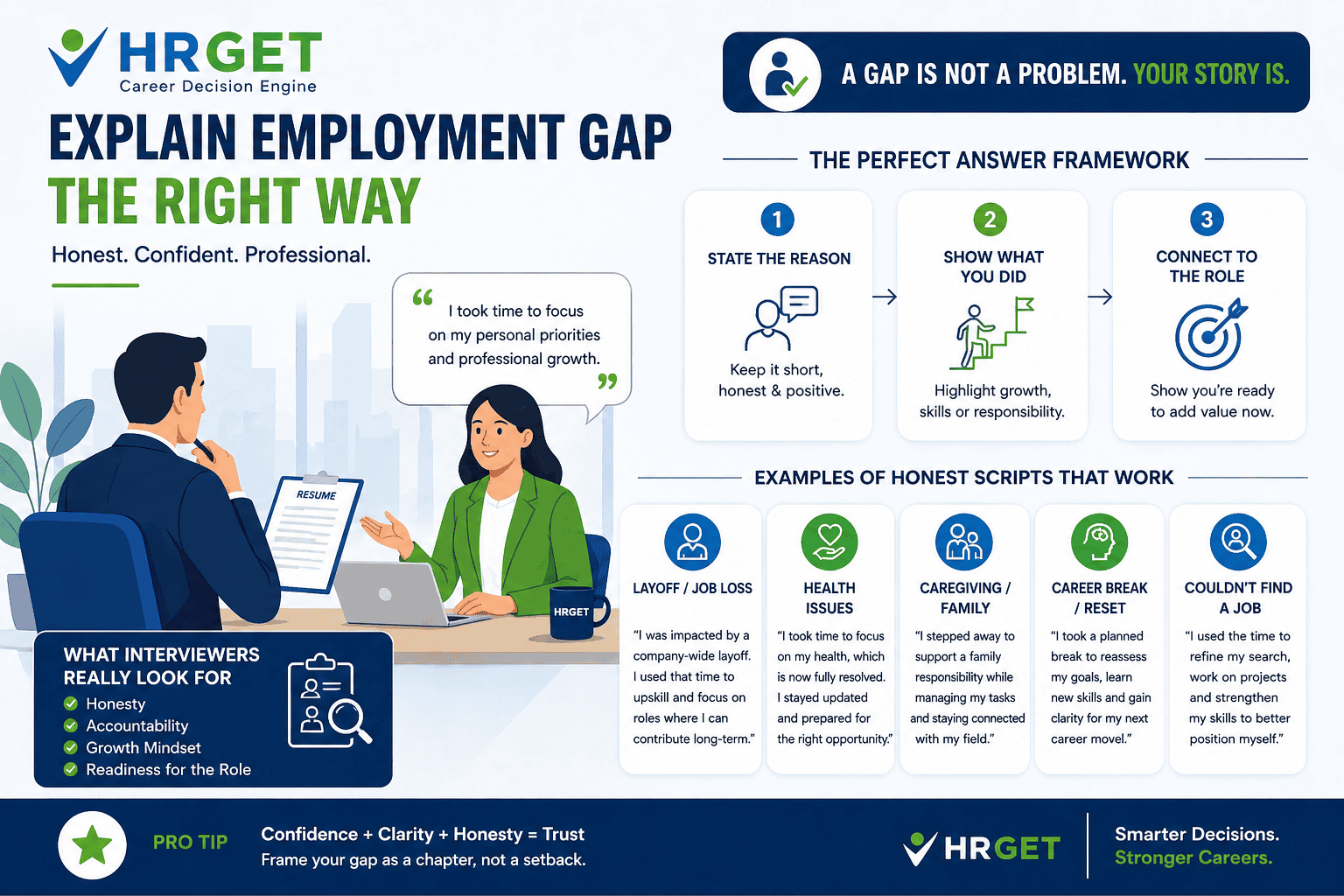
The “Perfect Answer” Framework (Use This Every Time)
After coaching hundreds of professionals through career transitions, I’ve seen one structure work consistently across every type of gap. It has three parts—and the order matters.
1
State the reason — short and honest
One or two sentences maximum. No elaborate backstory. The more you elaborate unprompted, the more suspicious you appear. State the reason matter-of-factly, as if it’s the most unremarkable thing in the world—because it should be.
2
Show what you did during the gap
Learning, caregiving, freelancing, recovery, reflection—anything that demonstrates you weren’t simply sitting still. Even one concrete thing (“I completed a Google Project Management certification”) shifts the perception entirely.
3
Bring it back to the job — explain why you’re ready now
This is the pivot that most candidates skip entirely. Closing the loop—”which is why I’m particularly excited about this role”—signals forward momentum and makes the gap feel like context, not baggage.
Example structure:
“I took a break due to [reason]. During that time, I focused on [productive action]. I’m now fully ready to return, and that experience has actually made me more intentional about roles like this one.”
Simple. Clean. Effective. Now let’s apply it to the real scenarios.
Honest Scripts for Every Common Gap Scenario
These aren’t generic templates—they’re built around the framework above, designed to sound human rather than canned. Customize with your specifics before you use them.
1. Layoff or Company-Wide Redundancy
“I was impacted by a company-wide restructuring—about 15% of the workforce was affected. I used the following months to step back, reassess where I wanted to focus next, and upskill in [specific skill]. Now I’m energized and focused, specifically targeting roles where I can contribute long-term.”
Why it works: Layoffs are widely understood—especially post-2023. Naming a scale (“15% of the workforce”) removes any suggestion of individual performance issues. The upskilling detail shows agency. The final line signals stability, which is exactly the risk they’re trying to assess.
2. Health Issues — Physical or Mental
“I took time off to address a health matter, which is now fully resolved. During that period, I stayed engaged with my field by [reading, online courses, staying in contact with my network]. I’m fully ready to return to work, and I’m grateful I took the time to do it properly rather than push through.”
Why it works: You don’t owe anyone your medical history. The phrase “fully resolved” is crucial—it removes the interviewer’s concern about recurring disruption. The last line actually reframes the gap as a mark of good judgment rather than a weakness.
3. Caregiving or Family Responsibilities
“I stepped away from full-time work to care for a family member. It was the right decision for my family, and I managed that responsibility seriously. During that time, I also stayed current in my field through [networking, reading, a part-time project]. That chapter is now closed, and I’m fully committed to returning to full-time work.”
Why it works: Caregiving is a legitimate life responsibility—frame it as such, not as something you’re apologizing for. “Managed that responsibility seriously” signals character. The phrase “that chapter is now closed” gives the interviewer exactly the certainty they need.
4. Career Break — Burnout or Deliberate Reset
“I made a deliberate decision to take a career break. I’d been running hard for several years and recognized that I needed space to recalibrate—both personally and professionally. I used that time to reflect on what kind of work I find most meaningful, learn [skill], and think carefully about the next chapter. That clarity is precisely why I’m so interested in this particular role.”
Why it works: Be careful here—this is the scenario where candidates most often overcorrect into either over-sharing or defensive justification. This script is confident and self-aware. The pivot to “that clarity is precisely why I’m so interested in this role” is the most important line—it turns a personal decision into a hiring advantage.
5. Extended Job Search — The Most Sensitive Case
“After my previous role, I took time to be selective rather than reactive in my search. The market was challenging in [field/region], but I used the time intentionally—I worked on [freelance project / certification / open source contribution] and refined what I was really looking for. I’m now confident about what I want and why this role fits.”
Why it works: Never say “I just couldn’t get hired.” That framing gives all the power away. This script repositions a difficult period as a deliberate decision—and the concrete activity you mention removes any perception of passivity.
Real Interview Scenario: What Works vs. What Fails
Let’s put this in context. A candidate is interviewing for a Senior Marketing Manager role after a nine-month gap following a layoff. The interviewer asks: “I notice there’s a gap in your resume—can you tell me about that period?”
| ❌ Weak Answer | ✅ Strong Answer |
|---|---|
| “Yeah, I was just trying to find something. The market was really bad and companies weren’t hiring. I applied everywhere but it just wasn’t working out.” | “I was part of a company-wide layoff. The market was genuinely tough for senior marketing roles, but I used that time purposefully—I completed a HubSpot advanced certification, ran a small freelance content project for a SaaS startup, and was selective about which roles I pursued. That focus is why I’m particularly interested in this one.” |
| What the interviewer hears: Blaming, passive, no growth, uncertain future performance. | What the interviewer hears: Ownership, initiative, clarity of direction, signals stability. |
Same gap. Nine months. The difference is entirely in the narrative.
Smart Strategy: Turn Your Gap Into an Advantage
Here’s what most people miss—and I say this based on years of observing hiring decisions: a well-explained gap can actually increase your credibility with a sophisticated interviewer. It signals self-awareness, intentionality, and the kind of resilience that’s genuinely hard to screen for in a 45-minute interview.
Three moves that shift perception:
Show intentionality. A planned break—where you made a deliberate choice—reads very differently from a passive one. Even if the gap started involuntarily, describing what you chose to do during it reframes the narrative entirely.
Name one concrete skill or project. You don’t need to have pivoted careers. Even a single certification, a freelance engagement, or a volunteer contribution acts as a proof point that you were engaged and growing. One concrete detail does more work than three paragraphs of explanation.
Demonstrate clarity about what you want now. Hiring managers love candidates who know what they want and why. If your gap gave you that clarity—say so explicitly. “That period helped me realize I want to focus on [X], which is exactly what drew me to this role” is one of the most powerful things you can say in an interview.
PRO TIP — For Long Gaps (6+ Months)
If your gap runs six months or longer, try to have at least one tangible activity you can name: a freelance project, a relevant certification, a mentorship role, a startup experiment—anything. Even something small creates a massive shift in perception. It moves the conversation from “what were they doing?” to “interesting, tell me more.” That’s the ground you want to be on.
Common Mistakes That Kill Your Chances
I’ve watched strong candidates lose offers over how they answered this question. These are the five mistakes I see most often—avoid every one of them.
1. Over-explaining. Long, rambling answers create suspicion, not sympathy. If you’re talking for more than 90 seconds, you’ve already said too much. State the reason, show the activity, pivot to readiness. Done.
2. Lying or stretching dates. Don’t do it. Background checks, reference calls, and LinkedIn timestamps make inconsistencies easy to find—and getting caught in a lie, even a small one, ends your candidacy immediately. There’s no gap that’s worse than a dishonesty flag.
3. Being defensive or apologetic. Every time you apologize for the gap, you’re teaching the interviewer to see it as a problem. Confidence isn’t arrogance—it’s speaking about your gap the same way you’d speak about any other career decision. Matter-of-fact, not defensive.
4. Saying “I did nothing.” Even if largely true, this framing is fatal. There was something—reflection, skill development, time with family, personal projects. Reframe what you did, don’t describe what you didn’t do.
5. Failing to close the loop. Every gap explanation must end with a forward-facing statement: why you’re ready now, what you’re looking for, why this role specifically. Without it, the interviewer is left wondering “okay, but are they actually ready to come back?” Don’t make them wonder.
The Confidence Switch Most Candidates Miss
Let me be direct: interviewers don’t reject gaps. They reject uncertainty.
If your answer sounds calm, structured, and forward-looking—you are already ahead of 80% of candidates who have answered this same question. Because most people panic, ramble, or shrink when it comes up.
Here’s the quick-reference cheat sheet to keep in your head going into the room:
| Say This | Never Say This |
|---|---|
| “I took time to…” | “I couldn’t find anything…” |
| “During that period, I focused on…” | “They weren’t hiring…” |
| “Now I’m ready and specifically interested in…” | “It was a really difficult time…” |
| “That experience gave me clarity about…” | “I don’t really know how to explain it…” |
FAQ: Employment Gaps in Interviews
How long of an employment gap is considered too long?
There’s no universal cutoff, but most recruiters start asking questions once a gap exceeds three to six months. That said, length matters far less than explanation quality. A 12-month gap explained confidently with clear activity often lands better than a 3-month gap explained poorly. Focus on your narrative, not the calendar.
Should I mention the employment gap on my resume?
Don’t hide it—that rarely works and often backfires. If the gap is significant, you can add a brief parenthetical in your resume timeline, such as “Career Break — Caregiving” or “Professional Development Period.” This frames it before the interview even begins, which reduces the dramatic weight of the question when it comes up.
Can I lie about my employment gap?
No—and not just for ethical reasons. Background verification is standard at most companies today, and inconsistencies between your resume, LinkedIn, and reference checks are easy to catch. Getting caught in a lie, even a small one, is an immediate disqualifier. The gap itself will rarely cost you the job. A lie will.
What if I genuinely did nothing during my employment gap?
Reframe what actually happened. Did you rest and recover? That’s responsible self-management. Did you spend time with family? That requires planning and emotional bandwidth. Did you reconsider your career direction? That’s strategic. Even genuine downtime can be framed as purposeful—the key is to not describe it as vacancy, but as a deliberate choice with a forward outcome.
Do employers actually reject candidates because of employment gaps?
Rarely, in isolation. What employers reject is unresolved uncertainty—candidates who sound unsure of themselves, can’t explain where they’ve been, or show no evidence of readiness to return. The gap is a trigger for the question; your answer is what determines the outcome. Handle the question well and the gap becomes a non-issue.
How do I explain multiple employment gaps?
Group them under a common theme where possible: “I had a couple of short career breaks—once for a family health situation and once during the 2023 tech downturn. In both cases, I stayed active in my field by [activity].” Linking them with a coherent thread prevents them from looking like a pattern of instability.
Should I bring up the employment gap myself if the interviewer doesn’t ask?
Only if it’s clearly visible on your resume and recent enough that skipping it feels conspicuous. If it’s more than two years old and the interviewer hasn’t asked, let it go. If you do decide to address it proactively, keep it brief—one sentence of context, one sentence of what you did, done. Don’t turn a non-issue into an issue by dwelling on it.
Final Takeaway: Your Gap Isn’t the Problem. Your Narrative Is.
An employment gap is a fact. Your narrative is a choice. And in 2026, as hiring managers review more candidates than ever through AI-assisted screening, the ones who get through to final rounds are the ones who walk in with clarity, confidence, and a story that makes sense.
Use the framework. Customize the scripts. Practice the answer out loud until it sounds like conversation, not recitation. And remember: if you stay honest, show growth, and sound certain about where you’re headed—you won’t just be justifying your employment gap. You’ll be demonstrating exactly the kind of self-awareness employers most want to hire.
Don’t try to hide it. Own it. Frame it. Move forward.
Ready for your next career move?
Once you’ve landed the interview and nailed the gap question, the next challenge is negotiating the offer. Read our guide on how to negotiate a job offer to make sure you’re walking away with the right number.

Jonathan Reed: Executive Career Strategist & Leadership Advisor | Former Partner, McKinsey & Company | Executive Coach to Amazon & Unilever Leaders | 18+ Years in Career Strategy
Jonathan Reed spent nearly two decades as a Partner at McKinsey & Company, where he advised organisations on leadership development, talent strategy, and organisational design across the US, UK, and Asia. Since leaving consulting, he has worked as an executive coach to senior leaders at Amazon, Unilever, and a clutch of high-growth scale-ups — helping them navigate promotions, career pivots, and the unwritten rules of visibility and influence at the top. Based between London and New York, Jonathan writes for HRGet.com to give working professionals an honest look at how careers actually scale — and why so many talented people stall without ever knowing why.