
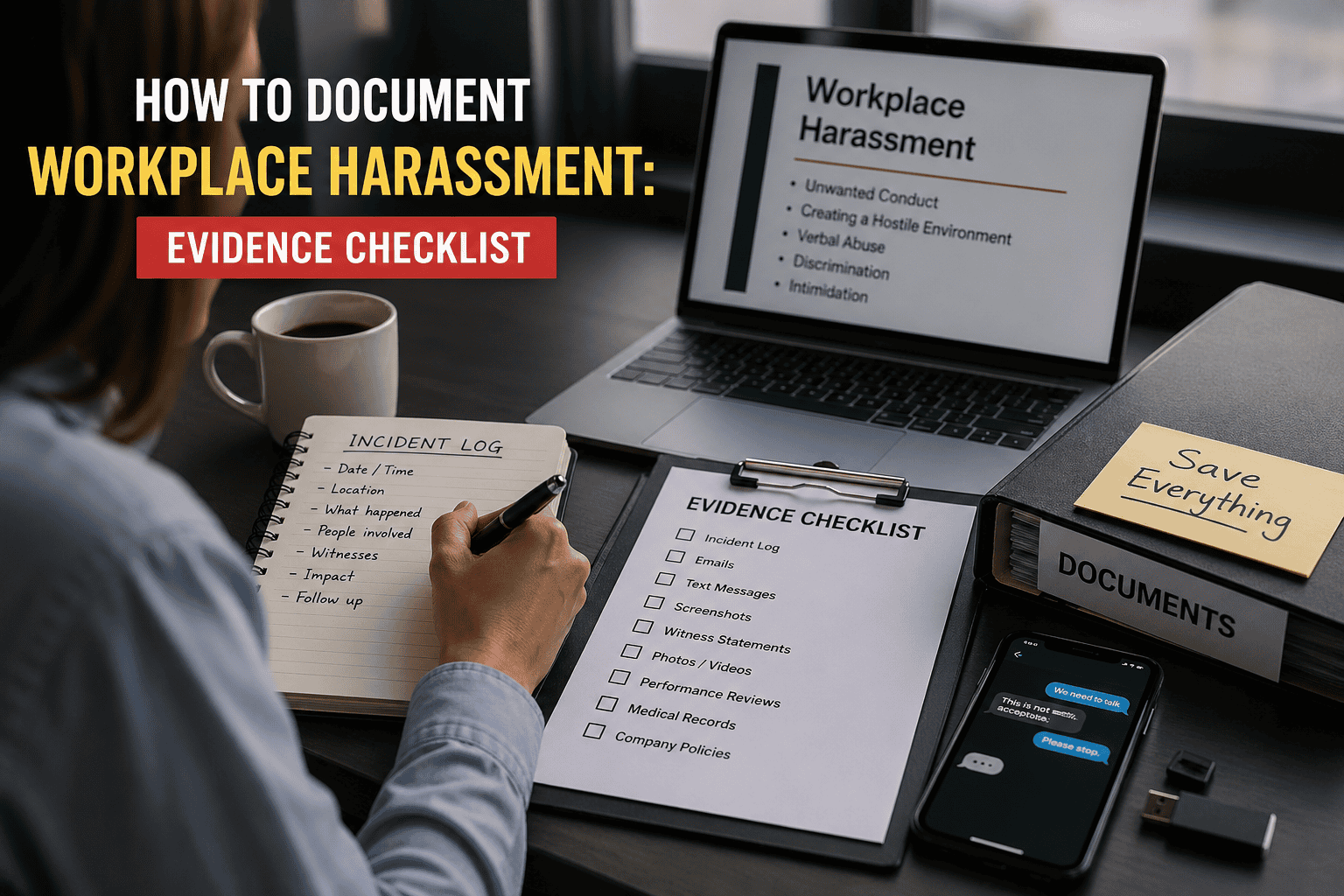
If you ever need to prove workplace harassment, your memory is not enough.
That’s the uncomfortable truth most employees realize too late — usually when they’re already sitting across from HR with nothing but a frustrated account of events they can barely sequence correctly. By the time a formal complaint begins, the question isn’t “Did this happen?” It’s “Can you prove it?” And that’s where most people fall apart — not because they’re wrong, but because they didn’t build a record.
I’ve consulted on dozens of workplace investigations, and I’ve watched strong cases collapse simply because the employee waited too long, kept everything on a work laptop, or approached HR with feelings instead of facts.
This guide changes that. You’ll leave with a complete evidence checklist, a step-by-step documentation system, and the strategies that actually give you leverage — whether you’re dealing with a toxic manager in Mumbai, a hostile team in Chicago, or a pattern of discrimination in London.
What Counts as Workplace Harassment?
Before you start documenting, get clear on what you’re dealing with. A lot of people either over-define harassment (treating normal management feedback as abuse) or dangerously under-define it (tolerating genuinely illegal conduct because it doesn’t seem “serious enough”).
Legally, workplace harassment is typically defined as repeated or severe conduct that creates a hostile work environment based on a protected characteristic — gender, race, age, disability, religion, national origin, or sexual orientation, depending on jurisdiction.
Common forms include:
- Verbal abuse — insults, threats, demeaning language
- Sexual harassment — unwanted advances, comments, or messages
- Discriminatory treatment — exclusion, targeting, or different standards applied based on identity
- Workplace bullying — public humiliation, intimidation, deliberate isolation
- Retaliation — negative consequences for raising concerns or reporting earlier incidents
Here’s what most articles won’t tell you: a single incident can qualify if it’s severe enough. A sexually explicit comment in a team meeting. A racial slur from a manager. You don’t always need a pattern — but building one makes your case exponentially stronger.
📌 US Legal Reference: Under Title VII of the Civil Rights Act and the EEOC guidelines, harassment becomes unlawful when it creates a work environment that a reasonable person would find hostile or abusive. In India, the POSH Act (Prevention of Sexual Harassment) covers sexual harassment specifically, with similar documentation requirements for complaints to the Internal Committee.
Why Documentation Is Everything
HR professionals don’t act on emotion. They act on evidence and risk. When an employee walks in and says “my manager makes me feel terrible,” HR hears a complaint they can’t act on. When an employee walks in with a 12-entry incident log, timestamped screenshots, and two witness names — they hear a liability.
That’s the difference. And it’s entirely within your control.
Without documentation:
- It’s your word against theirs — and management typically gets the benefit of the doubt
- HR “monitors the situation” (nothing happens)
- Any legal claim is weak and may not survive early stages
With strong documentation:
- Patterns become undeniable — HR cannot look the other way
- You control the narrative, not the harasser
- You have real leverage, whether in HR proceedings or with an employment attorney
Documentation turns a complaint into a case. And a case is what protects you.
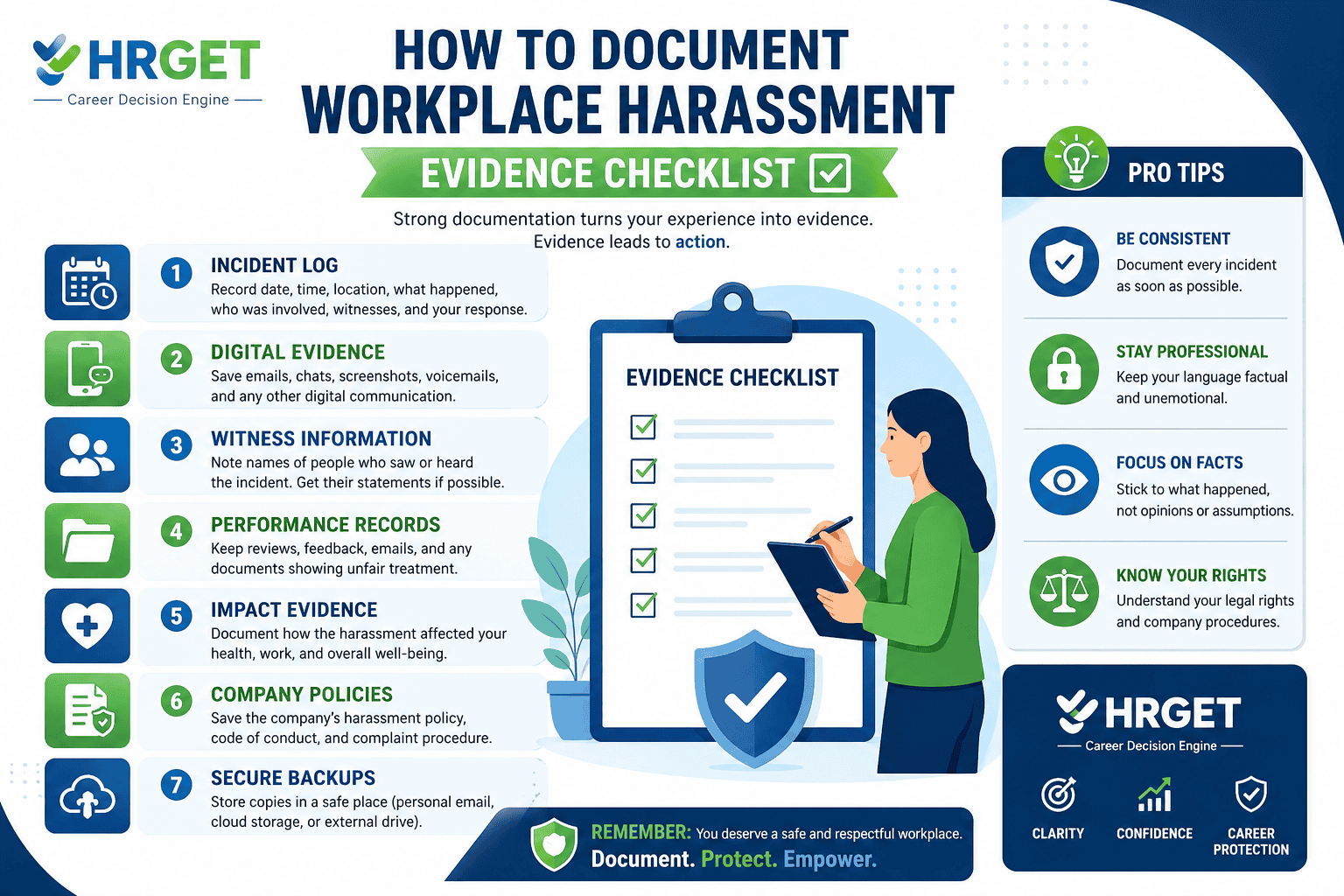
Workplace Harassment Evidence Checklist
If you take only one section from this guide, make it this one. These are the seven categories of evidence that HR investigators and employment attorneys actually care about.
✅ 1. Incident Log (Your Most Powerful Asset)
A private, chronological log of every incident is the foundation of any harassment case. For each entry, record:
- Date and exact time
- Location — office floor, Zoom call, Slack thread, hallway
- Verbatim quote if possible (“She said: ‘…'”) not paraphrased impressions
- Who was present — names, roles
- Witnesses, even if they didn’t intervene
- Your response at the time
- How it affected you (anxiety, inability to focus, etc.)
📝 Example Entry:
March 12, 2026 — 3:15 PM — Zoom call, Engineering All-Hands Manager (David H.) said: “You’re too emotional for leadership roles” while I was presenting Q1 results. Witnesses present: John M. (Senior Engineer), Priya S. (Product Lead) My response: “Can you clarify what you mean by that?” Impact: I was visibly shaken and left the call early. Spoke to a colleague afterward who confirmed they found the comment inappropriate.
This is gold-level evidence. Specific, sourced, timestamped, and witnessed.
✅ 2. Screenshots & Digital Communications
Workplace harassment increasingly happens in writing — which is actually good for you. Capture everything:
- Emails (forward to a personal email address with date and context noted)
- Slack or Microsoft Teams messages — screenshot before they’re deleted
- WhatsApp or SMS if used for work communication
- Calendar invites that reveal patterns (excluded from certain meetings, for example)
- Performance feedback sent via email that contradicts prior positive reviews
Critical rules: Never edit screenshots — even cropping can be challenged. Keep original timestamps visible. Always back up to personal cloud storage, not your work laptop.
✅ 3. Audio or Video Recordings (Know Your Jurisdiction First)
Recordings can be compelling — but they carry legal risk if done improperly.
- One-party consent states/countries (e.g., most US states, UK): You can record a conversation you’re part of without notifying the other party.
- All-party consent jurisdictions (e.g., California, Illinois, many EU countries): Everyone in the conversation must consent. Recording without consent may be illegal and inadmissible.
In India, recording laws are less standardized — check with a legal advisor before using this approach.
Only use recordings if it’s legal in your location and the situation is escalating to a point where other evidence may not be sufficient.
✅ 4. Witness Statements
Witnesses dramatically strengthen a harassment case. The bar isn’t high — you don’t need someone willing to file their own complaint. Even informal acknowledgment counts.
- Colleagues who witnessed incidents directly
- People who experienced similar behavior from the same person
- Anyone who can confirm behavioral patterns, even without a specific incident
A simple message from a colleague saying “Yes, I’ve seen him speak to you that way and I found it unprofessional” is usable. Save it. Screenshot it if it’s in a chat.
✅ 5. Performance Records
Harassment and discrimination frequently show up in performance management. Document the contrast between your actual work quality and how it’s being assessed:
- Previous positive reviews vs. sudden negative feedback
- Praise from clients or colleagues that contradicts the internal narrative
- Blocked promotions or opportunities given to less-experienced peers
- KPI reports showing your performance is objectively on track
This is how you establish pattern and intent — showing that the treatment isn’t performance-based, it’s personal.
✅ 6. Impact Documentation
Underrated and often ignored. The personal and professional impact of harassment is legally relevant — particularly in claims involving emotional distress or constructive dismissal.
- Medical or therapy visits linked to workplace stress
- Notes from a doctor or counselor (with their consent)
- Sick days taken specifically due to the hostile environment
- Personal journal entries describing anxiety, sleep disruption, avoidance behavior
This doesn’t just add emotional weight — in many jurisdictions, documented psychological harm can turn a harassment claim into a significant damages case.
✅ 7. Company Policy References
Pull your company’s official documentation and save local copies:
- Anti-harassment policy (from the employee handbook)
- Code of conduct
- Formal complaint procedure
- Any prior communications from HR on expected workplace behavior
When you can demonstrate that specific conduct violates stated company policy — not just your personal boundaries — HR’s risk exposure multiplies. You’re no longer saying “this is wrong.” You’re saying “this violates the company’s own written standards.”
That’s a fundamentally stronger position.
Quick Comparison: Weak Case vs. Strong Case
Same situation. Two very different outcomes — determined entirely by documentation.
| Factor | Employee A (Weak Case) | Employee B (Strong Case) |
|---|---|---|
| Incident records | None — verbal memory only | 12 documented entries with dates, quotes, location |
| Digital evidence | No screenshots saved | Screenshots of messages + performance emails |
| Witnesses | None confirmed | 2 colleagues who saw incidents |
| Performance link | Not documented | Pattern of biased reviews saved and compared |
| HR outcome | “We’ll monitor the situation” | Formal investigation opened, manager flagged |
How to Document Workplace Harassment: Step-by-Step
Knowing what to collect is only half the battle. Here’s how to actually build the system.
Step 1: Start Immediately — Not “When It Gets Serious”
The first incident matters. People routinely tell me they wish they’d started documenting sooner. There’s no threshold you have to wait for. The moment something feels wrong, start writing it down. Memory degrades fast — particularly under stress.
Step 2: Set Up a Private Log Outside Work Systems
Use Google Docs, Apple Notes, Notion, or a password-protected document on a personal device. Never use your work laptop, work email, or company-issued phone as your primary record. Your employer can access, restrict, or delete those at any time. Keep everything on personal infrastructure.
Step 3: Capture Evidence in Real-Time
Don’t reconstruct incidents from memory three days later. Screenshot immediately after receiving a problematic message. Write your incident log entry the same day — ideally within hours. If an incident happened on a call, write down what was said word-for-word as soon as the call ends.
Step 4: Back Up Redundantly
One copy isn’t enough. Store evidence in at least two places: a personal cloud (Google Drive, iCloud, Dropbox) and a personal email thread you use as an archive. If you have physical documents, photograph them. Never trust a single device.
Step 5: Stay Professional in Every Response
Everything you write at work — emails, Slack messages, responses to your manager — can be pulled into an HR investigation. Don’t retaliate emotionally. Don’t send heated messages even if you’re provoked. Keep your written communication calm and professional. The contrast between their behavior and yours becomes part of your evidence.
Smart Strategy: Build the Case Before You File It
Here’s the approach most employees get wrong: they report after 1–2 incidents with almost no documentation, HR says they’ll look into it, nothing changes — and now the harasser knows a complaint has been filed.
The smarter play, in most situations, is to document quietly first. Build a pattern. Then escalate with evidence that makes it impossible for HR to dismiss.
This doesn’t mean tolerating severe harassment indefinitely. If you’re facing an immediate threat to your safety, physical harassment, or coercion — report immediately and document simultaneously. But for the more common patterns of verbal abuse, exclusion, or discriminatory treatment:
- Document quietly — build your record without announcing it
- Establish the pattern — 6–10 documented incidents across several weeks carries significantly more weight than 2 incidents reported immediately
- Consult an employment attorney before filing — even a free 30-minute consultation can tell you whether your documentation is strong enough and what to expect
- Escalate with a full file — walk into HR with your incident log, screenshots, witness names, and policy references already organized
This dramatically increases the probability of a real outcome — not just a “we’ll monitor it” non-response.
Common Mistakes That Kill Your Case
❌ 1. Relying on Memory Alone
Stress and time distort memory quickly. Dates blur, exact words shift, sequence gets confused. Attorneys and HR investigators notice inconsistencies immediately. Write things down — even if you don’t think you’ll ever need it.
❌ 2. Editing or “Cleaning Up” Evidence
Even minor edits to screenshots — cropping context, adjusting timestamps — can destroy your entire case if discovered. Submit raw, unaltered evidence. If something needs context, add it in writing separately.
❌ 3. Storing Everything on Work Devices
Your employer has the right to access company devices. If you’re terminated or suspended, your work laptop could be collected before you have a chance to retrieve anything. Use personal devices and personal accounts for all documentation.
❌ 4. Emotional Confrontation on Record
Sending an angry email to your harasser, venting to colleagues in company chat, or escalating aggressively — all of this can be used against you. It muddies the record and gives the other side ammunition to reframe the situation.
❌ 5. Waiting Until It Feels “Bad Enough”
By the time most people start documenting, they’ve already lost months of evidence. Start at the first incident. The threshold isn’t “serious enough to report” — it’s “something I should have a record of, just in case.”
When to Escalate to HR or Legal
Escalation timing is strategic, not just emotional. Move forward when:
- The behavior is continuing or escalating despite any informal attempts to address it
- You have at least 4–6 documented incidents with clear specifics
- Your performance, compensation, or job security is being visibly affected
- The harassment involves a protected characteristic (race, gender, disability, etc.)
- You’re experiencing measurable mental health or physical health impact
The escalation path:
- Direct manager — only if the harasser is not your manager and you have a reasonably safe relationship with them
- HR formal complaint — in writing, with your documentation attached or referenced
- EEOC (US) / Acas (UK) / NHRC (India) — external regulatory bodies if HR fails to act or retaliates
- Employment attorney — particularly if you’re facing potential termination, constructive dismissal, or significant damages
Pro Tips From HR Investigators
💡 Use Neutral, Factual Language in Your Log
Instead of writing “He insulted me,” write “He said ‘You’re too emotional for leadership roles’ in front of six team members.” Facts hold. Interpretations get challenged. Lead with what was said, not how it made you feel — then add the impact separately.
💡 Think Like an HR Investigator Reading Your File
Ask yourself: “If I were the investigator, would this entry give me a clear picture of what happened, who was involved, when, and where?” If the answer is no, add detail. Your goal is a file that tells the story without you having to explain it.
💡 Document Patterns, Not Just Individual Events
Individual incidents can be dismissed as misunderstandings. Patterns cannot. If your manager consistently interrupts you in meetings but not male colleagues, document every instance. Frequency and repetition are what transform isolated events into a demonstrable pattern of conduct.
💡 Don’t Announce That You’re Documenting
Telling a colleague “I’m building a case” or venting in company Slack channels can compromise your strategy. Quiet documentation is more effective — and prevents the other party from adjusting their behavior or coaching their own witnesses.
Frequently Asked Questions
Can I legally record workplace conversations without telling the other person?
It depends on your location. In the US, most states allow one-party consent — meaning you can record a conversation you’re part of without notifying others. California, Illinois, and a handful of other states require all-party consent. In the UK, one-party recording is generally permitted. In many EU countries and India, check local law or consult an attorney before recording. Using an illegal recording can render it inadmissible and create legal exposure for you.
What if there were no witnesses to the harassment?
Witnessless harassment cases succeed regularly. A detailed incident log, contemporaneous notes, digital communications, and impact documentation can carry a case on their own. Witnesses strengthen it, but their absence doesn’t eliminate it. What matters most is the consistency and specificity of your record over time.
Should I report to HR immediately after the first incident?
Not always — unless the incident involves a direct threat, physical contact, or immediate safety concern. For patterns of verbal abuse, discrimination, or bullying, building a documented record over 4–8 weeks before filing tends to produce stronger outcomes. Premature reporting without evidence often leads to a “we’ll monitor” non-response and tips off the harasser.
Can subtle or indirect harassment be documented and reported?
Yes. Microaggressions, passive exclusion, and consistent undermining can qualify as harassment when documented as a pattern. The key is volume and specificity — individual subtle incidents may seem minor, but 15 documented instances over three months tell a very different story. Include dates, exact language, and any witnesses.
What if HR receives my complaint and does nothing?
Document HR’s response — or lack of it — in writing. Follow up your verbal complaint with an email that confirms what you reported and when. If HR fails to act, escalate to external bodies: the EEOC in the US, Acas in the UK, or the relevant labour commission in India. Inaction after a complaint can itself constitute retaliation if your employment conditions then worsen.
Is verbal harassment enough to build a legal case?
Yes, if documented consistently and clearly. Verbal harassment is taken seriously when the record shows frequency, specificity, and a connection to a protected characteristic. Word-for-word quotes, dates, witnesses, and impact documentation all strengthen a verbal harassment case significantly.
Should I use my personal phone and email to store evidence?
Yes — exclusively. Work devices, work email, and company-issued cloud accounts are all accessible to your employer. Use a personal phone to screenshot, a personal Gmail or iCloud account to store backups, and a personal laptop or tablet for your incident log. This isn’t paranoia — it’s practical risk management.
Build Your Case — Before You Need It
Workplace harassment cases are decided on documentation, not emotion. The professionals I’ve seen successfully navigate these situations weren’t necessarily those with the worst experiences — they were the ones who had the clearest records.
If you’re dealing with something right now, start your incident log today. Save that email. Screenshot that message. Write down what was said, when, and who heard it. You may never need any of it. But if you do, having it transforms you from someone making a complaint into someone with a case that HR cannot ignore.
And that’s a fundamentally different position of power — one that gives you real options, not just a vague hope that someone will listen.
📖 Related: Once your documentation is ready, learn exactly how to file an HR complaint — including the right language to use and what to expect from the investigation process.

Organizational Psychologist & Workplace Behavior Advisor (Former consultant with Boston Consulting Group, research contributor aligned with Harvard Business Review)
Dr. Amelia Grant is an organizational psychologist specializing in burnout, toxic workplaces, leadership behavior, and employee mental resilience. She writes practical, research-backed workplace guidance for modern professionals.