

Most people still believe a dangerous myth: “If you don’t have a degree, your income has a ceiling.” I’ve spent 18 years advising executives and coaching mid-career professionals through pivots, promotions, and complete reinventions. And I can tell you — that belief has cost more people more money than any economic downturn I’ve ever seen.
Here’s the reality in 2026: high paying careers without a degree are not fringe opportunities. They’re the mainstream path for a growing slice of the workforce — and in some sectors, employers actively prefer candidates who’ve proven themselves through output, not credentials.
Companies care about results, not resumes. Markets reward scarcity, not diplomas. If you’re willing to learn strategically and execute consistently, you can out-earn degree holders — often in less time, and with zero student debt dragging you back.
This isn’t a motivational post. It’s a practical guide — salary ranges, realistic entry paths, the fastest routes to $100K, and the mistakes that keep smart people stuck for years longer than they should be.
What “High Paying Without a Degree” Actually Means
Let’s get specific, because most articles are vague about this. When we say high paying, we mean:
| Market | Target Income Range | Timeline (Realistic) |
|---|---|---|
| United States | $60K–$180K+ | 1–4 years with focus |
| India (domestic) | ₹8L–₹40L+ | 2–5 years, faster via freelancing |
| UK / Europe | £45K–£120K+ | 1–3 years, trades faster |
| UAE | AED 120K–AED 400K+ | 1–3 years, tech and sales |
One thing I want to be clear about before we go any further: these careers are accessible, not easy. Every path on this list requires real skill-building, consistency, and the willingness to be bad at something for 6–12 months before you’re good. Anyone promising otherwise is selling you something.
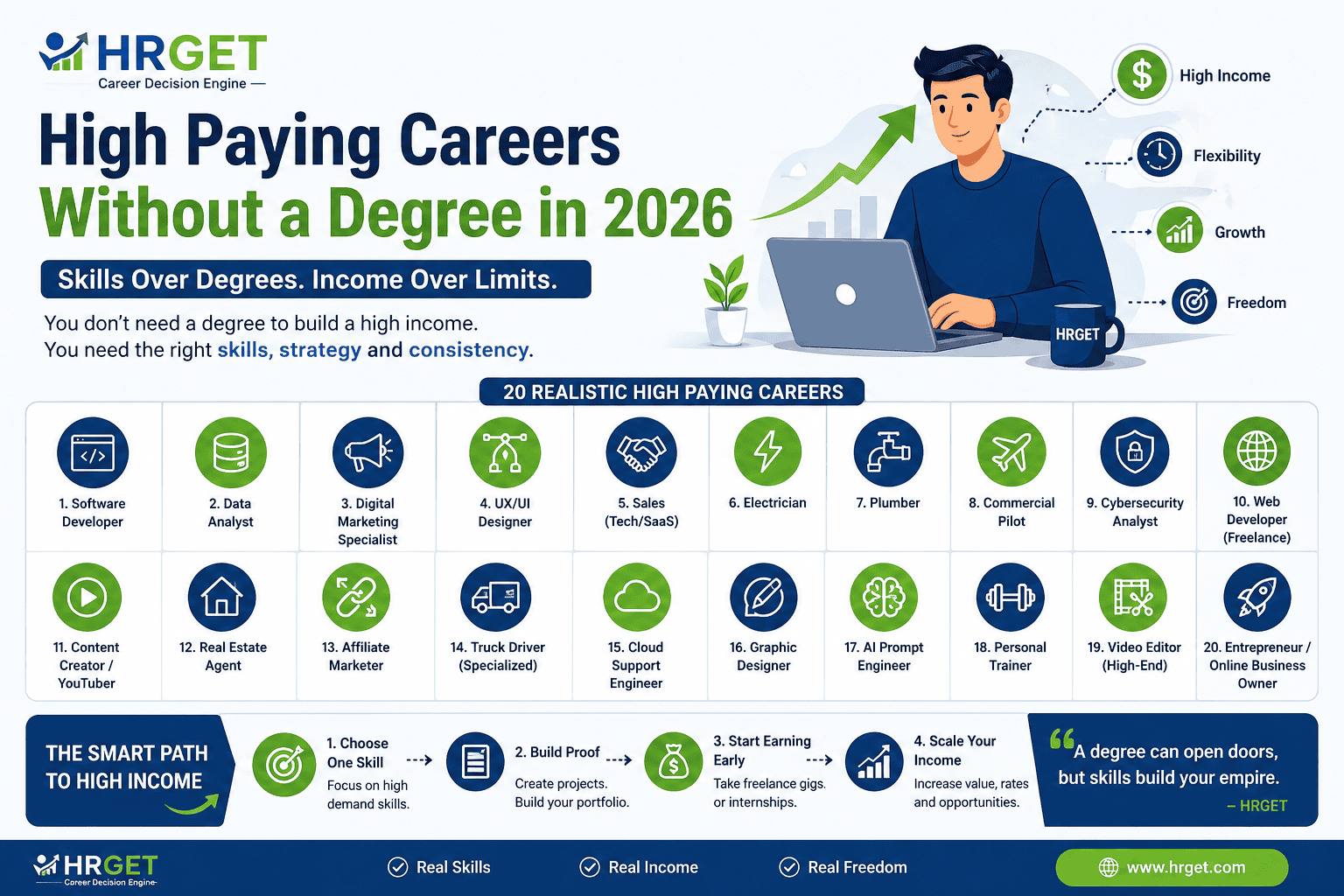
Top 20 High Paying Careers Without a Degree (2026)
I’ve organized these by income potential and entry difficulty. The ones at the top aren’t necessarily the “best” — they’re the most lucrative if you can handle a steeper early learning curve.
1. Software Developer (Self-Taught or Bootcamp)
US Salary: $80K–$180K+ | India: ₹12L–₹50L+ (with global remote work) | Entry: 6–18 months
Core skills: JavaScript, Python, React, system design basics. The entry path is a structured bootcamp (like App Academy or Springboard) or self-study via FreeCodeCamp + a strong GitHub portfolio. The brutal truth: this path has the highest ceiling on this list, but also the highest dropout rate — because most people stop when the projects get hard. Don’t. That’s exactly when you’re about to break through.
2. Data Analyst
US Salary: $70K–$130K | India: ₹8L–₹25L | Entry: 3–9 months
SQL, Excel, Power BI, and basic Python are the toolkit. Google and IBM both offer free data analytics certifications that carry genuine hiring weight. Build three or four real projects — analyze public datasets, build dashboards — and you’ve got a portfolio that beats half the degree holders in the room.
3. Cybersecurity Analyst
US Salary: $85K–$155K | India: ₹10L–₹35L | Entry: 6–12 months
The CompTIA Security+ and Google Cybersecurity Certificate are your starting point. This field has a global talent shortage — the (ISC)² 2023 workforce report cited a gap of nearly 4 million professionals. Employers are actively lowering degree requirements to fill roles. Focus on networking fundamentals, ethical hacking basics, and SIEM tools like Splunk.
4. Tech Sales (SaaS / Enterprise)
US Salary: $90K–$250K+ (base + commission) | Entry: 1–6 months with hustle
This is the fastest non-technical route to six figures on this entire list. No degree required — just coachability, persistence, and the ability to handle rejection without spiraling. Start as a Sales Development Rep (SDR), prove your numbers within 6–12 months, and you’re looking at Account Executive roles that pay $120K–$180K with commission. I’ve seen people make this leap inside 18 months.
5. Digital Marketing Specialist
US Salary: $60K–$120K | India: ₹6L–₹22L+ (freelance can 2–3x this) | Entry: 3–6 months
SEO, paid media (Google Ads, Meta Ads), analytics, and email marketing are the core skills. The freelance angle here is significant — a competent digital marketer in India who works with US or UK clients can earn ₹20L–₹40L+, billing in dollars while managing living costs in rupees. That arbitrage is real and available right now.
6. UX/UI Designer
US Salary: $75K–$145K | India: ₹8L–₹30L | Entry: 4–9 months
Figma is the industry standard tool — learn it deeply. Pair it with user research methodology, prototyping, and basic accessibility standards. Your portfolio is everything here. Three to five well-documented case studies showing your design process (not just the final screens) will get you interviews at companies that explicitly don’t require degrees.
7. Cloud Support / Cloud Engineer
US Salary: $80K–$145K | India: ₹10L–₹35L | Entry: 6–12 months
AWS Certified Solutions Architect, Google Cloud Associate, or Azure Fundamentals — these certifications carry more weight in hiring conversations than a generic IT degree. AWS and Microsoft both offer structured learning paths. I’ve reviewed job postings at Amazon, Microsoft, and Google where certifications explicitly substitute for a four-year degree requirement.
8. Electrician
US Salary: $65K–$105K (master electrician: $120K+) | UK: £40K–£75K | Entry: Apprenticeship (3–5 years)
Here’s what most career guides won’t say: skilled trades are aging out faster than any digital profession. The average age of a US electrician is over 40. By 2030, the demand gap for licensed electricians is projected to be in the hundreds of thousands. You earn while you learn (apprentice wages start around $18–$22/hr in the US), and there’s zero automation risk. A robot cannot rewire a building.
9. Plumber
US Salary: $58K–$125K (own business: higher) | UK: £35K–£70K | Entry: Apprenticeship
Same argument as electricians. Strong union protections in the US and UK, extremely stable demand, and the potential to start your own business within 5–7 years. Master plumbers who run their own operations routinely earn $150K–$200K+. The upfront time investment is real, but so is the long-term ceiling.
10. Freelance Web Developer
Income: $40K–$200K+ (project-based, location-independent) | Entry: 4–8 months
WordPress, Webflow, and Shopify specialism are the fastest routes to paying clients. You don’t need to be a software engineer. You need to build things that work and communicate well with non-technical clients. Upwork, Toptal, and direct LinkedIn outreach are your three acquisition channels. Rates for experienced freelancers on US projects: $75–$150/hr.
11. AI Prompt Engineer / AI Workflow Specialist
US Salary: $90K–$165K | India: ₹15L–₹45L (global remote) | Entry: 3–6 months
This is 2026’s most undervalued career path. Companies are spending millions integrating AI tools into workflows, and they need people who understand how to use Claude, GPT-4, Gemini, and Midjourney productively — not just theoretically. No degree is ever going to be issued for this. It’s entirely skills and portfolio-based, and the demand is outpacing supply right now.
12. Real Estate Agent / Broker
Income: Commission-based — $45K (new agent) to $350K+ (top 10%) | Entry: 2–4 months (licensing)
Real estate licensing requires no degree anywhere in the US — just passing the state exam. The income distribution is steep (most new agents struggle; top agents thrive), so success depends entirely on network-building and local market knowledge. If you’re a naturally social person who enjoys property, this has a genuine $200K+ ceiling with 3–5 years of consistent effort.
13. Video Editor (High-End / Ads / YouTube)
US Salary: $60K–$125K | India: ₹8L–₹30L+ | Entry: 3–6 months
Adobe Premiere Pro, DaVinci Resolve, and After Effects are the tools. The key insight most video editors miss: specialize. General editors are cheap. Editors who specialize in direct response ads, YouTube channels with 500K+ subscribers, or corporate brand content command $80–$150/hr freelance. Niche is income.
14. Graphic Designer (Specialized)
US Salary: $50K–$105K | India: ₹5L–₹20L+ (freelance earns more) | Entry: 3–8 months
Again — specialism is everything. Logo designers are commodity. Brand identity designers for funded startups, SaaS UI designers, or motion graphic artists for brand campaigns earn 2–3x the generic rate. Build a niche portfolio on Behance and LinkedIn, and actively pitch to startup communities on Product Hunt and AngelList.
15. Truck Driver (Specialized / Long-Haul)
US Salary: $70K–$125K (hazmat / specialized: higher) | Entry: CDL training, 3–6 months
Owner-operators — drivers who own their rigs — can earn $150K–$200K. The trade-off is lifestyle: extended time away from home. Hazardous materials (hazmat) endorsements and tanker certifications push base pay significantly higher. It’s not glamorous, but a 28-year-old with no degree and a CDL can be earning more than a 28-year-old with a humanities degree and $80K in student loans within 18 months.
16. Content Creator / Affiliate Marketer
Income: Highly variable — $20K to $500K+ | Entry: 6–18 months to meaningful income
I’ll be honest — this is the one with the most survivors’ bias in career advice content. For every YouTuber earning $200K, there are 500 who quit at 18 months. That said, niche content sites with SEO-driven traffic and affiliate monetization are genuine businesses. Finance, health, tech, and career content niches have the highest RPMs and affiliate commissions. Treat it like a business, not a hobby.
17. Personal Trainer (Premium / Online Coaching)
Income: ₹10L–₹30L+ (India online) / $60K–$150K+ (US, premium clients) | Entry: 3–6 months
NASM or ACE certification is your baseline. The money, however, is in online coaching + content. Trainers who build a following on Instagram or YouTube and transition to group coaching programs routinely break ₹25L–₹40L per year in India without leaving their city. The jump from in-person sessions at ₹500/hr to a group program at ₹15,000/month per client is what changes everything.
18. Commercial Pilot
Salary: $100K–$250K+ (captain level) | Entry: Flight school, 2–3 years
In the US, a degree is not federally mandated to earn an Airline Transport Pilot (ATP) certificate — flight hours and training are what matter. Regionally in India and the UAE, the DGCA and GCAA issue CPL licenses through flight academies without requiring a bachelor’s degree. Upfront cost is high (₹40L–₹70L for training in India), but the earning trajectory is among the strongest on this list.
19. Insurance Broker / Financial Sales
US Income: $55K–$200K+ (commission) | India: ₹8L–₹40L+ | Entry: 1–3 months (licensing)
This is one of the most underrated paths on this list. Insurance brokers who specialize in commercial lines (business coverage, professional liability) routinely earn $120K–$180K without a degree. The IRDA in India and state licensing boards in the US require exams, not degrees. Top performers build renewal-based income that compounds every year — that’s the part no one talks about.
20. Entrepreneur / Online Business Owner
Income: Unlimited ceiling, high variance | Entry: Depends on the model
This includes e-commerce, SaaS micro-products, consulting, and productized services. No degree required — ever. What’s required is a specific market problem, a scalable model, and the stomach for 12–24 months of low or zero income before things click. Most people aren’t built for that window. The ones who are often change their financial trajectory permanently.
Highest ROI Career Paths: Fastest to $100K Without a Degree
If your goal is maximum income in minimum time, here’s how the top five stack up:
| Career Path | Avg Time to $100K | Upfront Investment | Location Flexibility |
|---|---|---|---|
| Tech Sales (SDR → AE) | 12–24 months | Low (free training) | Remote possible |
| Software Development | 18–30 months | Medium ($5K–$15K bootcamp) | Fully remote |
| Cybersecurity | 18–36 months | Low-Medium (certs) | Mostly remote |
| Cloud Engineering | 18–30 months | Low (certs only) | Fully remote |
| Freelance Web Dev | 24–36 months | Low (self-taught) | Fully remote |
Notice what all five have in common: global demand, remote access, and skill-based hiring. These aren’t flukes. They’re structural advantages that no credential shift is going to remove.
Real Scenario: From ₹0 to ₹22L Without a Degree
Let me give you a realistic composite — based on people I’ve either coached or seen go through this path.
Rahul, 24, Tier 2 city, no degree
Month 1–3: Learned basic SEO and WordPress via free resources. Built two test blogs. Month 4–8: Landed first freelance client at ₹15,000/month writing and optimizing content for a US-based SaaS company. Month 9–18: Expanded to three clients at ₹25,000–₹40,000/month each. Built a niche content site on the side. Year 3: Niche site earning ₹8L/year in AdSense + affiliate. Freelance client income at ₹14L/year. Total: ₹22L.
What made the difference wasn’t talent. It wasn’t luck. It was compounding one skill consistently for three years, not chasing three different paths at once. That’s the pattern I see repeatedly — across markets, across income levels.
Smart Strategy: How to Enter These Careers Fast
Most people waste 12–18 months in a preparation loop that never ends. Here’s how to avoid that:
Step 1: Pick One Skill That Has Market Demand
Not what you’re passionate about — what people are hiring for or willing to pay for. Cross-reference LinkedIn job postings and Upwork/Toptal demand in your target field before you commit. Pick one. Not two. One.
Step 2: Build Proof, Not Just Certificates
A certificate tells an employer you sat through a course. A portfolio of real work tells them you can actually do the job. Build 3–5 real projects — websites for local businesses (even free), data dashboards, security audit reports — anything that demonstrates output. Portfolio beats resume every time in skill-based hiring.
Step 3: Start Earning Within 90 Days — Even Small
Freelance gigs, small contracts, internships with real output — start monetizing within 3 months of learning. This creates two things: real-world feedback that accelerates your learning faster than any course, and psychological momentum that keeps you moving when the early grind feels pointless.
Step 4: Scale Income — Don’t Just Work More Hours
The income jump comes from one of three moves: switching to a higher-paying employer once you have 12+ months of provable results; raising your freelance rates as your portfolio matures; or building income assets — content sites, tools, productized services — that generate revenue without trading time for money. Pick whichever fits your career model.
Pro Tip: The biggest income unlock in any of these careers is positioning, not just skill level. A web developer who says “I build websites” earns less than one who says “I build conversion-optimized Shopify stores for DTC brands that do $1M+ in revenue.” Same skill. Completely different price point.
Common Mistakes That Keep People Stuck for Years
I’ve seen these patterns repeat across dozens of people I’ve coached. Knowing them in advance saves you 12–18 months of frustration.
❌ Trying to learn three skills at once. This creates shallow competence in everything and genuine competence in nothing. Employers don’t hire well-rounded beginners. They hire people who are exceptional at one specific thing. Pick your lane and stay in it for at least 12 months.
❌ Consuming content instead of creating output. Watching tutorials feels productive. It isn’t — not until you’re building alongside them. Every hour of learning should be matched with 30–45 minutes of application. If you can’t build something with what you just learned, you haven’t learned it yet.
❌ Chasing passion over market demand. Passion matters — but passion with no market demand produces low income. Find the overlap between what you can learn to do well, what the market pays for, and what you find sustainable for 3+ years. That Venn diagram intersection is your target.
❌ Expecting income before month 6. Most high-income skills require 6–18 months before you’re earning meaningfully. The people who drop out at month 4 because “it’s not working” are the ones who were 8 weeks away from the breakthrough. Set a 12-month runway mentally before you start.
❌ Undervaluing sales and visibility. The formula is: income = skill × visibility. A $120K developer who has zero LinkedIn presence is invisible. The $90K developer who shares work publicly, networks at conferences, and shows up consistently online often earns more over time — because opportunity finds visible people. Don’t skip this step.
Final Verdict: Is This Path Right for You?
Let’s be honest about who this works for and who it doesn’t.
| This path works if you… | This path won’t work if you… |
|---|---|
| Can stay focused on one skill for 12+ months | Need guaranteed structure and a formal paycheck from day one |
| Want control over your income ceiling | Avoid taking initiative without being told what to do |
| Are okay building before you’re recognized | Expect results before you’ve built real proof |
| See learning as a lifelong career tool | Want to learn once and stop once you reach stability |
In 2026, high paying careers without a degree are more accessible than at any point in modern employment history. But the path is still a path — it requires direction, time, and discipline. Degrees are now optional for more jobs than ever before. Discipline never is.
Pick one path from this list. Commit to it for 12 months. Track income, not effort. That’s how people actually break out — not by finding the perfect path, but by going deep on a good one.
Once you’re earning, the next challenge is negotiating what you’re worth. Read our guide on how to negotiate your compensation like a professional — the principles apply whether you’re salaried or freelance.
FAQs: High Paying Careers Without a Degree
Can I realistically earn $100K without a degree?
Yes — but only in the right fields. Tech sales, software development, cloud engineering, and cybersecurity all have documented $100K+ earners without degrees. The path takes 18–36 months of focused skill-building and portfolio development. It’s not fast, but it’s real and repeatable.
Which high-paying career is easiest to break into without a degree?
Digital marketing and tech sales have the lowest entry barriers. Digital marketing can be self-taught via free resources in 3–4 months. Tech sales requires no technical skills — just strong communication and coachability. Both have clear hiring paths and real income potential within your first year.
How long does it take to become job-ready without a degree?
For most skill-based careers: 3–6 months to be minimally hireable, 9–18 months to be competitive for mid-level roles. Trades (electrician, plumber) take 3–5 years through apprenticeship programs. Cloud and cybersecurity certifications can get you interview-ready in 6–9 months with dedicated daily study.
Are certifications worth it if you don’t have a degree?
Only if they unlock interviews or client trust. AWS, CompTIA Security+, Google’s data analytics certificate, and NASM (personal training) all have genuine hiring weight. Generic online course certificates from minor platforms don’t. The test: does this certification appear in job postings from companies you want to work for?
What is the safest high-paying career without a degree?
Licensed trades — electrician and plumber — are the most stable options. Demand is structurally high, automation risk is near zero, union protections exist in most markets, and income grows steadily with experience and licensing levels. The tradeoff is a 3–5 year apprenticeship before you’re fully licensed.
What are the best high-paying career options without a degree in India?
In India, the highest-leverage paths are: freelance digital marketing and SEO (billing global clients in USD), self-taught software development with a strong GitHub portfolio, online fitness coaching with content, and cloud certifications leading to remote IT roles. The geographic arbitrage for India-based freelancers working with Western clients is one of the strongest income accelerators available right now.
Can I switch from a low-paying job to a high-income career without going back to school?
Yes — and this is one of the most common transitions I’ve advised on. The practical approach: start learning your target skill in the evenings and weekends (10–15 hours/week), build your portfolio while still employed, land your first client or junior role, then transition fully once income replaces at least 70–80% of your current salary. Don’t quit until you have proof the new path is working.

Jonathan Reed: Executive Career Strategist & Leadership Advisor | Former Partner, McKinsey & Company | Executive Coach to Amazon & Unilever Leaders | 18+ Years in Career Strategy
Jonathan Reed spent nearly two decades as a Partner at McKinsey & Company, where he advised organisations on leadership development, talent strategy, and organisational design across the US, UK, and Asia. Since leaving consulting, he has worked as an executive coach to senior leaders at Amazon, Unilever, and a clutch of high-growth scale-ups — helping them navigate promotions, career pivots, and the unwritten rules of visibility and influence at the top. Based between London and New York, Jonathan writes for HRGet.com to give working professionals an honest look at how careers actually scale — and why so many talented people stall without ever knowing why.