
Here’s the uncomfortable truth most offer letters won’t tell you: a higher salary in a new city doesn’t automatically mean a better financial life. I’ve seen this play out more times than I’d like — a senior product manager moves from Austin to San Francisco for a $35K raise, and within eight months they’re calling me asking how to negotiate an exit package because they can’t afford to stay.
The culprit? They never ran a proper cost of living calculator comparison before signing. They compared gross salary figures, not real-world financial outcomes. And that’s a mistake that costs real money.
This guide walks you through exactly how to evaluate a relocation offer the right way — with a step-by-step framework, a real scenario breakdown, city-specific tax traps, and a negotiation script you can use today. Whether you’re weighing New York vs. Chicago, Bangalore vs. Hyderabad, or London vs. Manchester, the methodology is the same.
What a Cost of Living Calculator Actually Tells You (and What It Doesn’t)
A cost of living calculator answers one core question: how much would you need to earn in City B to maintain your exact lifestyle from City A? Tools like the MIT Living Wage Calculator, NerdWallet’s Cost of Living tool, and CNN Money’s calculator index cities across housing, taxes, transportation, food, healthcare, and childcare.
Here’s what they’re good at: housing and tax benchmarks. These two factors alone can swing your real income by 20–40%, and calculators capture them fairly well.
Here’s what they miss: your lifestyle. If you eat out four nights a week in Bangalore at ₹800 a meal, that same habit in Mumbai will cost ₹2,200+. If you drive everywhere in Dallas, the walkability of Manhattan adds subway costs but removes car insurance. Generic calculators can’t personalize for you — which is why you need the step-by-step framework below, not just a number from a tool.
Use calculators as a starting benchmark. Then stress-test that number against your actual spending patterns.
Why Salary Comparisons Mislead Almost Everyone
Most job decisions reduce to one emotional moment:
“I’m getting a 30% raise. Of course I should take it.”
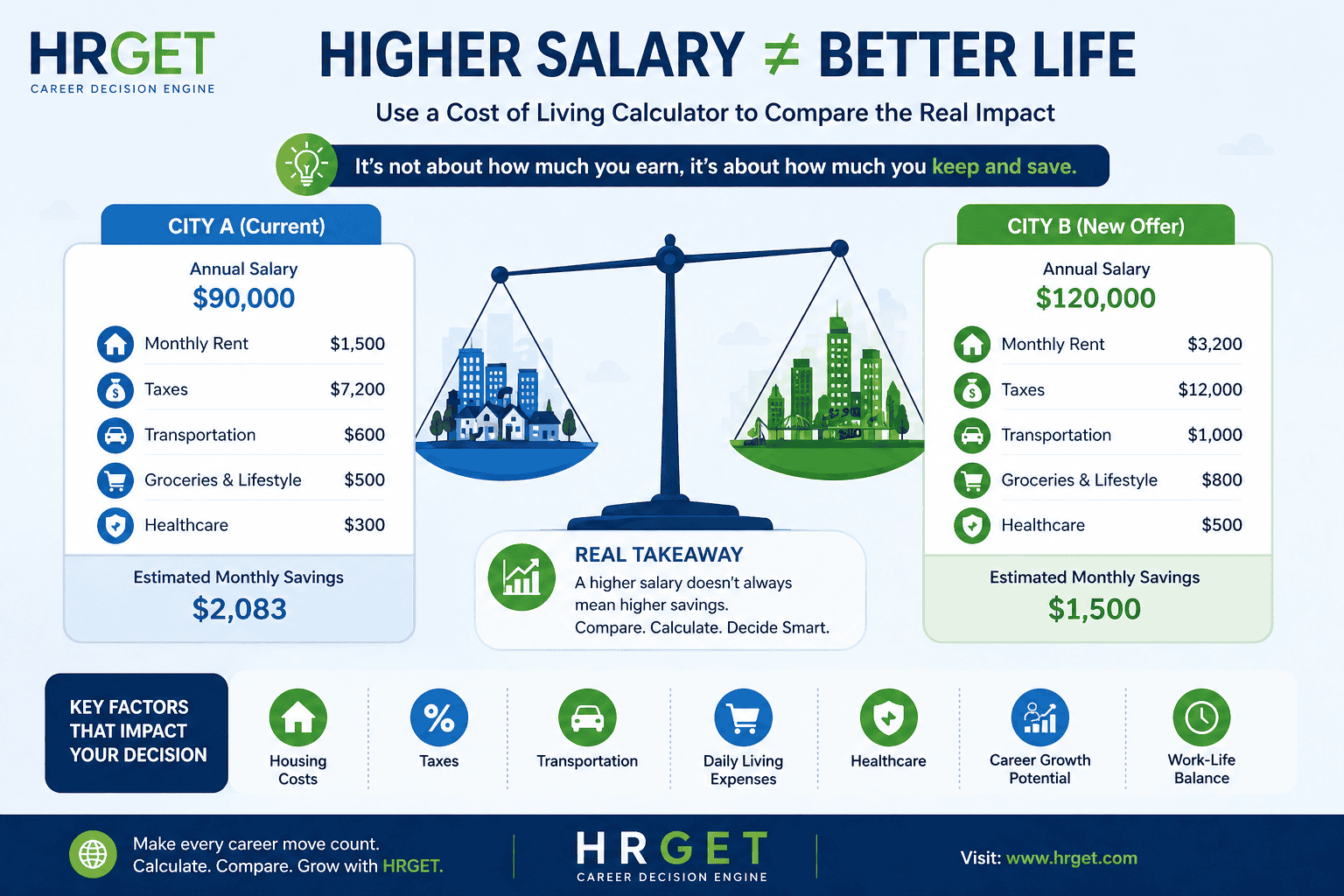
That instinct is understandable. It’s also frequently wrong. Because gross salary tells you nothing about purchasing power — which is what actually determines your quality of life.
Consider this table. Same professional, two cities, $30K difference in salary:
| Factor | City A (Austin, TX) | City B (San Francisco, CA) |
|---|---|---|
| Gross Salary | $95,000 | $130,000 |
| State Income Tax | $0 (no state tax) | ~$9,750 (9.3% bracket) |
| Monthly Rent (1BR) | ~$1,600 | ~$3,400 |
| Commute Cost (monthly) | ~$200 (car) | ~$150 (transit) + time |
| Estimated Annual Savings | ~$26,000 | ~$17,000 |
On paper: a promotion. In practice: a $9,000/year savings downgrade — with more stress, a longer commute, and higher lifestyle costs on top.
This is why the salary number is the worst place to start your evaluation.
How to Evaluate a Job Offer in a New City: A 6-Step Framework
I’ve walked dozens of professionals through this exact process. Here’s the sequence that actually works.
Step 1: Lock In Your Current Lifestyle Baseline
Before you look at the new salary, document your current financial reality — not your budget, your actual spending. Pull three months of bank statements and answer these:
- What do you save each month, on average?
- What percentage of take-home goes to rent?
- What does your social/lifestyle spending look like?
- How many hours does commuting consume per week?
This baseline is your benchmark. Every new city number gets measured against it — not against an idealized budget you’ve never actually lived on.
Step 2: Run the Cost of Living Adjustment
Now plug your current salary into a city comparison tool (NerdWallet, CNN Money, or Numbeo for international moves). The output you want is the equivalent salary — the amount you’d need in City B to match your purchasing power in City A.
If the offer is at or above that equivalent salary, you’re at break-even or better. If it’s below — and many offers are — you need to either negotiate or walk away.
Step 3: Compare After-Tax Take-Home, Not CTC
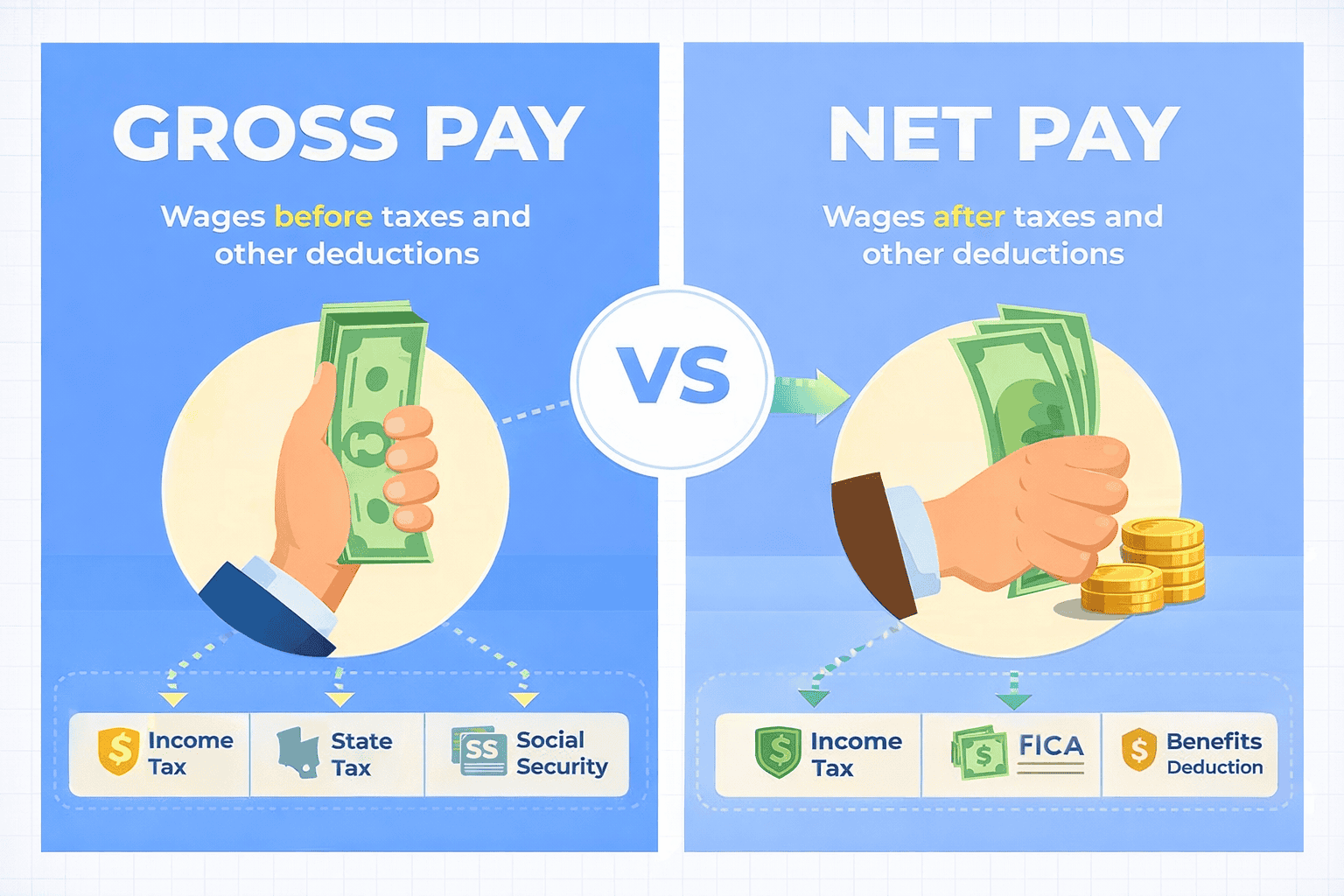
This is the step most candidates skip, and it’s where offers fall apart. Use a paycheck calculator (Smartasset, PaycheckCity, or ClearTax for India) to calculate your monthly after-tax income in both cities.
$120K in California nets approximately $7,200/month after state + federal tax. The same $120K in Texas nets around $8,500/month. That $1,300 monthly gap — $15,600 annually — is real money that doesn’t show up on the offer letter.
Step 4: Stack Your Fixed Costs First
Fixed costs are non-negotiable drains. List them for the new city and subtract them from take-home before you even think about lifestyle:
- Rent or mortgage — use Zillow, Zumper, or Housing.com for India
- Childcare — if applicable, this alone can run $2,000–$4,000/month in NYC or London
- Health insurance — if the new employer’s plan is weaker, budget the difference
- Transportation — car payment, insurance, parking, or transit passes
What’s left after fixed costs is your discretionary income. That’s what you actually live on.
Step 5: Estimate Lifestyle Costs in the New City
These are the costs that surprise people. Groceries in San Francisco run roughly 15–20% higher than Austin. A gym membership in Manhattan averages $120–$180/month versus $30–$60 in Raleigh. Eating out, weekend activities, personal care — they all scale up in major metros, and they scale fast.
Don’t guess. Use Numbeo.com to compare city-specific cost indices for food, entertainment, and utilities. It’s imperfect but far better than assuming your current spending habits transfer unchanged.
Step 6: Calculate Your “Real Upgrade Score”
Score the move across three dimensions:
- Will my monthly savings increase?
- Will my commute time stay the same or decrease?
- Will my stress level remain manageable?
If two out of three are worse in the new city, that’s a red flag — regardless of what the gross salary says. If all three improve, it’s probably a good move. The gray zone is when one dimension improves significantly (say, career trajectory) while the others take a short-term hit. That’s where judgment, not math, has to carry the decision.
Real Scenario: The $130K Offer That Became a $9K Annual Loss
A software engineer — let’s call him Raj — came to me after accepting a role in San Francisco at $130K. He’d been making $95K in Austin and thought the 37% raise was a no-brainer.
Six months in, here’s what his numbers actually looked like:
- Rent jumped by $1,800/month (from $1,600 to $3,400)
- California state income tax added $9,750/year in new liability
- Commute: no car needed, but 90 minutes daily — gone
- Food costs up roughly $400/month
His annual savings dropped from $26,000 in Austin to around $17,000 in San Francisco. He was earning $35,000 more on paper and saving $9,000 less in practice.
He moved back to Austin eleven months later. The offer wasn’t bad — the decision-making process was. He never ran a proper cost of living comparison before signing.
Lesson: A salary increase is a number. A life upgrade is a calculation.
Key Factors Most People Ignore When Comparing Cities
State and Local Tax Differences
Nine US states have no state income tax: Texas, Florida, Nevada, Washington, Tennessee, Wyoming, South Dakota, Alaska, and New Hampshire. California tops out near 13.3%. New York City adds its own city-level tax on top of the state rate.
For a $130K salary, moving from Texas to California represents a state income tax difference of roughly $10,000–$12,000 per year. That’s not a rounding error — that’s a car payment, or six months of groceries. Always model the tax gap before anything else.
Rent Inflation Trajectory (Not Just Today’s Rate)
Here’s what most comparison tools don’t show: how fast rents are rising. A city might look affordable today — Miami looked cheap in 2018 — but if rent is climbing 8–12% annually, your “good deal” lease becomes a financial problem at renewal. Before you commit, check a city’s 5-year rent trend on Apartment List’s National Rent Report or Zillow Research.
Commute Time as a Financial Asset
Time is money, but it’s rarely modeled in salary comparisons. A 90-minute daily round trip adds up to roughly 450 hours per year — the equivalent of 11 full working weeks. If you value your time at $40/hour, that commute costs you $18,000 annually in lost time. Some people accept that trade. Most people would reconsider if it was put that plainly.
Career Growth vs. Immediate Pay: The Long-Term Calculation
Sometimes a move makes sense even when the short-term numbers are worse. A one-year stint at a FAANG company in Seattle or a top finance firm in London can add $15–25K to your next base salary through brand association alone. If the move improves your earning trajectory for the next decade, a 12-month financial sacrifice might be entirely rational — as long as you know that’s the deal you’re making.
The professionals who regret relocation didn’t do the math wrong. They didn’t do it at all.
Smart Strategy: How to Use Cost of Living Data in Salary Negotiations
This is where most candidates leave real money on the table. They either accept the offer as-is, or they ask for more salary without any supporting logic. Both approaches are weak.
Here’s the framing that actually works in 2026:
“Based on the cost of living differential between [City A] and [City B], along with the tax impact, my equivalent take-home would require a base of $X to match my current lifestyle. I’d like to discuss how we can bridge that gap — either through base, a relocation package, or a housing allowance.”
That framing is rational, data-backed, and non-confrontational. It’s not “I want more money.” It’s “here’s what the math shows, let’s solve it together.” Recruiters and hiring managers respond very differently to those two approaches.
Beyond base salary, here’s what’s actually negotiable when relocating:
- Relocation bonus — typically $5,000–$20,000 for professional roles; sometimes more for senior positions
- Housing allowance — especially common in financial services and consulting for international moves
- Signing bonus — a one-time payment that helps bridge the gap while you find affordable housing
- Remote flexibility — if you can work remotely 2–3 days/week, you may be able to live in a cheaper suburb and commute part-time
- Earlier performance review — negotiate a 6-month review instead of 12-month, with a salary adjustment tied to performance
The worst thing you can do is negotiate on instinct. Bring the numbers. They do the heavy lifting for you.
Common Mistakes That Cost Professionals Thousands
Mistake 1: Comparing gross salary, not take-home pay. The offer letter shows $130K. Your bank account shows something much lower. Always model your monthly net income — not your annual CTC — for both cities.
Mistake 2: Ignoring state and local taxes. I still see sharp professionals miss this one. It’s not a detail — it can represent 8–12% of your salary in high-tax states. Run the numbers on SmartAsset or use your state’s tax authority calculator.
Mistake 3: Using first-month rent, not renewal-month rent. Landlords often offer a below-market rate for new leases and adjust aggressively at renewal. Budget for 10–15% rent inflation in fast-moving markets like Miami, Austin, or London’s outer zones.
Mistake 4: Underestimating lifestyle creep. Moving to a bigger city almost always expands spending. New social circle, new neighborhood, new standards. Budget a 10–15% lifestyle cost buffer for the first 6 months until you recalibrate.
Mistake 5: Not building an exit clause. Before you relocate, confirm: if this doesn’t work, how easy is it to find another role here? Strong job markets (NYC, London, Bangalore tech corridor) give you optionality. Thin markets leave you stuck.
Pro Tip: Ask the Wrong Question and You’ll Get the Wrong Answer
Most people ask: “Is this offer better than what I have?” The smarter question is: “Will my earning trajectory in five years be meaningfully better if I take this move?” A short-term financial sacrifice — say, breaking even for 12 months — can be worth it if it lands you at a company whose alumni consistently earn 20–30% more in their next role. Brand association compounds. Make sure the trade is explicit and deliberate, not accidental.
Should You Take That Offer? A Brutally Honest Decision Framework
Stop deciding with your gut. Here’s a clear framework:
| Scenario | Recommendation |
|---|---|
| Real savings increase + career growth + acceptable lifestyle | Take it. This is the full trifecta. |
| Real savings neutral + significant career upside | Negotiate first, then consider. You have leverage. |
| Real savings drop + similar career path | Renegotiate or decline. The math doesn’t work. |
| Real savings drop + massive brand / trajectory upside | Gray zone. Model 5-year outcomes before deciding. |
| Moving for the salary alone, no career growth signal | High risk. Don’t relocate for money alone. |
One more thing I’ll add from experience: the professionals who are happiest with relocation decisions are the ones who made them with clear eyes — not the ones who got the biggest salary bump. Clarity is worth more than a few extra thousand dollars.
FAQ: Cost of Living Calculator & Job Offer Decisions
How accurate are cost of living calculators?
Directionally accurate — not precise. These tools index average spending patterns across a city, which won’t match your individual habits exactly. Use them to establish a rough equivalent salary, then stress-test that figure against your actual spending baseline. Treat the output as a floor, not a ceiling.
What is the single biggest factor in cost of living differences between cities?
Housing. Every time. Rent or mortgage costs can vary by 100–200% between cities at similar salary levels. Healthcare and childcare come second, particularly in the US. Everything else — food, transport, utilities — matters, but housing is the variable that will make or break your financial outcome in a new city.
Should I relocate for a 20% salary increase?
Only if the after-tax, after-housing math still leaves you better off — or if the career trajectory justifies the short-term cost. A 20% gross raise can easily become a 5–10% real-income gain after taxes and rent increases in high-cost cities. Run the numbers before you commit, not after you sign.
Which US cities have the highest hidden costs for relocating professionals?
San Francisco, New York City, Boston, and Seattle consistently top the list for hidden financial drag — high state income taxes, aggressive rent markets, and elevated lifestyle costs. Conversely, Austin, Nashville, Raleigh, and Jacksonville offer strong professional ecosystems with substantially lower cost burdens. Outside the US, London and Sydney follow similar patterns to high-cost US metros.
Is it better to live in a cheaper city and work remotely?
For many professionals in 2026, yes — this is one of the highest-ROI career strategies available. Earning a Tier 1 city salary while living in a Tier 2 or Tier 3 city (whether that’s Raleigh vs. NYC, or Pune vs. Mumbai) creates a significant savings advantage that compounds quickly. The constraint is career ceiling — some roles still require physical presence for promotion and visibility.
How do I properly compare two competing offers in different cities?
Compare monthly after-tax take-home, subtract estimated fixed costs (rent, insurance, transport, childcare), and look at the remaining discretionary income. Then layer in qualitative factors: career trajectory, network quality, exit optionality, and personal lifestyle fit. The best offer isn’t always the highest salary — it’s the one that optimizes across all of those dimensions.
Should I factor in inflation when evaluating a relocation offer?
Absolutely — especially for long-term moves. If rent in your target city has been rising 8–10% annually, a salary that works today may feel tight in three years without a corresponding pay increase. Ask your new employer about their annual merit increase cycle and average raise percentages before signing. This is a legitimate question — and the answer tells you a lot.
The Bottom Line on Using a Cost of Living Calculator
Most relocation decisions are made emotionally and justified financially — after the fact. The professionals I’ve seen make the best moves are the ones who reversed that order: they did the math first, built a clear-eyed picture of what life actually costs in the new city, and either negotiated a package that made sense or walked away with confidence.
A cost of living calculator is your starting point, not your answer. The answer comes from combining that data with your actual spending baseline, your after-tax take-home, your fixed costs in the new city, and an honest assessment of where this move takes your career in 5 years — not just this year.
Run the numbers. Negotiate with data. And don’t sign an offer letter until you know what the move actually costs you.
If you’re navigating a job offer that includes a salary package you’re not sure about, read our guide on how to negotiate a compensation package for strategies you can use before you sign.

Eleanor Whitmore | Former Partner, Mercer | Advisor, World Economic Forum | 20+ Years in Global Compensation
Author bio: Eleanor Whitmore has spent over two decades shaping how the world’s leading organisations pay, retain, and reward talent. As a former Partner at Mercer and an advisor to World Economic Forum working groups on the Future of Work, she has designed compensation frameworks for Fortune 500 companies across the US, UK, Europe, and emerging markets. Based between London and New York, Eleanor writes for HRGet.com to translate boardroom-level pay strategy into actionable guidance for working professionals navigating real compensation decisions.