

Updated: June 2026 | Career Growth
If you’ve ever felt like your career is “stuck” — not failing, but not moving either — you’re not alone. Career stagnation is one of the most common problems I see among mid-level professionals, and it’s also one of the most underdiagnosed.
Here’s the uncomfortable truth: career stagnation rarely feels dramatic. It creeps in quietly. No promotions. No new challenges. Same work, different day. And most people ignore it until it’s too late to course-correct without significant pain.
I’ve spent 18 years coaching senior leaders and high-potential professionals across McKinsey, Amazon, and Unilever. The pattern I keep seeing? The professionals who fall furthest behind aren’t lazy. They’re just not paying attention to the right signals.
This guide will help you identify the real career stagnation signs — not just temporary slowdowns — and give you a practical, no-nonsense plan to get moving again.
What Is Career Stagnation (Really)?
Most people define career stagnation as “not getting a promotion.” That’s too narrow — and it causes people to miss the real problem until it’s already baked into their profile.
Career stagnation is what happens when your professional trajectory flatlines. Specifically, it’s when:
- Your skills stop growing — you’re doing the same things you were doing 18 months ago
- Your market value plateaus — what a competitor would pay you hasn’t changed
- Your work becomes predictable and repetitive — no stretch, no discomfort, no learning
- Your income growth slows below inflation — you’re effectively earning less every year in real terms
The key idea: if your professional future looks identical to your present, you’re stagnating.
What makes this tricky is that stagnation can feel comfortable. A stable job, a familiar team, no drama. But comfort without growth isn’t a career — it’s a holding pattern. And in 2026’s job market, holding patterns don’t hold for long.
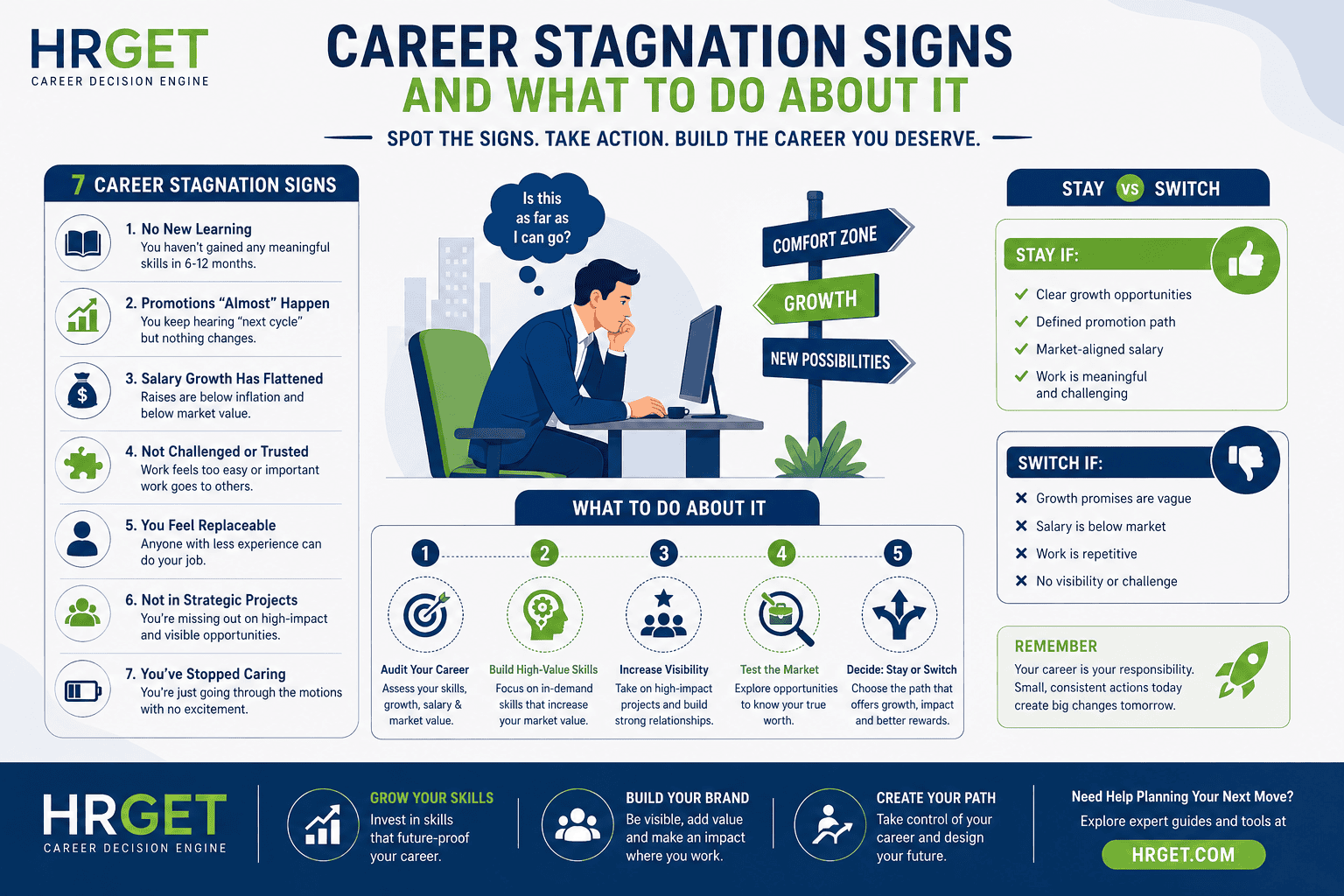
Top Career Stagnation Signs You Shouldn’t Ignore
These are the signals I look for when coaching professionals who feel “off” but can’t quite name why. If three or more of these apply to you, you’re not in a slow patch — you’re stagnating.
1. You Haven’t Learned Anything Meaningful in 6–12 Months
If your daily work feels like muscle memory — if you could do it half-asleep — that’s a red flag. Real professional growth feels slightly uncomfortable. The moment your job stops stretching you, your market value starts slipping. Think about it: what new capability did you add this year that you could put on your CV right now?
2. Promotions Keep “Almost” Happening
You hear phrases like “next cycle,” “you’re on track,” or “just a little more time.” But the cycle comes and goes, and nothing changes. Look — I’ve sat on the other side of that conversation. When managers say “almost,” they’re often delivering a soft rejection dressed up as encouragement. A real promotion timeline has a specific date and specific criteria. Vague promises aren’t a plan; they’re a delay tactic.
Insider Note: In most companies, promotion decisions are made 2–3 months before the official review cycle. If your manager hasn’t had a concrete conversation with you about criteria and timeline by then, you’re probably not in the running for this round.
3. Your Salary Growth Has Flattened Below Inflation
If your annual raises are running at 3–5% while inflation is running at 4–6% and market salaries for your role are climbing 8–12% annually (as they have in tech, finance, and consulting markets across the US and India), you’re losing ground every year you stay. A software engineer in Bengaluru who was earning ₹22 LPA three years ago should reasonably expect ₹32–38 LPA in the same market today. If that gap isn’t closing, the number on your payslip is not the whole story.
4. You’re Not Being Trusted With Strategic Work
High-growth professionals get pulled into leadership visibility, cross-functional projects, and decisions above their pay grade. That’s deliberate — it’s how companies groom the next layer of leaders. If the interesting work keeps going to someone else, pay attention. Either you’re not being considered for growth, or your manager isn’t advocating for you. Both are worth addressing directly.
5. Someone With Less Experience Could Do Your Job
Brutal, but worth asking. If a person with 2 fewer years of experience — maybe even someone who joined your team recently — could step into your role without much ramp-up time, you haven’t been evolving with the job. This isn’t about blame. It’s a signal that your role has commoditized around you while you weren’t building differentiated skills.
6. You’ve Mentally Checked Out
This is the final stage, and the one that worries me most. You’re technically doing your job, but you don’t care about the outcomes. You clock in, you clock out, and work is something that happens to you rather than something you’re driving. At this point it’s not just a career stagnation sign — it’s a performance risk. Companies notice disengagement faster than people think.
Real Scenario: How Career Stagnation Compounds Silently
Real Scenario
Rohan joined a mid-size tech company in Pune at ₹18 LPA. Strong hire, good reviews, growing fast.
Year 1: Learning fast, two new product areas, promoted to Senior Associate.
Year 2: Solid delivery, trusted team member, 12% raise.
Year 3: Same work, similar projects, 6% raise. “Next level is being discussed.”
Year 4: No promotion. “You’re a valuable contributor.” Still ₹24 LPA.
By Year 5, Rohan discovered that new hires for similar roles were coming in at ₹26–28 LPA. His skills hadn’t meaningfully expanded beyond what he’d done in Year 2. Switching became psychologically harder — and practically harder, because his profile no longer stood out.
This is how career stagnation compounds. It doesn’t announce itself. It quietly erodes your position until moving feels risky — which is exactly when you most need to move.
Why Career Stagnation Happens (Hidden Causes)
Most articles tell you to “upskill.” That advice isn’t wrong — it’s just incomplete. Stagnation usually has a root cause that skills alone won’t fix.
The Comfort Trap
You optimize for stability. Low stress, good work-life balance, a team you like. These are real, legitimate priorities — but they come with a trade-off. Every year you choose comfort over stretch, the gap between your current skills and the market’s expectations widens. The irony is that the comfortable choice often becomes the riskier one long-term.
Poor Manager Alignment
This one is underappreciated. I’ve watched brilliant professionals stagnate for years simply because they had a manager who didn’t advocate for them in the rooms where promotions are actually decided. If your manager doesn’t sponsor you, doesn’t give you visibility, doesn’t push for your growth when budget is allocated — your career slows down regardless of how good your work is. Manager quality is arguably the single biggest factor in career velocity.
No Career Strategy — Just Reactions
Most professionals manage their careers reactively. They respond to what’s in front of them rather than engineering toward a specific outcome. No 2-year roadmap. No targeted skill-building. No deliberate positioning. The result? You drift. And drift, over time, looks like stagnation.
Over-Specialization in Low-Growth Areas
Being deeply skilled in something is valuable — unless that something is shrinking. If your expertise is in a legacy tech stack, a declining function, or a niche that’s being automated, doubling down on that specialty is a trap. Transferable skills — leadership, problem-solving, commercial thinking, AI fluency — hold their value across market cycles.
What to Do About Career Stagnation (Step-by-Step Plan)
Here’s where most career articles fall apart — they say “upskill and network” and call it done. That’s not a plan. Here’s what an actual plan looks like.
Step 1: Run a Brutally Honest Career Audit
Before you do anything else, get clear on where you actually stand. Ask yourself:
- What specific, demonstrable skills did I add in the last 12 months?
- What would a competitor company pay me today — and how does that compare to my current salary?
- Am I on a visible track for promotion, or is that conversation vague?
- Is my work producing outcomes I’m proud of, or am I just filling a seat?
If the answers are weak — or if you’re avoiding the questions — that’s your signal.
Step 2: Identify High-Leverage Skills to Build
Don’t learn randomly. Focus on skills that directly increase your earning power or make you more hireable across multiple companies. In 2026, the high-leverage areas that consistently command salary premiums include:
- AI integration and automation — applicable across almost every function
- Revenue ownership and commercial accountability — especially in B2B roles
- System design and architecture — for senior engineering tracks
- Data literacy and storytelling — cross-functional and in high demand
Step 3: Engineer Your Visibility Inside the Company
Growth doesn’t happen by doing good work quietly. It happens when the right people see you doing good work. If strategic project assignments aren’t coming to you, go find them. Volunteer for cross-functional initiatives. Ask to present to senior leadership. Propose something. Visibility is a skill, and like any skill, you can practice it.
Step 4: Test the Market — Even If You’re Not Ready to Leave
Apply to 5–10 roles. Not because you’re desperate — but because the market is the only honest mirror you have. The responses you get (or don’t get), the salary ranges you see, the feedback in interviews — all of it is real data about where you stand. This exercise alone breaks complacency. And sometimes it produces an offer that changes your entire calculation.
Step 5: Have the Conversation You’ve Been Avoiding
If you’ve identified stagnation and you want to fix it internally, you need to have a direct, specific conversation with your manager. Not “I feel stuck.” Something like: “I’d like to talk about what a promotion path looks like for me — specifically what I need to achieve and by when.” If that conversation leads to clear criteria and a real timeline, you have something to work with. If it leads to vague reassurances, you have your answer too.
Smart Strategy: Stay vs Switch Decision Framework
This is the decision that most stagnating professionals get wrong — they either leave too late out of loyalty, or they leave too impulsively out of frustration. Neither is optimal. Use logic, not emotion.
| Signal | Stay | Switch |
|---|---|---|
| Promotion timeline | Specific date + criteria | Vague or repeatedly postponed |
| Compensation vs. market | Within 10–15% of market | More than 20% below market |
| Skills development | Clear growth in the role | Same work for 12+ months |
| Manager quality | Active sponsor and advocate | Passive, indifferent, or blocking |
| Switching upside | Less than 20% gain | 30–50%+ upside available |
Simple rule: If switching gives you a 30–50% upside in salary, skills, or title — staying needs a very strong, concrete reason. “I like my team” doesn’t clear that bar.
Common Mistakes That Make Career Stagnation Worse
Waiting Too Long to Act
Stagnation compounds. The longer you stay in a plateau, the harder it becomes to exit gracefully — your confidence drops, your profile ages, and hiring managers start asking questions about the gap between your title and your tenure. Acting 12 months into stagnation is a minor correction. Acting at 36 months is a major intervention.
Confusing Loyalty With Strategy
Companies reward impact, not tenure. The professionals who get the fastest promotions and biggest raises are the ones who make themselves hard to replace — not the ones who stay the longest. Loyalty is a personal value. It’s not a career strategy. If you’ve stayed 4+ years in a role that stopped growing you 2 years ago, loyalty has cost you real money and real opportunity.
Learning Without Direction
Taking random courses and adding certifications to your profile without a clear outcome in mind is a productivity trap that feels like progress. Before you spend 3 months on a certification, ask: will this qualification make me more hireable for roles that pay 20%+ more? If you can’t answer yes confidently, revisit the decision.
Tracking Growth Without Tracking Pay
Many professionals focus exclusively on learning and impact while letting compensation fall behind. Growth and pay are not separate metrics — they’re linked. If your skills are genuinely growing but your salary isn’t, you’re subsidizing your employer’s talent retention problem. Track both.
Pro Tips From an HR Insider
Here’s what happens inside organizations that most professionals never see:
- Promotions are often decided 2–3 months before review cycles — in informal conversations between senior leaders, not in formal calibration meetings.
- Visibility in leadership meetings carries more weight than performance scores in many organizations. If your name isn’t being said in the right rooms, your rating doesn’t matter as much as you think.
- External hires almost always get higher starting salaries than internal promotions for equivalent roles. That’s not an accident — it’s how compensation systems are built.
- Hiring managers in 2026 are paying close attention to recent impact, not historical reputation. What you did 3 years ago at a previous employer is increasingly irrelevant without something current to anchor it.
The takeaway: if you’ve been stagnant for 12–18 months and internal paths aren’t opening up, an external move is often the fastest and highest-ROI way to reset your trajectory.
Final Takeaway
Career stagnation isn’t a phase you should “wait out.” The professionals who recover fastest are the ones who spot the signs early, run an honest audit, and take deliberate action — whether that’s engineering visibility internally, building targeted skills, or testing the external market.
The one thing that makes career stagnation permanent? Doing nothing.
If nothing changes in the next 12 months — where will your career be? If that question makes you uncomfortable, you already know what to do. Start with Step 1 above.
Related reading: If you’ve decided to push for a promotion internally, read our guide on how to ask for a promotion — and actually get it.
Frequently Asked Questions
How do I know if I’m truly stagnating or just going through a slow phase?
The clearest test: if there’s been no meaningful skill growth and no income growth for 12 or more consecutive months, that’s stagnation — not a slow phase. Temporary slowdowns usually come with a clear end point (a company restructure, a budget freeze). Stagnation is structural, not situational. If you can’t point to a specific reason why things are slow and a date when they’ll improve, assume it’s stagnation and act accordingly.
How long is too long in one role without a promotion?
Three to four years without meaningful title progression or compensation growth is a strong warning signal in most corporate environments. There are exceptions — individual contributor tracks in deep technical roles, for example — but as a general rule, if you’ve been at the same level for more than three years and can’t point to a clear, credible path forward, that’s worth addressing directly with your manager now rather than in another year.
Should I quit immediately if I feel stuck at work?
No. A hasty exit without a strategy often leads to a lateral move at best. The right sequence is: (1) assess your real market value by applying to external roles, (2) attempt to create internal growth through a direct, criteria-specific conversation with your manager, and (3) only then decide — with actual data in hand. Quitting from frustration without those two steps is how people end up in a different version of the same problem.
Is switching jobs the only way to overcome career stagnation?
It’s not the only way, but it’s often the fastest. Internal promotions are possible — but they depend heavily on manager advocacy, budget availability, and organizational structure. External moves let you reset your compensation, your title, and your narrative in one move. If internal paths are genuinely open and credible, pursue them. If they’re not — or if you’ve been waiting more than 18 months — external is the higher-return option in most cases.
Can career stagnation affect mental health?
Yes, meaningfully so. Extended stagnation is closely linked to reduced motivation, persistent frustration, and eroded self-confidence. There’s a well-documented connection between sense of progress and psychological wellbeing — when people feel their work isn’t going anywhere, it affects how they feel about themselves outside of work too. This is one more reason not to treat stagnation as something to endure. It has real costs beyond your career trajectory.
What’s the biggest long-term risk of staying in career stagnation?
Becoming unhireable — or at least, significantly less hireable — in your field. Skills age. Titles age. When you stay in the same role too long without growing, the gap between your current capabilities and what the market expects from someone at your experience level widens. At a certain point, that gap becomes a negotiation anchor that follows you into every subsequent job search. The longer you wait, the harder that correction becomes.
Which industries or roles see the most career stagnation?
The highest stagnation rates tend to cluster in large, slow-moving corporations with rigid hierarchies; roles built around legacy technology stacks (particularly older ERP systems and mainframe environments); and non-revenue functions like compliance, admin, and certain HR specializations where headcount is managed conservatively. Professionals in these environments often need to be more proactive about building transferable skills and external market visibility than those in faster-moving sectors like product, data, or growth functions.
Jonathan Reed
Executive Career Strategist & Leadership Advisor
Former Partner at McKinsey & Company. Executive coach to senior leaders at Amazon, Unilever, and HSBC. Based in London and New York with 18+ years of experience in leadership transitions, promotion strategy, and mid-career pivots.

Jonathan Reed: Executive Career Strategist & Leadership Advisor | Former Partner, McKinsey & Company | Executive Coach to Amazon & Unilever Leaders | 18+ Years in Career Strategy
Jonathan Reed spent nearly two decades as a Partner at McKinsey & Company, where he advised organisations on leadership development, talent strategy, and organisational design across the US, UK, and Asia. Since leaving consulting, he has worked as an executive coach to senior leaders at Amazon, Unilever, and a clutch of high-growth scale-ups — helping them navigate promotions, career pivots, and the unwritten rules of visibility and influence at the top. Based between London and New York, Jonathan writes for HRGet.com to give working professionals an honest look at how careers actually scale — and why so many talented people stall without ever knowing why.