
Author: Daniel Carter | Director of Compensation & Benefits (Ex-Mercer, PwC clients) | New York / London | 15+ years
I’ve spent 15 years advising on compensation across Fortune 500 companies and consulting firms in New York and London. Here’s what I’ve seen over and over: the professionals who earn more aren’t necessarily the most qualified. They’re the ones who ask — and ask correctly.
This guide gives you the exact scripts — for email, phone, and pushback scenarios — plus the reasoning behind each move so you actually understand what you’re doing and why it works.
Table of Contents
Why Counter Offers Work (and When They Fail)
Here’s something most candidates never find out: companies expect you to negotiate. It’s not a surprise move — it’s a built-in part of their hiring process.
When a company extends an offer of ₹20 LPA (or $100K), they’ve typically budgeted for a band of ₹22–₹26 LPA (or $110K–$120K). The first number isn’t their ceiling — it’s their opening. HR professionals are trained to make initial offers with room to move.
So why do so many people stay silent? Fear. Fear of seeming greedy. Fear of losing the offer. Fear of saying the wrong thing. That fear is costing you real money — often ₹5L–₹25L or more over the course of a career.
Counter offers fail not because negotiation doesn’t work — but because people execute it poorly. The four most common execution failures:
| Failure Mode | Why It Kills the Negotiation |
|---|---|
| Using personal reasons (“I have rent”) | Companies pay for value, not your circumstances |
| Sounding unsure or apologetic | Signals weak leverage, invites a firm no |
| Not naming a specific number | “Can you increase a bit?” has no anchor to work from |
| Over-negotiating without leverage | Multiple rounds without competing offers damages relationships |
Negotiation is not about need. It’s about value, confidence, and framing. Get those three right, and the scripts below will do the heavy lifting.
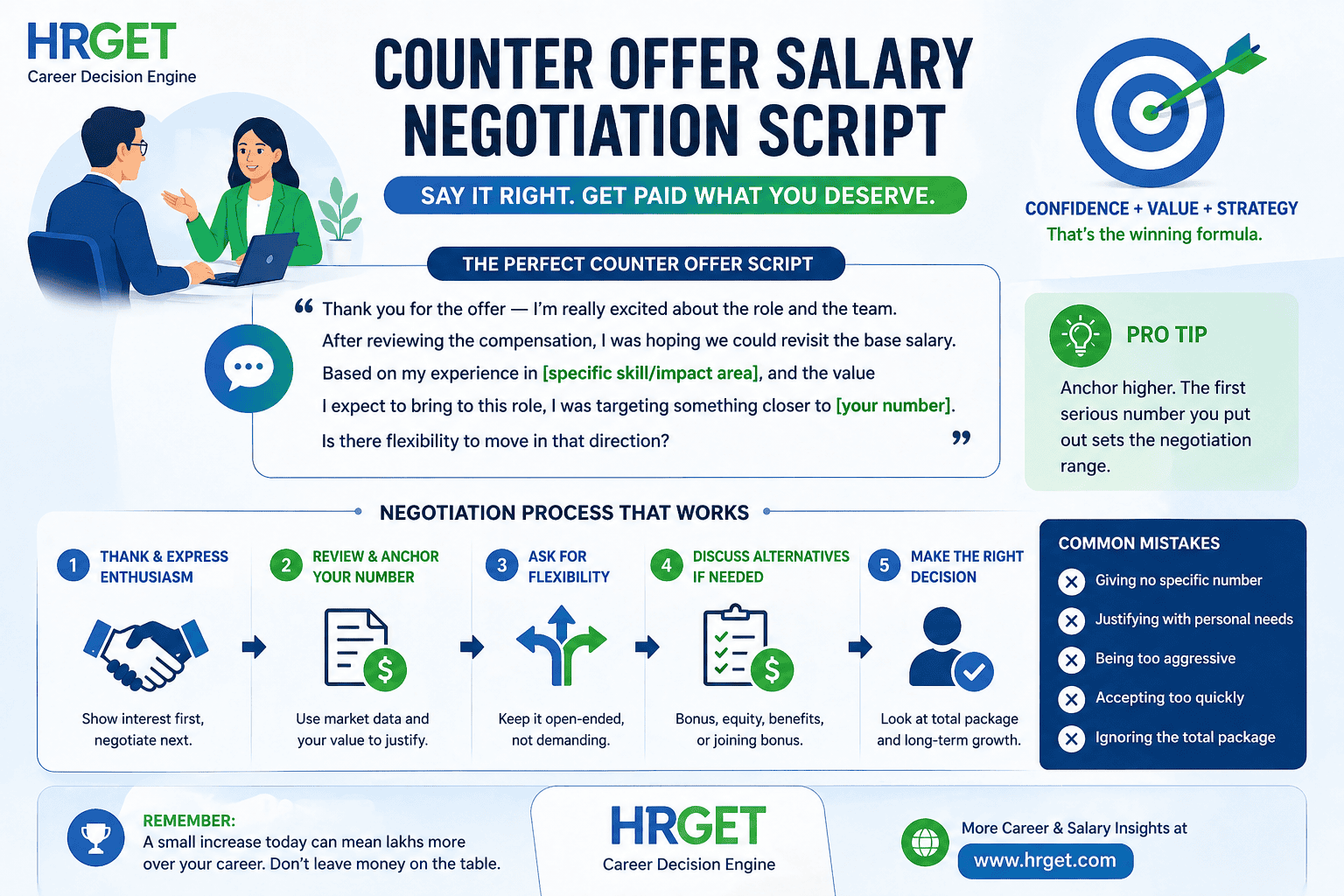
The Exact Counter Offer Salary Negotiation Script (Use This Verbatim)
I want to be direct with you. Most negotiation scripts online are vague to the point of uselessness. This one isn’t. Every word has a reason. Don’t “personalise” it beyond the bracketed fields — the structure is deliberate.
For a phone or video call:
“Thank you for the offer — I’m genuinely excited about the role and the team.
After reviewing the compensation, I was hoping we could revisit the base salary.
Based on my experience in [specific skill or impact area — e.g., ‘scaling B2B SaaS revenue past $10M’ or ‘leading HR compliance across 5 APAC markets’], and the value I expect to bring to this role, I was targeting something closer to [your number].
Is there flexibility to move in that direction?”
Why Each Line Is Doing Work
- “Genuinely excited” — reduces defensiveness; signals you’re not walking away
- “Hoping we could revisit” — collaborative language, not a demand
- Specific skill + impact area — frames the ask as value-based, not need-based
- “Targeting something closer to” — sets an anchor without an ultimatum
- “Is there flexibility” — open-ended, invites them to problem-solve with you
After you say your number — stop talking. Silence is not awkward. It’s power. The first person to speak after the number is named has already flinched.
Email Version: Paste-Ready Counter Offer Template
Email is often the better medium for a salary counter offer. It gives you time to craft your language precisely, removes the pressure of real-time response, and creates a paper trail. Many hiring managers actually prefer it — it gives them something concrete to take to finance or their VP.
Subject: Re: Offer – [Your Name] / [Role Title]
Hi [Hiring Manager / Recruiter Name],
Thank you for the offer — I’m genuinely excited about the opportunity to join [Company Name] and contribute to [specific team goal or initiative you discussed].
After carefully reviewing the details, I’d like to discuss the base salary component. Given my experience in [specific skill or impact — be precise], I was targeting something closer to [your number].
I’d love to see if there’s flexibility to align on this. I’m confident we can find a structure that works for both sides.
Looking forward to your thoughts.
Best,
[Your Name]
Keep it short. Resist the urge to write three paragraphs explaining your logic. The above email is the right length — anything longer reads as insecure and over-justifying.
If They Push Back: The Script Most People Get Wrong
This is where the negotiation either holds or collapses. Most candidates hear “there’s no room on base salary” and immediately back down. That’s the wrong move — and often unnecessary.
When they push back on base salary, use this:
“I completely understand, and I appreciate you being upfront about the constraints.
I’m still very much interested in the role. If base salary is fixed at this level, is there flexibility in other components — for example, a joining bonus, performance bonus uplift, or additional RSUs?”
This does three things at once: it removes confrontation, it keeps you in the conversation, and it shifts negotiation to components that sometimes have more flexibility than base salary. Joining bonuses, in particular, don’t affect the long-term payroll cost the same way a salary increase does — which means finance teams are often more willing to approve them.
For India-based roles, also consider negotiating on: variable pay structure, ESOPs, remote work days (which reduces commute cost), and joining date (sometimes a later joining gives you a full extra month at your current employer’s salary).
Real Scenario: What Actually Happens Inside the Company
Let me show you what happens on the other side of that call or email, because most candidates imagine it as confrontational. It isn’t.
Priya — a senior product manager in Bengaluru — received an offer of ₹28 LPA from a Series B startup. The role had been open for two months. She’d cleared four rounds, including a case study with the CEO. She used a version of the script above to ask for ₹33 LPA.
Here’s what happened on their side: the recruiter forwarded her counter to the hiring manager, who immediately said “she’s worth it.” They checked the internal salary band — ₹26–₹34 LPA for the role — and approved ₹31 LPA with a ₹1L joining bonus. The whole process took 48 hours. Priya walked away with ₹4 LPA more than the original offer, simply because she asked.
The process inside most companies: HR checks the approved budget band → hiring manager signals priority level → finance approves exceptions for top candidates → offer is revised. If you’re their preferred hire, they will try to close the gap.
The brutal truth: your negotiation power is directly proportional to how replaceable you appear. The more specific your skills and the longer they’ve invested in your candidacy, the more leverage you hold.
Smart Strategy: How to Anchor Higher Without Sounding Greedy
Most people ask for 5–10% more than the offer. That’s almost always too conservative. Here’s why: the first number you say becomes the psychological anchor for the rest of the conversation. If you anchor low, you cap yourself before negotiations even begin.
The right ask — assuming you have reasonable market benchmarks to back it up — is 15–25% above the offer. This isn’t greed; it’s anchoring theory in practice. The final number almost always settles somewhere between the offer and your counter.
| Initial Offer | Weak Counter (5–10%) | Smart Anchor (20–25%) | Likely Outcome |
|---|---|---|---|
| ₹20 LPA | ₹21–₹22 LPA | ₹24–₹25 LPA | ₹22–₹23 LPA |
| $100K | $105K–$110K | $120K–$125K | $112K–$115K |
| £55K | £58K–£60K | £65K–£68K | £61K–£64K |
One important caveat: your anchor must be defensible. Ground it in one of these: your current or most recent CTC + growth, market benchmarks from sources like Glassdoor, Levels.fyi, or LinkedIn Salary Insights, or a competing offer you’ve received. Don’t manufacture a number — justify it clearly in one sentence.
Also: give a specific number, not a range. “I’m targeting ₹24 LPA” is stronger than “I’m looking at ₹23–₹25 LPA.” A range tells them to aim for the bottom of it every time.
Common Mistakes That Kill a Counter Offer
I’ve watched candidates negotiate themselves out of good offers. Here are the five mistakes I see most often — and what to do instead.
❌ Mistake 1: Vague language with no number.
“Can you do a bit better?” has no anchor. There’s nothing for the other side to respond to. Always name a specific figure.
❌ Mistake 2: Personal justification.
“My rent has gone up” or “I need to support my family” are irrelevant to a company’s hiring decision. They are paying for the value you deliver, not your life expenses. Keep it about market rate and your experience.
❌ Mistake 3: Ultimatum framing without leverage.
“I need X or I’ll have to decline” only works if you have a competing offer or are clearly their top choice. Without that leverage, it can backfire and make you seem difficult before you’ve even started.
❌ Mistake 4: Accepting immediately.
Even if the first offer is reasonable, taking it instantly signals that you may have underpriced yourself — and plants a seed of doubt about your market awareness. At minimum, ask for 24–48 hours to review before accepting, even if you’re already happy.
❌ Mistake 5: Negotiating multiple components simultaneously.
If you try to negotiate base, bonus, equity, title, and start date all in one go, you look indecisive and create negotiation fatigue. Prioritise base salary first — it’s the highest-impact lever — then revisit other components if needed.
Pro Tips from the Hiring Side (What HR Won’t Tell You)
Here’s what I know from being inside compensation discussions — things candidates rarely hear.
💡 The first offer is almost never the maximum. Budget bands exist with room to move, typically 10–20% above the starting offer. The question is simply whether you’re worth activating that room — and how you ask determines that.
💡 Confidence outperforms credentials. I’ve watched a mid-level candidate in a strong negotiating position outperform a more qualified candidate who hedged and apologised through every ask. Tone matters enormously. If you sound like you’re asking for a favour, they’ll treat it like one.
💡 “Final offer” often isn’t final. In 2026, with talent markets still competitive in tech, product, and finance, the phrase “this is our best offer” is sometimes a test. A calm, respectful follow-up asking about flexibility in other components frequently cracks it open.
💡 Timing is everything. The optimal window for a counter offer salary negotiation is the 24–72 hours after you receive the formal written offer. Before the formal offer, you have no leverage — they haven’t committed. After you verbally accept, renegotiating damages trust. The window in between is your moment.
What to Do If They Say No
A no on base salary is not the end of the negotiation. Here are four options — pick based on your situation.
Option 1: Accept strategically. If the role offers significant learning, a step up in title, or access to a stronger brand on your CV, the short-term salary compromise may be worth it. Calculate the true 3-year value — not just year one.
Option 2: Ask for a performance review at 6 months. Use this: “If base salary is fixed at this point, would you be open to committing to a compensation review after six months based on performance milestones?” Get this in writing if they agree — include it in your offer letter or a confirming email.
Option 3: Negotiate alternative benefits. Joining bonus, extra annual leave, remote work flexibility, accelerated equity vesting, a better title, or budget for professional development. These have real monetary value and are often easier to approve.
Option 4: Walk away. Only if the offer is genuinely below your market rate and you have alternatives. This is the nuclear option — and it occasionally triggers a revised offer. But don’t bluff. Only use it if you’re genuinely prepared to decline.
Final Checklist Before You Send Your Counter Offer
Run through this before you hit send or pick up the phone:
| Checklist Item | Why It Matters |
|---|---|
| ✔ You’ve named a specific number | Ranges invite them to the bottom; specifics anchor the midpoint |
| ✔ Your tone is confident, not apologetic | Tone signals leverage before the words even land |
| ✔ You’ve framed it around value, not need | Companies pay for output, not your circumstances |
| ✔ You’ve opened positively | Reduces defensiveness; reminds them you want the role |
| ✔ You have a fallback plan | Knowing your options before negotiating removes anxiety from the conversation |
One last thing: review the full compensation package before you counter. Base salary is the most important lever, but total compensation — including variable pay, equity (ESOPs or RSUs), health insurance, and leave policy — determines what the offer is actually worth.
FAQs: Counter Offer Salary Negotiation
Should I always make a counter offer on a salary?
Yes, in the vast majority of cases. The only exceptions are when the offer is already above market rate, when the role is in a public sector or government context with fixed pay bands, or when you’ve been explicitly told the offer is non-negotiable due to internal equity rules. Otherwise, a well-framed counter costs you very little and frequently delivers 10–20% more.
How much should I ask for in a salary counter offer?
Aim for 15–25% above the initial offer, anchored by market data from sources like Glassdoor, LinkedIn Salary, or Levels.fyi. For senior roles or when you have competing offers, you can push toward the higher end. For entry-level positions or roles in constrained sectors, keep the counter to 10–15%. Always name a single number, not a range.
Is it better to negotiate salary over email or phone?
Both work. Email gives you time to craft your words precisely and creates a record of the conversation — useful if the offer is later revised. Phone or video allows for tone, warmth, and real-time flexibility. If you’re someone who tends to over-apologise or trail off under pressure, email is the safer choice. Use the template in this guide and send it within 24 hours of receiving the offer.
Can an offer be withdrawn if I try to negotiate?
Rarely, and almost never when you negotiate professionally. Offers are withdrawn in extreme cases — usually when a candidate is aggressive, disrespectful, or makes unreasonable demands repeatedly after being told no. A polite, confident counter offer using the script in this guide carries virtually zero risk of withdrawal. Companies have invested significant time and cost in hiring you; they don’t abandon that lightly.
Should I mention a competing offer when negotiating?
Only if you actually have one. A real competing offer is one of the strongest negotiation levers available — use it clearly and factually. Fabricating a competing offer is extremely risky; hiring circles are smaller than candidates think, and it damages your reputation permanently if discovered. If you have an offer, mention the company category (not necessarily the name) and the number. That’s usually enough.
What if HR says it’s their “final offer”?
Test it once, calmly. Respond with something like: “I appreciate that — is there any flexibility on non-salary components like a joining bonus or additional equity?” This respects the boundary on base salary while keeping the conversation alive. In many cases, “final offer” on base salary doesn’t mean final on total compensation. You’ll know you’ve genuinely hit the ceiling when they decline the alternative ask as well.
Can freshers or entry-level candidates negotiate salary?
Yes — with appropriate calibration. As a fresher, your leverage is lower, so keep the counter to 5–10% above the offer. Ground it in your internship results, academic achievement, or a competing offer from another company. Many companies have standard starting packages but can flex on joining bonus, professional development budget, or designation. Don’t stay silent just because you’re new — professional confidence is noticed from day one.
The One Thing That Changes Everything
Here’s what I want you to take away from this: using a counter offer salary negotiation script isn’t about being bold or confrontational. It’s about being prepared, structured, and calm. The candidates who get paid more aren’t the most talented — they’re the ones who ask with confidence and back it up with a clear value case.
A ₹2–₹3 LPA increase today doesn’t just affect this year. It becomes the baseline for every future negotiation, every promotion band, every new offer. That compounding effect makes the 5-minute conversation worth it every single time.
Copy the script. Know your number. Send it.
Related read: How to Negotiate a Severance Package — a step-by-step guide for when you’re leaving, not joining.

Eleanor Whitmore | Former Partner, Mercer | Advisor, World Economic Forum | 20+ Years in Global Compensation
Author bio: Eleanor Whitmore has spent over two decades shaping how the world’s leading organisations pay, retain, and reward talent. As a former Partner at Mercer and an advisor to World Economic Forum working groups on the Future of Work, she has designed compensation frameworks for Fortune 500 companies across the US, UK, Europe, and emerging markets. Based between London and New York, Eleanor writes for HRGet.com to translate boardroom-level pay strategy into actionable guidance for working professionals navigating real compensation decisions.