By Victoria Hale — Employment Law Partner | Former Partner, Freshfields Bruckhaus Deringer | 20+ Years in US & EU Employment Law
Updated: June 2026 • 10 min read
Here’s the truth most employees never hear from HR: earning PTO and getting it approved for specific dates are two entirely different things under the law.
If your employer denied your PTO request, you’re probably asking whether that’s even legal — and the answer is frustratingly nuanced. Yes, in most situations they can. But there are real limits, and a fair number of denials cross the line into legally challengeable territory.
After 20 years advising on employment law across the US and Europe, I’ve seen employees lose winnable disputes simply because they didn’t know the rules — and I’ve seen employers back down quickly when employees did. This guide gives you the framework to know exactly where you stand.
What you’ll know by the end of this article: whether your employer’s denial was legal, what state law actually covers (it’s narrower than most think), how to respond strategically, and what the true red flags for illegal denial look like.
What Federal Law Actually Says About PTO
Let’s start with the foundation, because this surprises a lot of people: there is no federal law in the United States that requires employers to offer PTO at all.
The Fair Labor Standards Act (FLSA) — the federal law governing wages and hours — says nothing about vacation time. The Department of Labor’s own guidance confirms this: paid vacation is a matter of agreement between employer and employee, not a federal mandate.
This means federal law does not force employers to:
- Provide any vacation or PTO at all
- Approve leave requests for specific dates
- Let you take PTO whenever you choose
- Pay out unused PTO when you leave
The key exceptions — and they’re important — are protected leaves under laws like the Family and Medical Leave Act (FMLA), the Americans with Disabilities Act (ADA), or the Pregnant Workers Fairness Act (2023). These override PTO policy in specific circumstances, and I’ll flag where they’re relevant below.
Outside of those protections, your PTO rights come primarily from three sources: state law, your employment contract, and your employer’s written policy. That’s it.
Can Employers Legally Deny PTO? (The Short Answer)
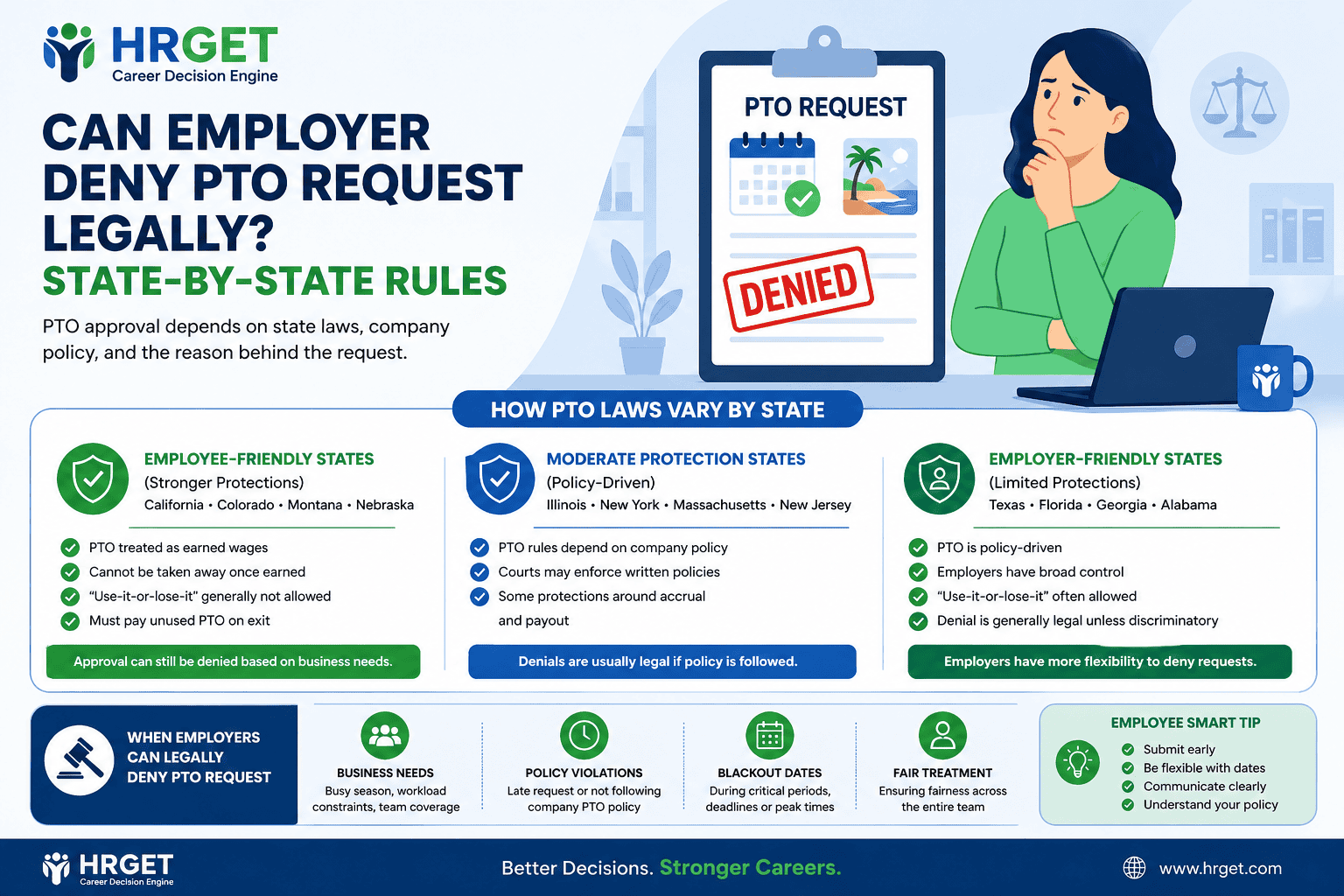
Yes — in most situations, employers can deny PTO requests. The legality isn’t usually about the denial itself. It’s about the reason behind the denial and whether proper policy was followed.
| ✔ Legal PTO Denial | ✗ Potentially Illegal Denial |
|---|---|
| Busy season / workload peak | Denial based on race, gender, religion, or other protected class |
| Too many colleagues already approved off | Retaliation after a complaint or whistleblowing |
| Request submitted without required notice | Denying leave that qualifies as FMLA or ADA accommodation |
| Critical project deadline | Violating payout/accrual rules under state law |
| Blackout period per company policy | Ignoring the company’s own written approval process |
Here’s what most articles miss: pattern matters. A single denial for operational reasons? Almost always legal. Repeated denials targeting the same employee, or approvals that consistently go to some groups but not others? That’s where discrimination claims get traction.
State Laws vs Company Policy: The Real Rulebook
This is where most employees get confused — and understandably so. They hear that California has strong worker protections and assume their PTO request can’t be denied. That’s not how it works.
State PTO laws primarily govern three things: whether accrued PTO is treated as earned wages, whether unused PTO must be paid out at termination, and whether “use-it-or-lose-it” policies are permitted. They mostly do not govern whether your manager can say no to Tuesday off in August.
Your employer’s written PTO policy — the actual document in your employee handbook — is often the most powerful document in this conversation. Courts regularly hold employers to their own stated policies. If your handbook says requests submitted 10+ days in advance will be approved absent a business conflict, and yours was denied without any stated business reason, that’s a different conversation than a request made two days out.
Pro Tip: Pull your employee handbook right now — specifically the PTO section. Find the approval criteria, the notice requirements, and any language about manager discretion. That language is your playbook for any challenge.
State-by-State PTO Rules (Simplified)
Below is a practical breakdown of how states differ — focused on what actually matters for you as an employee navigating a denial.
🟢 Employee-Friendly States (Stronger PTO Protections)
California, Colorado, Montana, Nebraska
- Accrued PTO is treated as earned wages — it cannot be forfeited
- “Use-it-or-lose-it” policies are generally not permitted
- Employers must pay out unused PTO upon termination
But: even in California, your manager can deny the timing of your request for legitimate business reasons. Earning PTO ≠ controlling when you take it.
🟡 Moderate Protection States
Illinois, New York, Massachusetts, New Jersey, Washington
- PTO rules depend heavily on company policy language
- Courts often enforce written policies strictly against employers
- Some protections around accrued PTO; payout rules vary
Note: Illinois’s Paid Leave for All Workers Act (effective 2024) gives employees up to 40 hours of paid leave annually — but this is leave, not necessarily PTO scheduling control.
🔴 Employer-Friendly States
Texas, Florida, Georgia, Alabama, Tennessee
- PTO is almost entirely dictated by company policy
- “Use-it-or-lose-it” is generally permitted
- No state requirement to pay out unused PTO on exit
In these states, denying PTO is legal unless it’s discriminatory, retaliatory, or violates a specific written policy commitment.
For the most current state-specific rules, the U.S. Department of Labor state contacts page is the authoritative source.
Real Scenarios: Legal PTO Denial vs Illegal PTO Denial
These are the types of situations I’ve seen play out — names changed, patterns real.
Scenario 1 — Legal ✔
The Peak Season Rejection: A marketing manager at a retail company requests two weeks off in late November. The company denies it due to the holiday campaign crunch.
Verdict: Legal. Operational business need, applied consistently across the team.
Scenario 2 — Legal ✔
The Last-Minute Request: A software engineer requests Thursday–Friday off on Tuesday afternoon. Company policy requires five business days’ notice. Request denied.
Verdict: Legal. Policy followed consistently.
Scenario 3 — Potentially Illegal ✗
The Selective Denial: Two employees request the same week off for Eid. Both are in the same role. The Muslim employee’s request is denied; the non-Muslim colleague’s is approved with no documented business reason.
Verdict: Likely illegal. Disparate treatment based on religion is a Title VII violation.
Scenario 4 — Legally Challengeable ✗
The Policy Violation: The employee handbook states PTO requests submitted 14+ days in advance will be approved unless the team is at minimum coverage. An employee submits 17 days out. No staffing issue exists. Request denied with no reason given.
Verdict: Challengeable. Employers can be held to their own written commitments.
Scenario 5 — Illegal ✗
Post-Complaint Denial: An employee filed an internal HR complaint about their manager in March. Since April, every PTO request has been denied while colleagues with the same role see approvals. Pattern emerges over 8 weeks.
Verdict: Retaliation. Potentially actionable under Title VII, the NLRA, or state anti-retaliation statutes.
Smart Strategy: How to Respond to a Denied PTO Request
Don’t fire off an emotional reply. The employees who navigate this best treat it like a negotiation, not a grievance — at least at first. Here’s the play, step by step.
1
Read Your Employee Handbook First
Find the PTO section. Note the approval criteria, notice requirements, and any language about manager discretion or blackout periods. This is your baseline — and if the denial violates it, you have standing to push back formally.
2
Ask for the Business Reason — Professionally
Skip “Why was this denied?” Try instead: “Can you help me understand the business constraints so I can plan better next time?” This opens dialogue without putting your manager on the defensive — and it gets the reason on record, which matters if you escalate later.
3
Offer Alternatives
This is the move most employees skip, and it’s one of the highest-leverage options available. Can you shift the dates by a week? Reduce from five days to three? Offer to work remotely from your destination? Managers say yes far more often when you show operational flexibility — it signals you understand the team’s needs, not just your own.
4
Document Everything If Something Feels Wrong
If you suspect the denial isn’t about operations — save the denial email, note the date and reason given, capture screenshots of any written policy, and log whether similar requests by colleagues were approved. Patterns are everything in a legal challenge, and documentation you create at the time is far stronger than memory six months later.
5
Escalate — But Only When It’s Worth It
Involve HR when: the denial clearly contradicts written policy, you have documented evidence of disparate treatment, or you have reason to believe this is retaliation. Going to HR prematurely on a simple operational denial will cost you goodwill without gaining anything. Go in with documentation, not just frustration.
Common Mistakes Employees Make
I’ve seen these same errors repeatedly — across industries, seniority levels, and states.
❌ Treating earned PTO as a scheduling entitlement
Accruing 15 days of PTO means you have 15 days of paid leave — not the right to take any specific 15 days. The timing is almost always subject to employer approval.
❌ Booking travel before getting written approval
This puts you in an impossible position and removes your negotiating flexibility entirely. Always get written confirmation before committing to non-refundable travel.
❌ Ignoring blackout periods
Most companies in retail, finance, healthcare, and tech have predictable high-restriction windows. If you don’t know yours, ask — ideally at the start of each year when you’re planning time off.
❌ Being inflexible in the initial request
“I need these exact five days or nothing” raises the cost of approval without reason. Offering two or three date options in your initial request almost always improves approval rates.
❌ Going straight to legal threats without documentation
Threatening to call an employment attorney on the first denial — without evidence of discrimination or clear policy violation — almost always backfires professionally. Build your case before you escalate.
The Insider View: What Managers Won’t Say Out Loud
Here’s what I know from the other side of the table — having advised managers and HR teams as well as employees.
Most managers don’t deny PTO arbitrarily. They’re optimizing for team coverage, project continuity, and fairness across their direct reports. When your request lands in an already-full week, the math simply doesn’t work out — and they often can’t explain the full picture to you without revealing another employee’s plans.
What actually gets approvals: employees who submit early, communicate clearly about coverage, and have a track record of reliability. It’s not favoritism — it’s risk management. A manager who approves your two-week absence needs confidence that things won’t fall apart. If you’re the person who always delivers, you’re a lower-risk approval.
The real play: Instead of “I deserve this break,” frame your request as: “All my deliverables will be covered and here’s how.” That shifts the manager’s mental risk calculus — and I’ve watched it turn denials into approvals more times than I can count.
One more thing nobody tells you in 2026: with more teams running lean post-pandemic, coverage concerns are real. Stack your request with long weekends or company holidays where possible — fewer PTO days needed means less disruption to argue against.
Frequently Asked Questions
Can my employer deny PTO I’ve already earned?
Yes. Earning PTO means you have the hours — it doesn’t guarantee approval for specific dates. Most states allow employers to control the timing of when earned PTO is taken, even if they can’t take the hours away from you. California, Colorado, and a handful of others protect the balance, not the schedule.
Is it illegal for an employer to deny PTO without giving a reason?
Not typically — especially in at-will employment states. There’s no federal requirement to explain a denial. However, if you request the reason and the answer reveals discrimination or retaliation, that’s where legal exposure appears. Employers in states with stricter labor laws may face higher scrutiny on unexplained denials that fit a pattern.
Can a PTO request be denied at the last minute?
Generally yes, especially if the business has a legitimate operational need or if your request was submitted without required advance notice. The frustrating reality is that even approved PTO can sometimes be revoked in genuine emergencies — though doing this repeatedly without compensation is a retention problem the employer creates for themselves.
Do state laws control when I can take PTO?
Mostly no. State laws primarily regulate whether PTO accrues as wages, whether it must be paid out at termination, and whether use-it-or-lose-it policies are enforceable. They rarely tell employers they must approve specific requests. The exceptions are protected leaves — FMLA, state sick leave laws, and disability accommodations — which override standard PTO approval discretion.
What if my manager always denies my PTO requests but approves colleagues’?
That pattern is significant. Document every denied request — the date, reason given, comparable approvals for colleagues in similar roles. If a protected characteristic (race, gender, religion, national origin, age, disability) appears to be the common thread, you have the foundation of a Title VII or state anti-discrimination claim. Consult an employment attorney before escalating internally if you believe it’s intentional.
Can I resign if PTO is repeatedly denied, and will I get paid out?
You can resign for any reason. Whether you receive unused PTO payout depends on your state: California, Colorado, Montana, and Nebraska require it; most others do not unless your employment contract or handbook promises it. Check your handbook’s termination section for exact language before making any decisions.
Is sick leave treated differently from PTO when it comes to denial?
Yes — significantly so. Many states now mandate paid sick leave (California, New York, Illinois, Colorado, and over a dozen others), and employers cannot deny sick leave taken for qualifying medical reasons. If your employer uses a combined PTO bank, the sick leave protections still apply to qualifying absences. This is one area where knowing your specific state law matters a great deal.
The Bottom Line on PTO Denial
Yes, your employer can deny a PTO request — and in most cases, they’re within their legal rights. Federal law simply doesn’t protect your right to take leave on specific dates. What state law does is protect the value of what you’ve earned: the accrual, the payout, the inability to forfeit it without consent.
Where employees actually have leverage is in two places: their own company’s written policy (which courts take seriously), and anti-discrimination protections when denial follows a pattern tied to a protected characteristic.
The most effective approach isn’t waiting to win a legal argument — it’s removing the reasons for denial before they arise. Submit early, show coverage, stay flexible, and build the kind of track record that makes your manager’s risk calculus easy. That’s what actually gets approvals.
If your situation has crossed from operational inconvenience into patterns that look like discrimination or retaliation, don’t navigate it alone. Document, consult a qualified employment attorney, and if warranted, file with the EEOC.
Related reading on HRGet: If you’re facing broader workplace rights questions — including what constitutes wrongful termination or how at-will employment affects your options — our guide on wrongful termination rights covers exactly that territory.

Victoria Hale | Former Partner, Freshfields Bruckhaus Deringer | Employment Law Specialist | 20+ Years Advising Multinationals & Executives
Author: Victoria Hale spent over two decades as an Employment Law Partner at Freshfields Bruckhaus Deringer — one of the world’s most prestigious Magic Circle law firms — advising multinational corporations and senior executives on some of the most complex employment disputes in the US and Europe. Her practice covered wrongful termination litigation, executive exits, non-compete enforcement, FLSA compliance, and cross-border workforce restructuring under EU labour law. Now based between London and New York, Victoria writes for HRGet.com to close the gap between legal theory and how employment law actually plays out in the real world — for employees who need to know their rights before it’s too late.