

By Jonathan Reed — Executive Career Strategist & Leadership Advisor | Former Partner, McKinsey & Company | 18+ years coaching senior leaders at Amazon, Unilever & beyond
Updated: April 2026 | 12 min read
Let me be direct with you. The best remote jobs that pay well in 2026 are not the ones flooding job boards right now. They’re the skill-intensive, leverage-driven roles that most people overlook because they sound intimidating — or because nobody told them these roles even existed remotely.
After 18 years helping senior professionals navigate career transitions — from junior analyst to C-suite, from corporate to fully remote — I’ve seen the same pattern repeat itself: talented people settle for $15/hr customer support or $500/month content gigs when they’re fully capable of earning $80K–$200K working from anywhere.
This guide cuts through the noise. You’ll see the 12 highest-paying remote roles in 2026, the real salary ranges (both USD and INR for India-based readers), what skills actually matter, and — critically — the three mistakes that keep smart professionals stuck at the bottom of the remote pay scale. Let’s get into it.
What Makes a Remote Job “High Paying” in 2026
Here’s the framework I use when advising clients on remote career pivots. A remote job pays well when it sits at the intersection of three forces — and the further you get from all three, the lower your ceiling.
1. Leverage over time: The best-paying remote roles produce outcomes that scale beyond your working hours. A software engineer who ships a feature used by 10,000 users creates more value per hour than someone answering 50 support tickets. Coding, automation, product strategy, analytics — these have leverage. Data entry doesn’t.
2. Global demand with local cost arbitrage: US and EU companies are actively hiring remote talent in India, Southeast Asia, and Eastern Europe because they get world-class skills at a fraction of on-site costs. If you’re in Bangalore or Hyderabad working for a US-based SaaS company, you can earn $60K–$120K — which is ₹50L–₹1Cr+ — while your cost of living stays the same. That’s a structural income advantage most people don’t fully exploit.
3. Skill scarcity: The roles that pay $100K+ remotely are not ones with 50,000 applicants. They’re specialized enough that companies genuinely struggle to hire. Think: AI/ML engineers, cloud architects, growth-focused data scientists, technical product managers. Not generic roles. Specific, rare expertise.
If your current (or target) remote role doesn’t score well on at least two of these three dimensions — it’s worth reconsidering your direction before investing more time in it.
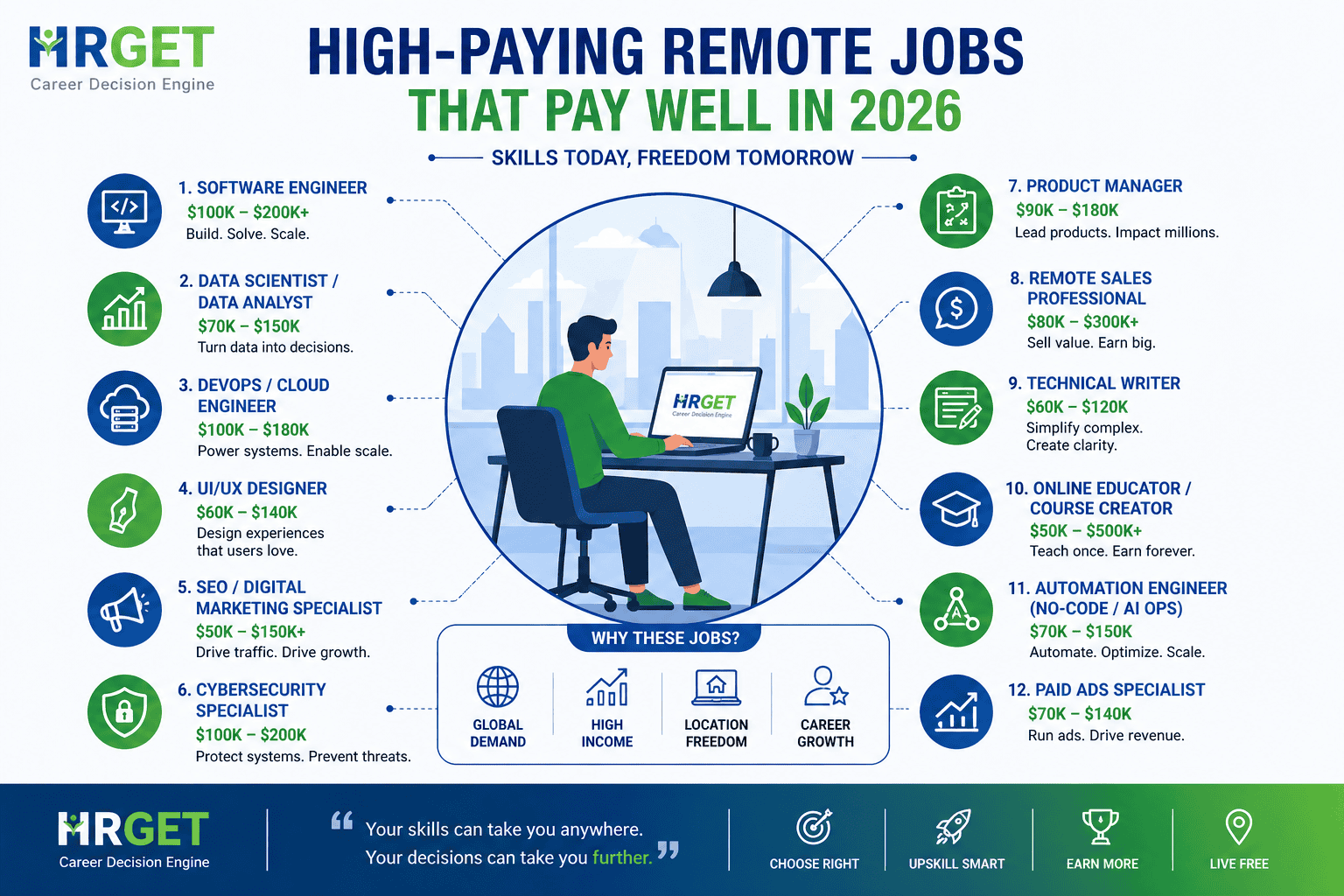
Top 12 Best Remote Jobs That Pay Well in 2026
These aren’t aspirational fantasy roles. These are positions actively hiring right now on LinkedIn, Toptal, Deel, and company career pages — fully remote, globally accessible, with salaries I’ve confirmed through offer letters and compensation benchmarks I review regularly.
1. Remote Software Engineer (AI / Backend / Full Stack)
Salary: ₹20L–₹80L (India) | $100K–$200K+ (Global)
Software engineering remains the king of remote work — and AI integration has pushed compensation even higher. Companies aren’t just hiring engineers to build features anymore; they need engineers who understand how to embed LLM APIs, fine-tune models, and build systems that automate workflows. That’s the premium tier right now.
Skills that matter: Python, Java, or Node.js at a senior level; system design; REST/GraphQL APIs; and increasingly, familiarity with tools like LangChain, OpenAI APIs, or vector databases.
Pro tip: Don’t just be a frontend developer. The real pay jump happens when you move into backend + AI integration. A full-stack engineer with AI experience earns 30–50% more than a pure frontend role at most remote-first companies.
2. Remote Product Manager (Tech / SaaS)
Salary: ₹25L–₹60L (India) | $90K–$180K (Global)
Product managers own business outcomes — not just tasks. That’s why they’re paid like executives at senior levels. The remote PM market exploded post-2020 and has stabilized into genuinely high-paying roles, especially at Series B+ startups and established SaaS platforms.
The honest reality: Breaking in without prior PM experience is hard. But if you’re currently an engineer, designer, or analyst, an internal pivot is often faster than an external job search. Most of the best remote PMs I know started as something else first.
3. Data Analyst / Data Scientist
Salary: ₹15L–₹45L (India) | $70K–$150K (Global)
Data roles are not created equal. A “data analyst” pushing Excel pivot tables earns very differently from a growth data scientist building revenue forecasting models. If you’re in this field, the highest-paid remote opportunities are in business analytics, revenue ops, and growth analytics — all of which require SQL, Python, and the ability to turn numbers into business decisions.
Avoid: Generic analyst roles tied to reporting. Target roles where your output influences revenue or product decisions directly.
4. UI/UX Designer (Product-Focused)
Salary: ₹12L–₹40L (India) | $60K–$140K (Global)
The best-paid remote UX designers aren’t the ones with the prettiest portfolios — they’re the ones who can show how their design decisions improved conversion rates, reduced churn, or cut support tickets. SaaS product design and conversion-focused UX work both pay significantly more than generic app or website design.
What most designers get wrong: Focusing on aesthetics, not outcomes. When you tie your work to business KPIs in interviews, you immediately differentiate from 90% of applicants.
5. DevOps / Cloud Engineer
Salary: ₹20L–₹55L (India) | $100K–$180K (Global)
Supply-demand mismatch is extreme here. There aren’t enough experienced cloud engineers to meet hiring demand, which keeps salaries high even in a post-layoff tech market. AWS, Azure, GCP — pick one deeply, add Kubernetes and Terraform, and you’re in the top percentile of remote earners globally.
This is one of the few roles where a strong certification (AWS Solutions Architect Professional, Google Cloud Professional) can genuinely move the needle on salary offers.
6. Technical Writer (High-End SaaS)
Salary: ₹12L–₹30L (India) | $60K–$120K (Global)
This one surprises people. But think about it: complex developer tools and enterprise SaaS platforms are completely worthless if nobody can figure out how to use them. Strong technical writers — people who understand APIs, SDKs, and developer workflows and can explain them clearly — are genuinely hard to find.
If you have a technical background but don’t want to write code all day, this is an underrated path to a $80K–$120K fully remote role.
7. SEO Specialist (Programmatic / High-Ticket)
Salary: ₹10L–₹35L (India) | $50K–$150K+ (Global)
Generic SEO work pays poorly. But programmatic SEO — building content systems that scale to thousands of pages, automating keyword research pipelines, owning organic revenue for a B2B SaaS — that’s a different business. The top end of this market pays like a senior engineer because the ROI is direct and measurable.
Technical SEO consultants working with enterprise clients can charge $10K–$25K/month retainers. If you want to go independent, this is one of the clearest freelance paths to six figures.
8. Paid Media / Paid Ads Specialist
Salary: ₹10L–₹30L (India) | $60K–$130K (Global)
Google Ads, Meta Ads, and LinkedIn Ads specialists who can prove ROAS (return on ad spend) improvements command high salaries and retainers. This isn’t about knowing how to click buttons in Ads Manager — it’s about understanding customer acquisition economics, attribution, and creative strategy simultaneously.
Performance marketers at growth-stage startups often earn equity on top of base salary. At the senior level, this role crosses into CMO territory.
9. Cybersecurity Analyst / Penetration Tester
Salary: ₹18L–₹60L (India) | $90K–$180K (Global)
Cybersecurity is one of the most shortage-driven fields in tech. Every company — regardless of industry — needs security talent, and remote work is widely accepted here because the nature of the work is inherently digital. CEH, OSCP, and CISSP certifications can open doors that a CS degree alone won’t.
Penetration testers and red team specialists are especially in demand, with some senior contractors billing $200–$400/hour.
10. Remote Financial Analyst / FP&A Specialist
Salary: ₹15L–₹40L (India) | $70K–$140K (Global)
FP&A (Financial Planning & Analysis) roles have quietly gone remote-first at many mid-size US companies. If you understand three-statement models, scenario planning, and can communicate financial narratives to non-finance stakeholders — you’re rare. CFOs at remote-first companies are actively hiring for this.
This is a strong path for Indian CA/CFA holders looking to break into US-market remote roles.
11. Remote HR Business Partner / People Operations
Salary: ₹14L–₹35L (India) | $70K–$130K (Global)
Remote-first companies need HR professionals who understand how to build culture, manage performance, and handle employee relations across time zones and jurisdictions. This is no longer just a back-office function — it’s a strategic role, especially at companies scaling internationally.
If you’re already in HR, targeting remote-first companies (Deel, GitLab, Automattic, Buffer) is the fastest path to above-market compensation in this field.
12. AI/ML Engineer or Prompt Engineer (Emerging)
Salary: ₹25L–₹90L (India) | $110K–$250K (Global)
The highest ceiling on this list. AI/ML engineers who can build production-grade machine learning systems — not just run Jupyter notebooks — are commanding compensation that rivals senior engineers at FAANG. The “prompt engineering” subset is still evolving, but companies like Anthropic, OpenAI, and enterprise AI labs are paying $200K+ for the right talent.
Even without an ML background, transitioning into AI application development (building on top of existing models) is a realistic 12–18 month upskilling path for experienced engineers.
Quick Salary Comparison: Remote Roles at a Glance
Here’s how the 12 roles stack up. India figures assume a US-company remote contract; global figures reflect mid-to-senior levels at remote-first companies.
| Role | India (INR/yr) | Global (USD/yr) | Entry Difficulty |
|---|---|---|---|
| AI/ML Engineer | ₹25L–₹90L | $110K–$250K | High |
| Software Engineer (Backend/AI) | ₹20L–₹80L | $100K–$200K+ | High |
| DevOps / Cloud Engineer | ₹20L–₹55L | $100K–$180K | Medium |
| Cybersecurity Analyst | ₹18L–₹60L | $90K–$180K | High |
| Product Manager | ₹25L–₹60L | $90K–$180K | High |
| Data Scientist | ₹15L–₹45L | $70K–$150K | Medium |
| Financial Analyst (FP&A) | ₹15L–₹40L | $70K–$140K | Medium |
| UI/UX Designer | ₹12L–₹40L | $60K–$140K | Lower |
| Paid Ads Specialist | ₹10L–₹30L | $60K–$130K | Lower |
| Technical Writer | ₹12L–₹30L | $60K–$120K | Lower |
| HR Business Partner | ₹14L–₹35L | $70K–$130K | Medium |
| SEO Specialist (Programmatic) | ₹10L–₹35L | $50K–$150K | Lower |
Real Scenario: Why Most People Fail at the Remote Job Search
Real Scenario
Priya is a 29-year-old marketing manager in Pune with four years of experience. She decides to go remote. She spends three months applying to 80+ remote jobs on LinkedIn and Naukri. She gets two interviews, zero offers. She starts wondering if remote work “isn’t for her.”
Here’s what actually went wrong. Priya was applying for every remote job with “marketing” in the title — most of which were for US-specific roles requiring local market knowledge, or for roles with 400+ applicants where her India-based location was quietly filtered out.
She didn’t identify which specific skill she had that would make her stand out to a remote-first US or EU company. Her resume said “managed social media campaigns” — which means nothing. It didn’t say “grew organic reach 3x in 6 months” or “managed $50K/month ad spend with a 4.2x ROAS.”
And she was applying on platforms where US companies aren’t actually looking for international remote hires — they use Deel, Remote.com, Toptal, and specific community job boards (like We Work Remotely or Remote OK) for that.
One pivot later — she narrowed her focus to paid media for SaaS companies, rewrote her resume around ROAS and CAC metrics, and found a $65K/year role through Remote OK within six weeks. Same skills. Completely different presentation and platform.
Smart Strategy to Break Into High-Paying Remote Jobs
This isn’t a 10-step system. It’s four moves that actually work, based on patterns I’ve seen across hundreds of remote career transitions.
Step 1: Specialize, then niche down further. “I’m a data analyst” gets you nowhere. “I’m a growth data scientist who helps B2B SaaS companies reduce churn using cohort analysis and predictive modeling” gets you shortlisted. The narrower your positioning, the fewer competitors you face and the higher the perceived value.
Step 2: Build a body of evidence, not just a resume. Remote hiring managers can’t meet you in person. They rely heavily on proof: GitHub repos, portfolio case studies, published articles, LinkedIn posts showing your thinking. Pick one channel and invest six weeks making it excellent before you start applying.
Step 3: Target the right companies, not the most famous ones. Series B–D startups (typically 50–300 employees) hire aggressively for remote roles and pay well. They’re less bureaucratic than enterprises, and the equity upside is real. Tools like Crunchbase, AngelList, and LinkedIn’s “Remote” filter let you identify these companies efficiently.
Step 4: Use specialized platforms. For global remote roles: We Work Remotely, Remote OK, Toptal (for freelance/contract), Deel’s talent network, and LinkedIn with “Remote” + “Worldwide” filters. For India-specific US-company contracts: Deel, Multiplier, and direct outreach to US founders on Twitter/X remain underused.
Common Mistakes That Keep People Stuck
I’ve reviewed hundreds of remote job searches that stalled. These are the patterns that come up again and again.
Mistake #1: Treating “remote” as a filter, not a market.
Remote isn’t just a work arrangement — it’s a specific employer segment with its own culture, tools, and hiring norms. Companies that have been remote-first for years (GitLab, Automattic, Basecamp) hire very differently from companies that recently added a “remote” option. Target the former.
Mistake #2: Applying without time zone alignment.
Many US companies say “remote” but actually mean “remote within US time zones.” If you’re in India applying for a US role, be upfront about your availability overlap (IST has 9.5–13.5 hours difference from US time zones). Proactively addressing this in your cover note eliminates it as an objection.
Mistake #3: Pricing yourself at local market rates for global work.
I’ve seen talented Indian engineers quote $15–$20/hr for contracts that US companies expected to pay $50–$80/hr for. Know the international market rate for your skill. Underpricing signals inexperience, not value. Use Glassdoor, Levels.fyi, and remote-specific salary surveys to calibrate.
Mistake #4: Waiting until your skills are “perfect” before applying.
The 80% rule matters here. If you meet 80% of a job description’s requirements, apply. Remote hiring managers expect to train on specifics — they’re hiring for potential and communication skills as much as for an exact technical checklist. Waiting for 100% readiness means waiting forever.
How to Choose the Right Remote Career Path for You
There’s no single best remote job. The right one depends on where you are now — and what you’re willing to invest over the next 12–18 months.
Here’s a fast framework I use with clients:
If you’re already technical (engineer, data professional): Push deeper into AI/ML or cloud. The market rewards depth here more than breadth. A backend engineer who adds LLM integration to their skillset can jump 40–60% in salary within a year.
If you’re in marketing: Specialize in performance (paid media or programmatic SEO). The ability to show measurable ROI is the single fastest path to premium remote compensation in this category.
If you’re in finance or operations: Target FP&A roles at US remote-first companies. Indian CAs and CFAs are significantly undervalued in the domestic market relative to what US-market remote roles pay.
If you’re in HR: Prioritize remote-first employers and build expertise in remote culture, distributed team management, and tools like Rippling, Deel, or Lattice. These skills are genuinely scarce.
If you’re making a pivot from a non-technical role: Technical writing and UX design are the most accessible high-salary entry points. Both are learnable without a CS degree, and both have clear portfolio-based hiring paths.
Pro Tip
The fastest way to break into a high-paying remote role isn’t to apply to hundreds of jobs — it’s to get referred by someone already inside the company. Spend 20% of your job search time on warm outreach via LinkedIn to people 2–3 levels above the role you want. One genuine connection converts better than 50 cold applications.
Frequently Asked Questions
What are the highest paying remote jobs in 2026 without a degree?
UI/UX design, paid media advertising, technical writing, and SEO are all accessible without a traditional degree. What matters is a strong portfolio and measurable results. Cybersecurity is also possible via certifications like CEH or CompTIA Security+. Salaries range from $50K–$120K for strong mid-level professionals in these fields.
Can I get a remote job in India that pays in USD?
Yes — and this is one of the most underutilized income strategies for Indian professionals. US and EU companies hire internationally via EOR platforms like Deel or Remote.com. You’re paid in USD (or your local equivalent at the USD rate), while living in India. Software engineers, data scientists, and product managers are the most commonly hired roles this way.
What remote jobs pay $100K or more per year?
At the $100K+ remote threshold in 2026, you’re looking at senior software engineers, DevOps/cloud engineers, AI/ML engineers, senior product managers, and experienced cybersecurity analysts. FP&A specialists at growth-stage US companies can also reach this level at 5–8 years of experience. These roles all require demonstrated depth in a specific domain.
Which remote jobs have the best work-life balance?
Technical writing, UX design, and data analytics roles tend to have the most predictable hours in the remote market. DevOps and on-call engineering can involve irregular hours. Paid media roles at agencies often have demanding client timelines. The best work-life balance comes less from the job title and more from choosing async-first companies with strong remote work culture.
How do I find legitimate high-paying remote job listings?
The most reliable platforms for legitimate, high-paying remote roles are: We Work Remotely, Remote OK, LinkedIn (with “Worldwide” + “Remote” filter), Toptal (for freelance/contract), and direct company career pages for remote-first employers. Avoid generic job boards where “remote” listings are often misclassified or location-restricted.
Is remote work still growing in 2026?
The post-pandemic RTO (return to office) push slowed remote-only hiring at large enterprises, but remote-first startups and mid-size tech companies have continued expanding remote hiring, especially for international talent. The total addressable market for remote work remains far larger than it was pre-2020, and roles in AI, cloud, and data science are increasingly location-agnostic by default.
What skills should I learn to get a high-paying remote job in 2026?
The highest-ROI skills for remote income in 2026 are: Python (for data/AI), cloud platforms (AWS or GCP), product analytics (SQL + data storytelling), and performance marketing (Google Ads, Meta Ads with ROAS focus). AI fluency — knowing how to use and build with LLMs — is increasingly a differentiator across all roles, technical and non-technical alike.
The Bottom Line on Best Remote Jobs That Pay Well
The best remote jobs that pay well in 2026 share a common thread: they reward demonstrated skill, global relevance, and the ability to produce measurable outcomes — not just logged hours. Customer support and basic data entry will always exist remotely. They just won’t pay well.
If you’re serious about crossing the ₹20L+ or $80K+ threshold working remotely, the path is the same regardless of where you start: pick a high-value skill, niche it down, build proof of that skill publicly, and target the right platforms and companies. That’s it.
Ready to take the next step? Read our guide on how to negotiate your remote salary offer — because once you land the interview, knowing your leverage is what separates a good offer from a great one.

Jonathan Reed: Executive Career Strategist & Leadership Advisor | Former Partner, McKinsey & Company | Executive Coach to Amazon & Unilever Leaders | 18+ Years in Career Strategy
Jonathan Reed spent nearly two decades as a Partner at McKinsey & Company, where he advised organisations on leadership development, talent strategy, and organisational design across the US, UK, and Asia. Since leaving consulting, he has worked as an executive coach to senior leaders at Amazon, Unilever, and a clutch of high-growth scale-ups — helping them navigate promotions, career pivots, and the unwritten rules of visibility and influence at the top. Based between London and New York, Jonathan writes for HRGet.com to give working professionals an honest look at how careers actually scale — and why so many talented people stall without ever knowing why.