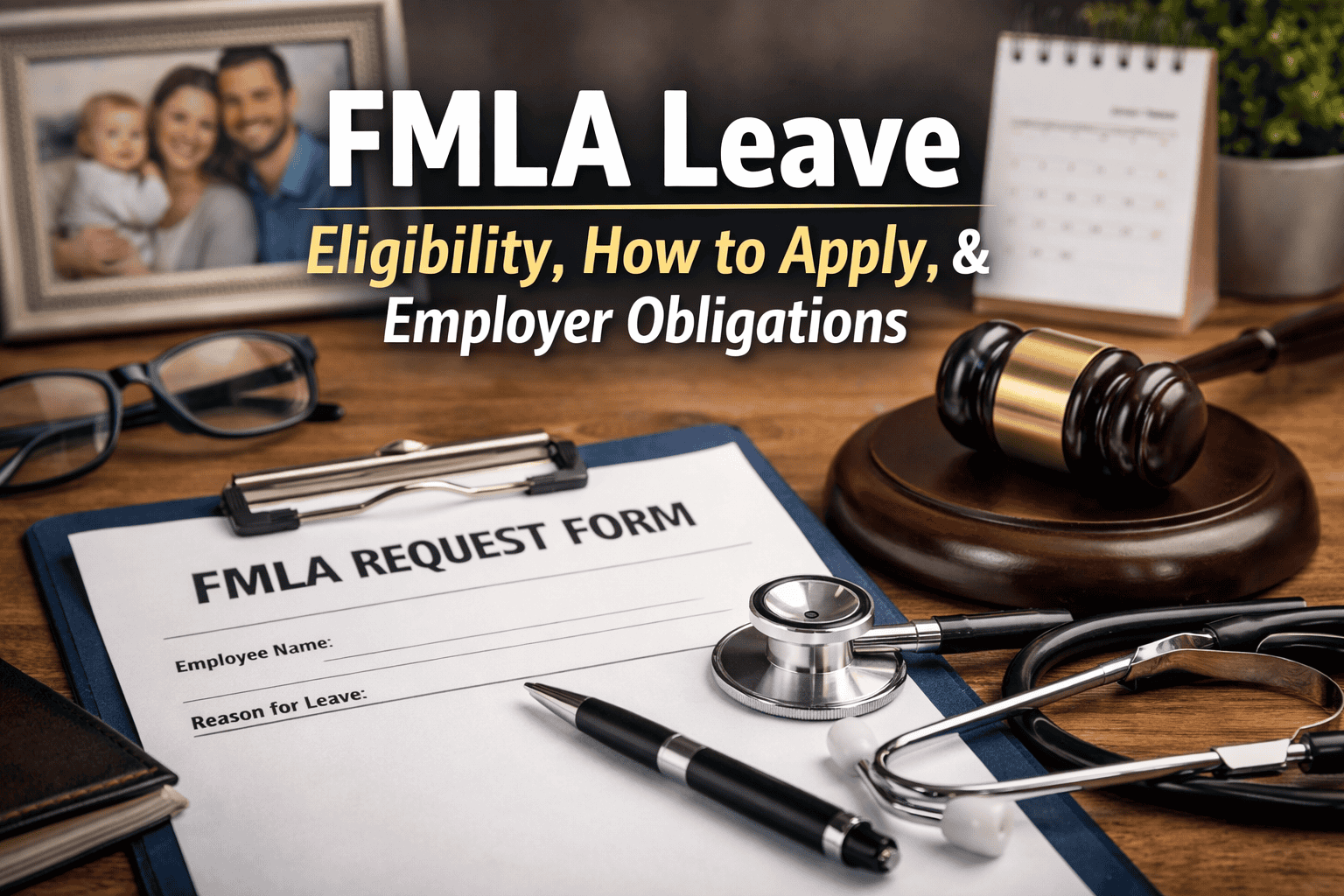
If you’ve ever sat across from an HR manager and wondered whether you even have the right to take FMLA leave — or worse, found out after the fact that you didn’t qualify — you know exactly how high the stakes are. FMLA leave is one of the most powerful job-protection tools U.S. employees have. It’s also one of the most misunderstood.
I’ve spent two decades advising multinational employers and executives on employment law across the US and UK. What I see repeatedly: employees assume they’re protected when they’re not, and employers — often inadvertently — create liability by mishandling the process. Both sides pay for these mistakes.
This guide covers what FMLA actually covers, who truly qualifies, how to apply without making the errors that get claims denied, and what your employer is legally obligated to do. Read it before you need it — because by the time the crisis hits, you won’t have time to learn from scratch.
What Is FMLA Leave?
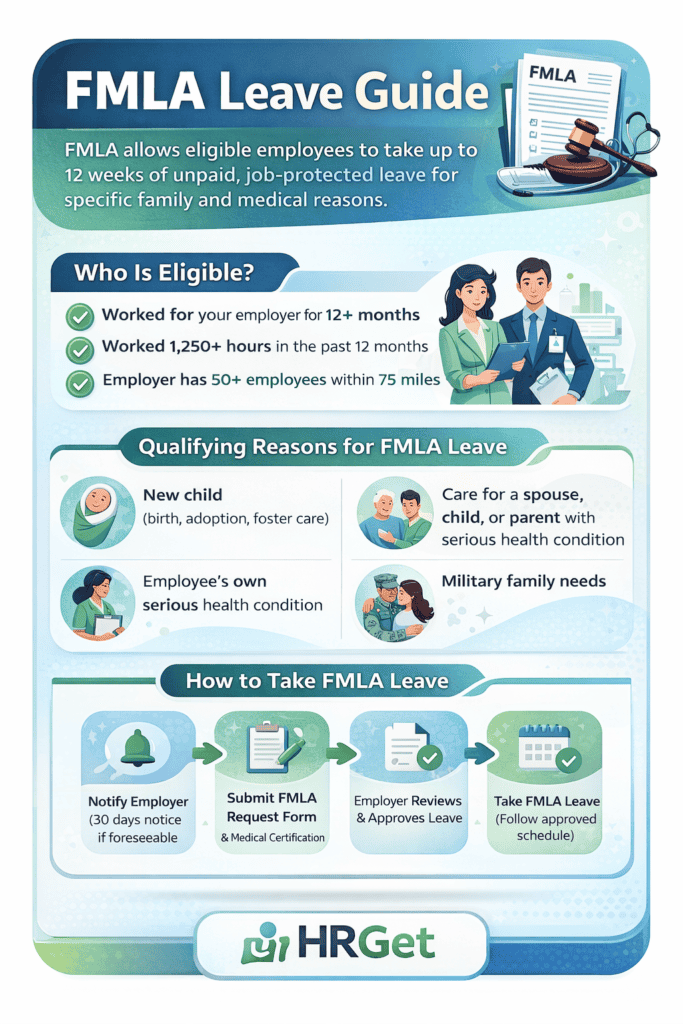
The Family and Medical Leave Act (FMLA) is a federal U.S. law enacted in 1993 that grants eligible employees up to 12 weeks of unpaid, job-protected leave per year for specific family and medical reasons. During that leave, your employer must maintain your group health insurance under the same terms as if you had continued working.
Here’s what “job-protected” means in practice: when you return, your employer must restore you to the same position you held before — or an equivalent one with the same pay, benefits, and terms. They cannot demote you, reduce your pay, or strip your responsibilities simply because you exercised a federal right.
What FMLA doesn’t do is pay you. This is the piece most employees misunderstand. The law protects your job; it doesn’t replace your income. I’ll come back to that distinction, because financially planning for FMLA leave is just as important as legally qualifying for it.
🔎 Insider View:
The DOL (Department of Labor) enforces FMLA and receives thousands of complaints annually. The most common violation isn’t outright termination — it’s interference: employers who delay approvals, request documentation beyond what the law allows, or subtly retaliate through performance reviews. Know your rights so you can spot these patterns early.
FMLA Eligibility: The Three-Part Test You Must Pass
This is where the gaps appear. FMLA eligibility is not automatic — it’s conditional on three simultaneous requirements. Miss even one and you have no FMLA protection, regardless of how serious your medical situation is.
The Three Eligibility Criteria
- 12 months of employment: You must have worked for your current employer for at least 12 months. These don’t need to be consecutive — periods of employment separated by gaps under 7 years count.
- 1,250 hours in the past 12 months: That’s roughly 24 hours per week averaged across the year. Part-time employees frequently miss this threshold, often without realizing it.
- 50-employee coverage rule: Your employer must have 50 or more employees within 75 miles of your worksite. Remote workers present a wrinkle here — the DOL’s guidance (updated as recently as 2023) generally counts a remote worker’s “worksite” as the office to which they report or from which assignments are made.
⚠ Warning:
Many employees at startups, regional offices, or companies that recently downsized assume they’re covered — and they’re not. Before you request leave, confirm with HR in writing that you meet all three criteria. A verbal “you should be fine” is not FMLA approval.
State-level protections can extend beyond federal FMLA in important ways. California’s CFRA, New York’s NYPFL, and Washington’s PFML programs, for example, cover smaller employers or provide paid benefits that federal FMLA does not. If you’re in a state with robust leave laws, you may have protections even when federal FMLA doesn’t apply.
What Situations Actually Qualify for FMLA Leave?
FMLA is specific. It covers serious, defined circumstances — not every health inconvenience or family need.
Qualifying Reasons Under Federal FMLA
- The birth of a child and bonding during the first year of life
- Adoption or foster care placement of a child (within the first year)
- A serious health condition that makes you unable to perform essential job functions
- Caring for a spouse, child, or parent with a serious health condition
- Qualifying military exigency arising from a family member’s covered military service
- Military caregiver leave: caring for a covered servicemember with a serious injury (up to 26 weeks)
What Doesn’t Qualify
- Common colds, the flu, or minor illnesses that don’t involve inpatient care or continuing treatment
- Burnout or job stress — unless your physician certifies it as a serious mental health condition requiring ongoing treatment
- Care for siblings, grandparents, or in-laws (under federal law — some states differ)
- Voluntary medical procedures that aren’t medically necessary
The critical legal concept here is “serious health condition” — which the DOL defines as an illness, injury, impairment, or physical or mental condition involving inpatient care or continuing treatment by a healthcare provider. A three-day hospital stay qualifies. A bad cold that clears in four days does not.
How Much Leave You’re Entitled To
Standard FMLA provides up to 12 workweeks of leave during a 12-month period. Military caregiver leave extends this to 26 weeks — but only for caring for a covered servicemember, and only once per servicemember per injury.
What most guides gloss over is intermittent and reduced-schedule leave — and these are often more practically valuable than a single block of time off.
Intermittent FMLA: The Underused Tool
If your condition or caregiving need doesn’t require a continuous block of leave, you can take FMLA in separate increments — even as little as one hour at a time. This is enormously useful for people managing chronic conditions like Crohn’s disease, migraines, or autoimmune disorders, or for parents attending recurring medical appointments with a sick child.
💡 Pro Tip:
Intermittent FMLA requires the same medical certification as block leave — but it gives you flexibility that most employees never use. If your physician certifies that you may need 2–4 hours off per week for treatment or flare-ups, that certification locks in protection for the full leave year. Request it proactively.
Employers can require you to schedule intermittent leave to minimize operational disruption — but they cannot deny it if your condition medically requires it.
How to Apply for FMLA Leave (Step-by-Step)
The application process is where well-intentioned employees make the mistakes that cost them their protection. Follow this sequence exactly.
Provide timely notice to your employer
If your leave is foreseeable — scheduled surgery, a due date, a planned adoption — you must give at least 30 days’ advance notice. If it’s not foreseeable, notify your employer as soon as practicable. The DOL considers “same day or next business day” as the standard for unforeseeable leave. You don’t need to invoke the word “FMLA” — you just need to provide enough information for HR to recognize this may be FMLA-qualifying.
Receive and review the FMLA eligibility notice
Within 5 business days of your request, your employer must provide a written eligibility notice (DOL Form WH-381). This tells you whether you meet the eligibility criteria and what documentation is required. If they don’t send it — follow up in writing and document that you did.
Submit the medical certification form
Your employer will provide a Certification of Health Care Provider form (DOL Form WH-380-E for your own condition, WH-380-F for a family member’s). Your healthcare provider must complete this — not you. You generally have 15 calendar days to return it. Missing this deadline can result in your leave being denied.
Await the employer’s designation notice
Within 5 business days of receiving sufficient information, your employer must issue a designation notice (DOL Form WH-382) confirming whether your leave is approved as FMLA-qualifying. Do not begin leave under the assumption it’s approved — wait for written confirmation.
Maintain communication during leave
Employers may require you to check in periodically during leave — comply with reasonable requests. Keep all communications in writing. If your situation changes (you need more time, or you’re returning early), notify HR promptly.
⚠ Critical Warning:
Never assume verbal approval equals legal FMLA designation. I’ve seen employees return from leave to find their absence coded as “unexcused” because no one formally designated the leave under FMLA. Get every step confirmed in writing — email is sufficient.
What Employers Must Do: Legal Obligations Under FMLA
FMLA places substantial duties on covered employers — and many employers either don’t fully understand them or quietly hope employees don’t either.
What Employers Are Required to Do
- Post FMLA notices: Employers must display the DOL’s FMLA poster in a conspicuous location and include FMLA information in employee handbooks.
- Provide eligibility and rights notices: As described above — within 5 business days of a leave request.
- Maintain health benefits: Your group health insurance must continue during FMLA leave under the same terms. You’re still responsible for your employee premium share.
- Restore your position: Upon return, you must be reinstated to your same job or an equivalent one — same pay, benefits, shift, location, and working conditions.
- Keep medical information confidential: Your health information must be stored separately from your personnel file and shared only on a strict need-to-know basis.
What Employers Cannot Do
- Terminate you for taking FMLA leave or for requesting it
- Demote you, reduce your pay, or strip your responsibilities upon return
- Count FMLA absences in attendance or disciplinary records
- Request medical information beyond what the certification form requires
- Interfere with, restrain, or deny the exercise of FMLA rights
🔎 Insider View:
The retaliation that happens under FMLA is rarely overt. In my practice, it shows up as suddenly poor performance reviews after return, being excluded from meetings, or a restructuring that conveniently eliminates your role. The legal standard for FMLA retaliation is not a smoking gun — it’s a pattern. Document everything before, during, and after your leave.
Real Scenarios: Where FMLA Protects You — and Where It Doesn’t
📋 Scenario A: The Case That Worked:
Marcus, Senior Software Engineer, fintech company (Chicago) — needed cardiac surgery and an 8-week recovery. He notified HR 30 days before the scheduled procedure, received the eligibility notice, had his cardiologist complete the WH-380-E within the 15-day window, and received written FMLA designation before his leave began. He checked in with HR by email every two weeks during recovery. He returned to his exact role without incident. The process worked because he treated it like a legal procedure — because it is one.
📋 Scenario B: The Case That Didn’t:
Diana, Marketing Director, regional retail chain (Atlanta) — had been struggling with severe anxiety and burnout for months. She told her manager she “needed time off for mental health” and assumed HR would handle the rest. No FMLA paperwork was ever initiated. No medical certification was submitted. When she returned after three weeks, her leave was coded as unauthorized absence. A performance improvement plan followed within six weeks. Her employer wasn’t necessarily acting in bad faith — the process simply never started. Mental health conditions absolutely can qualify for FMLA, but only when properly certified by a physician as a serious health condition requiring treatment. Saying you need a mental health break doesn’t trigger legal protection.
FMLA vs. Paid Leave: The Critical Difference
This is the most financially consequential distinction, and most employees don’t understand it until they’re already on leave.
| Feature | FMLA Leave | Paid Leave / PTO | State Paid Leave Programs |
|---|---|---|---|
| Paid? | No — unpaid | Yes — employer policy | Partial — varies by state |
| Job-protected? | Yes — federal law | Depends on employer policy | Usually yes |
| Legal right? | Federal statute | Employer discretion | State statute |
| Max duration | 12 weeks (26 for military caregiver) | Whatever you’ve accrued | Varies (CA: up to 8 weeks; NY: up to 12) |
| Can be combined? | Yes — runs concurrently with PTO/sick leave if employer requires | Yes | Yes — often stackable |
Here’s the strategic move most employees miss: your employer can require you to use accrued PTO, vacation, or sick time concurrently with FMLA leave — meaning they run at the same time, not sequentially. This reduces the financial gap but doesn’t extend your total leave beyond 12 weeks.
If your employer doesn’t require concurrent use, you can often elect to exhaust FMLA first, then use PTO — giving you income during the PTO period. Check your employer’s written leave policy carefully before your leave begins.
💡 Pro Tip:
Before going on FMLA leave, check whether you’re enrolled in your employer’s short-term disability (STD) plan. STD typically pays 60–70% of your base salary for 6–12 weeks following an elimination period (usually 7–14 days). FMLA and STD run concurrently — but the STD benefit means you’re not going entirely without income. Many employees don’t enroll during open enrollment and regret it exactly at this moment.
Common FMLA Mistakes That Cost Employees Their Protection
I’ve reviewed dozens of FMLA disputes over my career. The same errors appear with striking regularity.
Mistake 1: Assuming eligibility without verifying it
People assume that working at a company for over a year automatically qualifies them. But if your employer has 45 employees, or you worked part-time for most of the year, you may fall short. Confirm all three criteria — in writing — before you request leave.
Mistake 2: Relying on verbal communication
A manager saying “don’t worry, take the time you need” is not FMLA designation. If it isn’t in writing from HR with the official designation notice, it doesn’t exist legally. Every conversation should be followed by a confirmation email.
Mistake 3: Missing the medical certification deadline
Fifteen calendar days moves faster than you think when you’re managing a health crisis. Contact your healthcare provider the day you receive the certification form — not the day before it’s due.
Mistake 4: Misclassifying the qualifying reason
Burnout, caregiver stress, and general mental fatigue are not automatically FMLA-qualifying. Your physician must certify a “serious health condition” under the regulatory definition. If your doctor is willing to certify, make sure the paperwork is thorough and clinically specific.
Mistake 5: Going silent during leave
Disappearing entirely during FMLA leave creates problems on return. Maintain minimal, professional communication with HR — not your manager — to confirm your status and anticipated return date. It demonstrates good faith and protects against any claim that you abandoned your position.
Smart Strategy: How Experienced Professionals Protect Themselves
Here’s how I advise professionals who want FMLA protection without career damage — because the law protects your job, but your reputation is something you have to manage yourself.
Before Leave Begins
- Document your performance achievements in the 60–90 days before leave. This is your baseline if a performance review looks suspiciously negative after your return.
- Prepare a detailed transition memo for your team. The more seamlessly your work is covered, the less resentment accumulates.
- Confirm in writing — via email to HR — your leave dates, expected return date, and the name of whoever issued your FMLA designation notice.
- Review your short-term disability enrollment and understand your employer’s policy on concurrent PTO use.
During Leave
- Keep HR — not your direct manager — as your primary point of contact for leave administration.
- If your return date changes, notify HR promptly in writing.
- Avoid any social media activity that could contradict your medical certification. I’ve seen this used in litigation.
Upon Return
- If you’re returned to a position that differs in any material way from your pre-leave role, raise it with HR in writing within the first week. Don’t wait.
- If your first performance review post-return is markedly worse than prior reviews, request a meeting with HR and ask for the specific performance data supporting the evaluation.
- Keep records. FMLA retaliation claims have a two-year statute of limitations — three years if the violation was willful.
🔎 Insider View:
The employees who navigate FMLA without career consequences are almost always the ones who treated it as a structured legal process from day one — not an informal arrangement. The law is on your side. But you still have to work it correctly.
Frequently Asked Questions About FMLA Leave
Can my employer deny my FMLA leave request?
Yes — if you don’t meet the three eligibility criteria, or if your reason doesn’t qualify as a serious health condition or other covered circumstance under FMLA. Your employer cannot deny leave to an eligible employee for a qualifying reason. If they do, that’s an FMLA violation and grounds for a DOL complaint or civil lawsuit.
Do I get paid during FMLA leave?
Federal FMLA is unpaid. However, your employer may — or in some cases must — require you to use accrued PTO or sick leave concurrently. Some state paid leave programs (California, New York, New Jersey, Washington, Massachusetts, and others) provide partial wage replacement that can run alongside FMLA. Check your state’s program and your employer’s STD benefits before assuming the leave is entirely without income.
Can I be fired while on FMLA leave?
Not for taking FMLA leave — that’s illegal retaliation. But you can be terminated for reasons entirely unrelated to your leave, such as a company-wide layoff or pre-existing performance issues that were documented before you ever requested leave. The employer bears the burden of proving the termination is genuinely unrelated to the leave.
Does mental health qualify for FMLA leave?
Yes — when properly certified. Depression, anxiety disorders, PTSD, and other mental health conditions qualify as serious health conditions under FMLA if they involve inpatient care or continuing treatment by a healthcare provider (typically two or more visits to a mental health professional within 30 days of incapacitation). General burnout without a clinical diagnosis and treatment plan typically does not qualify.
What’s the difference between intermittent FMLA and block FMLA leave?
Block leave is a continuous period away from work — say, 6 consecutive weeks for surgery recovery. Intermittent leave is taken in separate increments when your condition flares or requires treatment. You can take intermittent leave in as little as one-hour increments if that’s the minimum leave period your employer tracks. Both require the same medical certification process.
Can I take FMLA leave to care for a sibling or grandparent?
Not under federal FMLA, which covers only spouses, children (biological, adopted, foster, stepchildren, or those for whom you act as a parent), and parents. Some states have expanded this — Oregon, for example, includes grandparents, siblings, and domestic partners. Check your state’s leave laws if your family situation doesn’t fit the federal definition.
What should I do if my employer retaliates after I return from FMLA leave?
Document every incident — changed responsibilities, negative performance reviews without documented basis, exclusion from meetings, sudden disciplinary actions — with dates, names, and specifics. File a complaint with the DOL’s Wage and Hour Division within two years of the violation (three if willful). Consider consulting an employment attorney; many take FMLA retaliation cases on contingency.
Does FMLA apply to remote workers?
Yes, if you meet all three eligibility criteria. For remote employees, the DOL generally considers your “worksite” to be the office from which your work is assigned or to which you report. So a remote employee whose home office is 400 miles from any company office, but who is assigned work from a headquarters with 200 employees, would likely be covered under the 50-employee threshold.
Know Your Rights Before You Need Them
FMLA leave is one of the most powerful employment protections in U.S. law — but only when you use it correctly. If you’re navigating a workplace dispute or need to understand your full rights under employment law, explore our Employment Laws & Rights resource hub for in-depth guidance on wrongful termination, at-will employment, and workplace protections.
The Bottom Line on FMLA Leave
FMLA leave is job protection, not income protection. That distinction shapes everything — how you plan for it financially, how you execute the process legally, and how you manage your career around it.
The employees who use FMLA effectively treat it exactly as it is: a federal legal right with a specific process that must be followed correctly. They verify eligibility before they need it. They document every step. They maintain their professional reputation throughout. And they come back to work prepared to defend their position if the dynamics have quietly shifted.
If there’s one thing I’d want you to take from this: don’t assume you’re protected. Confirm it. Then protect yourself with the same rigor the law is trying to protect you with.
Victoria Hale is an Employment Law Partner with 20+ years advising multinational employers and executives across the US and UK. She previously served as a Partner at Freshfields Bruckhaus Deringer, specializing in FLSA compliance, wrongful termination, and executive employment disputes.

Victoria Hale | Former Partner, Freshfields Bruckhaus Deringer | Employment Law Specialist | 20+ Years Advising Multinationals & Executives
Author: Victoria Hale spent over two decades as an Employment Law Partner at Freshfields Bruckhaus Deringer — one of the world’s most prestigious Magic Circle law firms — advising multinational corporations and senior executives on some of the most complex employment disputes in the US and Europe. Her practice covered wrongful termination litigation, executive exits, non-compete enforcement, FLSA compliance, and cross-border workforce restructuring under EU labour law. Now based between London and New York, Victoria writes for HRGet.com to close the gap between legal theory and how employment law actually plays out in the real world — for employees who need to know their rights before it’s too late.