
By Eleanor Whitmore — Global Head of Compensation Strategy | Former Partner, Mercer | Advisor to WEF Working Groups · Updated April 2026
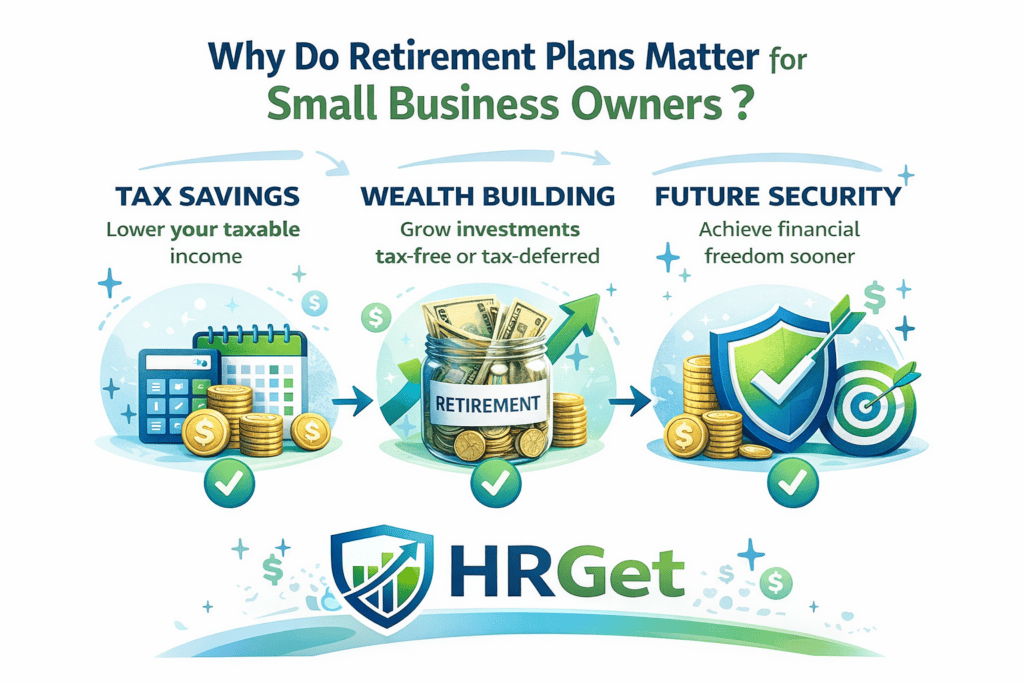
Here’s something I’ve noticed in 20 years of advising on compensation strategy: small business owners are often the most sophisticated thinkers about their company’s financials — and the most neglectful of their own. The best retirement plans for small business owners in 2026 aren’t complicated, but picking the wrong one costs you tens of thousands in unnecessary tax every single year.
Unlike a salaried employee who has an employer auto-enrolling them into a 401(k) and matching their contributions, you’re doing everything yourself. That’s a burden — but also a massive opportunity. The tax-deferral potential available to self-employed founders and solo operators dwarfs what most corporate employees ever see. The question is whether you’re actually using it.
This article gives you a clear decision framework: what each plan actually does, who it’s right for, and the sequencing strategy that high-earning founders quietly use to minimize their tax burden while building serious long-term wealth.
Why Retirement Planning Is Different When You Own the Business
Employees complain about their 401(k) match being 3%. You should be so lucky to have that as your only concern. When you’re self-employed or running a small business, income variability is real — a strong Q3 can be followed by a painful Q1. That unpredictability makes it tempting to defer retirement contributions indefinitely.
But here’s what that delay actually costs: every year you’re not maximizing a tax-advantaged account, you’re paying your marginal tax rate on money that could have been compounding tax-deferred. For a business owner in the 32% or 37% federal bracket, that’s not a small number. And with tax rates being discussed in Washington as potentially rising post-2025 as some provisions of the Tax Cuts and Jobs Act sunset, 2026 is arguably the best time to lock in deductions.
The other thing employees don’t grapple with is the exit strategy dimension. Your business may be your biggest asset — but it’s illiquid. A properly funded retirement account gives you personal financial independence that doesn’t depend on finding a buyer for your company. That’s not just financial planning. That’s leverage.
Insider View:
The founders I’ve worked with who built serious personal wealth alongside their businesses almost universally treated their Solo 401(k) or defined benefit plan as a non-negotiable line item — not a “whatever’s left over” decision. The mindset shift from “I’ll save what I don’t spend” to “I’ll fund my retirement first, then run the P&L” is worth more than any specific plan selection.
Solo 401(k): The Best Overall Plan for High Earners
If you’re self-employed with no full-time employees other than a spouse, the Solo 401(k) — also called an Individual 401(k) or One-Participant 401(k) — is almost always the strongest option. The reason is structural: you wear two hats simultaneously.
As the employee, you can defer up to $23,000 in 2026 (or $30,500 if you’re 50+). As the employer, you can contribute an additional 25% of net self-employment income. Combined, the annual cap sits at $69,000 for those under 50 — and higher with catch-up contributions. No other plan gets you to that number as efficiently.
What most listicles skip: the Solo 401(k) also allows a Roth component. That means you can split contributions between pre-tax (Traditional) and post-tax (Roth) buckets, giving you tax diversification that’s worth gold when you’re uncertain where marginal rates will land in 20 years. You can also take a loan against the balance — a feature almost no other self-employed retirement plan offers.
Pro Tip:
If you’re a consultant, freelancer, or single-founder operating as an S-Corp or sole proprietor earning $120K–$300K annually, the Solo 401(k) will almost certainly beat the SEP IRA on total contributions. Run the math on your specific net self-employment income before assuming the SEP is “simpler” — simpler doesn’t mean better when the gap is $20K in additional tax-deferred contributions.
The one real limitation: once you hire a non-spouse W-2 employee who works 1,000+ hours per year, you can no longer use a Solo 401(k). At that point, you’d graduate to a full 401(k) plan with broader eligibility rules. That’s a good problem to have — it means your business is growing — but plan for it.
SEP IRA: Best for Simplicity — With a Catch
The SEP IRA (Simplified Employee Pension) has one genuine advantage over every other plan: setup and administration are almost frictionless. You can open one in an afternoon, contribute for prior tax years up until your filing deadline (including extensions), and there’s no annual IRS filing requirement. For a business owner who is perpetually time-starved, those qualities matter.
Contribution limit in 2026: up to 25% of net self-employment income, capped at $69,000. On paper, that sounds comparable to the Solo 401(k). In practice, it often isn’t — because the 25% employer contribution formula works differently against your net SE income, and you lose the employee salary deferral component entirely. For many earners in the $100K–$200K range, this means leaving $10,000–$20,000 in annual contribution room on the table versus a Solo 401(k).
There’s also a meaningful downside if you have employees: SEP IRA contributions must be made at the same percentage for all eligible employees as you contribute for yourself. If you put in 20% of your income, you must contribute 20% of every eligible employee’s compensation too. That generosity can get expensive fast. Compare that to a SIMPLE IRA or full 401(k), which give you more controlled cost structures as a plan sponsor.
Insider View:
I’ve seen plenty of solo consultants default to SEP IRAs because their accountant set one up years ago and nobody revisited it. It’s a reasonable starting point — but if you’ve grown your income past $100K and you haven’t compared it to a Solo 401(k) recently, you’re probably leaving money on the table every April.
SIMPLE IRA: The Right Tool for Small Teams
The SIMPLE IRA (Savings Incentive Match Plan for Employees) is built for businesses with 100 or fewer employees who want to offer a retirement benefit without the administrative weight of a full 401(k) plan. It’s not designed to maximize a founder’s personal contribution ceiling — and if that’s your primary goal, this isn’t your plan.
The 2026 employee contribution limit is $16,500 ($20,000 if 50+), which is meaningfully below the Solo 401(k) ceiling. The employer must make either a matching contribution of up to 3% of compensation or a flat 2% non-elective contribution for all eligible employees, regardless of whether they participate. That mandatory employer contribution is real overhead — budget for it.
Where the SIMPLE IRA wins is in the offer itself. For early-stage companies competing for talent without the budget for a premium benefits package, being able to say “we have a retirement plan with employer matching” closes candidates. It signals organizational maturity. The setup cost is low, the IRS paperwork is manageable, and unlike a full 401(k), you don’t need a third-party administrator. For a 5–20 person company trying to scale without drowning in compliance, that’s a real value proposition.
One hard rule: once you establish a SIMPLE IRA, you’re locked into it for the full calendar year. You can’t simultaneously maintain another qualified plan. So if you think you’ll outgrow it quickly, plan accordingly.
Defined Benefit Plan: The High-Earner’s Tax Wrecking Ball
This is the one that most articles gloss over — and it’s the most powerful tool in the arsenal for business owners earning $200,000 or more annually.
A defined benefit plan (sometimes called a “cash balance plan” in its modern form) works in reverse from other retirement accounts. Instead of asking “how much can I contribute?”, it asks “what monthly benefit do I want at retirement?” — and then calculates the required annual contribution to fund that promise. The IRS allows contributions needed to fund that benefit, which can run anywhere from $100,000 to $300,000+ per year depending on your age, income, and target benefit.
At 50, with $400K in annual income, a properly designed defined benefit plan can shelter more than $200,000 from federal income tax in a single year. Combined with a Solo 401(k) — which you can run simultaneously — you’re looking at a total tax-deferred contribution that’s simply not available through any other vehicle.
Warning:
Defined benefit plans require an actuarial calculation each year, mandatory annual contributions regardless of business performance, and termination is a formal process. If you’re in a volatile revenue business or can’t commit to multi-year mandatory funding, the rigidity could hurt you. This is a plan for established earners with predictable high income — not a tool for variable-income freelancers in growth mode.
The ideal candidates are doctors in private practice, high-billing attorneys, successful consultants, and agency owners who’ve consistently crossed $250K in annual profit and are behind on retirement savings. The defined benefit plan lets them compress 20 years of savings into 10 — legally and aggressively.
Quick Comparison: All Plans Side by Side
| Plan | Best For | 2026 Max Contribution | Roth Option | Employees Allowed | Admin Complexity |
|---|---|---|---|---|---|
| Solo 401(k) | Solo high earners ($80K–$250K) | ~$69,000 ($76,500 if 50+) | Yes | No (spouse only) | Medium |
| SEP IRA | Simplicity seekers, variable income | ~$69,000 (25% of net income) | No | Yes (equal % required) | Very Low |
| SIMPLE IRA | Small teams (<100 employees) | $16,500 ($20,000 if 50+) | No | Yes | Low |
| Defined Benefit | Ultra-high earners ($200K+) | $100K–$300K+ (actuarially determined) | No | Yes (with cost) | High |
| Traditional / Roth IRA | Supplemental layer only | $7,000 ($8,000 if 50+) | Roth version yes | N/A | Very Low |
Real Scenario: The $500K Gap Most Founders Never See
Real Scenario:
Marcus, 42, runs a digital marketing agency in Austin. Annual profit: $160,000.
Marcus has been contributing $6,500/year to a Roth IRA for the past eight years because “he never got around to setting up anything else.” Over those eight years, he’s saved roughly $52,000 in retirement accounts (plus investment growth).
Had Marcus used a Solo 401(k) from day one, he could have contributed approximately $42,000–$50,000 per year at his income level. Over eight years, that’s $336,000–$400,000 in tax-deferred contributions — plus avoiding roughly $13,000–$16,000 in federal taxes each year through the deduction.
The difference between his actual retirement balance and what it could have been? Conservatively, north of $500,000 over a 10-year horizon when you factor in the compounding on both the larger principal and the tax savings reinvested into the business.
Marcus isn’t unusual. I’ve seen this exact pattern with founders across industries. The plan they never got around to setting up is quietly the most expensive decision they never made.
Smart Strategy: How High Performers Actually Structure This
The founders who get this right don’t pick one plan and call it done. They sequence plans deliberately as income grows. Here’s the layered approach that actually works:
Phase 1 — Starting Out ($50K–$100K net income): Open a Solo 401(k) immediately, even if you can only contribute $10,000–$15,000 the first year. The Roth component is particularly valuable here — your income is lower now than it will be, so you’re paying tax at a lower rate on money that grows tax-free for decades. Don’t bother with a SEP IRA unless the administrative setup of the Solo 401(k) feels genuinely prohibitive.
Phase 2 — Growth Phase ($100K–$200K net income): Max out the Solo 401(k) annually. Add a Roth IRA if your income falls under the phase-out thresholds (use a backdoor Roth if it doesn’t). At this stage, the tax deduction from maxing the Solo 401(k) is significant — often $14,000–$18,000 in federal tax savings per year for someone in the 32% bracket.
Phase 3 — High Earner ($200K+ net income): Layer a defined benefit plan on top of the Solo 401(k). This is the combination that CPAs who work with high-earning founders know well. Done correctly, you can shelter $150,000–$250,000 of income annually from federal tax. Hire an actuary and a CPA who specializes in retirement plans — the setup cost is real but trivial relative to the tax savings.
Pro Tip:
Don’t lock all your liquidity into retirement accounts. The most common mistake I see in Phase 3 is over-optimizing for tax deductions at the expense of business cash flow and personal emergency reserves. Retirement plans are powerful — but they’re only one part of a complete financial architecture. Keep 3–6 months of personal and business expenses accessible before aggressively funding a defined benefit plan.
Common Mistakes That Cost Business Owners Dearly
Waiting for the business to “stabilize” before starting. It never feels stable. The business that feels too early-stage to think about retirement at $80K is the same business that feels too busy at $180K and too complicated at $300K. Open the plan now, contribute what you can, and adjust as you grow.
Treating the IRA as a retirement strategy. A Roth or Traditional IRA is a supplement, not a strategy. At $7,000 per year, it’s the financial equivalent of bringing a knife to a gunfight. Use it as a Roth for tax diversification — but your core vehicle should be a Solo 401(k) or defined benefit plan.
Choosing the SEP IRA because the accountant set it up years ago. SEP IRAs are fine. They’re not optimal for most earners above $100K who have no employees. If your accountant hasn’t proactively compared your current plan to a Solo 401(k) in the last two years, ask them to do the math.
Ignoring the interaction with business structure. Whether you’re a sole proprietor, single-member LLC, S-Corp, or C-Corp changes the contribution calculation meaningfully. An S-Corp owner paying themselves a $70K W-2 salary and taking $100K in distributions has a very different Solo 401(k) contribution ceiling than a sole proprietor with the same total income. Get this right before you contribute — fixing it later is painful.
Not reviewing the plan annually. Your income changes. The tax code changes. IRS contribution limits adjust for inflation every year. A plan that was optimal at 38 may be leaving significant money on the table at 45. Annual review with a CPA who understands self-employed retirement accounts is not optional — it’s part of the job.
The Bottom Line
For most self-employed founders and solo operators: Solo 401(k) first, always.
Add a Roth component for tax diversification. Keep the SEP IRA in your back pocket if you need a late contribution before tax day. Layer in a defined benefit plan once your income consistently clears $200K and you have a CPA who knows how to run one.
The best retirement plan for small business owners isn’t the most complicated one — it’s the one you actually fund, year after year, while the tax code subsidizes your wealth-building at every step.
Frequently Asked Questions
What is the best retirement plan for a self-employed person with no employees in 2026?
The Solo 401(k) is almost universally the best option for self-employed individuals with no full-time employees. It allows the highest combined contribution ceiling (up to $69,000 in 2026, or $76,500 with catch-up contributions), offers both Traditional and Roth options, and includes the ability to take loans against your balance. For most solo operators earning above $80,000 in net self-employment income, it will outperform the SEP IRA on total contributions.
Can a small business owner have both a Solo 401(k) and a SEP IRA?
Generally, no — not in the same year for the same business. The IRS does not permit simultaneous contributions to both a Solo 401(k) and a SEP IRA for the same self-employment income. However, you can have a Solo 401(k) and a defined benefit plan simultaneously, which is a strategy used by high-earning founders to maximize tax-deferred contributions well beyond what either plan allows individually.
How much can a small business owner contribute to a Solo 401(k) in 2026?
In 2026, the total contribution limit for a Solo 401(k) is approximately $69,000 for those under 50, and $76,500 for those 50 or older. This combines the employee deferral ($23,000, or $30,500 with catch-up) and the employer profit-sharing contribution of up to 25% of net self-employment compensation. The exact employer contribution ceiling depends on your business structure and net income — an S-Corp owner’s calculation differs from a sole proprietor’s.
Is a SEP IRA or Solo 401(k) better for small business owners?
For most business owners earning above $100K with no employees, the Solo 401(k) is better. It allows higher total contributions at lower income levels because you can make both employee salary deferrals and employer contributions. The SEP IRA is simpler to administer and allows contributions until your tax filing deadline (including extensions), making it useful if you need flexibility around timing. But “simpler” often means leaving significant contribution room unused.
At what income level does a defined benefit plan make sense for a business owner?
A defined benefit plan typically becomes compelling when your net business income consistently exceeds $200,000 annually and you want to shelter more income than a Solo 401(k) allows. The plan is actuarially determined — meaning the allowable contribution scales with your income, age, and target retirement benefit. Owners in their late 40s or 50s with high, stable income get the most leverage because the actuarial calculation permits larger contributions to fund the promised retirement benefit in a shorter timeframe.
Can a small business owner contribute to retirement plans if income was low or negative this year?
Your contribution amount to most plans is tied directly to your net self-employment income for the year — so in a low-income year, your contribution capacity is limited. For the SEP IRA and Solo 401(k), you can contribute $0 in a bad year without any penalty. However, if you have a defined benefit plan, mandatory contributions are required regardless of whether your business was profitable, which is the primary risk of that structure for variable-income operators.
What retirement plan options exist for Indian small business owners?
Indian business owners don’t have access to US 401(k) or IRA structures, but there are strong equivalents. The National Pension System (NPS) offers tax deductions under Section 80CCD and is available to self-employed individuals. The Public Provident Fund (PPF) provides guaranteed returns with Section 80C deductions up to ₹1.5 lakh annually. High-earning proprietors should also explore business structuring through a private limited company to access corporate tax benefits on retirement provisioning. The layering strategy is conceptually identical — maximize tax-advantaged accounts before taxable savings.
Retirement planning is just one layer of your total compensation strategy. If you’re also navigating salary benchmarking or equity decisions as a business owner, explore our complete compensation strategy resources.

Eleanor Whitmore | Former Partner, Mercer | Advisor, World Economic Forum | 20+ Years in Global Compensation
Author bio: Eleanor Whitmore has spent over two decades shaping how the world’s leading organisations pay, retain, and reward talent. As a former Partner at Mercer and an advisor to World Economic Forum working groups on the Future of Work, she has designed compensation frameworks for Fortune 500 companies across the US, UK, Europe, and emerging markets. Based between London and New York, Eleanor writes for HRGet.com to translate boardroom-level pay strategy into actionable guidance for working professionals navigating real compensation decisions.