
You worked 50 hours last week. You’re staring at your paycheck and the overtime pay rules aren’t adding up — or worse, there’s no overtime at all. Your manager says the extra hours were “unapproved.” The system auto-deducted your lunch. Your after-hours Slack messages “don’t count.”
Here’s what I’ve learned after 15 years in HR: most overtime disputes aren’t about math. They’re about what the Fair Labor Standards Act (FLSA) legally defines as hours worked — and the gap between that definition and what your employer tells you.
That gap can cost you $5,000 to $10,000 a year. This article closes it.
What Is Overtime Under the FLSA?
The Fair Labor Standards Act is the federal law that sets the floor for wage protections in the US. Under the FLSA, the overtime pay rules are straightforward on paper:
- Rate: 1.5× your regular rate of pay for every hour beyond 40 in a workweek
- Threshold: 40 hours per workweek — not per day, not per pay period
- Workweek: A fixed, recurring 7-day period set by your employer
If you earn $25/hour, every overtime hour pays $37.50. Work 45 hours? That’s $187.50 in overtime — before any state law top-ups.
Two things employers imply (but aren’t actually legal): offering “comp time” instead of overtime pay in private-sector companies, and averaging hours across two-week pay periods to keep weekly totals below 40. The FLSA prohibits both. Your overtime is calculated week by week, full stop.
State laws can and do add protections on top of this federal baseline. California, for example, requires daily overtime after 8 hours. But the FLSA sets the national floor — and for most workers outside California, it’s the governing standard.
Who Qualifies: Exempt vs. Non-Exempt Employees
This is the single most abused area in overtime law. I’ve seen it misapplied hundreds of times — sometimes accidentally, often not.
Non-exempt employees are covered by FLSA overtime protections. You qualify as non-exempt if you’re paid hourly, or if you’re salaried but earn below the federal threshold (currently $684/week, or about $35,568/year as of 2026). Most frontline, operational, and support-role workers fall here.
Exempt employees must meet two tests simultaneously: a salary test AND a duties test. Both must apply. Here’s the critical nuance that most articles miss:
Your job title is legally irrelevant. A person titled “Marketing Manager” who executes tasks without meaningful independent judgment may be non-exempt despite the title. The FLSA’s executive, administrative, and professional exemptions each require that the employee’s primary duties involve specific types of decision-making or specialized knowledge — not just that they sound senior.
Common misclassification scenarios I’ve encountered: warehouse leads called “supervisors,” call center agents promoted to “team leads” without any real managerial authority, and software support roles titled “IT Administrators” who spend 90% of their time on routine troubleshooting. All were misclassified as exempt. All were owed back overtime pay.
If your employer gave you a title bump without a meaningful duties change, that’s worth scrutinizing.
What Legally Counts as Hours Worked
This is the section that will either cost or save you money. The FLSA’s definition of “hours worked” is broader than most employees — and employers — realize.
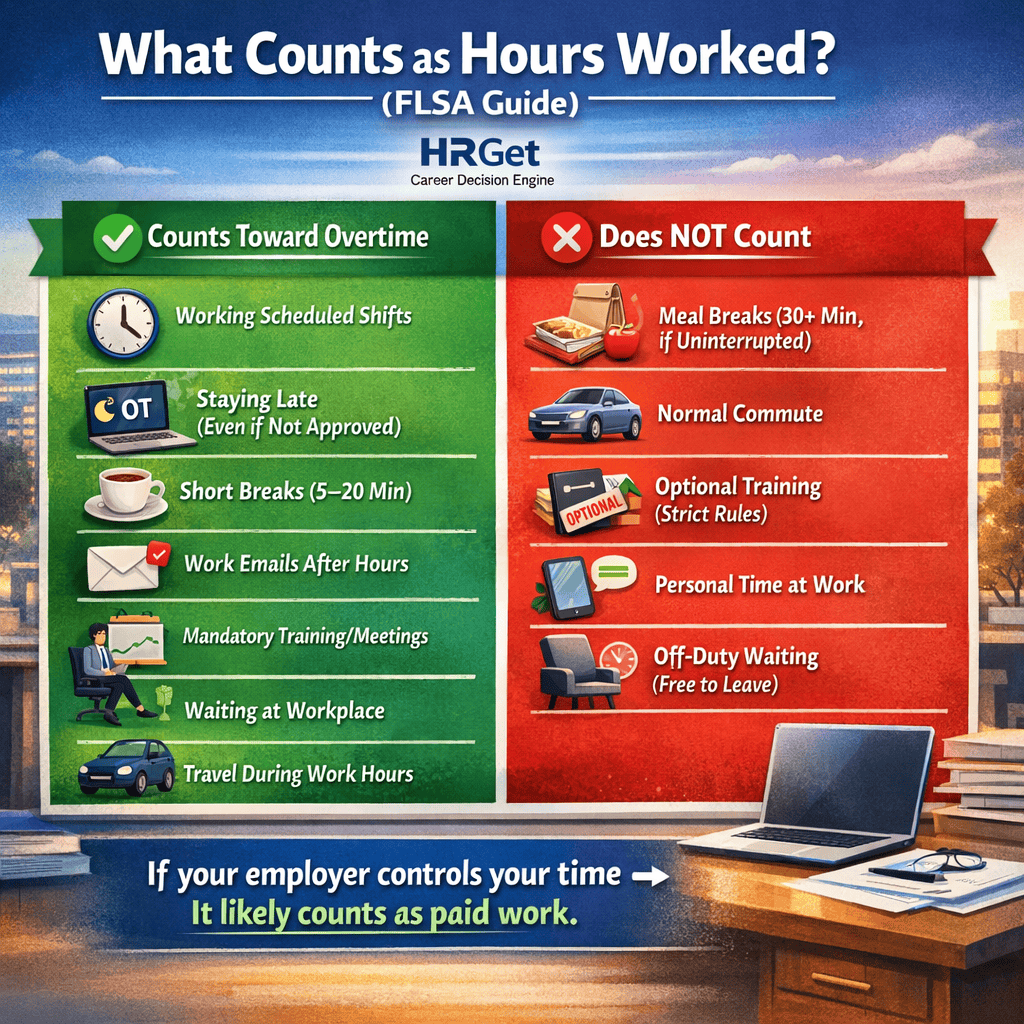
Scheduled and Required On-Duty Time Paid
Your regular shifts, mandatory overtime requests, and any time your employer requires you to remain at your workstation. No surprises there.
Work You Did Without Being Asked — But Your Employer Knew About Paid
This one trips people up. If you stayed 30 minutes late to finish a report, started early to prep for a call, or skipped lunch to meet a deadline — and your manager was aware — the FLSA says that time must be compensated. “I didn’t authorize it” is not a legal defense against paying for it. The employer can discipline you for working unapproved hours. They cannot withhold your pay for those hours.
Short Rest Breaks (5–20 Minutes) Paid
Coffee breaks, brief rest periods — these count as paid time under federal law. Not because it’s generous, but because the DOL determined decades ago that short breaks primarily benefit the employer’s productivity.
Job-Related Training and Mandatory Meetings Paid
If attendance isn’t truly optional, it’s paid time. Required compliance training, onboarding sessions, mandatory team meetings — these count toward your weekly hours. The narrow exception is voluntary training that occurs outside work hours, isn’t directly tied to your current job, and involves no productive work. In practice, that exception is rarer than employers claim.
Off-the-Clock Work From Home Paid
Checking email at 9pm. Responding to Slack. A “quick” task that takes 25 minutes. If it benefits your employer and they know (or reasonably should know) it’s happening, those minutes are compensable under the FLSA. This is one of the fastest-growing categories of wage theft in 2026, particularly in remote and hybrid roles.
Waiting Time — The Nuanced One
The FLSA distinguishes between two types of waiting:
| Type | Definition | Paid? |
|---|---|---|
| “Engaged to wait” | You’re at work with no assignment but must remain available (e.g., a security guard between rounds, a dispatcher between calls) | ✓ Yes |
| “Waiting to be engaged” | You’re completely free to leave, use your time as you choose, and happen to be on-call | ✗ Generally No |
Most employers blur this line. If your “unpaid” waiting time still requires you to stay on premises or respond within a few minutes, it’s almost certainly compensable.
Travel Time — Partially Sometimes Paid
Travel during your normal workday counts. So does traveling from one job site to another. Your regular home-to-office commute does not. One nuance: if you’re a non-exempt employee asked to travel to a one-day out-of-town assignment, the travel time (minus normal commute time) likely counts as hours worked.
What Does NOT Count as Hours Worked
Equally important. Here’s where legitimate deductions live — and where employees sometimes overclaim.
Bona Fide Meal Breaks (30+ Minutes) Unpaid
A meal break is only unpaid if you’re completely relieved of all duties. Not “mostly” free. Completely free. The moment your employer asks you to cover the phones, stay nearby in case something comes up, or you’re expected to respond to anything work-related during that period — it flips to compensable time. Many employers auto-deduct 30 minutes from every shift regardless of whether that condition was actually met. That’s where legal exposure builds up quietly.
Regular Home-to-Work Commute Unpaid
Standard commuting, even if long, doesn’t count. The Portal-to-Portal Act of 1947 specifically carved this out. Driving to a different job site mid-day is a different matter entirely.
Truly Optional Training Unpaid
It must satisfy all four criteria simultaneously: outside regular work hours, completely voluntary, not directly job-related, and no productive work performed. If your employer is saying training is “optional” but your performance review suffers if you skip it, that’s not actually optional under the law.
Personal Time at Work Unpaid
Extended personal phone calls, personal errands run during a long break, or time spent on activities that clearly don’t benefit the employer don’t count. This is the rare category that actually favors employers and is rarely contested.
Gray Areas Employers Exploit (And How to Spot Them)
Let me be direct: the gray areas below aren’t gray because the law is unclear. They’re gray because enforcement is inconsistent and employees rarely push back. I’ve seen the same patterns across companies of every size.
The “Off-the-Clock Culture” Problem
This is endemic in service industries, retail, and increasingly, white-collar remote roles. It’s never a formal policy. It’s a cultural norm: “Just shoot me a quick reply,” “It only takes two minutes,” “The system is down, just clock out and we’ll figure it out later.” Two minutes per day, five days a week, 50 weeks a year adds up to over 8 hours of uncompensated work annually — at a minimum. Multiplied across a team, it’s a significant liability.
Misclassification as “Exempt”
The DOL has consistently identified misclassification as one of the most widespread wage violations. A job title with “manager,” “director,” or “lead” in it does not automatically create an exemption. Employers know this. Some rely on employees not knowing it.
Automatic Lunch Deductions That Don’t Reflect Reality
Many payroll systems auto-deduct 30 minutes for every shift longer than 6 hours — regardless of whether the employee actually took an uninterrupted break. If your employer does this and you regularly work through lunch, you may be owed money for every such shift over the past two to three years (the FLSA has a 2-year statute of limitations, 3 years for willful violations).
Time-Rounding Against You
Rounding is legal under the FLSA — but only if it’s neutral over time, meaning it should average out in the employee’s favor as often as the employer’s. If your clock-in at 8:53am always rounds to 9:00am, but your clock-out at 5:06pm also rounds down to 5:00pm, that’s a systemic pattern that consistently works against you. Document it.
Most overtime violations aren’t prosecuted because employees assume their employer’s records are accurate. They’re not always. Your employer’s timekeeping system serves their interests. Maintaining your own parallel log — simple, consistent, timestamped — is the single most powerful thing you can do to protect yourself. If a dispute ever arises, your contemporaneous records carry significant weight.
Real Scenario: Where the Money Disappears
Marcus, 34, Operations Coordinator — Mid-sized logistics firm, Dallas, TX
Marcus earns $25/hour. He routinely works 46–48 hours per week. On paper, his paycheck shows 40–41 hours most weeks. Here’s the breakdown of what’s being missed:
- 2 hours/week: Responding to supplier emails after 6pm (“just quick replies”)
- 1 hour/week: Auto-deducted lunch on days he ate at his desk
- 1.5 hours/week: Pre-shift equipment checks that started before his official clock-in time
That’s 4.5 hours of uncompensated work per week. At $37.50/hour (overtime rate), that’s $168.75 per week — approximately $8,775 per year quietly walked out of his paycheck.
Marcus assumed this was normal. It’s not. It’s a textbook FLSA violation across three separate categories.
Smart Strategy: How to Protect Your Overtime Pay
You don’t need a lawyer to start protecting yourself. You need a system and the willingness to use it.
1Track your own hours independently. Use a simple Google Sheet or a free time-tracking app like Toggl. Log your actual start time, end time, whether you took a real lunch break, and any after-hours work. Do this every day. The five minutes it takes is worth thousands of dollars in potential back pay.
2Create a paper trail for off-the-clock work. Your email timestamps, Slack message history, and calendar invites are evidence. When you respond to a work message at 9:17pm, that timestamp exists. Don’t delete it. If you’re regularly working after hours, forward relevant emails to a personal account so you have a record outside your employer’s systems.
3Ask clarifying questions in writing. If you’re unsure whether certain time counts, ask your HR team or manager via email: “I’ve been responding to client emails after 6pm most evenings — should I log that time on my timesheet?” The question itself creates accountability. Their answer (or silence) is documentation.
4Compare your records to your pay stubs regularly. Once a month, pull out your own time log and compare it to what was actually paid. If there’s a consistent discrepancy, you have a documented pattern — which is exactly what the DOL and employment attorneys look for.
5Know your escalation path. Start with a written inquiry to HR. If that doesn’t resolve it, you can file a complaint with the U.S. Department of Labor Wage and Hour Division — for free, confidentially, and without needing an attorney. The WHD investigates and can recover back wages on your behalf.
Several states have overtime rules that exceed the federal FLSA baseline. California mandates daily overtime after 8 hours (and double-time after 12). Alaska and Nevada have similar daily thresholds. Always check your state’s Department of Labor website alongside federal rules — your state’s law may give you stronger protection.
Common Mistakes That Cost You Money
- Assuming “salaried” means no overtime. Salary status alone doesn’t create an exemption. If your salary is below the federal threshold, or if your duties don’t meet the FLSA’s duties test, you’re non-exempt — and owed overtime — regardless of how you’re paid.
- Trusting your employer’s timekeeping system completely. Payroll systems are set up by your employer. Automatic deductions, rounding rules, and break policies may all be configured in ways that systematically reduce your compensable hours. Your own records are the check on this.
- Ignoring “small” uncompensated tasks. The legal standard doesn’t have a de minimis threshold for regular work. If you’re consistently doing 10–15 minutes of work before clocking in each day, that’s about 40–50 hours per year — and at an overtime rate, the dollar value adds up fast.
- Accepting “comp time” as a substitute for overtime pay. Private-sector employers cannot legally offer future time off instead of overtime pay. Only government employees under specific conditions are eligible for comp time. If your employer offers this, they’re violating the FLSA.
- Not understanding the statute of limitations. FLSA violations can be recovered going back 2 years (3 years for willful violations). That means if you’ve been shorted on overtime, you may have a meaningful back-pay claim — but only if you act. Waiting erodes that window.
FAQs: Overtime Pay Rules (US)
Can my employer refuse to pay overtime if I didn’t get it approved first?
No. Under the FLSA, your employer must pay for all hours worked over 40 in a workweek — even if those hours weren’t pre-approved. The employer has the right to discipline you for working unapproved overtime, but they cannot withhold pay for hours you actually worked. “Unauthorized” doesn’t mean “unpaid” under federal law.
Does working from home count toward overtime hours under the FLSA?
Yes, if the work benefits your employer and they know or have reason to know it’s happening. Remote and hybrid workers are fully covered by the FLSA. Answering emails, completing tasks, or attending calls after your scheduled hours — at home or elsewhere — count toward your 40-hour weekly threshold just as in-office time does.
Are bonuses included when calculating my overtime rate?
Non-discretionary bonuses — those tied to performance metrics, attendance, or productivity — must be included in your “regular rate of pay” when calculating overtime. This means your effective overtime rate may be higher than 1.5× your base hourly wage. Discretionary bonuses (like a one-time holiday gift with no set criteria) are excluded. This distinction is frequently overlooked and often results in underpayment.
Can my employer average my hours across a two-week pay period to avoid paying overtime?
No. The FLSA calculates overtime strictly on a weekly basis — each workweek stands alone. Even if your employer runs biweekly payroll, overtime is determined by hours worked in each individual 7-day workweek. Working 50 hours one week and 30 the next means 10 hours of overtime in week one, regardless of the biweekly average.
What if I believe I’m misclassified as an exempt employee?
Start by comparing your actual job duties — not your job title — against the FLSA’s exemption criteria. If your duties don’t genuinely involve executive, administrative, or professional decision-making as defined by the DOL, you may be misclassified. You can file a complaint with the Wage and Hour Division, consult an employment attorney (many work on contingency for wage cases), or submit an inquiry to your state’s labor agency.
Do short breaks count as work time for overtime purposes?
Yes. Rest breaks of 20 minutes or less are counted as compensable work time under the FLSA, meaning they count toward your 40-hour weekly threshold. Only bona fide meal periods of 30 minutes or more — during which you’re fully relieved of all duties — are unpaid. Employers who classify short breaks as unpaid time are misapplying federal law.
How far back can I claim unpaid overtime?
The FLSA allows you to recover unpaid wages going back 2 years from the date you file a claim. If your employer’s violation was “willful” — meaning they knew or showed reckless disregard for the law — that window extends to 3 years. Act promptly: the statute runs from the violation date, and every week you wait potentially removes a week of recoverable back pay from your claim.
The Bottom Line on Overtime Pay Rules
Here’s what separates workers who get paid correctly from those who quietly lose thousands: knowledge and records. The FLSA’s overtime pay rules aren’t complicated once you understand the framework. What counts as hours worked is determined by federal law — not by your employer’s approval system, not by their payroll software, and not by workplace culture that treats after-hours work as a given.
You don’t need to be confrontational to protect yourself. You just need to track your time, understand the categories above, and know your escalation options if something seems off.
Start with one thing today: open a spreadsheet and log this week’s actual hours. That simple habit is worth more than any single piece of advice in this article — because in overtime disputes, what gets documented is what gets paid.

Jonathan Reed: Executive Career Strategist & Leadership Advisor | Former Partner, McKinsey & Company | Executive Coach to Amazon & Unilever Leaders | 18+ Years in Career Strategy
Jonathan Reed spent nearly two decades as a Partner at McKinsey & Company, where he advised organisations on leadership development, talent strategy, and organisational design across the US, UK, and Asia. Since leaving consulting, he has worked as an executive coach to senior leaders at Amazon, Unilever, and a clutch of high-growth scale-ups — helping them navigate promotions, career pivots, and the unwritten rules of visibility and influence at the top. Based between London and New York, Jonathan writes for HRGet.com to give working professionals an honest look at how careers actually scale — and why so many talented people stall without ever knowing why.