
Losing your job is hard enough. Losing it as part of a mass layoff — without warning, without process, without anyone explaining what happens next — is something else entirely. And here’s what most employees never realise until it’s too late: EU collective redundancy rules are not just guidelines that companies are “encouraged” to follow. They’re legally binding obligations with real teeth.
I’ve spent over a decade on the HR side of restructures — everything from 20-person team reductions at mid-sized firms to 400+ role eliminations at multinationals with footprints across Germany, France, and the Netherlands. And the pattern I keep seeing? Companies rush the process, employees accept whatever lands in front of them, and everyone loses — the employees their leverage, the company its reputation and sometimes its legal standing.
This guide covers exactly what must happen before a mass layoff takes effect in the EU, what your rights are as an affected employee, and where companies most often cut corners. No legal jargon. No filler. Just the information that actually matters.
What Is a Collective Redundancy in the EU?
A collective redundancy, at its most basic, is when an employer dismisses a significant number of employees within a defined period for business reasons — not for anything the employees did wrong. Think restructuring, offshoring, site closures, cost-cutting rounds. The key phrase here is business reasons: the law doesn’t apply to individual performance dismissals.
The legal framework governing all of this is the EU Collective Redundancies Directive (98/59/EC), which has been in force since 1998 and sets the minimum standards every EU member state must implement. The operative word is “minimum” — Germany, France, Belgium, and the Netherlands all layer on top of this with stricter national obligations. So if your employer says “we followed EU law,” that’s a floor, not a ceiling.
The directive exists because legislators recognised a simple power imbalance: when a company decides to cut 50 jobs, those 50 people are each facing one of the most disruptive events of their professional lives. Without mandatory consultation and notice requirements, companies could (and historically did) drop the news on a Tuesday and have people clearing desks by Friday.
Collective redundancy = dismissal of a threshold number of employees within a specific window, for business reasons unrelated to individual conduct. Governed by Directive 98/59/EC, with country-level variations that often add further protections.
When Do EU Collective Redundancy Rules Apply?
Here’s where most confusion starts — including among HR teams who should know better. The directive kicks in when layoffs cross certain thresholds, measured within a 30-day window (and in some countries, a 90-day window to prevent deliberate gaming of timelines).
| Company Size | Redundancy Threshold (30 days) |
|---|---|
| 20–100 employees | 10 employees |
| 100–300 employees | 10% of the total workforce |
| 300+ employees | 30 employees |
A few things worth flagging. First, the 90-day lookback window used in countries like the UK (pre-Brexit), France, and the Netherlands means a company can’t quietly drip-fire people in small batches to stay under threshold. If cumulative dismissals across a rolling 90-day period cross the trigger point, the rules apply — retroactively, if necessary.
Second, the directive applies to employees, not contractors. But — and this matters — if a company has been using contractors in roles that function as employees (a grey area that’s increasingly litigated across Europe in 2026), courts have in some cases ruled those relationships as employment relationships. If that’s your situation, it’s worth getting legal advice.
Third, certain categories are sometimes excluded at the national level: fixed-term contracts ending naturally, seafarers under specific maritime rules, and public sector employees in some countries. The baseline assumption should always be: if you’re a permanent employee and your role is being eliminated, you’re covered.
Companies sometimes miscalculate headcount by excluding part-time staff or counting only full-time equivalents. That miscalculation doesn’t exempt them from the law — it just makes their legal exposure worse when challenged.
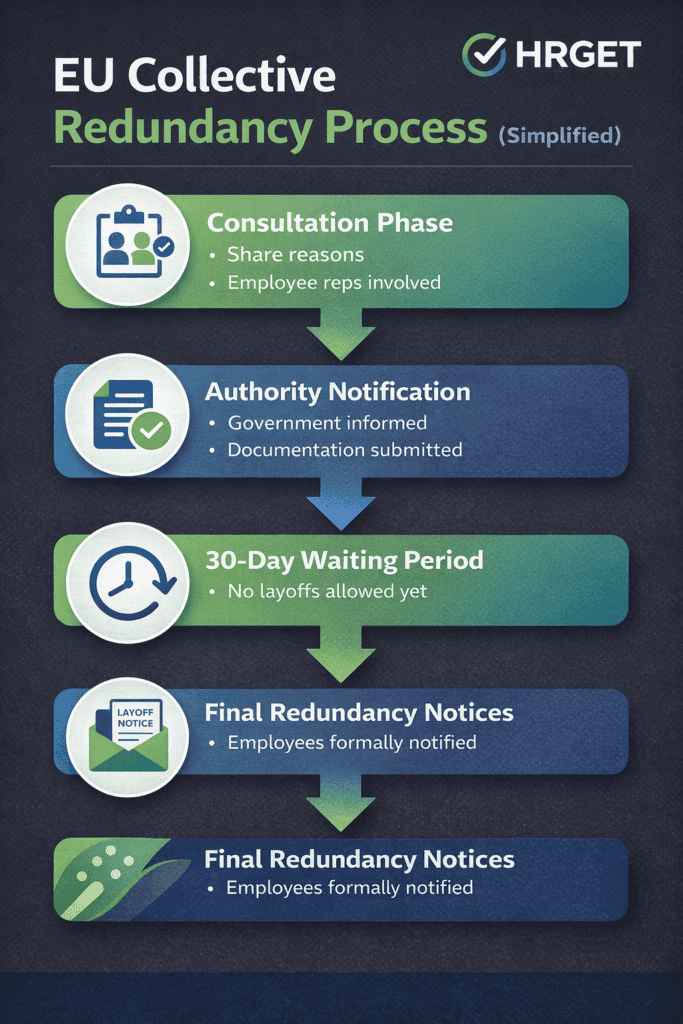
The Consultation Process, Step by Step
This is the engine room of EU collective redundancy law — and the place where companies most often get it wrong, either through ignorance or deliberate corner-cutting. The consultation process is not a formality. It’s a legally mandated negotiation.
Start Consultation Before Decisions Are Locked
Employers must begin consulting employee representatives — works councils, trade unions, or elected employee delegates, depending on the country — before any redundancy decisions are finalised. Not announced. Not implemented. Before they’re decided.
I know that sounds obvious, but you’d be surprised how often companies brief their leadership team, draft the org chart, and only then call the works council to “inform” them. That’s not consultation. That’s notification after the fact, and it’s illegal.
2
Disclose All Required Information in Writing
The employer must provide employee representatives with a formal written document covering: the reasons for the redundancies, the total number of employees being let go, the categories and roles affected, the selection criteria being used, the proposed timeline, and the method for calculating severance. Every one of these is mandatory, not optional.
3
Engage in Genuine, Good-Faith Discussion
Consultation must cover three specific themes: ways to avoid the redundancies altogether, ways to reduce the number of dismissals, and ways to mitigate the consequences for affected employees (think redeployment, retraining, phased exits). If the company comes in with a fixed number and refuses to discuss alternatives, that’s a legal vulnerability. Courts across Germany and France have struck down collective redundancy processes on exactly this ground.
4
Document Everything
Every meeting, every proposal made by employee representatives, every management response, every rejected alternative — it all needs to be recorded. If an employer ends up in court six months later, the first thing a judge will ask for is evidence that real consultation happened. Meeting minutes that say “consultation conducted” without any detail are nearly worthless as a legal defence.
If decisions about who is made redundant are communicated to affected employees before the consultation process has formally concluded, the process is invalid. This is one of the most litigated points in EU employment law — and employees win it more often than employers expect.
Notification Requirements to Authorities
Running parallel to the employee consultation is a separate obligation: notifying the relevant public authority. In Germany, that’s the Federal Employment Agency (Bundesagentur für Arbeit). In France, it’s the regional labour inspectorate (DIRECCTE). In the Netherlands, the UWV. The name changes; the obligation doesn’t.
The notification must include: the total number and categories of roles being eliminated, the timeline over which dismissals will occur, the results (or status) of the employee consultation, and the reasons for the redundancies. Critically, this notification triggers the mandatory waiting period — which I’ll cover in detail in the next section.
The purpose here isn’t bureaucratic box-ticking. Governments use this notification to prepare support services — job placement programs, retraining funds, unemployment benefit processing. A company that skips or rushes this step isn’t just breaking the law; it’s undermining the public infrastructure designed to help the people they’re letting go.
One practical thing to know: in most EU countries, notification to the authority must happen simultaneously with or immediately after the start of employee consultation — not at the end of it. Waiting until consultation is done before notifying the authority is itself a procedural violation.
Mandatory Timelines You Must Know
The directive mandates a minimum 30-day cooling-off period from the date of authority notification before any dismissals can take effect. Many countries extend this. Germany can extend to 60 days. France can run significantly longer when negotiations are complex. Spain has moved towards judicial approval requirements in certain cases.
| Phase | Minimum Duration | Key Obligation |
|---|---|---|
| Pre-consultation preparation | Variable (1–2 weeks typically) | Identify affected roles, prepare written information package |
| Employee consultation | 2–6 weeks (varies by country) | Genuine discussion with employee reps; explore alternatives |
| Authority notification & waiting period | 30 days minimum (EU baseline) | No dismissals can take effect until this period expires |
| Individual notice periods | Role/contract dependent | Run concurrently or after the process concludes |
Add it up and the realistic minimum end-to-end timeline for a lawful collective redundancy process in most EU countries is 6 to 10 weeks. In Germany with a larger works council, or in France with a mandatory Social Plan (Plan de Sauvegarde de l’Emploi) for 10+ redundancies, the clock can stretch to four or five months.
If your employer announces a restructuring on a Monday and starts issuing notices by week three, something is off. That’s the timeline tell that should prompt you to start asking harder questions.
Most employees fixate on severance as the metric of a “good” or “bad” redundancy outcome. The smarter play is to scrutinise the process itself. A flawed consultation, a missed notification deadline, or a rushed authority notice is often worth more leverage than the first severance number your employer puts on the table. Process violations are where the real negotiating power lives.
Real Scenario: How It Actually Plays Out
Real Scenario
A 600-person technology company with offices in Germany, the Netherlands, and Spain decides to close its Amsterdam engineering hub — 75 roles gone. Here’s what a compliant process looks like versus what actually happened at one company I consulted for:
What should have happened:
- Works council informed before any decisions were public — with the full written information package
- Consultation commenced with genuine discussion of redeployment to other offices and voluntary redundancy options
- Dutch UWV notified simultaneously with consultation start
- 30-day waiting period observed — no individual notices issued during this period
- Affected employees informed individually only after the process concluded
What actually happened:
- Leadership team briefed internally and restructuring communicated to senior managers two weeks before works council contact
- Works council given a four-page document and told consultation would last five business days
- Individual letters drafted before consultation concluded
- UWV notified the day the individual letters went out
The works council challenged the process. The company ultimately paid significantly enhanced severance to the affected employees — not because the law required it, but because the legal cost and delay of a protracted dispute made negotiation the cheaper option. The total additional cost: approximately €2.1 million above what the original severance budget had been.
What Employees Are Entitled to Receive
During and after a lawful collective redundancy, employees have specific entitlements — and the specifics vary considerably by country. Here’s the core picture:
Written individual notice is mandatory. You can’t be verbally told your role is gone and expected to act on that. The notice must specify the effective date, the reason (in general terms), and your right to access consultation outcomes.
Explanation of selection criteria is something most employees don’t think to request but absolutely should. If you were selected for redundancy and a colleague in the same role wasn’t, the employer must be able to explain why — objectively. Selection criteria typically include things like performance ratings, skills matrix scores, length of service, and attendance records. If the criteria are vague or feel suspiciously personal, that’s worth examining.
Statutory redundancy pay is mandatory in most EU countries, though the calculation method varies. Germany uses a formula linked to years of service and salary; France has statutory minimums set by the Labour Code; the Netherlands calculates a “transition payment” (transitievergoeding) based on employment duration. Some collective agreements add significant top-ups above statutory floors.
Redeployment consideration is often overlooked. In many EU countries, employers are legally required to actively explore whether affected employees can be moved into other available roles before dismissal is confirmed. This isn’t a courtesy — it’s an obligation. And if a suitable role exists and the company didn’t offer it, that strengthens any subsequent legal challenge considerably.
In France, for companies with 50+ employees making 10+ redundancies, a formal Plan de Sauvegarde de l’Emploi (PSE) is required — a structured package of outplacement support, retraining budgets, and financial measures. Comparable “social plan” obligations exist in Belgium and the Netherlands. These can be worth tens of thousands of euros per employee if negotiated well.
Common Mistakes Employers Make (And How to Spot Them)
I’ve seen the same errors play out across industries and countries. They’re not always malicious — sometimes they’re the result of an HR team under enormous pressure from leadership to move fast. But the legal consequence is the same regardless of intent.
Scheduling one 90-minute meeting with the works council and calling it “consultation” doesn’t fly. Courts want to see multiple sessions, documented counterproposals, and genuine engagement with alternatives — not a slide deck and a sign-off.
Some companies prepare the letters before consultation ends and accidentally (or intentionally) issue them early. This is one of the clearest procedural violations and is frequently the basis for successful legal challenges.
Excluding part-time staff, fixed-term employees, or roles in subsidiary entities to stay under the threshold is a tactic that backfires badly. If challenged, courts look at the economic reality of the employment relationships, not just the org chart.
Filing notification the same week as employee consultation begins — or worse, after individual notices go out — compresses the mandatory waiting period in a way that often invalidates the whole process.
A US or UK headquarters instructing European operations to follow its internal redundancy playbook is a recipe for legal exposure. The EU directive plus local law governs — not whatever the parent company’s global HR policy says.
Smart Strategy: If You’re Caught in a Mass Layoff
If you’re reading this because you’ve just been told you’re at risk of redundancy — or it’s been announced and you’re trying to figure out what to do — here’s a clear, practical playbook.
Request written confirmation of when consultation started, when authorities were notified, and what the proposed timeline is. The answers (or non-answers) will tell you a lot about how clean this process is.
Severance agreements in the EU almost universally include a waiver of claims. Once you sign, your ability to challenge the process disappears. Take the full time you’re legally entitled to for review — typically 7–15 days depending on country and age group.
Works councils and union reps know things individual employees don’t — including whether the process has been run correctly. Connect with them before forming any view on what your options are.
Ask your employer directly — in writing — what open roles exist and whether any are suitable for your profile. If they haven’t considered it, you’ve just created a paper trail showing they failed a legal obligation.
Employment lawyers across the EU frequently offer initial consultations at low or no cost. If the timeline seems compressed, if consultation feels like a formality, or if your selection criteria don’t hold up — a one-hour legal consult can be worth far more than accepting whatever’s on the table.
Economic uncertainty across sectors — including tech, finance, and automotive — has triggered more mass layoff events in Europe in 2025 and 2026 than at any point since the 2009 financial crisis. Governments across Germany, France, and the Benelux are actively enforcing compliance, and labour courts are handling record caseloads. The environment has shifted. Employees who know their rights are in a meaningfully better position than they were two or three years ago.
Frequently Asked Questions
What is the minimum number of employees required for EU collective redundancy rules to apply?
It depends on the size of the organisation. The trigger is typically 10 employees in companies with 20–100 staff, 10% of the workforce in companies with 100–300 employees, or 30 employees in organisations with more than 300 staff — all measured within a 30-day window. Some countries use a 90-day window alongside this to prevent staged dismissals.
Can a company skip consultation if the layoffs are urgent due to financial crisis?
No. Financial urgency does not suspend the obligation to consult. Courts across the EU have consistently held that even companies facing insolvency must make reasonable efforts to comply with consultation requirements. An administrator or liquidator stepping in does create some procedural variations, but the obligation to consult doesn’t disappear entirely even in those circumstances.
How long does a full collective redundancy process take in the EU?
Realistically, the minimum is 6–10 weeks from the start of consultation to when dismissals can legally take effect. In Germany, France, Belgium, or the Netherlands — where works council rights, social plan requirements, or extended authority waiting periods apply — the process often runs three to five months for larger-scale restructures.
What can employees do if an employer violates EU collective redundancy rules?
Affected employees can bring claims through national labour courts challenging the validity of the redundancy process. Remedies include financial compensation above the statutory severance, delays to the dismissal taking legal effect, or in some countries, reinstatement. The strength of the claim depends on which procedural obligations were breached and how significantly.
Does EU collective redundancy law apply to remote workers based in another country?
Generally, the law of the country where the employee habitually works governs the employment relationship. So a German employee working remotely for a French company is typically covered by German collective redundancy law, not French law. Cross-border situations can get complex, and in 2026 there is still limited EU-level guidance on fully remote arrangements — independent legal advice is strongly recommended.
Is severance pay mandatory under EU collective redundancy law?
The EU directive itself does not mandate severance pay — it focuses on consultation and notice obligations. However, the vast majority of EU member states require statutory redundancy pay through national law. France, Germany, Belgium, the Netherlands, Spain, and Portugal all have statutory entitlements, and collectively negotiated agreements frequently provide above-statutory payments. What you’re owed depends on your country, your contract, and any applicable collective agreement.
Can employees actually stop a mass layoff from happening?
Rarely outright — but that’s the wrong frame for thinking about it. What employees and their representatives can do is delay, improve the financial terms, expand redeployment options, and ensure the company bears the full legal cost of a flawed process. Works councils in Germany and the Netherlands in particular have used procedural challenges to significantly reshape both the financial and practical terms of large-scale restructures. Stopping layoffs entirely is rare; materially improving the outcome is not.
The Bottom Line
EU collective redundancy rules aren’t designed to make layoffs impossible. They’re designed to make them fair — to force companies to slow down, tell the truth, and give employees a genuine seat at the table before their livelihoods are changed. Whether or not that happens in practice depends largely on whether affected employees and their representatives actually enforce those rights.
If you’re an employee facing a mass layoff: the process is the leverage. Get the timeline, verify the consultation happened properly, and don’t sign anything before you’ve had it reviewed. The severance your employer puts in front of you on day one is almost never the final number — especially if the process has been rushed.
If you’re on the employer side: the cost of getting EU collective redundancy rules wrong has never been higher. Labour courts are moving faster, enforcement is tighter in 2026, and employees are better informed than they’ve ever been. Build the time, documentation, and genuine engagement into your restructuring plan from day one — not as an afterthought.
Learn exactly what your employer must pay you when a role is eliminated: Your Redundancy Pay Rights: What Employers Must Give You

Michael Reeves | Former Senior Counsel, Littler Mendelson | Severance & Restructuring Specialist | 18+ Years in Employment Law
Author bio: Michael Reeves spent nearly two decades as Senior Counsel at Littler Mendelson — one of the world’s largest employment law firms — advising on mass layoffs, corporate restructurings, and severance negotiations for Fortune 500 companies across the US and Europe. He has worked both sides of the table: structuring cost-efficient separation packages for employers and, more recently, helping employees understand exactly where their leverage lies. Based between Chicago and London, Michael writes for HRGet.com to demystify the legal and financial dimensions of layoffs — so employees stop leaving money on the table.