
Getting told your role is “at risk” is one of those gut-punch moments where time seems to slow down — and then immediately speeds up. Before the meeting even ends, your brain is already asking: how much money will I actually get?
Here’s the thing about UK statutory redundancy pay that most people miss: it’s entirely predictable once you know the rules. The problem is that most employees either underestimate what they’re owed, misapply the formula, or — worst of all — accept a number their employer has quietly under-calculated.
I’ve seen it happen in the room. An employee walks away with £4,000 when they were entitled to £6,500. Not because the employer cheated them, necessarily — but because the employee never questioned the figure. This guide is the one you read before that meeting happens.
What Is UK Statutory Redundancy Pay?
Statutory redundancy pay is the minimum legal payout your employer must provide if you’re made redundant in the UK. It’s governed by the Employment Rights Act 1996, and it’s not discretionary — it’s a legal entitlement if you meet the qualifying conditions.
Think of it as your guaranteed floor. Many employers offer enhanced redundancy on top of the statutory minimum — a higher per-year multiplier, inclusion of bonuses, or additional weeks’ pay. That’s the ceiling. What we’re talking about here is the legal baseline no employer can go below.
One nuance worth flagging early: statutory redundancy pay and notice pay are two separate things. Both may appear in your settlement paperwork. They’re taxed differently, calculated differently, and confused constantly. We’ll cover the tax distinction in detail below.
The honest reality: Most employers calculate redundancy pay accurately — but they calculate the minimum. If your contract has enhanced terms or your service years span a birthday that triggers a higher multiplier, those details can easily get missed unless you check the maths yourself.
Who Qualifies for Redundancy Pay?
To be entitled to statutory redundancy pay in 2026, you need to meet all four of these conditions simultaneously:
| Condition | What It Means in Practice |
|---|---|
| Employee status | You must be classified as an employee — not a worker, contractor, or freelancer. PAYE payslips and an employment contract are good indicators. |
| 2+ years continuous service | Unbroken employment with the same employer (or qualifying associated employer) for at least two years before the redundancy date. |
| Genuine redundancy | Your role must be disappearing or fundamentally changing — not a dismissal for performance, conduct, or capability. |
| No unreasonable refusal of alternative work | If your employer offers you a suitable alternative role, you cannot refuse it without good reason and still claim redundancy pay. |
The two-year threshold is the big filter. Many employees who’ve had short breaks in employment — a gap between contracts, a period of maternity leave handled awkwardly — worry this affects their continuity. In most cases it doesn’t, because the law recognises various gaps that preserve continuity of employment. If you’re unsure, ACAS has a straightforward checker, or your HR team can confirm your official continuous service start date.
Who Does NOT Qualify — The Surprises
This is where employees get blindsided. The assumption that “I’m being let go, so I’m getting redundancy pay” is wrong more often than people realise.
- Contractors and freelancers — even long-term ones working exclusively for one company — are typically excluded. Employment status is a legal determination, not just a label.
- Employees with under 2 years’ service — regardless of the circumstances, the two-year rule is absolute for statutory entitlement (though some employment contracts include enhanced terms with no minimum).
- Employees dismissed for gross misconduct — this voids the redundancy entitlement entirely, even if a restructuring coincidentally removed their role.
- Employees who voluntarily resign — unless you can prove constructive dismissal, walking out before the redundancy is formalised means losing your entitlement.
- Employees who unreasonably refuse a suitable alternative role — this one catches people off guard. If the company offers you a comparable job and you turn it down without trialling it, you could forfeit the payment.
Watch for this tactic: Some companies quietly structure a restructuring to create alternative roles that just barely qualify as “suitable” — then offer them to employees facing redundancy. It’s legal, but it’s worth understanding your rights around the 4-week statutory trial period before accepting or declining.
How Statutory Redundancy Pay Is Calculated
The formula is age-weighted and based on years of service — a straightforward structure that, once you understand it, you can verify in about ten minutes.
The Formula
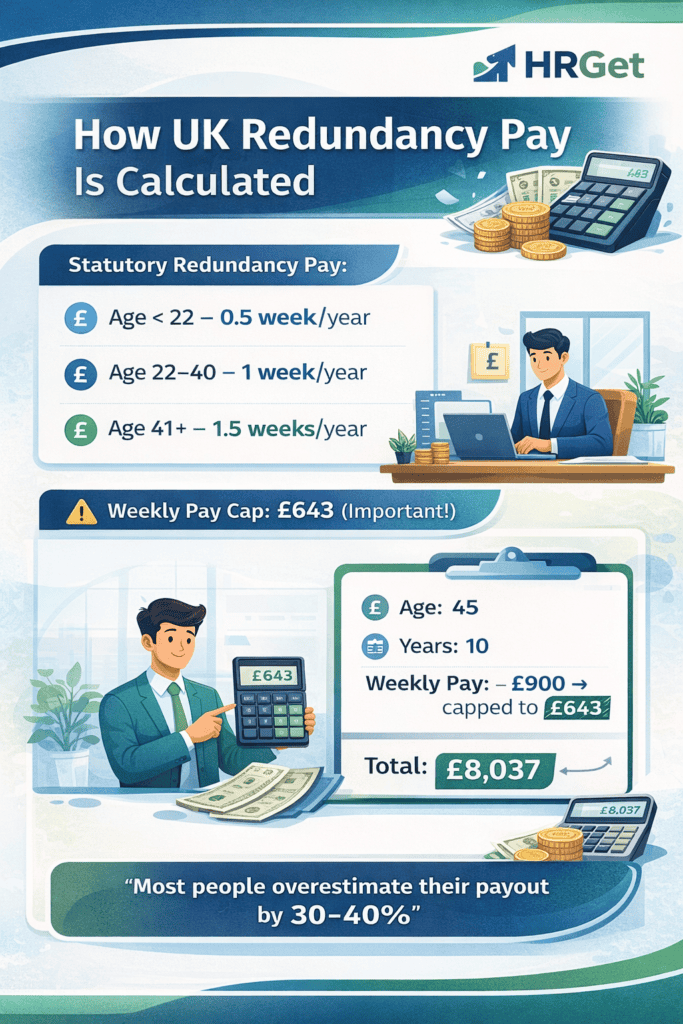
- 0.5 week’s pay for each full year of service under age 22
- 1 week’s pay for each full year of service aged 22–40
- 1.5 weeks’ pay for each full year of service aged 41 and over
Maximum qualifying service is capped at 20 years. So even if you’ve worked somewhere for 30 years, only the most recent 20 count toward the calculation — and they’re typically the 20 where you were oldest, which gives you the highest multiplier.
A few practical details worth knowing. The age bands apply to how old you were during each year of service, not just your age at the point of redundancy. So if you turned 41 mid-employment, you get the 1.5 multiplier only from that birthday onwards. This is where self-calculations often go wrong — people apply a single multiplier to the entire service period.
Example 1: Standard Mid-Career Employee
Age: 36 | Service: 7 years | Weekly pay: £520
All 7 years fall in the 22–40 band → 7 × 1 = 7 weeks
7 × £520 = £3,640 statutory redundancy pay
Example 2: Senior Employee Spanning the Age 41 Boundary
Age: 47 | Service: 12 years | Weekly pay: £850 (capped to £643)
Years aged 35–40: 5 years × 1 = 5 weeks
Years aged 41–47: 6 years × 1.5 = 9 weeks
Total: 14 weeks × £643 = £9,002
Without the weekly cap at full salary: £850 × 14 = £11,900 — a gap of nearly £2,900.
The Weekly Pay Cap: The Number That Catches Everyone Off Guard
Here’s the detail that quietly eats thousands of pounds from higher earners’ calculations — and most employees only discover it when it’s too late to negotiate.
Your “week’s pay” for statutory redundancy purposes is legally capped. For 2026, the cap sits at £643 per week (confirm the current year’s figure via GOV.UK, as it’s typically updated each April). It doesn’t matter if you earn £150,000 a year — your redundancy is calculated as though you earn £643 weekly.
The brutal arithmetic: A senior manager earning £95,000/year (roughly £1,827/week) receives redundancy pay based on £643/week. That’s a 65% reduction on the calculation base. After 10 years of service, they’d get roughly £9,645 — not the £27,405 their actual salary would suggest.
This is why the enhanced redundancy conversation matters so much for senior employees. Your employer may have discretion to calculate on actual salary. Many do, particularly in larger organisations or during significant restructuring events. But they’re under no legal obligation — so unless your contract specifies it, you need to ask.
Low and mid earners are generally unaffected. If your weekly pay is under £643, the cap is irrelevant and the calculation uses your actual earnings.
Real Scenario: What a Typical Employee Actually Receives
Sarah, 39 — Marketing Manager, London
Sarah has worked for the same retail group for 8 years. Her salary is £62,000/year (£1,192/week). She’s told her entire team is being cut as the company restructures its digital division.
Sarah’s assumption: “8 years × ~£1,200/week ≈ £9,600”
Actual calculation:
All 8 years fall in the 22–40 band → 8 × 1 = 8 weeks
Weekly pay capped at £643 → 8 × £643 = £5,144
That’s a £4,456 gap from what Sarah expected — simply because she didn’t know the weekly pay cap existed.
Her contract, though, included an enhanced redundancy clause: “2× statutory pay.” So her actual payout became £10,288 — and she only found that clause because she re-read her contract on the train home from the “at risk” meeting.
This scenario plays out constantly. The difference between employees who walk away with the right number and those who don’t almost always comes down to one thing: whether they read their contract before accepting the offer.
Tax Rules — What You Actually Keep
This is where a lot of people get relieved — and then immediately confused again when they see their settlement figures broken down.
The headline rule: the first £30,000 of redundancy pay is completely tax-free. This applies to statutory redundancy pay and to enhanced redundancy payments, combined — so it’s a total allowance, not per payment.
| Payment Component | Tax Treatment |
|---|---|
| Statutory redundancy pay | ✓ Tax-free |
| Enhanced redundancy pay (within £30k total) | ✓ Tax-free |
| Redundancy pay above £30,000 | ✗ Taxed at marginal rate |
| Notice pay (PILON — Payment in Lieu of Notice) | ✗ Fully taxable as income |
| Holiday pay owed | ✗ Fully taxable as income |
| Garden leave pay | ✗ Fully taxable as income |
The most common source of confusion is PILON — Payment in Lieu of Notice. Since April 2018, PILON is taxed as earnings regardless of whether it’s written into your contract or paid as a discretionary settlement. It’s not part of the £30,000 exemption, even though it often appears on the same payment document as redundancy pay.
When reviewing your settlement paperwork, make sure each payment component is clearly labelled. A lump sum described simply as “termination payment” is ambiguous — you want to see “statutory redundancy pay,” “enhanced redundancy pay,” and “notice pay” as separate line items. This protects you if HMRC ever queries the tax treatment.
Smart Strategy: How to Maximise Your Redundancy Payout
Most people treat redundancy as something that happens to them. The employees who come out significantly better treat it as a negotiation — because that’s what it is.
Calculate your own baseline first. Use the formula above (or the official GOV.UK redundancy pay calculator) before any conversation with HR. Know your statutory minimum cold. When HR presents a number, you want to be able to confirm or challenge it immediately — not weeks later.
Read your employment contract before signing anything. Specifically look for “redundancy pay,” “termination,” or “severance” clauses. Enhanced terms — 1.5× statutory, capped at 6 months’ salary, or similar — are more common than employees assume, particularly in organisations over 250 people.
Understand the “suitable alternative employment” rules. If your employer offers you a different role, you have a statutory right to a 4-week trial period under Section 138 of the Employment Rights Act 1996. Try the role genuinely. If it’s unsuitable, you can still claim redundancy pay. If you refuse before trialling without good reason, you may lose it entirely.
Ask about enhanced packages. During large-scale redundancies — restructurings of 20+ roles — employers often have more flexibility on the package than they initially present. Senior employees with specialist knowledge or those with potential legal claims (age discrimination, for instance) frequently have leverage. Use it professionally.
Time it if you can. Your weekly pay calculation is based on pay in the relevant reference period. If a pay rise, promotion, or bonus is imminent, and you have any control over the timing of your departure date, these can materially change the calculation.
Common Mistakes That Cost Employees Money
- Assuming full salary is used in the calculation. The weekly pay cap applies regardless of your actual earnings. High earners almost always discover this number is lower than expected.
- Applying the wrong age multiplier to all service years. The multiplier changes at ages 22 and 41. If your employment spans these birthdays, different years attract different rates. Using a single multiplier for the full period gives you a wrong answer.
- Confusing redundancy pay with notice pay on tax. Many employees assume their entire settlement is tax-free up to £30,000. PILON and garden leave payments are taxable income from pound one.
- Rejecting an alternative role without trialling it. Declining immediately — even if the role is genuinely unsuitable — can void your entitlement. The four-week trial is your safety net. Use it.
- Accepting the first number without checking the contract. Enhanced redundancy clauses are the most straightforward way to significantly improve your payout. They’re also the most commonly missed.
Frequently Asked Questions
How many years of service count toward UK statutory redundancy pay?
Only continuous years of service are counted, and the maximum is capped at 20 years. If you’ve worked for 25 years, only 20 years enter the calculation — typically the most recent 20, which tend to carry the highest age multiplier. Each year must be a full year; part years don’t count toward the total.
Is UK statutory redundancy pay the same as severance pay?
Not exactly. Statutory redundancy pay is the legally mandated minimum under the Employment Rights Act 1996. “Severance pay” is a broader, informal term that can include enhanced redundancy pay, negotiated settlements, notice pay, and other exit payments. Your total severance package may be significantly more than the statutory redundancy amount alone.
Can I calculate my redundancy pay myself?
Yes, and you should. The formula is publicly available, and GOV.UK has an official redundancy pay calculator at gov.uk/calculate-your-redundancy-pay. You’ll need your employment start date, date of redundancy, date of birth, and your weekly pay (up to the cap). Calculating it yourself means you can verify your employer’s figure before signing any settlement documents.
What happens if my employer refuses to pay statutory redundancy pay?
You can make a claim to an employment tribunal — but you must do so within six months of your employment ending. Before going that route, raise the issue formally in writing with your employer and contact ACAS (Advisory, Conciliation and Arbitration Service) for free guidance. ACAS early conciliation is a required step before most tribunal claims and often resolves disputes without a full hearing.
Do bonuses count toward the weekly pay used in the calculation?
It depends. Regular, contractual bonuses that form part of your standard remuneration may be included in the “week’s pay” calculation. Discretionary bonuses — those paid at the employer’s discretion rather than guaranteed by contract — typically don’t count. If your bonus represents a significant portion of your total pay, this distinction is worth clarifying with HR or an employment adviser.
Does receiving redundancy pay affect my Universal Credit or Jobseeker’s Allowance?
Redundancy pay itself doesn’t directly disqualify you from claiming benefits, but it may be treated as capital that affects means-tested benefits like Universal Credit. Notice pay — because it’s treated as earnings — can create a waiting period before certain benefits begin. The timing of your final payments and how they’re classified matters, so it’s worth speaking to the Department for Work and Pensions (DWP) or Citizens Advice before your employment ends.
Can I be made redundant while on maternity leave?
Yes, but with significant legal protections. Employees on maternity leave who are made redundant have priority rights to any suitable alternative vacancy within the business before it’s offered to other at-risk employees. Selecting someone for redundancy because they’re on maternity leave is automatically unfair dismissal and potentially sex discrimination — a much higher legal bar for employers to clear. Your redundancy pay calculation uses your pre-maternity pay, not your statutory maternity pay rate.
The Bottom Line
UK statutory redundancy pay is more predictable than most employees realise — but the gap between what you’re legally entitled to and what you actually receive often comes down to three things: knowing the formula, understanding the weekly pay cap, and checking your contract before you sign.
For the majority of UK employees, the statutory figure is modest. The real opportunity — sometimes worth thousands of pounds — sits in enhanced redundancy terms that are already written into your employment contract and waiting to be invoked. The employees who find those clauses are the ones who thought to look.
One action to take today: locate your employment contract and search for “redundancy.” Read that clause. If your employer offers you a figure that doesn’t match it, you have grounds to negotiate — politely, professionally, and with the numbers in front of you.
Related reading on HRGet: If you’re being kept on the payroll during your notice period without actually working, you may also be entitled to garden leave benefits beyond basic pay. Read our guide: Garden Leave After a Layoff — What You’re Actually Entitled To

Jonathan Reed: Executive Career Strategist & Leadership Advisor | Former Partner, McKinsey & Company | Executive Coach to Amazon & Unilever Leaders | 18+ Years in Career Strategy
Jonathan Reed spent nearly two decades as a Partner at McKinsey & Company, where he advised organisations on leadership development, talent strategy, and organisational design across the US, UK, and Asia. Since leaving consulting, he has worked as an executive coach to senior leaders at Amazon, Unilever, and a clutch of high-growth scale-ups — helping them navigate promotions, career pivots, and the unwritten rules of visibility and influence at the top. Based between London and New York, Jonathan writes for HRGet.com to give working professionals an honest look at how careers actually scale — and why so many talented people stall without ever knowing why.