
Losing your job is stressful enough. What makes it worse is discovering — weeks after you’ve already signed the paperwork — that you walked away with far less than you were legally entitled to. I’ve seen it happen more times than I care to count during my time in HR.
UK redundancy notice periods are one of the most misunderstood areas of employment law. Most employees assume their contract is the final word. It isn’t. Statutory law can override your contract entirely — and that gap often means weeks of extra pay that should be in your pocket.
By the time you finish this article, you’ll know exactly how to calculate your entitlement, how statutory and contractual notice interact, and the specific questions to ask your employer before you sign anything.
What Is a Redundancy Notice Period in the UK?
A redundancy notice period is the minimum amount of time your employer must give you between telling you that your role is being made redundant and your last working day. Think of it as a legal buffer — time for you to job-search, prepare financially, and transition without being pushed off a cliff overnight.
Critically, this isn’t just a courtesy. It’s a legal obligation under the Employment Rights Act 1996. Employers who fail to honour it expose themselves to an unlawful deduction of wages claim — which is something most HR teams are very keen to avoid.
The notice period kicks in from the moment you’re formally notified of your redundancy. That notification must be clear and unambiguous — a vague mention in a restructuring meeting doesn’t count. Once it’s confirmed in writing, the clock starts.
Statutory Notice Periods: The Legal Floor
The statutory notice period is the minimum that UK law requires. Your employer cannot go below this — full stop. Here’s how it works under the Employment Rights Act 1996, Section 86:
| Length of Continuous Service | Minimum Statutory Notice |
|---|---|
| Less than 1 month | No statutory notice required |
| 1 month to 2 years | 1 week |
| 2 years | 2 weeks |
| 3 years | 3 weeks |
| 4 years | 4 weeks |
| 5–11 years | 1 week per completed year of service |
| 12+ years | 12 weeks (maximum cap) |
The calculation uses your continuous employment start date — not your most recent contract renewal, not your promotion date. If you moved from a fixed-term to a permanent contract at the same employer without a break, that earlier start date counts.
One thing that trips people up: the 12-week cap. If you’ve worked somewhere for 18 years, you don’t get 18 weeks — you get 12. The law sets the ceiling as well as the floor. But reaching that cap still means three months of protected income, which is significant.
Contractual Notice Periods: Where the Real Gains Hide
Your employment contract can — and often does — grant better terms than the statutory minimum. Employers use longer contractual notice to attract and retain talent, especially at mid-to-senior levels. It’s one of those benefits that doesn’t look exciting in a job offer but matters enormously when things go wrong.
Typical contractual notice periods in the UK in 2026 look roughly like this:
- Entry to mid-level roles: 1 month (most common)
- Senior individual contributors / team leads: 3 months
- Director and C-suite: 6 months to 12 months
- Financial services, legal, and regulated sectors: Often 6+ months regardless of seniority
Here’s the thing most employees don’t think about until it’s too late: a longer contractual notice period is only an advantage if you know it exists and you invoke it. Employers won’t always volunteer the better number. They’ll tell you what’s in the contract — but they may conveniently not mention that the statutory calculation produces something higher.
Check your original offer letter, your most recent contract, and any addendums signed after a promotion. Notice period clauses sometimes get quietly updated. If your contract says “this supersedes all previous agreements,” that’s the one that governs — but it still can’t go below statutory minimums.
Statutory vs Contractual: Which One Actually Applies?
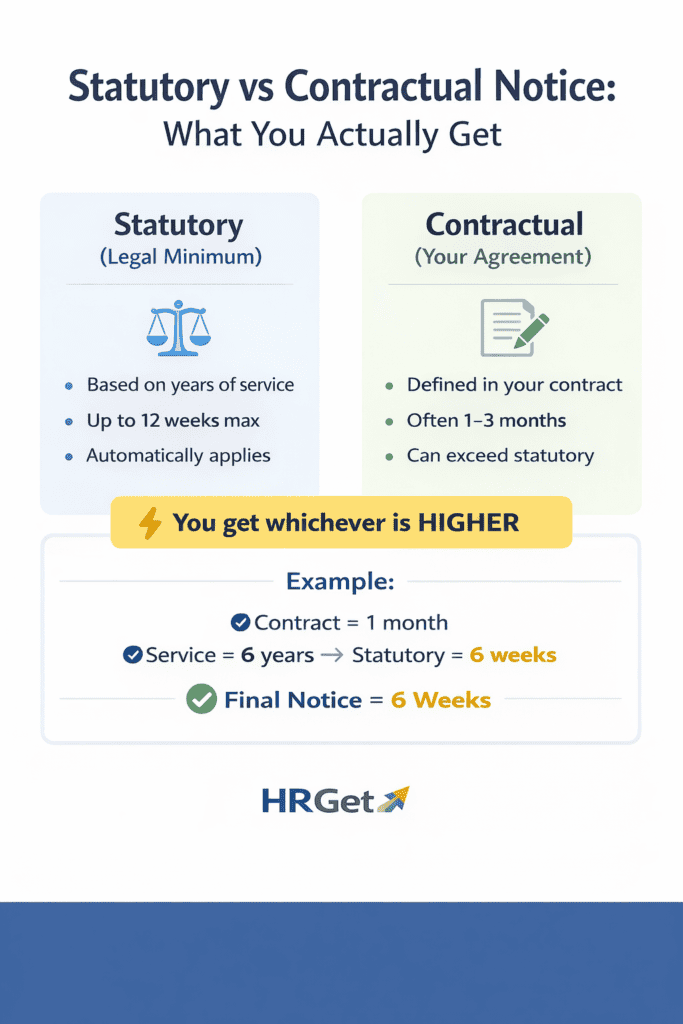
The rule is simple, even if the execution sometimes isn’t: you’re always entitled to whichever notice period is longer — statutory or contractual. Law sets the minimum; your contract can only go higher, never lower.
| Scenario | Contractual Notice | Statutory Notice | What You Receive |
|---|---|---|---|
| 6 years’ service, 1-month contract | 4 weeks | 6 weeks | 6 weeks (statutory wins) |
| 2 years’ service, 3-month contract | 13 weeks | 2 weeks | 13 weeks (contract wins) |
| 10 years’ service, 3-month contract | 13 weeks | 10 weeks | 13 weeks (contract wins) |
| 12+ years’ service, 1-month contract | 4 weeks | 12 weeks (capped) | 12 weeks (statutory wins) |
The scenario that catches people most often is the first one: a long-tenured employee with a standard 1-month contract. They assume “1 month” is it. But 6 years of service generates 6 weeks of statutory notice, and the law takes precedence. That’s an extra 2 weeks of pay — potentially £1,200–£2,500 depending on salary — left on the table if they don’t catch it.
Do the comparison calculation yourself before you sit in any redundancy meeting. Don’t rely on HR to flag it — that’s not a cynical point, it’s just pragmatic. Even well-meaning HR teams run on tight timelines during restructures.
Payment in Lieu of Notice (PILON) Explained
PILON — Payment in Lieu of Notice — is when your employer pays you your notice entitlement as a lump sum instead of having you work through the notice period. You leave immediately (or very shortly), and you receive a payment covering the weeks you would have worked.
From an employer’s perspective, PILON makes sense when they want to remove access to systems quickly, protect commercially sensitive information, or simply avoid the awkwardness of a departing employee who might be disengaged or disruptive. In tech, finance, and sales roles, PILON during redundancy is standard practice.
What to check in your PILON arrangement
- Is PILON in your contract? If there’s a specific PILON clause, the employer has an express right to use it. If not, forcing PILON without agreement may constitute a breach of contract — worth flagging to an employment solicitor if the numbers are significant.
- What’s included in the PILON payment? It should reflect your full contractual pay — base salary plus regular contractual benefits. Variable bonuses can be trickier to include, but fixed allowances (car allowance, etc.) are generally included.
- Is it taxed? Yes — PILON is subject to income tax and National Insurance in the UK under rules tightened in 2018. There’s no longer a £30,000 tax-free exemption for PILON specifically. Make sure the gross figure you’re quoted is what you actually expect.
Garden Leave vs Working Notice: Know the Difference
Once your notice period starts, there are three ways it can play out. Which one applies matters — both financially and practically.
| Type | Do You Work? | Are You Paid? | System Access | Start New Job? |
|---|---|---|---|---|
| Working Notice | Yes | Yes (normal salary) | Yes | No (still employed) |
| Garden Leave | No | Yes (full pay) | Usually removed | Typically restricted |
| PILON | No | Yes (lump sum) | No | Yes (employment ends) |
Working notice is the baseline. You turn up, do your job, serve the notice period, and leave on the end date. Simple, but it can be awkward — especially in team environments where everyone knows you’re going.
Garden leave keeps you employed and fully paid but removes you from the office and systems. You’re being paid to essentially stay home and not work for a competitor. It’s common in financial services and senior corporate roles. While it sounds like a holiday, you’re contractually bound — you generally can’t start a new role during this period without risking a breach of contract claim.
PILON severs the employment relationship immediately. Once paid, you’re free to start a new job the next day. For most redundancy situations, PILON is actually the most useful outcome — clean break, money in hand, free to move forward.
Real Scenario: How Employees Lose Weeks of Pay
James is a senior operations manager at a mid-sized logistics firm in Manchester. He’s been there 9 years. His contract, signed when he joined as a coordinator, says “1 month notice.”
In early 2026, his role is made redundant during a restructure. HR sends him a letter confirming 1 month’s notice and PILON. He accepts it, signs the settlement agreement within a week, and starts job-hunting.
What James didn’t check: Nine years of continuous service = 9 weeks of statutory notice. His contract said 4 weeks. The law gives him 9. He accepted 4.
On a £52,000 salary, that’s approximately £5 weeks × ~£1,000/week = £5,000 left on the table — simply because neither he nor his employer volunteered the correct calculation.
By the time he realised (from a colleague who’d had legal advice), the settlement agreement had been signed and the legal window was narrow. Don’t be James.
Smart Strategy: How to Protect Your Notice Pay
If you’re in a redundancy process right now — or you suspect one is coming — here’s the five-step approach I’d walk any employee through.
Calculate your statutory entitlement first. Pull up your employment start date (check your payslips or P60 if you’re unsure), count your completed years of service, and calculate your statutory notice weeks. This is your legal floor — everything else gets compared against this number.
Dig out your contract and read the notice clause carefully. Find the most recent version — not the one you signed on day one if you’ve since had a contract update. Look specifically for: notice period length, PILON clause (express right or not), and garden leave clause.
Take the higher of the two figures. Statutory vs contractual — whichever is longer is your entitlement. Write it down. This is the number you’re negotiating around, not the one HR put in the first letter.
Ask the right questions before signing anything. Specifically: “Can you walk me through how this notice period figure was calculated?” and “Does this account for my statutory entitlement?” These aren’t aggressive questions — they’re normal due diligence. Any HR team that gets defensive at these questions is probably aware there’s a discrepancy.
Get every agreement in writing before you sign a settlement. Verbal commitments about exit dates, PILON timing, or extended notice don’t exist in law. If it’s not in the written settlement, it’s not real. Take 48–72 hours to review before signing — and if the sums are significant (over £10,000), an hour with an employment solicitor is money well spent.
Common Mistakes That Cost Employees Real Money
These aren’t edge cases — these are patterns I’ve seen repeatedly during restructures at every level of organisation.
Accepting the first figure without checking statutory entitlement
The single most common and costly mistake. HR sends a letter, you read “4 weeks’ PILON,” it sounds reasonable, you sign. But if you’ve been there 7 years, you were entitled to 7 weeks. The difference — on an average UK salary of £35,000 — is roughly £1,346. On a senior salary, it’s much more.
Assuming your contract can’t be beaten by law
Contracts in the UK employment context are a floor, not a ceiling. Many employees — especially those who’ve been in the same role for years — have original contracts that pre-date their tenure earning higher statutory rights. The contract doesn’t automatically update. Statutory law does.
Not understanding the tax position on PILON
Since the Finance Act 2018, PILON is always subject to income tax and National Insurance — regardless of whether it was contractual or not. The old £30,000 exemption doesn’t apply to the portion covering notice pay. Some employees sign settlement agreements expecting a tax-free lump sum and then receive a significantly smaller net figure. Know the gross, estimate the net.
Confusing redundancy pay with notice pay
They’re separate entitlements. Statutory redundancy pay is calculated on a different formula (age, service, and weekly pay capped at £643/week in 2024–25). Notice pay is based on your full contractual weekly pay. You can receive both. Don’t let anyone bundle them together and present it as a single figure without breaking it out.
Signing a settlement agreement without independent legal advice
Under UK law, a settlement agreement (formerly a compromise agreement) is only legally binding if the employee has received independent legal advice from a qualified solicitor. Most employers actually cover this cost — typically £250–£500. Use it. Don’t skip it to move quickly.
Before any redundancy meeting where you’re expected to sign something, ask for it in writing 24 hours in advance. Legally, you’re entitled to reasonable time to consider. Employers who push for same-day signatures are often betting on the fact that most employees won’t read carefully under emotional pressure. Slow down. The urgency is usually manufactured.
Frequently Asked Questions
What is the minimum redundancy notice period in the UK?
The minimum is determined by your length of service under the Employment Rights Act 1996. After 1 month’s service you’re entitled to at least 1 week’s notice. This increases by one week per completed year of service, up to a maximum of 12 weeks after 12 or more years. If your contract offers more, you get the higher amount. Anything below these minimums is unlawful.
Can my employer give less notice than the statutory minimum?
No. Statutory notice is a legal floor — your employer cannot undercut it, regardless of what your contract says. If your contract specifies a shorter notice period than the statutory entitlement for your length of service, the statutory figure applies automatically. An employer who ignores this exposes themselves to a claim for unlawful deduction of wages or wrongful dismissal.
Do I have to work my notice period during redundancy?
Not necessarily. Your employer may place you on garden leave (still employed, full pay, no work required) or offer PILON (immediate departure with a lump sum payment). Which option applies depends on your contract terms and your employer’s preference. You can also negotiate — for example, agreeing to PILON if you want a clean break and an early start date for a new role.
Is notice pay taxable in the UK?
Yes. Notice pay — whether you work the notice period or receive it as PILON — is subject to income tax and National Insurance contributions in full. This has been the position since April 2018 when HMRC tightened the rules. The historic £30,000 tax exemption applies to certain other termination payments (like ex-gratia sums above notice entitlement), not to notice pay itself.
What if my employment contract says less than the statutory notice?
The statute takes precedence. Any contractual clause that provides for less than the statutory minimum is simply void in that respect — you default to the higher statutory entitlement. This applies even if you signed the contract willingly. You cannot legally contract out of statutory employment rights in the UK.
Does redundancy notice period affect my redundancy pay?
They’re calculated separately. Statutory redundancy pay uses a specific formula based on age, years of service, and your weekly pay (capped at £643/week for 2024–25). Your notice pay is based on your full contractual weekly pay with no such cap. Both can — and should — be paid together, but they’re separate legal entitlements. Ask for an itemised breakdown if they’re presented as a single figure.
Can I negotiate a longer notice period during redundancy?
You can’t typically extend the notice period itself once redundancy is confirmed — that’s governed by law and contract. What you can negotiate is how and when it’s paid, whether garden leave is an option, what’s included in the PILON calculation, and the overall exit package terms. An employment solicitor can advise on leverage points, particularly if you have a grievance claim or evidence of procedural failures in the redundancy process.
Does garden leave count as part of my UK redundancy notice period?
Yes. Garden leave runs concurrently with your notice period — it’s not an extension of it. If you’re entitled to 8 weeks’ notice and your employer puts you on 8 weeks’ garden leave, your employment ends at week 8. Garden leave is simply how that notice period is served: you’re employed and paid, but not required to attend work or perform duties.
The Bottom Line on UK Redundancy Notice Periods
Here’s the blunt version: most employees receive less than they’re entitled to during redundancy — not because their employer is malicious, but because nobody runs the numbers, nobody asks the right questions, and the process moves faster than people can think clearly.
UK redundancy notice periods are legally defined. Statutory entitlement is calculated by law. Your contract can only go higher, never lower. And every week of notice is real money — on a £40,000 salary, each week is worth roughly £769 gross.
Before you accept any redundancy package, do this: calculate your statutory notice, check your contract, take the higher figure, and ask HR how they arrived at their number. That single question — politely asked — has saved employees I’ve worked with thousands of pounds.
If the sums are significant, spend an hour with an employment solicitor. Most employers pay for that advice as part of a settlement agreement anyway. Use it.
📘 Next read: UK Statutory Redundancy Pay: How to Calculate What You’re Owed — the complete guide to the redundancy payment formula, qualifying rules, and how to challenge an underpayment.

Emily Carter is a career coach and former McKinsey talent advisor with 15+ years of experience helping professionals navigate career transitions, promotions, and high-stakes job decisions. She has advised professionals across consulting, technology, finance, and corporate leadership roles on offer negotiations, career positioning, and long-term growth strategy.
Role: Career Coach & Ex-McKinsey Talent Advisor: Focuses on helping professionals make smarter career moves—switching jobs, negotiating offers, and long-term career growth. She blends structured thinking with real-world coaching insights.