I’ve reviewed thousands of offer letters over my career in HR. And here’s something that still surprises me — most professionals can’t accurately convert their hourly rate into an annual salary. They punch in a rough number and call it done. That’s how people leave $5,000–$15,000 on the table during negotiations without realizing it.
An hourly to salary converter does more than basic math. It forces you to confront what your time is actually worth — after overtime, benefits gaps, and unpaid leave are factored in.
This guide gives you the formulas, the real-world examples, and — more importantly — the hidden adjustments that separate informed career decisions from expensive guesses.
What Is an Hourly to Salary Converter (And Why You Need One)
An hourly to salary converter translates your per-hour wage into an equivalent annual, monthly, biweekly, or weekly figure — and works in reverse, too. Simple enough on paper.
But here’s why it matters more than you think: employers deliberately frame compensation in whichever format sounds better. A recruiter might pitch “$42 an hour” for a contract gig because it sounds impressive. Run the math and you’re looking at about $87,360 before taxes — but without benefits, PTO, or retirement contributions. A $78,000 salaried role with full benefits could easily be worth more.
I’ve sat across from candidates who turned down better offers because they didn’t convert the numbers properly. A quick conversion isn’t just arithmetic. It’s a career decision tool.
You need one when you’re comparing a salaried offer against a freelance or hourly role, evaluating whether overtime actually boosts your income, negotiating a raise and need to frame your ask in hourly terms, or switching between contract and full-time work.
How to Convert Hourly Rate to Annual Salary
The standard formula is straightforward:
Annual Salary = Hourly Rate × Hours per Week × Weeks per Year
For a typical full-time schedule, that’s:
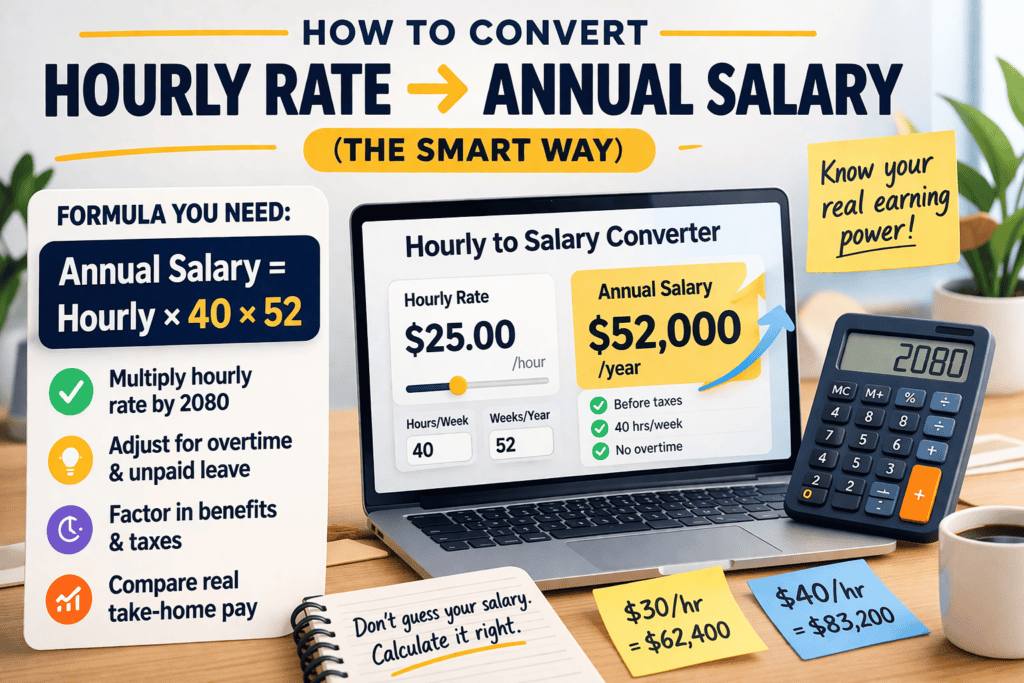
Annual Salary = Hourly Rate × 40 × 52
The number 2,080 is your magic constant — it’s 40 hours multiplied by 52 weeks. The Bureau of Labor Statistics, the IRS, and most employers all use this as the standard full-time work year.
Example: You earn $30 per hour, working 40 hours per week.
$30 × 2,080 = $62,400 per year
That breaks down to roughly $5,200/month, $2,400 biweekly, or $1,200/week before taxes.
But Here’s What That Formula Misses
The 2,080-hour calculation assumes you work every single week of the year with zero time off. No holidays, no sick days, no vacation. That’s not realistic for anyone.
If you get two weeks of unpaid leave, your real work year is 2,000 hours. At $30/hour, that drops your annual income to $60,000 — a $2,400 difference the basic formula hides.
I always tell candidates: use 2,080 as your baseline, then adjust downward for any unpaid time. That’s the number that actually hits your bank account.
How to Convert Salary to Hourly Rate
Going the other direction is just as useful — especially when you want to know what you’re really earning per hour of effort.
Hourly Rate = Annual Salary ÷ (Hours per Week × Weeks per Year)
Example: You earn $75,000/year on a standard schedule.
$75,000 ÷ 2,080 = $36.06/hour
Clean and simple. But now do this: ask yourself how many hours you actually work each week.
If you’re pulling 50-hour weeks — and plenty of salaried roles quietly demand that — the real number changes:
$75,000 ÷ (50 × 52) = $28.85/hour
That’s a 20% pay cut you never agreed to. And it’s shockingly common. I’ve seen senior managers at well-known companies whose effective hourly rate, once you account for actual hours worked, drops below what some experienced hourly workers earn in the same industry.
This is the calculation nobody wants to do. But it’s the one that tells the truth.
Quick Reference: Hourly to Salary Conversion Table
Here’s a quick-reference table based on a standard 40-hour workweek, 52 weeks per year (2,080 hours). Use it for ballpark comparisons — then read the sections below for the adjustments that make or break accuracy.
| Hourly Rate | Weekly | Biweekly | Monthly | Annual Salary |
|---|---|---|---|---|
| $15/hr | $600 | $1,200 | $2,600 | $31,200 |
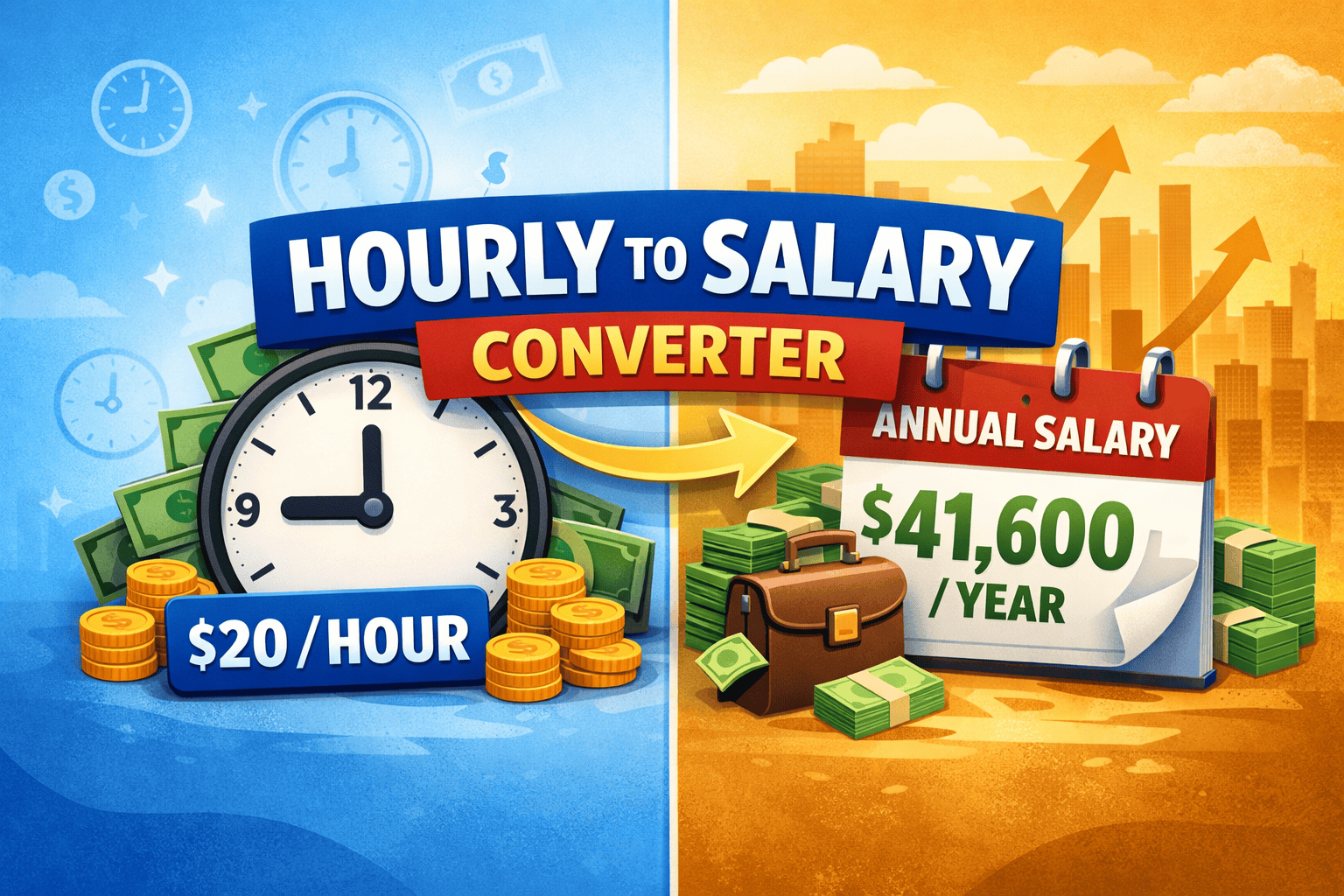
| $20/hr | $800 | $1,600 | $3,467 | $41,600 |
| $25/hr | $1,000 | $2,000 | $4,333 | $52,000 |
| $30/hr | $1,200 | $2,400 | $5,200 | $62,400 |
| $35/hr | $1,400 | $2,800 | $6,067 | $72,800 |
| $40/hr | $1,600 | $3,200 | $6,933 | $83,200 |
| $45/hr | $1,800 | $3,600 | $7,800 | $93,600 |
| $50/hr | $2,000 | $4,000 | $8,667 | $104,000 |
| $60/hr | $2,400 | $4,800 | $10,400 | $124,800 |
| $75/hr | $3,000 | $6,000 | $13,000 | $156,000 |
For India-based readers: ₹500/hour at 40 hrs/week ≈ ₹10.4 lakh/year. ₹1,000/hour ≈ ₹20.8 lakh/year. These are pre-tax figures and don’t account for India’s variable work-hour norms across industries.
Keep in mind: these numbers look clean because they assume perfect conditions. Reality is messier, and the next section shows exactly where most people’s estimates fall apart.
Real Scenarios Where the Math Gets Tricky
Let me walk you through three situations I’ve seen play out repeatedly in hiring rooms. Each one shows why a raw hourly-to-salary conversion can mislead you.
Scenario 1: The “Higher Hourly” Trap
Priya, a UX designer in Bangalore, gets two offers. Offer A is a contract role at ₹1,200/hour. Offer B is full-time at ₹14 lakh/year.
Quick math on Offer A: ₹1,200 × 40 × 52 = ₹24,96,000 — nearly ₹25 lakh. Looks obvious, right?
But Offer A has no paid leave, no employer PF contribution, no health insurance, and no gratuity. Subtract those benefits (roughly ₹3–4 lakh) and factor in two weeks unpaid time off, and Offer A’s real value drops to ₹19–20 lakh. The gap shrinks dramatically once you look past the headline number.
Scenario 2: The Salaried Overtime Illusion
Marcus earns $95,000 a year as a project manager in Chicago. Sounds solid. But he regularly logs 55-hour weeks.
His effective hourly rate: $95,000 ÷ (55 × 52) = $33.22/hour
A skilled electrician in the same city pulling $38/hour with overtime at time-and-a-half? That electrician’s annual pay at 45 hours/week comes to roughly $102,700. And they clock out when the job’s done.
Marcus is working more, earning less per hour, and doesn’t even realize it.
Scenario 3: When Overtime Flips the Script
Dana earns $26/hour as a warehouse supervisor. Standard 40-hour weeks bring in $54,080/year. Nothing special.
But she regularly picks up 10 hours of overtime at 1.5× pay ($39/hour). That adds $20,280 annually, pushing her total to $74,360 — competitive with many mid-level salaried roles in her region.
The hourly-to-salary converter only tells part of this story. Overtime eligibility — governed by FLSA classification as exempt or non-exempt — is the variable that changes everything.
Hourly vs Salary: Which Actually Pays More?
This is the wrong question — but I hear it constantly. After 15 years of advising professionals on compensation, I’ve learned that “which pays more” depends entirely on how you work, not just what you’re paid.
When Hourly Wins
Hourly pay works in your favor when overtime is consistently available (and paid at 1.5×), when you can control your schedule and pick up extra shifts, in trade and technical roles where billable hours directly increase income, and in contract or freelance work where you set your own rate.
The FLSA requires overtime pay for non-exempt workers after 40 hours in a workweek. If you’re hourly and regularly exceed 40 hours, that legal protection is real money. A 2026 update to the salary threshold for FLSA exemptions means more workers now qualify for overtime protection — something worth checking if you’ve been classified as exempt.
When Salary Wins
Salary works better when benefits are substantial (health insurance, retirement match, equity), when paid time off is generous (3–4 weeks is common at mid-level and above), when your hours are genuinely close to 40 per week, and when predictable income matters for mortgages, loans, or financial planning.
The Honest Answer
Neither format is inherently better. What matters is your effective hourly rate after total compensation. That’s base pay plus benefits plus paid time off, divided by actual hours worked. Everything else is noise.
The Hidden Factors Most Converters Ignore
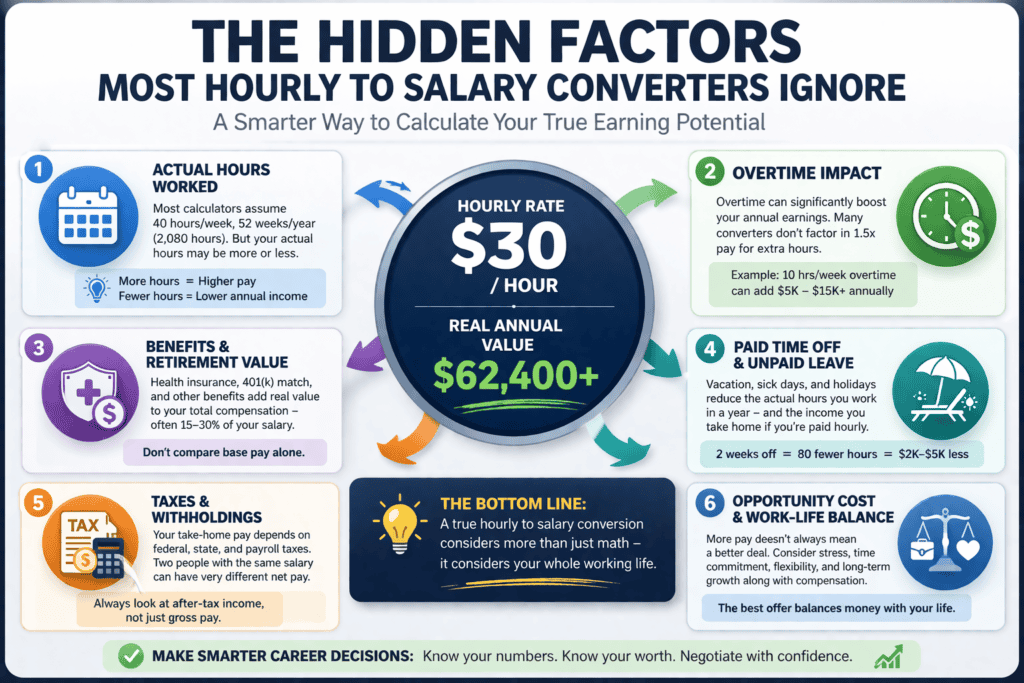
Most hourly-to-salary calculators online handle one multiplication and call it done. They’re not wrong — they’re just incomplete. Here’s what they leave out, and why it matters.
Benefits Are Compensation (and They’re Expensive)
BLS data shows benefits account for roughly 30% of total compensation costs for private industry workers. That’s not a rounding error.
Comparing a $50/hour contract role to a $90,000 salaried position? Add the benefits value to the salary side. Health insurance ($7K–$15K), a 4% 401(k) match ($3,600), and three weeks PTO ($5,200) push the $90K role’s total compensation to $105,000–$113,000. The contract role at $50/hour? $104,000 gross — and you’re buying your own insurance.
Tax Treatment Differs
Hourly contract workers (1099) pay self-employment tax — both the employee and employer portions of Social Security and Medicare, totaling 15.3% on the first ~$160,000 of net earnings in 2026. W-2 employees only pay the employee half (7.65%), with their employer covering the rest.
That difference alone can swing your effective pay by $4,000–$8,000 per year. Any honest hourly to salary converter should account for this — but almost none do.
Unpaid Time Erodes Hourly Income
Salaried workers get paid even when they’re sick, on vacation, or sitting through an all-day meeting that could’ve been an email. Hourly workers? If you don’t clock in, you don’t earn.
Two weeks of vacation, five sick days, and a handful of holidays can easily eat 15–20 working days per year. At $35/hour, that’s $4,200–$5,600 in foregone income.
Smart Strategy: How to Compare Job Offers Like a Pro
Here’s the framework I use when coaching professionals through competing offers. It works whether you’re comparing hourly vs. salary, two salaried positions, or even a freelance gig against a full-time role.
Step 1: Convert everything to annual gross. Use the formulas above. For hourly roles, use your realistic weekly hours — not the best-case scenario.
Step 2: Add benefits value to salaried roles. Health insurance ($7K–$15K), retirement match (3–6%), and other perks. If the employer provides a total compensation statement, use that number.
Step 3: Subtract self-employment costs from contract roles. The extra 7.65% self-employment tax plus your own insurance and retirement can reduce a $120,000 gross contract to an effective $95,000–$100,000.
Step 4: Divide by actual hours worked. This is the step most people skip — and it’s the most important one. A $110K salary at 55 hours/week is $38.46/hour. A $95K salary at 40 hours/week is $45.67/hour. The “lower” salary pays more per hour of your life.
Step 5: Factor in the intangibles. Commute costs, remote flexibility, career growth potential, and job stability all have real financial value. A 30-minute commute at $0.67/mile (2026 IRS mileage rate) across 250 workdays adds over $5,000/year in vehicle costs alone.
Pro Tip: During salary negotiations, convert the offer into an effective hourly rate and say it out loud. “At $88K with an expected 50-hour workweek, that comes to about $33.85/hour. I’m targeting closer to $42/hour effective, which would be around $109K for the same hours.” It reframes the entire conversation — and I’ve watched recruiters sit up straighter every time a candidate does this.
Common Mistakes That Cost You Money
I’ve seen each of these derail what should’ve been a straightforward decision. Don’t make them.
Comparing headline numbers without adjusting for benefits. A $70,000 salary with full benefits is almost always worth more than $40/hour with no benefits — even though $40 × 2,080 = $83,200. The gap narrows fast once you factor in insurance, retirement, and PTO.
Assuming 40 hours is 40 hours. Ask anyone in consulting, finance, or tech management whether they work 40 hours a week. The answer will make you wince. If a role regularly demands 50+ hours, divide accordingly. Your effective hourly rate is the truth.
Ignoring overtime eligibility. Under the FLSA, non-exempt workers earn 1.5× their regular rate after 40 hours. That’s a legal guarantee. If you’re being classified as exempt to avoid paying overtime — and your salary is near the FLSA threshold (currently $58,656 annually for most workers) — it’s worth understanding your rights. The Department of Labor’s Wage and Hour Division handles these classifications.
Forgetting about taxes on 1099 income. Self-employment tax is real and it’s steep. A $50/hour contract rate and a $50/hour W-2 rate are not the same take-home pay. Plan accordingly.
Making the decision on salary alone. I’ll say it plainly: I’ve seen people take a $15K raise and end up financially worse off because the new role had inferior benefits, longer hours, and a brutal commute. Total compensation per hour of life. That’s the only metric that matters.
FAQ: Hourly to Salary Conversion
How many work hours are in a year?
The standard full-time work year is 2,080 hours — that’s 40 hours per week multiplied by 52 weeks. The Bureau of Labor Statistics and the IRS both use this figure. If you take unpaid leave, subtract those hours. Two weeks off drops you to 2,000 hours; four weeks drops you to 1,920.
How do I convert $25 an hour to a yearly salary?
Multiply $25 by 2,080 (the standard annual work hours). That gives you $52,000 per year before taxes. For monthly pay, divide by 12: approximately $4,333. For biweekly pay, divide by 26: approximately $2,000 per paycheck.
Is it better to be paid hourly or salary?
Neither is universally better. Hourly pay is advantageous when overtime is available and legally protected. Salary is typically better when benefits are strong and actual weekly hours stay near 40. The real comparison isn’t hourly vs. salary — it’s total compensation divided by actual hours worked.
Does a salary include overtime pay?
Generally, no. Most salaried workers classified as “exempt” under the FLSA do not receive overtime pay, regardless of hours worked. Non-exempt salaried workers do qualify for overtime. Your classification depends on both your salary level and your job duties. Check with your employer or the Department of Labor if you’re unsure.
How do I account for benefits when comparing hourly and salary offers?
Add the estimated dollar value of benefits to the salaried offer before comparing. Health insurance typically adds $7,000–$15,000 per year, employer retirement matches add 3–6% of salary, and PTO has a calculable value based on your daily rate. A $75K salary with strong benefits often outperforms a $45/hour contract role without them.
What is a good hourly rate in the US in 2026?
It depends heavily on industry, location, and experience. As a general benchmark: $18–$25/hour covers entry-level and early-career roles, $30–$50/hour is typical for experienced professionals and skilled trades, and $50–$100+/hour applies to specialized fields like tech, legal, and healthcare. The BLS reports average hourly earnings for all private employees at roughly $35–$36 as of early 2026, though this varies significantly by sector.
How do I convert a part-time hourly wage to annual salary?
Use the same formula, but adjust the hours. If you work 25 hours per week at $22/hour for 50 weeks: $22 × 25 × 50 = $27,500/year. Don’t use 52 weeks if you have unpaid time off — that inflates the number and gives you a false picture.
Why does my actual paycheck not match the converter result?
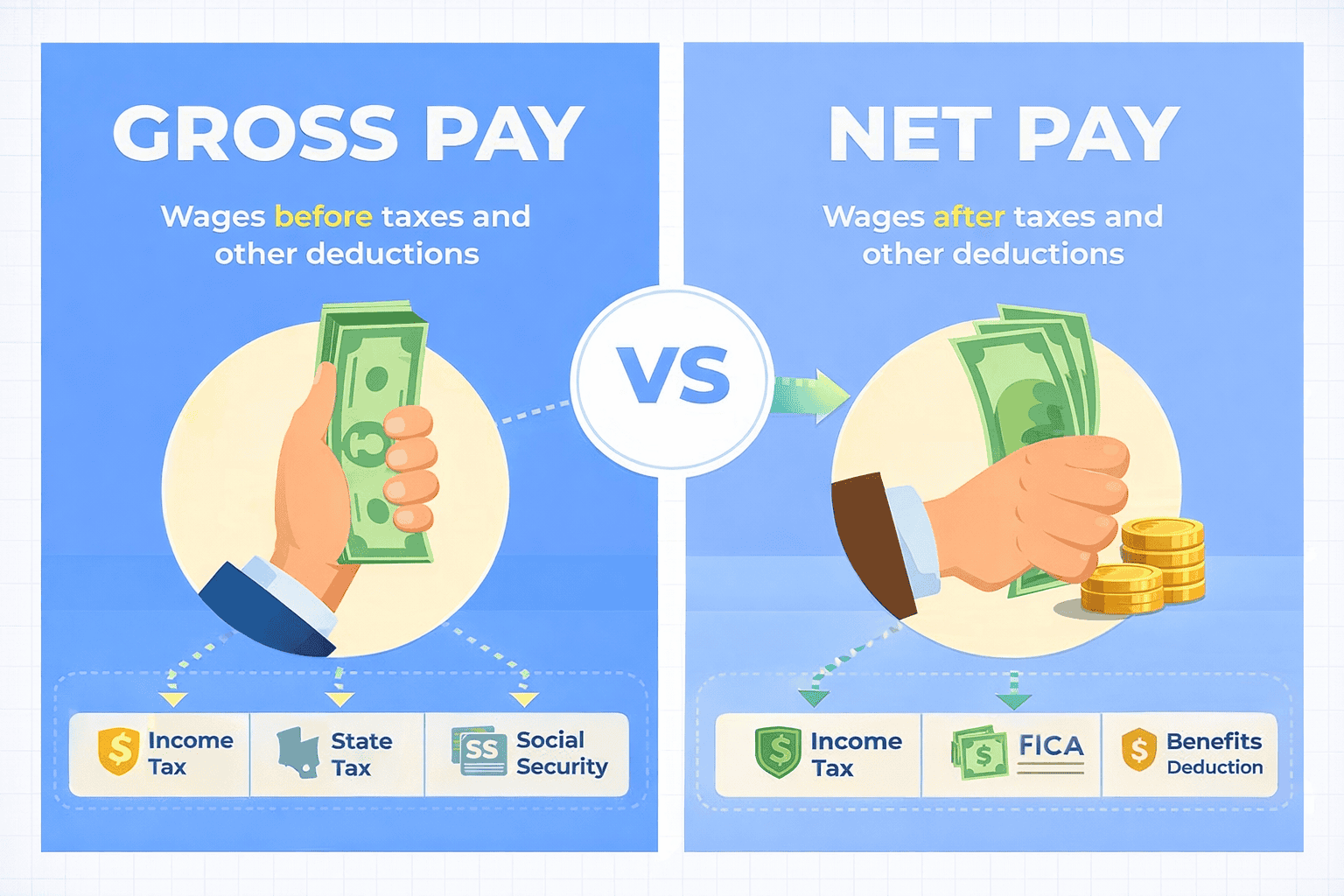
Converters show gross (pre-tax) pay. Your paycheck reflects deductions for federal and state income tax, Social Security (6.2%), Medicare (1.45%), and any pre-tax contributions like 401(k) or health insurance premiums. The gap between gross and net can be 25–35% depending on your tax bracket and deductions.
The One Number That Actually Matters
Look, most people think about pay in one of two buckets — hourly or salary. That’s the wrong framework.
After years of reviewing compensation packages and coaching professionals through tough offer decisions, here’s the only calculation I trust: total compensation divided by total hours worked. That single number — your effective hourly rate — cuts through every trick, every framing bias, and every recruiter pitch.
Use the hourly to salary converter formulas in this guide as your starting point. Then layer in benefits, taxes, unpaid time, and real hours. That’s how you stop guessing what you’re worth and start knowing.
Your next step? Run your current pay through this framework right now. You might be pleasantly surprised — or you might finally have the data you need to ask for more.
Related reading: Take-Home Pay Calculator (US): Convert Gross Salary to Net Pay by State | FLSA Exempt vs Non-Exempt: Know Your Overtime Rights

David Schneider : HR Technology Consultant & Former Head of People Systems | Former SAP SuccessFactors Implementation Lead | HR Tech Consultant (Workday, ADP) | 17+ Years in People Systems
David Schneider has spent 17 years on the implementation side of HR technology — the part vendors never show you in the demo. As a former SAP SuccessFactors implementation lead and Head of People Systems, he has designed and deployed HRIS, payroll, ATS, and performance management systems for organisations ranging from 1,000 to 50,000 employees across Europe and North America. He has advised enterprise clients on Workday and ADP migrations, untangled integration disasters, and helped HR teams understand why they’re overpaying for tools they’re only using at 30% capacity. Based between Berlin and New York, David writes for HRGet.com to give buyers the honest, implementation-level perspective that analyst reports and vendor case studies never will.